Category Archives: International

First Holy Door closed: ‘Special time for the Church is closed, but not God’s grace’

With the closing of the Holy Door of St. Mary Major Basilica in Rome, the Vatican began on Dec. 25 the gradual conclusion of the 2025 Jubilee Year of Hope convened by the Church. The rite was presided over by Cardinal Rolandas Makrickas, archpriest of the Marian basilica, who emphasized that “it is not divine grace that is being closed but a special time for the Church, and what remains open forever is the merciful heart of God.”

St. Mary Major is the first of the four papal basilicas in Rome to close its Holy Door. On Dec. 27, the Holy Door of St. John Lateran was closed by Cardinal Baldassare Reina; on Sunday, Dec. 28, that of St. Paul Outside the Walls by Cardinal James Michael Harvey; and finally, on Tuesday, Jan. 6, the solemnity of the Epiphany, Pope Leo XIV will close the Holy Door of St. Peter’s Basilica, officially concluding the jubilee.

During his homily, Makrickas noted that the 2025 Jubilee has been a unique event in the recent history of the Church, having unfolded under two pontificates. “Today we have seen the Holy Door close, but the door that truly matters is the door of the heart,” Makrickas pointed out, encouraging the faithful to open it by listening to the word of God, welcoming their neighbor, and offering forgiveness. “Having crossed the Holy Door was a gift; now becoming doors open to others is our mission,” he added.

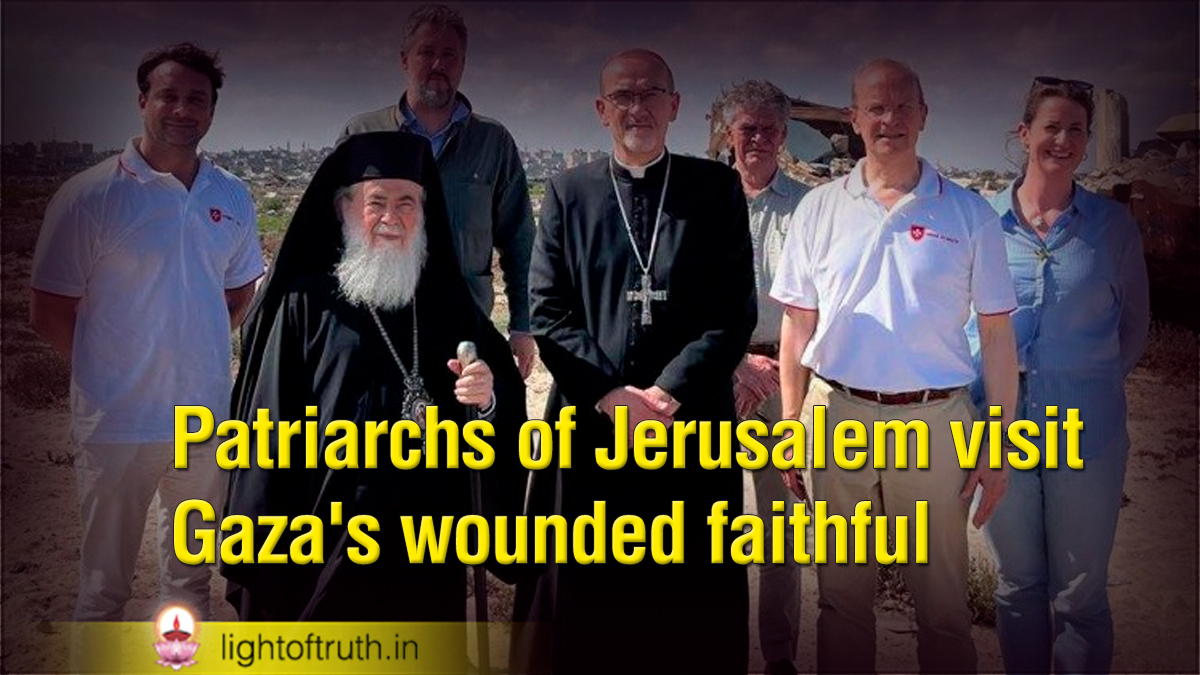
Cardinal Pizzaballa: We will do everything possible for Gaza

Cardinal Pierbattista Pizzaballa met with the press the day after he visited the Gaza Strip, where he went to offer his support—and through him, that of the entire Church—to the people of Gaza, exhausted by more than two years of war. It was also the first visit by the Latin Patriarch of Jerusalem to the autonomous territory since the ceasefire. 

His assessment is sobering: 80 percent of infrastructure has been destroyed; what remains standing risks collapse or is practically uninhabitable. The severe deterioration of some buildings has not, however, prevented a few families from returning to their homes. Four hundred people are still being sheltered on the grounds of the Holy Family parish, led by Father Gabriel Romanelli. But most residents continue to live in tents. “It is cold—I felt cold—so think of the children,” the Cardinal said.

Despite everything, “I saw a desire to return to life,” he noted. Shops remain closed, and the challenges are immense, yet some rudimentary stalls have appeared in tents, where fruit and vegetables are available.

“The situation of famine is behind us,” Cardinal Pizzaballa affirmed. Nevertheless, few Gazans can afford to purchase food. With no work and no income, the majority have no option but to rely on humanitarian assistance, which, thanks to international aid agencies, is finally arriving.

Cardinal You Heung-sik: Pope invites priests to fraternity

Pope Leo XIV’s Apostolic Letter “A fidelity that generates the future” emphasizes that the priesthood is “an indispensable ministry within the mission of the Church,” according to Cardinal Lazarus You Heung-sik, Prefect of the Dicastery of the Clery.

In an interview with Vatican Media, the Prefect says that, in his Letter, the Holy Father indicates the path to “preserve, proclaim, and foster the beauty of a priesthood faithful to Christ, His Word, and the Church,” and calls for “pastoral ‘styles’ that do not seek to diminish or water down the radical proposal of the Gospel, but that proclaim it without fear.” Cardinal Lazarus expressed his deepest gratitude for the Holy Father’s decision to celebrate the sixtieth anniversary of the conciliar decrees Optatam totius and Presbyterorum ordinis, which, albeit from different perspectives, deal with the life of priests, their formation, and ordained ministry. According to the Cardinal the Holy Father’s choice is particularly important, especially at a time when the priesthood can be seen as a legacy of an ancient world destined to disappear or – perhaps because of the many painful scandals – as a vocation that has lost its appeal, its beauty and its relevance. He said that this Apostolic Letter reminds all God’s holy people that the priesthood is a wonderful gift, a very high responsibility, but above all an essential ministry in the mission of the Church as willed by the Lord Jesus.

Pope Leo XIV: Christians have no enemies, only brothers and sisters

Pope Leo XIV on December 26 urged Christians to resist the temptation to treat others as enemies, saying the mystery of Christmas calls believers to recognize the God-given dignity of every person, even in their adversaries.

“Christians, however, have no enemies, but brothers and sisters, who remain so even when they do not understand each other,” the pope said on Dec. 26 during his Angelus address from the Apostolic Palace on the feast of St. Stephen, the Church’s first martyr.

Leo acknowledged that “those who believe in peace and have chosen the unarmed path of Jesus and the martyrs are often ridiculed, excluded from public discourse,” and sometimes even “accused of favouring adversaries and enemies.” Yet, he said Christian joy is sustained by “the tenacity of those who already live in fraternity.”

Reflecting on St. Stephen’s martyrdom, the pope noted that early Christians spoke of the saint’s “birthday,” convinced “that we are not born just once” and that “martyrdom is a birth into heaven.” Citing the Acts of the Apostles, Leo recalled that those who witnessed Stephen’s trial and death “saw that his face was like the face of an angel” (Acts 6:15), calling it “the face of one who does not leave history indifferently but responds to it with love.”

Nigeria: A decade of terror for Catholic priests

Between 2015 and 2025, at least 212 Catholic priests were kidnapped in Nigeria, in a wave of violence that affects the whole country. This is revealed by an ongoing study carried out by the Catholic Bishops’ Conference of Nigeria shared with the pontifical foundation Aid to the Church in Need (ACN).

The research documents kidnappings in at least 41 of the country’s 59 Catholic dioceses and archdioceses. The data is consistent with the findings of ACN’s Religious Freedom Report 2025, which identifies Nigeria as one of the most dangerous countries in the world for clergy and religious leaders.

According to the document sent to ACN, of the 212 kidnapped, 183 were released or escaped, 12 were murdered and 3 later died as a result of trauma and injuries suffered during their captivity. Currently, at least 4 kidnapped priests remain in captivity: Father John Bako Shekwolo, Father Pascal Bobbo, Father Emmanuel Ezema, and Father Joseph Igweagu. The report also confirms that at least six priests were kidnapped more than once, highlighting the persistent vulnerability of Catholic clergy. However, the real number of cases is certainly higher. Data from 18 dioceses has not yet been submitted, and ACN has independently recorded isolated kidnapping cases during the last years in at least five other dioceses not covered in the study so far. In addition, the report does not include incidents involving religious orders and congregations.

The New (and free) John Paul II House Museum Opens in Rome

In the heart of Rome, within the historic walls of the Pontifical Polish College, a new chapter in the remembrance of Pope John Paul II has begun. The John Paul II House Museum officially opened its doors to the public, offering free access in a gesture that aligns with the ongoing Jubilee initiatives and reflects a commitment to preserving both spiritual and cultural heritage. The project was made possible in part thanks to the support of Italy’s Presidency of the Council of Ministers.

The timing of the museum’s inauguration was marked by the visit of Italian Prime Minister Giorgia Meloni on 22 December. The Prime Minister toured the College’s historic rooms, spaces intimately linked to Karol Wojtyła’s time in Rome as Archbishop of Krakow and particularly the eve of the 1978 conclave that would see his election as Pope. It was from this very residence that Wojtyła embarked on the journey to the Vatican, unaware that his life—and the course of modern Catholicism—would change forever.

The museum preserves the tangible traces of John Paul II’s daily life and spiritual practices during his Roman sojourns. Visitors encounter his private study, filled with the tools of his work, and his bedroom, carefully maintained with original furnishings. Autographed documents, relics of his thoughts and plans, add layers of intimacy and historical resonance, allowing visitors to step into the personal rhythm of the man who would become a global spiritual figure.

Pope Leo XIV Named Treccani’s Person of the Year: A Pontificate of Subtle Strength and Measured Influence

In a year marked by geopolitical tensions, economic volatility, and social unrest, the Italian Encyclopedia Institute Treccani has recognized Pope Leo XIV as its 2025 Person of the Year. The decision underscores the impact of a pontificate that, while understated in public spectacle, embodies foundational Christian values such as sobriety, discernment, and attentive listening—qualities the Institute lauds as emblematic of “a Church for the poor.”

The Treccani Yearbook 2025 emphasizes the Pope’s deliberate choice to temper his visibility and rhetoric. “Parsimonious in presence and words,” Leo XIV has navigated the pressures of global attention by avoiding polarizing categorizations, both politically and theologically. This measured approach contrasts sharply with the high-octane rhetoric of contemporary world leaders, positioning the pontiff as a stabilizing presence in an era of fragmented narratives and competing ambitions.

Leo XIV’s recognition by Treccani reflects not only his influence within ecclesiastical circles but also his capacity to project a moral and diplomatic presence in world affairs. By exercising quiet leadership, prioritizing pastoral care, and resisting the pressures to adopt extremes, he has positioned the Catholic Church as a thoughtful actor in global discussions on justice, peace, and human dignity.

Vatican expert: Co-Redemptrix title of Mary not absolutely prohibited

Monsignor Maurizio Gronchi, an expert consultant for the Dicastery for the Doctrine of the Faith at the Vatican, clarified that the measure established last month regarding the use of the titles “Co-Redemptrix” and “Mediatrix” for the Virgin Mary is “not an absolute prohibition” and that these titles can still be used in popular piety, provided their meaning is understood.

“It’s not an absolute prohibition, but it will no longer be used in official documents or in the liturgy. But if used in popular devotion, understanding its meaning, no one will be reprimanded for it,” the expert said in an interview with “EWTN Noticias,” the Spanish-language broadcast edition of EWTN News.

The interview took place after the Nov. 4 publication of the doctrinal note “ Mother of the Faithful People” in which the Dicastery for the Doctrine of the Faith, led by Cardinal Víctor Fernández, stated that the use of the title “Co-Redemptrix” is “always inappropriate” and encourages “special prudence” regarding the title “Mediatrix of All Graces.” The text has sparked controversy among the faithful, especially among those who use these terms within the Catholic Church.

Gronchi explained that “the issue is an old one. This problem has been discussed for 99 years, since 1926. We have studied it on several occasions, and the dicastery has received numerous requests for clarification regarding these terms. These titles present a problem. There is a risk of obscuring, of not clearly explaining that the centrality of the paschal mystery of salvation lies in Jesus Christ.”

“For this reason,” the expert indicated, “now is the time to clarify these titles, so that when it is said that they have been used in the past, it will mean that it was done inappropriately. It doesn’t mean that it was wrong, but rather that a definition of these titles was not yet mature and clear.”

The consultant emphasized that the pontifical document is a doctrinal note that “deepens, clarifies, and states that these terms are not appropriate, they are not opportune, simply because Mary participates in the redemption, she collaborates in the redemption, but not in the same way as Jesus.” After noting that the Virgin Mary is like the moon reflecting the light of the sun, a symbol of Jesus, Gronchi said that “Mary gives birth to Jesus, but on the cross, Jesus dies, not Mary. Mary participates with her heart, with her affection, with all that she is, but it is a participation that the document calls dispositive, meaning that Mary disposes us to receive the grace of Christ, but she is not the source of grace, nor the mediatrix of all graces.”

Bethlehem celebrates 1st Christmas in two years

Cardinal Pierbattista Pizzaballa, recently returned from a visit to the Church of the Holy Family in Gaza—the enclave’s only Catholic parish, where he conveyed the closeness and solidarity of the Catholic Church—opened the Christmas celebrations in Jesus’ birthplace by making the traditional procession from Jerusalem to Bethlehem.

Upon his arrival in Manger Square, the Latin Patriarch of Jerusalem said he brought greetings from Gaza’s small Christian community, which, he noted, is animated by a strong desire to rebuild. He also expressed the hope for a Christmas marked by light.

The resumption of Christmas celebrations in Bethlehem carries significance on several levels. On the one hand, there is hope that the U.S.-backed peace initiative that led to the ceasefire may offer Palestinians the opportunity to move forward with reconstruction plans. On the other hand, it revives expectations that Bethlehem’s residents may gradually return to work, as 85 per cent of local families depend directly or indirectly on tourism, which came to a halt during the war.

Hotel owners and staff, shopkeepers selling religious articles, taxi drivers, restaurant owners, and tour guides have seen their livelihoods largely disappear over the past two years. Bethlehem has been among the hardest-hit cities in the West Bank, lacking a strong industrial base, significant commercial activity, agricultural capacity, or a large public-sector workforce.

These difficulties are compounded by challenges affecting the wider West Bank, including Israel’s revocation of entry permits for most seasonal Palestinian workers to its territory and settlements, as well as the partial payment of salaries to Palestinian Authority employees.

Despite these hardships, the population continues to demonstrate resilience and hope. Speaking to Vatican Radio’s Jean-Charles Putzolu, Bethlehem’s Mayor, Maher Nicola Canawati, said that the renewed celebrations are meant to restore hope after a prolonged period of hardship. “After two years of silence,” the Mayor said, “we believe we have reignited the spirit of Christmas, because the people of Bethlehem needed hope—hope for a better tomorrow. And that is exactly what we have done.”

Pope at Urbi et Orbi: Peace is a shared responsibility

As war continues to scar the world, Pope Leo XIV used his Christmas Urbi et Orbi message to renew his appeal for peace, dialogue, and responsibility, turning to those regions where violence and instability continue to claim innocent lives.

The Pope prayed for “justice, peace, and stability for Lebanon, Palestine, Israel, and Syria,” and urged that the promise of peace rooted in righteousness be renewed. He appealed in a particular way for Ukraine, asking that “the clamour of weapons cease,” and that all those involved, with the support of the international community, find the courage to engage in “sincere, direct, and respectful dialogue.”

Remembering conflicts that risk being forgotten, Pope Leo XIV expressed closeness to the victims of war and violence in Sudan, South Sudan, Mali, Burkina Faso, and the Democratic Republic of Congo, as well as to all those who suffer as a result of injustice, political instability, religious persecution, and terrorism.

The Pope also prayed for Haiti, calling for an end to violence and progress along the path of peace and reconciliation. He also invoked peace for Myanmar, asking that the country be guided towards reconciliation and hope, especially for its younger generations. Turning to Latin America, he encouraged those with political responsibilities to give space to dialogue for the common good, rather than to ideological and partisan divisions.

The Pope also prayed for the restoration of the “ancient friendship” between Thailand and Cambodia, and entrusted to God the peoples of South Asia and Oceania, who have been severely affected by recent natural disasters, calling for renewed commitment to assisting those who suffer. Against this backdrop of conflict, Pope Leo XIV recalled the meaning of Christmas, proclaiming that “today, true peace has come down to us from heaven.” Quoting Saint Leo the Great, he affirmed that “the Lord’s birth is the birth of peace.”

Reflecting on the Nativity, the Pope recalled that Jesus “was born in a stable because there was no room for Him in the inn,” and that the Son of God, “through whom all things were created,” was not welcomed. “Out of love,” the Pope said, Christ “accepted poverty and rejection, identifying Himself with those who are discarded and excluded.”

Already in the birth of Jesus, the Pope noted, “we glimpse the fundamental decision that would guide the entire life of the Son of God… the decision not to leave us under the burden of sin, but to bear it Himself for us.” At the same time, he reminded the faithful that peace also requires human responsibility. Quoting Saint Augustine, he said that “God, who created us without us, will not save us without us,” adding that “responsibility is the sure way to peace.”