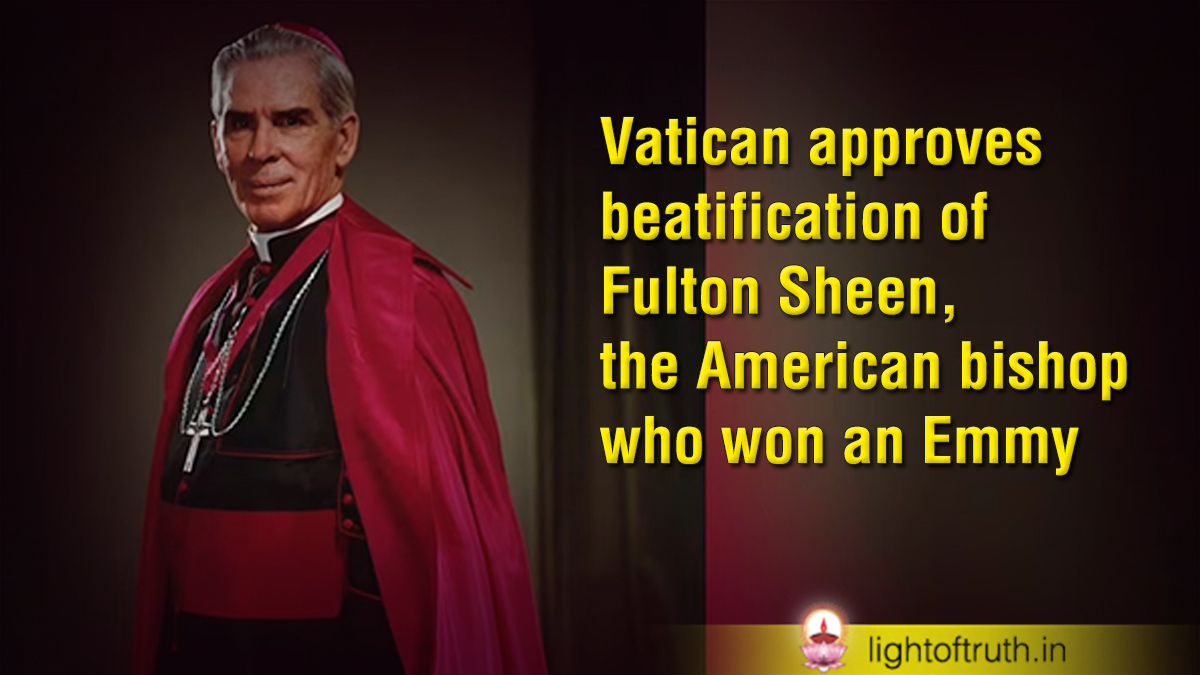
After more than two decades marked by enthusiasm, setbacks and prolonged silence, the cause of Archbishop Fulton J. Sheen has reached a decisive threshold. The Holy See has formally notified Bishop Louis Tylka of Peoria, Illinois, that the cause of the Venerable Servant of God may now proceed to beatification, clearing the way for the American prelate to be declared “Blessed” in the Catholic Church.
The announcement, welcomed by the Diocese of Peoria, places one of the most recognizable Catholic figures of the 20th century on the brink of official liturgical veneration. The next step, as Bishop Tylka explained, is the celebration of the beatification itself, the date and location of which are now being coordinated with the Vatican’s Dicastery for the Causes of Saints.
For Catholics less familiar with the Church’s canonization process, beatification represents a pivotal moment. It acknowledges that a deceased person lived a life of heroic virtue and that a miracle has occurred through his or her intercession, allowing for public veneration, usually at a local or regional level. Canonization, which would follow at a later stage, would extend that veneration to the universal Church and would require the recognition of a second miracle after beatification.
Few American churchmen have left a public footprint comparable to that of Fulton Sheen. Born Peter John Sheen on May 8, 1895, in El Paso, Illinois, he was ordained a priest for the Diocese of Peoria in 1919. His episcopal career unfolded largely on the national stage: he was appointed auxiliary bishop of New York in 1951, serving there until 1966, and later became bishop of Rochester, a post he held until his retirement in 1969 at the age of 74.
Yet it was not diocesan administration that made Sheen a household name. His television program Life Is Worth Living, broadcast from 1952 to 1957, brought Catholic moral teaching into American living rooms at a time when religious programming rarely reached mainstream audiences. The show earned an Emmy Award and attracted millions of viewers, a fact Bishop Tylka has often cited in calling Sheen a pioneer who anticipated the Church’s later engagement with mass media. Long before the age of digital evangelization, Sheen demonstrated how theology, philosophy and pastoral concern could be communicated with clarity and cultural relevance. Sheen’s influence extended well beyond the United States. In his later years, he served as national director of the Society for the Propagation of the Faith, supporting missionary work across the globe. According to Bishop Tylka, this phase of Sheen’s life underscored a conviction that the Church exists for all people, especially those on the margins or in places where the Gospel is scarcely heard.