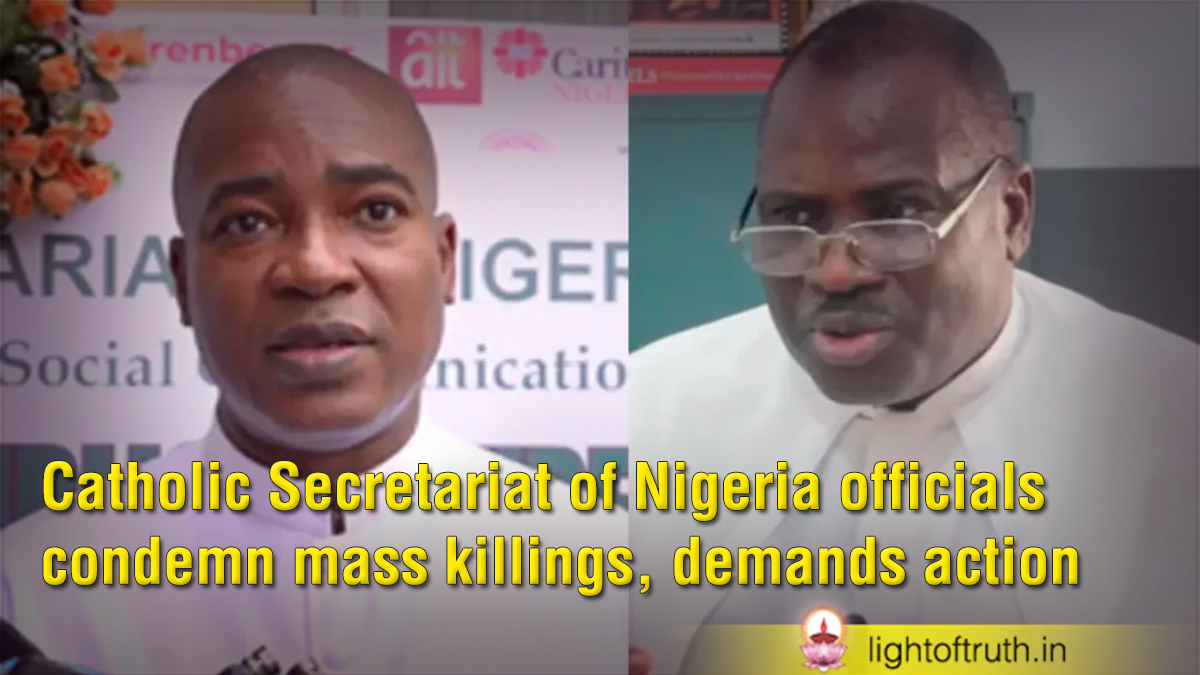
Officials at the Catholic Secretariat of Nigeria (CSN), the administrative headquarters of the Catholic Bishops’ Conference of Nigeria, have denounced what they have described as a “relentless wave of killings and abductions” across the West African nation, warning that continued violence and impunity are turning the country into “a field of grief” and eroding the foundations of governance.
In a statement issued on Saturday, Feb. 7, and shared with ACI Africa — the sister service of EWTN News in Africa — CSN Secretary-General Father Michael Banjo and National Director of Social Communications Father Michael Nsikak Umoh expressed “profound outrage and sorrow at the ongoing assault on human life and dignity.”
“After years of repeated complaints and unfulfilled promises, violence persists unchecked, leaving more communities devastated and citizens weary of empty condolences that do not guarantee their safety,” the CSN officials said.
They lamented that the renewed cycle of mass violence “has turned our country into a field of grief.” “Nigeria cannot afford to normalize bloodshed or treat mass killings as routine tragedies,” they emphasized in their one-page statement titled “The Cry of the Innocent: Stop This Slaughterhouse in Nigeria!”
Citing recent attacks between late January and early February, the Catholic officials questioned how such atrocities could be allowed to continue. “How can it be justified that, outside of war, over 160 innocent civilians were slaughtered in one coordinated attack in Woro, Kwara state?” they wrote.
They also referred to “the repeated killings and abductions in Agwara and Tungan Gero in Niger state, the wiping out of entire farming communities in Katsina and Kaduna, and the ongoing violence in Borno.”
“This is not ‘instability’ but a massacre allowed by silence and a betrayal of every Nigerian’s right to live in peace,” the Nigerian Catholic officials added.
They went on to remind politicians that “the constitution is not a lofty document of ideals but a binding covenant with the people” and warned that “when citizens are slaughtered with impunity and communities live in perpetual fear, the very foundation of governance is undermined.” They added that “a government that struggles unsuccessfully to safeguard its people risks diminishing its moral authority to lead.”