
Catholic Sisters Help Children Living with HIV Build a Better Future
Faith Brings New Hope to Assam Village Once Known for Alcoholism
Cardinal Tagle: Friendship reveals the face of Jesus and the Church
Israel prepares ‘extensive’ West Bank operation after deadly shooting near Tal
Pope: Visit to Türkiye and Lebanon teaches that peace is possible
Thousands protest corruption in Philippines as Church leaders call for accountability
Pope: Nicaea invites Christians to unity in face of violence, conflict
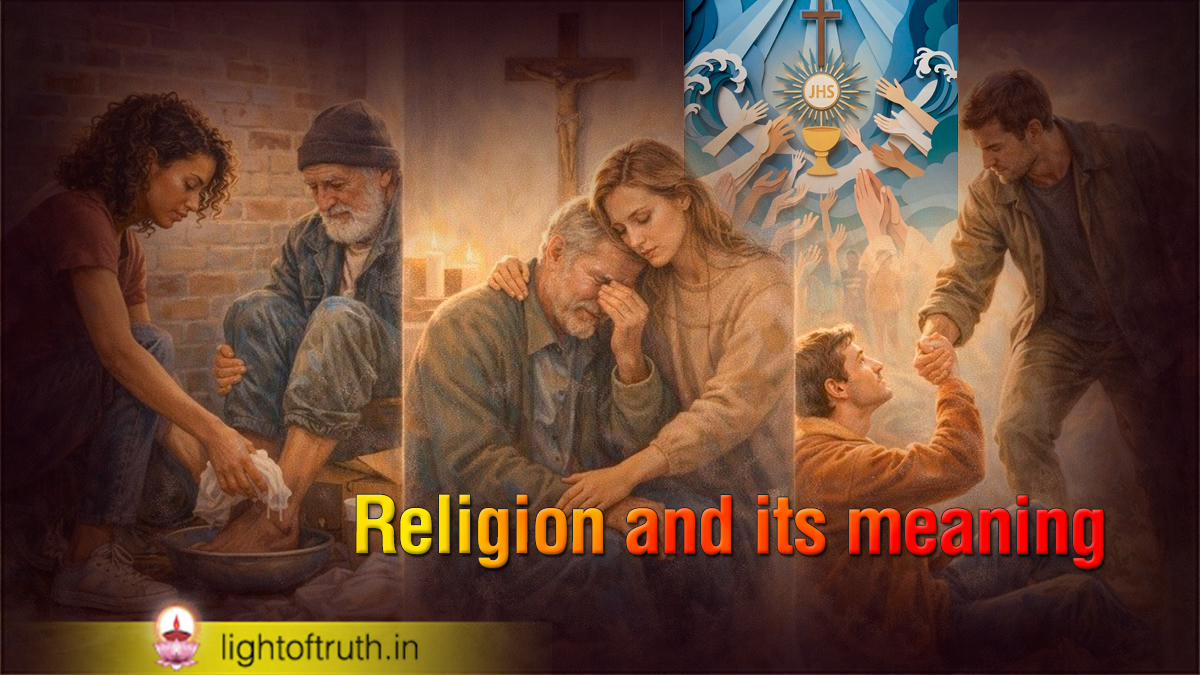
Human beings have always sought to understand the mystery of their existence. In their search for the meaning of life, they have come to realise that life becomes meaningful to the extent that they relate to the Ultimate Mystery, which is both the source and the destiny of their existence. This Ultimate Reality is called God or by various other names, depending on the languages and cultures of different peoples, although these names often seek to express the same fundamental reality. Human beings have also realised that they can relate to this Reality through faith, expressed in beliefs, religious practices and worship, and a way of life consistent with their beliefs and moral convictions.
In the worship of God, rituals provide a symbolic language through which individuals and communities express their faith, gratitude for the gift of existence, hopes, and repentance for their failures in relating to God, who gives meaning to their lives. However, when religion becomes institutionalised, there is always the possibility that rituals and other external expressions of faith may become hollow and lose their genuine content: the ennobling and transforming of human life through a meaningful relationship with God and with other human beings. Devoid of their spiritual significance, rituals can degenerate into mechanical actions without transformative power. Worse still, they may become instruments of discrimination, exclusion, oppression, and dehumanisation.
All world religions are vulnerable to this distortion of their original purpose. Religion is expected to liberate people from the existential fears and anxieties that undermine the meaning of their lives. Yet, at certain moments in history and in particular contexts, it has become an instrument of oppression and enslavement. Religion, therefore, is a means to an end, not an end in itself. At the time of Jesus, certain interpretations and practices of the Jewish religion had become excessively preoccupied with the meticulous observance of laws and rituals, sometimes imposing burdens on people rather than liberating them. Jesus therefore challenged religious practices and rituals that disregarded human beings and their existential situations.
Jesus was not opposed to genuine religious practices or ritual worship. Rather, he prophetically criticised the meticulous observance of rituals and other religious practices insisted upon by the Pharisees, scribes, and certain religious authorities when these took precedence over the well-being and dignity of human beings as children of God. The God whom Jesus experienced as his Abba was a God who placed human dignity and well-being at the heart of divine concern. For Jesus, human beings were more important than rituals and sacrifices that were believed to be pleasing to God. The God whom Jesus proclaimed placed human beings at the centre of divine love, and religious practices were meant to express their intimacy with God. They could never become substitutes for caring for the welfare of their brothers and sisters. For Jesus, the primary purpose of religion was to help human beings live in communion with one another and ultimately with God. Outside this communion, human beings cannot attain their full humanity, which is the glory of God!
Religion is meant to liberate human beings from their fears and anxieties about life, both in this world and beyond, by helping them realise that they belong to God and are called to live in right relationships with other human beings and with nature. However, when religion fails to fulfil its purpose and degenerates into an enslaving system of beliefs and practices, it needs to be challenged by enlightened persons and prophets. In the Old Testament, the prophets repeatedly challenged rituals and religious practices that were not accompanied by justice for the poor, compassion for widows and orphans, and concern for all those marginalised in society. The prophet Amos declares what God desires from those who claim to worship him: “I hate, I despise your feasts, and I take no delight in your solemn assemblies. Even though you offer me your burnt offerings and grain offerings, I will not accept them…. But let justice roll down like waters, and righteousness like an ever-flowing stream” (Amos 5:21–24). The prophet Isaiah likewise affirms that genuine worship cannot be separated from justice and care for the vulnerable (Isa. 1:11, 17). The prophet Micah expresses similar demands that the Lord makes of his people (Mic. 6:8). The prophet Hosea declares, “For I desire mercy, not sacrifice, and knowledge of God rather than burnt offerings” (Hos. 6:6). The entire prophetic tradition preceding Jesus insists on an essential aspect of the worship of God: genuine worship cannot be separated from ethical responsibility.
One’s relationship with God must be manifested in right relationships with other human beings. Jesus fulfilled his prophetic mission when he challenged the religious practices of his time. His statement, “I desire mercy, not sacrifice” (Mt. 9:13; 12:7), expresses one of the most profound insights into the nature of authentic religion and the relationship between God and human beings. Following the prophetic tradition of Hosea, Jesus invokes the first part of this divine declaration in Matthew’s Gospel to challenge a form of religious observance that gives greater importance to external practices than to authentic human relationships expressed through compassion, justice, and love.
Following this prophetic tradition, Jesus re-emphasises the intrinsic relationship between worship and loving concern and care for human beings. He invites us to examine critically the relationship between religious observance and authentic faith. Are religious rituals indispensable for human beings? Can one be genuinely religious without participating in established religious practices? What happens when the observance of religious laws conflicts with the demands of compassion and human dignity? These questions remain relevant not only to Christianity but also to all religious traditions.
Rituals are integral to human existence. Although generally associated with religious worship, they are also found in various forms in secular and non-religious ceremonies. Human beings express their deepest convictions, emotions, and relationships with one another and with God through symbolic gestures and shared practices. Celebrations of birth, marriage, and death, as well as occasions of reconciliation and anniversaries of significant events, are accompanied by appropriate rituals that express their meaning and significance for human life. Rituals give expression to the human search for meaning and transcendence. The sense of the sacred that we experience before the “tremendous and fascinating mystery” (Rudolf Otto) whom we call God can be approached, and communion with this Mystery can be expressed, through words of prayer and symbolic actions. Prayers, worship, pilgrimages, fasting, offerings, and sacred celebrations are all expressions of the human desire to enter into communion with God. Through these practices, human beings express not only their awareness of the vulnerability of their earthly existence but also their gratitude to God for the gift of life.
In the worship of the Church, rituals express the community’s faith in God revealed in Jesus Christ; they are not merely expressions of an individual’s private relationship with God. They therefore give expression to the communion of the People of God and their shared faith, hopes, and cherished memories. Rituals and forms of worship not only preserve the solidarity of those who share the same faith but also give a distinct identity to the community that gathers for common worship. The famous dictum lex orandi, lex credendi, lex vivendi-the law of prayer is the law of belief and the law of living-highlights the intrinsic interconnectedness of faith, worship, and life.
Rituals symbolically express what words alone cannot adequately communicate. Language can articulate, to some extent, what human beings experience. However, even a highly developed language cannot fully express the depth of human experiences, whether ordinary experiences such as pain or profound experiences such as mystical encounters. Alongside the expression of truth through evocative, metaphorical, and symbolic language, symbolic actions, gestures, sacred music, and silence during worship enable the community to express its relationship with God, as well as its praise and thanksgiving for what it is and what it receives from God.
If participation in the Eucharist does not make Christians more sensitive to the suffering of Dalits, Tribals, migrants, women, and other marginalised groups, the meaning of the Eucharistic celebration is seriously compromised. Just as the bread is broken, Christians are called to break their ego and self-centredness so that authentic communion may become possible in their families and society. If devotion to the Sacred Heart of Jesus does not inspire people to cultivate hearts filled with humanity and compassion, such devotion risks becoming merely sentimental. Similarly, if Marian devotion does not encourage the faithful to imitate Mary’s openness to God’s will and her concern for those in need, it loses an important dimension of its Christian significance. Mercy, compassion, love, justice, equality, reconciliation, and communion are not optional additions to Christian life; they are essential values and virtues for living the Christian faith authentically. Rituals, therefore, are not only expressions of faith but should also lead people to live out its demands. Jesus does not reject the use of rituals; rather, he condemns their observance when they become substitutes for the more fundamental human obligation to care for those in need with mercy and compassion.
In contemporary society, where religion continues to exercise considerable influence over the lives of believers, Jesus’ teaching, “I desire mercy, not sacrifice,” has profound relevance. In public life, religious identities, institutions, festival celebrations, elaborate rituals, and ornate and colourful vestments have become increasingly important expressions of religious belonging. There is sometimes a tendency to believe that the greater the external splendour and visibility of these expressions, the stronger the religious identity they communicate. The sad reality, however, is that increasing religious visibility does not necessarily indicate a corresponding growth in the followers’ commitment to justice, love, mercy, and compassion. The credibility of religious faith is demonstrated by the commitment of believers to the selfless service of others, especially the most vulnerable sections of society.
When people remain indifferent to poverty, discrimination based on caste, gender, language, or ethnicity, the exploitation of vulnerable sections of society, religious fundamentalism, and various forms of exclusion, religious practices and rituals lose their meaning, and religions themselves lose their credibility. It is in this context that Jesus’ teaching that God desires mercy and not sacrifice remains as relevant today as it was in his time. A Church that celebrates the sacraments through rituals appropriate to each sacrament but tolerates discrimination, clericalism, and exclusion contradicts the very message it proclaims. The Church is called to be a community in which the dignity of every person is respected and where the marginalised find acceptance, protection, and solidarity.
Jesus’ teaching that mercy is more important than ritual sacrifices invites Christians of every generation to continue his prophetic mission. The Church must not merely console people in their suffering through pastoral activities; it must also challenge the sinful structures and attitudes that produce and perpetuate suffering. Showing mercy to vulnerable people must therefore include both personal compassion and the pursuit of social justice. The Church needs to recognise that charitable activities, such as feeding the hungry, are admirable and necessary, but it must also prophetically challenge the systems that create hunger and deprivation. The biblical expression, “I desire mercy, not sacrifice,” is a profound affirmation of the primacy of love in the relationship between God and humanity. Religion exists to nurture communion with God and to promote life-giving relationships among human beings. Rituals provide symbolic expressions of faith and help sustain the religious and spiritual life of individuals and communities.


Leave a Comment