
Catholic Sisters Help Children Living with HIV Build a Better Future
Faith Brings New Hope to Assam Village Once Known for Alcoholism
Cardinal Tagle: Friendship reveals the face of Jesus and the Church
Israel prepares ‘extensive’ West Bank operation after deadly shooting near Tal
Pope: Visit to Türkiye and Lebanon teaches that peace is possible
Thousands protest corruption in Philippines as Church leaders call for accountability
Pope: Nicaea invites Christians to unity in face of violence, conflict
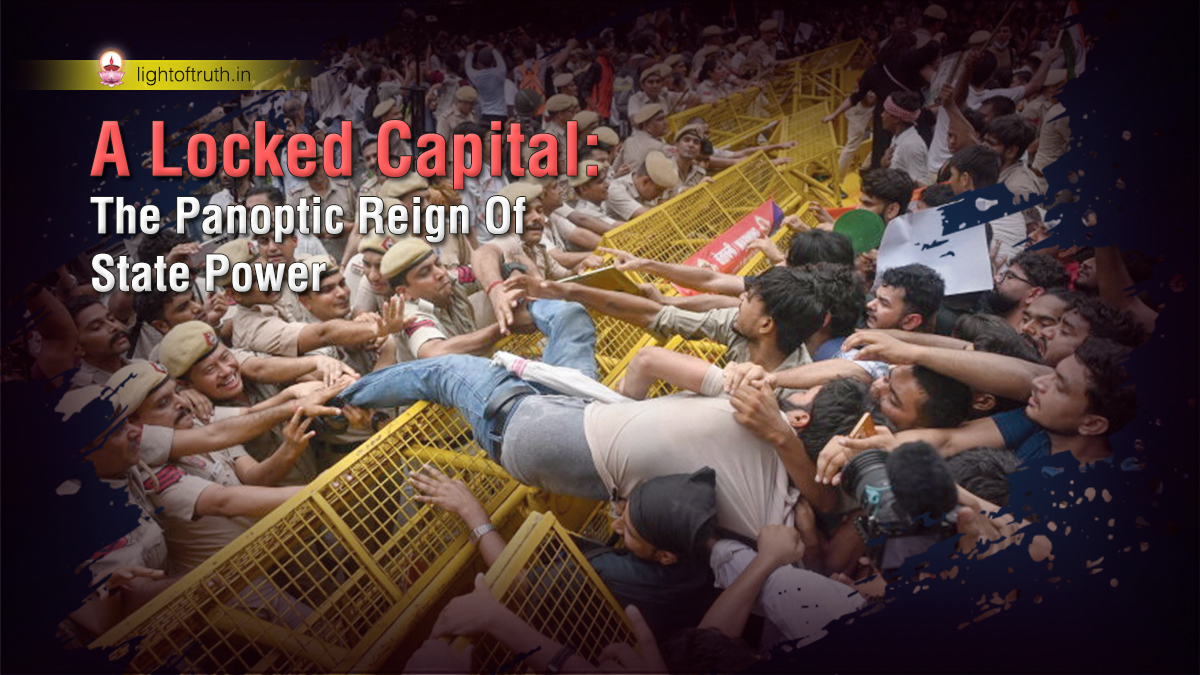
QUESTION : The allegations against the Chief Election Commissioner of India raise serious questions about the credibility of the electoral process, while the government’s response to dissent raises concerns about the protection of democratic freedoms. How should we understand these developments?
ANSWER: Dr. Saji Mathew Kanayankal CST
In light of recent incidents in several parts of the country, particularly in Delhi, the situation calls for profound and critical analysis. The central government has reportedly employed various measures to prevent protests against Chief Election Commissioner (CEC) Gyanesh Kumar, who has been accused of constitutional violations and multiple irregularities, particularly in connection with the implementation of the Special Intensive Revision (SIR) of electoral rolls. These alleged irregularities have raised serious concerns about the disenfranchisement of millions of voters and the manipulation of electoral rolls across the country.
In response, opposition parties, particularly the newly formed Cockroach Janata Party (CJP), have launched nationwide protests demanding the CEC’s resignation. The massive rally in Delhi marked a turning point in the movement, but authorities reportedly used coercive measures to prevent the demonstration, raising serious concerns about citizens’ constitutionally guaranteed right to peaceful protest. These developments recall Michel Foucault’s Panopticon, a model of surveillance and disciplinary power through which the state monitors individuals and regulates public behaviour. This parallel invites critical reflection on the interplay of state power, surveillance, political dissent, and democratic freedoms in contemporary India.
The Panopticon: A Symbol of Autocratic Power
The Panopticon is an eighteenth-century theoretical architectural design conceived by the English philosopher and social reformer Jeremy Bentham. It envisaged a circular prison with a central watchtower surrounded by individual cells. From the tower, an inspector could observe the prisoners at any time, while the prisoners could neither see the inspector nor determine when they were being watched. Consequently, they were compelled to assume that they were under constant surveillance.
Bentham conceived this structure as an “Inspection House” and a “new mode of obtaining power of mind over mind.” In his view, this system could contribute to social improvement by reforming morals, preserving health, invigorating industry, and promoting more disciplined ways of life.
Drawing on Bentham’s model, the French philosopher Michel Foucault developed the Panopticon into a powerful metaphor for modern disciplinary power in his influential work Discipline and Punish (1975). Foucault demonstrated how the possibility of continuous surveillance can induce individuals to monitor and regulate their own behaviour, even in the absence of direct intervention or physical coercion. For him, the Panopticon exemplifies the disciplinary mechanisms through which modern societies render individuals visible, governable, and subject to institutional power. Describing the asymmetrical relationship between observer and observed, Foucault writes: “He is seen, but he does not see; he is an object of information, never a subject in communication.” He further characterises the Panopticon as a “cruel, ingenious cage.”
The Modern Panopticon: Infrastructural Control and the Suppression of Dissent
When viewed against the contemporary Indian political landscape, particularly the ongoing struggles to reclaim the democratic ethos and the treatment of dissenters, the traces of the Panopticon become increasingly visible. During the first weeks of October, New Delhi appeared to take on the characteristics of a modern-day panoptic space. Through pre-emptive midnight raids and a series of coercive measures, the authorities reportedly imposed extensive restrictions on movement and public assembly across the capital. Express and mail train services to several Delhi stations were cancelled, approximately fifty metro stations were closed, ride-hailing services such as Ola and Uber were instructed to restrict movement in central Delhi, bus services were suspended, telecommunications companies were directed to suspend internet services, and the capital’s borders were sealed to buses, trucks, tractors, and other large vehicles. Thousands of people, including political leaders, female students, activists, farmers, and members and leaders of various organisations, were detained during the night and early hours of the morning. Some were reportedly detained without being informed of the grounds for their detention. Taken together, these measures raise serious concerns about the use of civic infrastructure as an instrument of state control over citizens.
Take the case of the CJP leaders and the way they were arrested immediately upon their arrival at the airport. Such an incident, if established, conveys a deeply unsettling message to ordinary citizens: “you may be watched at any time, and your movements, whereabouts, and communications may be subject to state scrutiny.” The significance of this message lies not merely in the capacity of the authorities to monitor individuals, but also in the possibility that the perception of continuous surveillance may itself become a mechanism of control.
As in the Panopticon, where prisoners cannot know when they are being observed and must therefore assume that surveillance is continuous, citizens may begin to regulate their own behaviour in anticipation of state scrutiny. Surveillance can, of course, serve legitimate public purposes, including crime prevention and the maintenance of public order. However, when these capabilities are employed disproportionately to suppress dissent or discourage peaceful political mobilisation, they become instruments of authoritarian control. The reported detentions and restrictions on movement raise fundamental questions about the protection of constitutionally guaranteed freedoms, including freedom of speech and expression, the right to assemble peacefully, and the rights to personal liberty and dignity. When coercive state power is directed against peaceful dissent, it threatens to undermine the democratic principles it is ostensibly intended to protect.
Such practices may create a form of infrastructural panopticism, in which the ordinary facilities through which citizens participate in public life become potential mechanisms of exclusion and control. The consequences extend beyond those who are directly detained or prevented from reaching a protest site. When the practical costs and perceived risks of dissent become prohibitively high, citizens may begin to withdraw from political participation, not because they agree with the government, but because they fear the consequences of expressing opposition. The Panopticon seeks to induce docility; by making access to a protest site logistically impossible, the state can produce a chilling effect in which citizens choose silence and withdrawal over participation. In this way, the suppression of dissent need not depend exclusively on direct coercion: the anticipation of surveillance, obstruction, and punishment may itself be sufficient to discipline democratic participation.
From Democracy to Authoritarianism: Gradual Erosion of Democratic Freedoms
When large numbers of citizens express public anger and discontent, a self-reflective government should engage in serious introspection and respond with the necessary reforms and corrective measures. When ordinary citizens abandon their daily routines and take to the streets in protest, it signals deep-seated resentment and indignation. Such mass mobilisation may indicate a failure of governance and reveal that public distress has reached a critical threshold. Rather than responding to dissent through coercion or dismissal, a responsible government should engage in critical self-examination and address the grievances that have prompted public mobilisation.
Citizens who question the functioning of constitutional institutions should not be caricatured as traitors or anti-national elements allegedly colluding with shadowy networks of ‘foreign forces.’ Peaceful dissent is not an act of disloyalty; it is an essential expression of democratic responsibility. Indeed, the willingness to question those in power and demand institutional accountability can itself be an expression of patriotism.
The allegations against the CEC extend beyond questions of corruption or individual malpractice; they raise broader concerns about the credibility and integrity of the electoral process itself. The issue, therefore, cannot be reduced to a matter of law and order or public safety. The impartiality of the CEC is inseparable from the integrity of the wider institutional framework that sustains electoral democracy. The gravest danger lies not merely in the barricading of streets or the restriction of public spaces, but in the gradual transformation of citizens from active participants in a constitutional democracy into subjects of surveillance and control. Democratic freedoms may be eroded not only through explicit prohibitions but also through the cumulative normalisation of exceptional measures that progressively restrict the space for dissent.
Michel Foucault’s insight that power does not necessarily eliminate resistance but may instead redirect, conceal, or intensify it beneath the surface is particularly relevant in this context. The erosion of democratic freedoms can occur gradually, as exceptional restrictions become normalised and institutional checks lose their effectiveness. In contemporary political contexts, the transformation of a democracy into an authoritarian system does not necessarily take place through a sudden military coup or an officially proclaimed emergency. More often, it unfolds incrementally through the systematic weakening of democratic norms, constitutional institutions, and civil liberties.
For many Indians, the concentration of political power, perceived erosion of electoral fairness, and limited opportunities to influence decisions that affect their lives have fostered a growing sense of political helplessness and alienation. The challenge confronting Indian democracy, therefore, is not merely to preserve the formal procedures of elections but to restore public confidence in the institutions, norms, and freedoms that make democratic participation meaningful. A democracy remains vibrant only when citizens can question authority without fear, constitutional institutions command public trust, and political power remains accountable to the people in whose name it is exercised.
Conclusion
In the contemporary political context, systemic surveillance and the suppression of dissent may silence its visible expressions, but they cannot necessarily eliminate the underlying conflicts and grievances. Rather, repression may drive resistance underground, allowing discontent to persist beneath the surface until circumstances create new opportunities for its expression. History repeatedly demonstrates that the suppression of political opposition does not guarantee its disappearance and that people continue to struggle for the freedoms and constitutional rights denied to them. The enduring aspiration for liberty reminds us that coercion cannot, by itself, secure lasting political legitimacy.
Mahatma Gandhi’s reflections on civil liberties remain particularly relevant in this regard. In his speech delivered in Ahmedabad on 28 December 1921, he described freedom of opinion and freedom of association as “the two lungs that are absolutely necessary for a man to breathe the oxygen of liberty.” He further warned: “If there is any authority in this country that wants to curb the freedom of speech and freedom of association, I want to be able to say in your name, from this platform, that that authority will perish, unless it repents, before an India that is steeled with high courage, noble purpose and determination, even if every one of the men and women who choose to call themselves Indians is blotted out of the earth.”
Gandhi’s words underscore the fundamental importance of freedom of expression and association to the life of a democratic society. These freedoms are not merely privileges granted by those in power; they are essential conditions for meaningful citizenship, public accountability, and collective resistance to injustice. When a state attempts to suppress them, it risks undermining the very foundations of its democratic legitimacy. The enduring lesson is that political authority cannot substitute coercion for consent, nor can the suppression of dissent resolve the grievances that give rise to it. A genuinely democratic state must recognise peaceful dissent not as a threat to national unity, but as an indispensable means of renewing democratic life and holding power accountable.





Leave a Comment