
Catholic Sisters Help Children Living with HIV Build a Better Future
Faith Brings New Hope to Assam Village Once Known for Alcoholism
Cardinal Tagle: Friendship reveals the face of Jesus and the Church
Israel prepares ‘extensive’ West Bank operation after deadly shooting near Tal
Pope: Visit to Türkiye and Lebanon teaches that peace is possible
Thousands protest corruption in Philippines as Church leaders call for accountability
Pope: Nicaea invites Christians to unity in face of violence, conflict
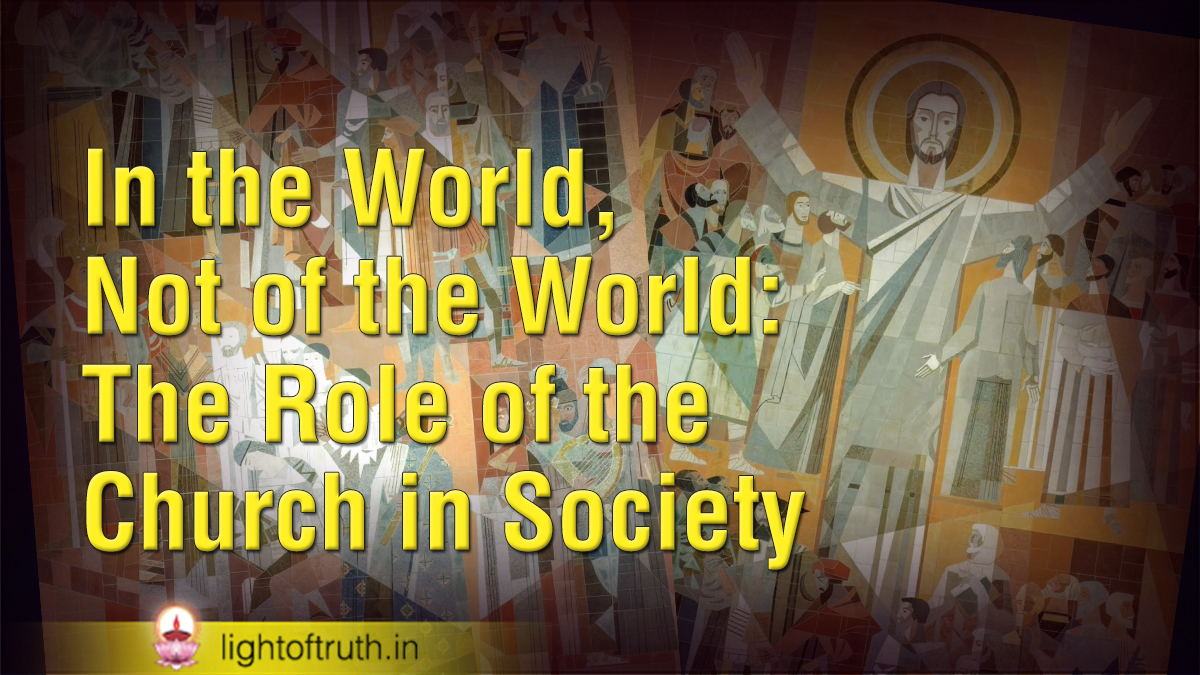
QUESTION : What is the Role of the Church in the Country in which it lives? (with reference to John 17:11–16)
ANSWER : Dr. Jacob Parappally MSFS
Although the Church is universal in its identity and mission, it is concretely present among particular peoples and within particular countries. Church cannot remain indifferent to the joys, hopes, struggles, sufferings, and aspirations of the people among whom it lives. At the same time, the Church cannot simply identify itself with any nation, political ideology, culture, or social system. Its ultimate belonging is to Christ, and its fundamental mission is to bear witness to the Kingdom of God.
The High Priestly Prayer of Jesus before his Passion and death, as presented in the Gospel of John, provides a profound theological foundation for understanding the Church’s presence in the country in which it lives. Jesus does not ask the Father to remove his disciples from the world. Rather, he asks that they be protected while remaining in it. The Church is therefore a community that is in the world but not conformed to the spirit of the world; a community rooted in a particular country but open to the Universal Kingdom of God; and a community that participates in society while retaining its prophetic freedom. The Church’s role in a nation is consequently neither withdrawal nor domination. It is a role of presence, service, witness, dialogue, solidarity, reconciliation, and prophetic engagement.
The Church as a Historical Community
Jesus does not envision a community separated from the world and human history. The disciples are to remain among people, sharing their lives and facing the same historical realities. At the time of Jesus, there were groups such as the Qumran community that sought to separate themselves from wider society in order to avoid what they regarded as the contamination of worldly life. Jesus, however, did not want his disciples to withdraw from the world. The Church, being a historical community, cannot understand itself as an isolated religious institution. It lives among particular peoples, speaks particular languages and encounters particular cultures.
For the Church in India, this means that it must genuinely be an Indian Church. It is not enough for the Church merely to exist geographically within India. It must engage in Indian history, culture, philosophy, literature, art, social realities, and religious traditions. The Christian faith must become incarnate within the concrete circumstances of the Indian people. This means that catholicity itself demands incarnation in particular cultures. The Universal Church becomes visible through particular churches that genuinely share the life of their peoples. As the Pastoral Constitution of the Second Vatican Council, Gaudium et Spes (The Church in the Modern World), states: “The joys and the hopes, the griefs and the anxieties of the people of this age, especially those who are poor or in any way afflicted, are the joys and hopes, the griefs and anxieties of the followers of Christ. Indeed, nothing genuinely human fails to raise an echo in their hearts” (GS, no. 1). The Church, therefore, rejoices when the nation rejoices and suffers when its people suffer. It cannot remain indifferent to poverty, unemployment, violence, discrimination, ecological destruction, social exclusion, or threats to human dignity. To be “in the world” means to share responsibility for the world.
The Church’s Prophetic Freedom
Yet Jesus introduces an important qualification: “They do not belong to the world, just as I do not belong to the world” (John 17:14). This statement should not be interpreted as contempt for the world or rejection of human society. In John’s Gospel, the “world” can refer to humanity loved by God, as in John 3:16, but it can also signify structures and attitudes opposed to God, truth, and love.
The Church is therefore not permitted to identify itself uncritically with the prevailing values of society. It must exercise its prophetic role by identifying what is opposed to human dignity and to the unfolding of human life as a gift of God. It must denounce what contradicts the values of the Gospel with prophetic courage and conviction, whatever the consequences may be. At the same time, it should affirm and promote whatever is good and humanising in the culture and society in which it lives and fulfils its mission. Therefore, the Church’s loyalty to Christ gives it the freedom both to appreciate what is good in society and to prophetically challenge injustice. The Church does not exist to provide unconditional support for any political ideology, nor is it called to give religious justification to political power. It should distinguish between love of one’s nation and the absolutisation of the nation.
Love of one’s country does not mean accepting everything a government does as a sign of patriotism. The uncritical acceptance of the slogan “my country, right or wrong” can become dangerous when it places national interests above truth, justice, and human dignity. Christian patriotism can affirm a people’s history, culture, freedom, and common good. But nationalism becomes incompatible with Christian faith when the nation is treated as an absolute value or when the dignity of other peoples, religions, or minorities is sacrificed for national interests. The Church’s ultimate allegiance belongs to God. The Church’s prophetic vocation in any nation requires it to challenge every power that threatens human dignity. It must speak out when the poor are exploited, when minorities are discriminated against, when violence is glorified, when corruption undermines society, or when creation is recklessly destroyed.
The Church in Service of the Common Good
The Church’s presence in a country must fundamentally be understood in terms of self-emptying service. Jesus’ own ministry was marked by self-emptying service to the least, the lost, and the last. He proclaimed good news of liberation and wholeness to the marginalised of his time. He healed the sick, welcomed sinners, defended the vulnerable, and restored human dignity. The Church, as the continuation of Christ’s mission in history, must likewise serve human flourishing.
But Christian service is not only philanthropy. It is rooted in the conviction that every human being is created in the image and likeness of God and that Christ identifies himself with the vulnerable. The Church therefore serves people not because they are Christians but because they are human beings loved by God.
The Church Promotes Human Dignity
The fundamental Christian affirmation that God became human in Jesus Christ and that all human beings are created in the image and likeness of God obliges the Church to champion human dignity and freedom. Every person is valuable in the sight of God. The inalienable dignity of every human person is independent of gender, religion, caste, economic status, or social position. In a caste- and class-ridden society such as India, where people continue to experience discrimination on the basis of caste and gender, and where such discrimination is sometimes justified by certain religious traditions, the Church’s contribution to national life is to proclaim credibly and consistently the dignity of every human person from womb to tomb. The Church cannot remain a silent spectator when the children of God—whatever their religion, ideology, or political affiliation—are discriminated against and their human dignity is trampled upon.
The Church as a Catalyst of Reconciliation
Jesus’ prayer for unity just before his Passion is not simply a prayer for unity among his disciples or members of the Church. It points towards the unity of the entire human family. It should not be considered an unattainable ideal, because it is intimately connected with the Cross and with Christ’s self-emptying love. There can be no genuine unity among people of good will without the self-emptying love revealed on the Cross. Conflicts among members of different religions, ethnic groups, and followers of various social and political ideologies are often intensified by individual and collective egoism. The desire to dominate and control others can make people forget that all are human beings, brothers and sisters. There is no shortcut to unity and peace without self-emptying love, forgiveness, and reconciliation.
When political parties use religion to divide people for their own advantage and create religious tension, the Church can become an instrument of dialogue. In doing so, it may have to suffer the consequences of being an agent of reconciliation, but it cannot abandon its evangelical obligation to be a peacemaker. Where communities are divided by caste, the Church should conscientize people about the dehumanisation caused by caste discrimination and work for fraternity. It should affirm, live, and proclaim the fundamental identity of every person as a human being and a child of God, before all other national, religious, social, or political identities. Indeed, the Church’s catholicity is expressed precisely through the communion of diverse peoples and cultures. The Church can contribute to national life by witnessing to a unity that does not eliminate diversity.
The Church and Interreligious Dialogue
Jesus’ High Priestly Prayer does not envision his disciples withdrawing from humanity. “I am not asking you to take them out of the world” (John 17:15) provides an important foundation for engagement with people of other religions and cultures in view of human communion. The Church can therefore approach people of other faiths like Hinduism, Islam, Sikhism, Buddhism, Jainism, and other religious traditions with respect and openness. Engaging in interreligious dialogue does not mean that Christians cease to believe in Christ. On the contrary, dialogue becomes possible precisely because Christian faith is confident enough to encounter the religious other without fear. The Church can recognise truth, goodness, and holiness wherever they are found while bearing witness to Jesus Christ. It should become a way of life expressed through shared concern for the poor, ecological responsibility, peace-building, education, social harmony, and the defence of human dignity.
Promotion of Responsible Citizenship
In a modern nation, the Church has the important mission of forming consciences and promoting responsible citizenship. It does not prescribe a particular political choice to its members. Rather, it should help to develop the moral and spiritual capacities necessary to participate responsibly in public life. Through its educational and social ministries, the Church can promote awareness of the responsibility of citizens towards the nation and society. Christians are called to be responsible citizens, not to be blinded by political rhetoric. As responsible citizens, they are called to work for justice, honesty, peace, solidarity, and the common good.
The Church can therefore contribute to democracy by encouraging respect for constitutional values, human rights, freedom of conscience, religious freedom, equality before the law, and the dignity of every person. At the same time, the Church must remain aware that its own institutional structures require continual conversion towards greater participation, accountability, and shared responsibility.
The Church’s responsibility towards the country also includes care for the natural environment. The world belongs to God, and human beings are entrusted with its care. The ecological crisis affects especially the poor and vulnerable. Environmental destruction, displacement, pollution, deforestation, and climate-related disasters therefore raise profound questions of justice. A Church that takes seriously its mission in the world cannot regard ecological concerns as secondary.
In the World but Not of the World
John 17:11–16 says that the disciples are in the world, but they are not of the world. They are not to withdraw from society, nor are they to become indistinguishable from values and structures that contradict the Gospel. The Church is at the service of God’s reign, and its mission is to proclaim the Kingdom of God, which transcends all nations. The Church lives within a nation while pointing beyond it. This gives the Church both a national and a universal identity.
Christians are citizens of their particular countries, but they also belong to a worldwide communion of believers. Their deepest identity is grounded in Christ. The Church therefore works for the good of the country while remembering that God’s Kingdom embraces all peoples. Thus, the Church’s vocation is neither to withdraw from the world nor to become captive to the world. It is called to be present in the world, serve the world, love the world, challenge what dehumanises the world, and bear witness to the Kingdom of God.



Leave a Comment