
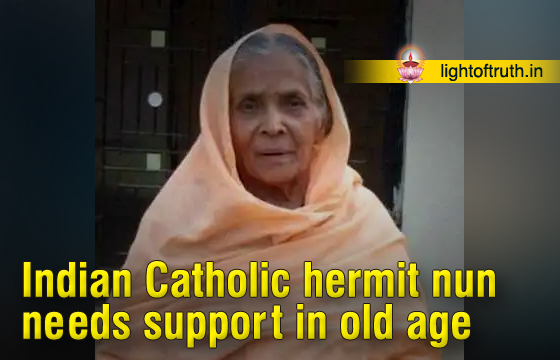
An aging Catholic nun, who adopted Hindu ascetic life during the movement for inculturation of the Indian Church some five decades ago, now lives under the care of a parish priest in western India.
The 88-year-old Sister Prasanna Devi lived alone for around 40 years in a forest around the sacred hill of Girnar in Junagadh district of Gujarat known for its Jain and Hindu temples dating back to centuries.
The surrounding forests happen to be the only natural habitat of the Asiatic lions and are home to leopards, jackals, striped hyena and the Indian fox besides several species of mammals, birds and reptiles.
Sister Prasanna Devi lived in the midst of this wildlife inside a hut-like hermitage from 1974 until September 2014 when she had a fall that caused her to move out of the forest to the annex of St. Ann’s Catholic Church, located six kilometers away and falling under Rajkot Diocese.
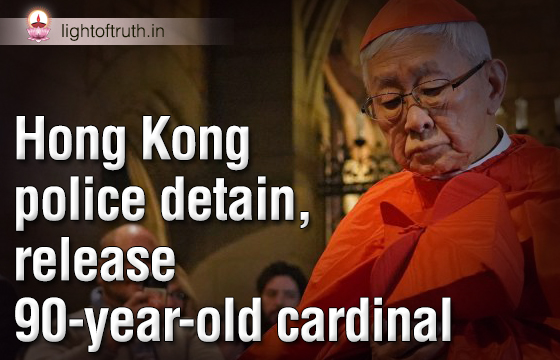
Hong Kong police detain, release 90-year-old cardinal
Hong Kong’s national security police released Cardinal Joseph Zen Zekiun, retired archbishop of Hong Kong, May 11 after detaining him for allegedly colluding with foreign forces.
The cardinal, 90, has been a very public supporter of pro-democracy and independence protests that have roiled the city for much of the past decade and came to a head in 2019 with unprecedented street marches and six months of spasmodic street battles with authorities. He was detained along with along with former opposition lawmaker Margaret Ng Ngoiyee and singer Denise Ho Wansze.
The independent Hong Kong Free Press tweeted a photo of a masked Cardinal Zen and said: “Cardinal Joseph Zen was released on bail from Chai Wan Police Station at around 11 p.m. on Wednesday. He did not speak. He then entered a private car parked outside the police station. The 90-year-old was accompanied by five people when he left the police station.”
The cardinal, Ng and Ho were among five trustees of the 612 Humanitarian Relief Fund, which was set up to offer financial assistance to those involved in anti-government protests in 2019 and which came under scrutiny of authorities over the past year.
A fourth trustee, former adjunct associate professor Hui Po Keung, was arrested by national security police May 10 as he was about to catch a flight to Germany, a source said. The South China Morning Post reported May 11 that Hui had been put on the list of people who would be stopped by law enforcers if they tried to leave the city via the airport or other control points.

Marcos Jr’s popularity shows lasting appeal of strongman leaders in the Philippines
Nearly 70 million Filipinos headed to polling centres on May 9)to elect the next president of the Philippines, hoping their pick will turn around a country battered by the COVID-19 pandemic over the last two years.
The fight for the presidency was centred between Ferdinand “Bongbong” Marcos Jr, the son and namesake of the late Filipino dictator, and Vice President Maria Leonor ”Leni” Robredo, a human rights lawyer and economist. On May 11 Marcos Jr claimed victory, after partial unofficial counts covering 98 percent of the votes showed he had obtained 31 million votes, double that of Robredo. Sara Duterte-Carpio, President Rodrigo Duterte’s daughter and Marcos Jr’s vice presidential running mate, has also been reported to have won over three times more voters than that of her closest opponent.
In the past, the Marcos family added to the general hardship of Filipinos by plundering billions of dollars from state coffers Dis-illusioned by unfulfilled promises from the Duterte administration to lower costs of living, end labour contractualisation and clean up corruption, they believe Marcos Jr could deliver change. Marcos’ campaign, focused on unifying the country and bringing it back to the global stage must have resonated.
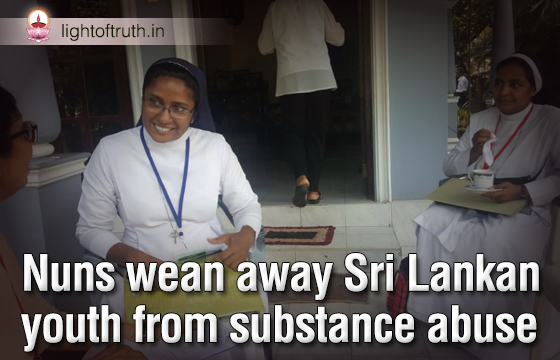
Nuns wean away Sri Lankan youth from substance abuse
Cletus (name changed) is just 24 but now undergoes treatment for heroin addiction at a rehabilitation centre in northern Sri Lanka.
The region, once the centre of the armed conflict between the Sri Lankan army and Tamil Tigers, now faces a new crisis – Substance Use Disorder, says Sister Theophane Cross, head of the Holy Family congregation’s Jaffna province.
The congregation in 2020 started its mission among sub-stance abuse victims when it celebrated its 200th anniversary of foundation.
The civil war ended in 2009, but the island nation is on another war – against drugs — “which is much more challenging and enslaving,” Sister Cross told.
The nuns, who are yet to open a de-addiction centre, refer their patients to the ‘Change Rehabilitation Centre’ managed by the Oblates of Mary Immaculate priests in Jaffna.
Sister Cross says she is deeply pained that most abuse victims are depressed young people with no jobs. “A lot of them are addicted to drugs and alcohol,” she bemoans.
Cletus was brought to the Oblate father’s centre in September 2021 by his wife, sister and mother on the advice of some Holy Family nuns who had visited them.

Pope tells Russian patriarch: ‘Don’t be Putin’s altar boy’
Warning that the Russian Orthodox patriarch should not “turn himself into Putin’s altar boy,” Pope Francis also said he would like to go to Moscow to meet Vladimir Putin in an attempt to end the conflict in Ukraine.
The Pope reiterated that he would not be going to Kyiv “for now,” but “I first must go to Moscow, I must first meet Putin,” he said in an interview with the Italian newspaper Corriere della Sera, published May 3. Vatican News also published most of the interview.
Pope Francis said he sent a message through Cardinal Pietro Parolin, Vatican secretary of state, “20 days after the war” started, to be delivered to Putin telling him, “I was ready to go to Moscow.”
“We still have not had a response, and we are still being persistent, even though I am afraid Putin may not be able to and may not want to have this meeting right now,” the Pope said. “I am doing what I can. If Putin were to open the door. …”
“But so much brutality, how do you not try to stop it? We saw the same thing with Rwanda,” he said, referring to the genocide against members of the Tutsi minority ethnic group in 1994, when at least 500,000 people were killed in about 100 days.
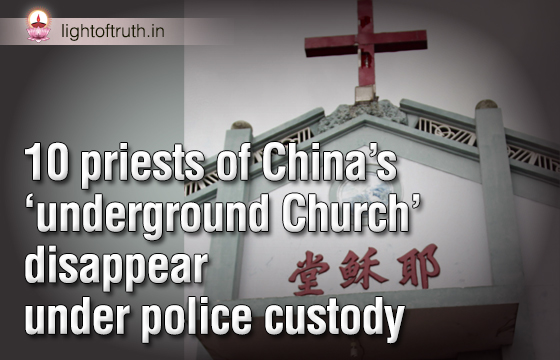
10 priests of China’s ‘underground Church’ disappear under police custody
At least 10 priests of the unofficial or “underground” Catholic community in the city of Baoding in the province of Hebei disappeared in the hands of the police since January this year.
At least four of those who went missing disappeared on the 29th and 30th of April, said a report on AsiaNews.
The underground Catholic community in Baoding is one of the oldest and most numerous in China even as its bishop, Giacomo Su Zhimin, has been in the hands of the police for at least 25 years, having already spent more than 40 years in forced labor in the 1970s.
Another Catholic priest in the city, Liu Honggeng, is in prison for seven years already. The unofficial community of Baoding split after its vicar, Francis An Shuxin, decided to join the “official Church” after spending decades in prison.

French bishop hailed as ‘friend of Buddhists’ in Cambodia
Buddhist leaders in Cambodia have honoured French Bishop Olivier Michel Marie Schmitthaeusler for his years of support and donations to local Buddhists and a popular pagoda.
Bishop Schmitthaeusler, the apostolic vicar of Phnom Penh, received the accolade “a great friend of Buddhists” at an event at Ang Monrei pagoda in Tram Kak district of Takeo province in southern Cambodia on April 30, reported Catholic Cambodia, the communications wing of the local Catholic Church. Seng Somony, secretary and spokesman of the Ministry of Cults and Religions, presided over the ceremony and handed a certificate of honor to Bishop Schmitthaeusler issued by the Mahanikaya Council of Cambodia, the country’s supreme Buddhist council.

Philippines: Archbishop reflects on fake News and the “golden era” of the Martial Law period
Archbishop Emeritus Antonio J Ledesma SJ of Cagayan de Oro reflects on the results of this week’s presidential elections in the Philippines. “Ferdinand Marcos Jr, known as ‘Bongbong’, the son and namesake of the country’s late dictator, who was ousted by a people’s revolt 36 years ago, is poised to become the next President of the Philippines for a six-year period. He amassed a huge lead over his nearest rival, the liberal human rights lawyer and incumbent vice-president Leni Robredo.
Election Day, May 9th, 2022, has come and gone. We are left with the election results. But who are the real losers and winners? Ten challenges confront us as individuals and as a nation” reflected Abp Emeritus Antonio J Ledesma SJ of Cagayan de Oro. “The massive DISINFORMATION campaign over social media by a particular candidate and his party cannot just be brushed aside. Over the past five to ten years, we are told, this online campaign has been stealthily carried out, reaching the minds and fantasies of cell phone users even in the remotest areas of the country. The dissemination of fake news about the “golden era” of the Martial Law period, the rehabilitation of the Marcos name, the downgrading of the reputations of other candidates, the casting of heroes as villains and villains as heroes – all this was planned with deliberation and strategic targeting of socioeconomic classes as well as age groups.
How can the country prevent this form of brain-washing and “vote buying” in future elections? There are cyber libel laws, but can they be easily implemented? Do we require senders of anonymous online messages to identify themselves? Frequent repetition of lies can eventually be accepted as the truth, a lesson from Goebbels of the Nazi regime.”
Declining birthrates impoverish future, pope says
The steady decline of birth-rates across Europe and the West are signs of a new form of poverty that deprives humanity of a future, Pope Francis said.
Families unable to have children and young people who struggle with having a family due to economic hardship or the allure of “mediocre substitutes” risk turning the “beauty of a family full of children” into a “utopia, a dream that is difficult to fulfill,” the Pope said in a message sent May 12 to participants of a conference on low birth-rates in Italy.
“This is a new poverty that scares me,” he said. “It is the generative poverty of those who discount the desire for happiness in their hearts, of those who resign themselves to watering down their greatest aspirations, of those who are content with little and stop hoping for some-thing great.”
According to the national statistics agency, ISTAT, Italy’s birth-rate hit an all-time low with 399,431 births in 2021 compared to 404,892 in 2020. Italy, Malta, Spain, Greece and Luxembourg have the lowest fertility rates in Europe.
The two-day “General State of Birth Rates” con-ference, its website stated, aims to “make proposals to reverse the demographic trend” in Italy which has “worsened by the effects of the COVID-19 pandemic.”
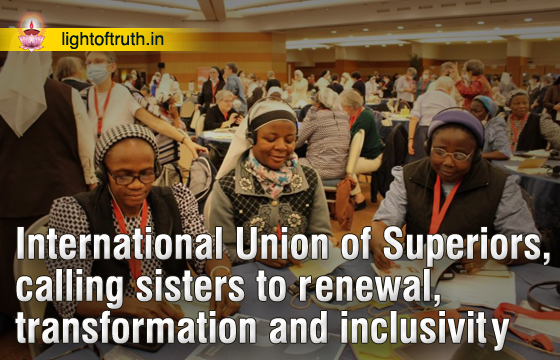
International Union of Superiors , calling sisters to renewal, transformation and inclusivity
With song, prayer and ritual, leaders of women’s religious congregations from around the world concluded five days of meetings in Rome on May 6, affirming their commitment to the process of synodality and em-bracing a journey of vulnerability that they believe is vital for the renewal of the church, religious life and their own communities.
The pledge was a culmination to the May 2-6 plenary of the International Union of Superiors General, during which numerous sisters, theologians and speakers voiced their support for Pope Francis’ vision of a synodal church that embraces its early historical roots, affirms the need for diversity, listens, and is more welcoming to those on society’s margins.
The 23-word commitment, spoken in unison by the 520 sisters attending the plenary in person and silently by another 200 or so who attended online, reads: “I commit myself to live vulnerable synodality through service as a leader, animating it within the community, together with the people of God.”
The plenary brought a strong sense of communion among the sister-leaders participating, UISG President Sr. Jolanta Kafka of the Claretian Missionary Sisters said in an interview after the gathering ended.