Category Archives: From The States

SPOT Convocation Highlights Growing Reach of Online Theology Formation

St Peter’s Pontifical Institute, Bangalore celebrated the third convocation of its St Peter’s Online Theology (SPOT) programme under the theme “Rooted in Christ, Rising in Wisdom,” marking another milestone in structured digital theological education.

The ceremony, attended by graduates, faculty and Church leaders, was livestreamed on YouTube to enable wider participation. The celebrations were centred on the Holy Eucharist, presided over by Bishop Antonysamy S., highlighting that theological formation is not merely academic pursuit but a journey of discipleship and service.

Students participated in departmental and common evaluation sessions and reflected on how the SPOT initiative enriched their understanding of Sacred Scripture, Church teaching and personal faith. They also suggested strengthening digital access to study materials and introducing more regular academic assessments.

The formal convocation ceremony was attended by Bishop Arockia Raj Satis Kumar as Chief Guest and Sr. Florence Fernandez of the FS Bangalore Province as Guest of Honour. Certificates were conferred on graduates in recognition of their academic achievement and commitment to ongoing formation.

In his address, the Chief Guest encouraged graduates to pursue lifelong wisdom and embody theological learning in daily Christian witness. The Guest of Honour urged them to remain rooted in Christ and serve the common good. The event reaffirmed SPOT’s mission of integrating academic rigour with spiritual growth, preparing graduates for meaningful engagement in Church and society.

Sankranti Celebration Brings Message of Hope to Mysuru Prison Inmates

The festival of Sankranti was observed at Mysore Central Prison with a special programme focused on renewal and personal transformation. The event was organised by the Mysore Unit of Prison Ministry India (PMI).

Prison authorities, PMI coordinators, volunteers and inmates gathered within the prison campus, creating an atmosphere of fraternity and reflection. Sankranti, traditionally symbolising transition and new beginnings, was marked not only as a cultural celebration but also as a moment for introspection and reform.

Swami Sarvajayananda Maharaj of the Ramakrishna Ashram delivered the keynote address, highlighting the spiritual significance of the festival. He reminded inmates that failure and weakness are part of the human journey but stressed that sincere effort, prayer and self-discipline can lead to genuine transformation. He encouraged prisoners to use their time meaningfully for reflection and self-improvement.

V. Seshumurthy, Chief Superintendent of the prison, presided over the programme and extended festive greetings to inmates and staff. He expressed hope that the message of renewal would inspire prisoners to reform their lives and prepare for responsible reintegration into society. The distribution of yellu bella, symbolising harmony and forgiveness, marked the celebration’s conclusion. The programme was widely appreciated, reinforcing the belief that every individual is capable of positive change and a fresh beginning.

Tamil Nadu Bishops’ Council SC/ST Commission Urges 4.6% Internal Quota for Dalit Christians

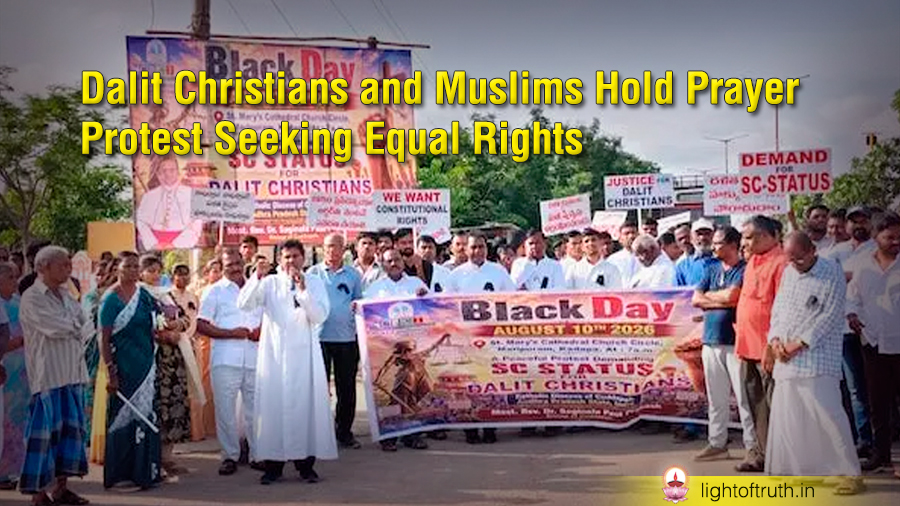
The Tamil Nadu Bishops’ Council SC/ST Commission has urged the State government to introduce a 4.6 percent internal reservation for Dalit Christians to ensure equitable access to education, employment and social opportunities.

The appeal was submitted on February 24 when Fr. Nithiya Sagayam OFM Cap, Secretary of the Commission, met Tamil Nadu Chief Minister M. K. Stalin in Kanyakumari on behalf of Commission chairman Bishop Jeevanandam. A memorandum called for the creation of a 4.6 percent internal quota for Dalit Christians within the Backward Class category.

The Commission noted that Dalit communities have historically faced structural discrimination that continues to hinder socio-economic progress. While Scheduled Caste Hindus receive reservation benefits, Dalit Christians and Dalit Muslims remain excluded despite experiencing similar disadvantages.

The memorandum also pointed out that Tamil Nadu has already implemented a 3.5 percent internal reservation for Muslims. Referring to the 2011 Census, it stated that Christians form about six percent of the State’s population, of whom nearly 65 percent are Dalit Christians—approximately 4.6 percent of the total population—forming the statistical basis for the demand.

Backing the appeal, the Commission conducted a year-long statewide mobilisation campaign, collecting over one lakh signatures. These will be submitted to the State Secretariat in Chennai as a collective representation. The Commission said the initiative aims to promote dignity, equality and inclusive development for marginalized communities.

Family demands federal probe into death of Indian Christian legislator

Family members of indigenous Christian legislator Vungzagin Valte have refused to bury his body, demanding a federal probe into his death and a separate district for the Zomi tribal community in violence-hit Manipur.

Valte, 61, a three-time lawmaker representing Thanlon constituency and a prominent Zomi leader, died in a New Delhi hospital on Feb. 21 after remaining hospitalized for nearly three years. He had suffered severe injuries in a mob attack on May 4, 2023, during the ethnic conflict between the Hindu-majority Meitei and predominantly Christian tribal groups. His driver was killed in the assault.

The conflict, which began in May 2023, has claimed more than 260 lives, displaced over 60,000 people, and damaged hundreds of homes, schools, and places of worship.

Family members and community leaders have demanded a probe by the National Investigation Agency and the creation of a separate administrative district for the Zomi tribe before proceeding with burial rites. The body has been kept at a government hospital morgue in Churachandpur district.

The Indigenous Tribal Leaders’ Forum criticized authorities for failing to make arrests in the 2023 attack and reiterated its call for a separate administration for Kuki-Zo tribal groups. However, some Church leaders cautioned that delaying the burial could further inflame tensions in the fragile state, where security forces continue patrols amid fears of renewed violence.

Indian court rules against denying Dalits access to burial, cremation grounds

The Madras High Court has ruled that denying marginalized communities access to public burial or cremation grounds amounts to practicing untouchability and can invite criminal action.

In its February 11 order, made public on February 23, the court stated that preventing Dalits and other socially disadvantaged groups from using common burial spaces is “not just discriminatory” but a violation of the constitutional ban on untouchability. India outlawed the practice in 1950, making it a punishable offense, though reports indicate it continues in subtle forms in some rural areas.

The order was issued by Justice V. Lakshminarayanan while hearing three petitions related to a land dispute in Karumandisellipalayam village in Erode district. While official records classified the land as a bullock cart track, evidence showed parts of it had been used as a burial ground for more than 70 years. The inquiry also confirmed that several graves had been levelled in 2025.

The court directed district authorities to demarcate and fence the burial ground, prevent encroachments, expedite its reclassification, and take action against those responsible for disturbing graves. Church leaders and Dalit activists welcomed the ruling, calling it historic and a ray of hope for marginalized communities, including Dalit Christians. According to government data, more than 200 million Indians belong to historically disadvantaged groups, underscoring the continuing relevance of the judgment.

Counsellor nuns help women escape toxic relationships in India

A Catholic mother of two has expressed gratitude to the Medical Sisters of St. Joseph for helping her leave what she described as a toxic interfaith relationship and rebuild her life.

The woman, who requested anonymity, said she was supported by the congregation’s Lumina Holistic Counselling and Psychotherapy Centre after her relationship turned controlling and abusive. She alleged that the man pressured her for money and valuables and later coerced her to convert and marry him. With the intervention of her parents, she spent six months at the center receiving counseling and spiritual guidance.

Sr. Jinu Thomas Valavanolickal, director of Lumina, said the center has handled 737 cases since its founding in 2017, including 347 involving Christian girls. She claimed many cases involve young women who feel isolated or vulnerable while studying away from home. The center provides psychotherapy alongside prayer, Eucharistic adoration and confession.

The sister said the ministry is not without risk. Some girls initially resist counseling, and young men have reportedly visited the center to threaten staff. Police occasionally provide protection or refer cases through court orders.

Supported by priests from the Thamarassery diocese, the sisters also conduct parish awareness programs. Parents of beneficiaries say the counseling has restored hope and stability in their families. The congregation, which has more than 700 members across India, funds and operates the center as part of its broader health and pastoral ministry.

Martyrdom Anniversary of Blessed Rani Maria Observed at Udainagar

The 31st martyrdom anniversary of Blessed Rani Maria was solemnly commemorated on February 25 at Udainagar Parish in the Diocese of Indore, drawing a large gathering of bishops, clergy, religious, and faithful. The solemn Eucharistic celebration was presided over by Peter Rumal Kharadi, Bishop of the Diocese of Jhabua. He was joined by several bishops, including Leo Cornelio, along with about 50 priests, 160 religious sisters, and more than 600 faithful who gathered in prayerful remembrance of the martyr’s witness.

In his homily, Archbishop Cornelio reflected on Blessed Rani Maria’s life of service and sacrifice, noting that she sought to transform society through love even in the face of grave danger. He emphasised that authentic love demands sacrifice and reminded the faithful that Christian mission is rooted in the transformation of hearts and minds, fostering goodness, fraternity, and peace in society.

Following the Holy Mass, six faithful shared testimonies describing spiritual graces and personal renewal experienced through the intercession of Blessed Rani Maria. A book highlighting her social commitment and missionary service was also released on the occasion.

The commemoration reaffirmed the enduring inspiration of Blessed Rani Maria’s witness of faith, charity, and courage, calling the faithful to continue her mission of love and transformative service in the world.

CCBI Trains Women Religious in Financial Administration in Goa

Thirty-five women religious from 11 congregations are taking part in a five-day Financial Management Training Programme in Goa aimed at strengthening responsible financial administration within Church institutions. The programme, organised by the CCBI Extension Secretariat at Shanti Sadan, runs from February 10 to 14 and focuses on promoting transparency, accountability, and effective stewardship of resources. The training began with a Eucharistic celebration presided over by Auxiliary Bishop Simião Purificacão Fernandes of Goa. In his homily, he encouraged participants to remain “PURE” in their service, describing it as Purity of intention, Understanding the purpose of resources, Responsibility with compassion, and Evangelical witness through integrity. Church leaders present highlighted that good financial administration helps build trust and credibility within religious communities and their ministries.

The programme has been designed especially for provincials and provincial financial administrators. Sessions are being led by chartered accountants who provide practical guidance on financial planning, compliance, ethical management, and transparent reporting. Organisers said the aim is to equip women religious with skills that support sound governance and responsible decision-making in Church institutions. In addition to academic sessions, participants will take part in a pilgrimage to important sacred sites in Goa, including the Basilica of Bom Jesus and the Sé Cathedral, allowing time for spiritual reflection alongside training. Shanti Sadan regularly conducts specialised courses for Church administrators, including programmes in diocesan management and finance. These initiatives seek to strengthen leadership capacity and promote accountability across Church structures while encouraging faithful stewardship of resources in service of the wider community.

Sr. Vineeta CSJ Appointed National Secretary of CRI for 2026–2030

The Conference of Religious India (CRI) has appointed Sr. Vineeta CSJ as its National Secretary for the 2026–2030 term. The announcement was made by Fr. Saju Chackalackal CMI, National President of CRI. A member of the Congregation of the Sisters of Saint Joseph of Chambéry, Tamnaya Province, Bhopal, Sr. Vineeta made her Final Profession on June 28, 2009. She brings to her new national responsibility a rich blend of academic excellence, administrative experience, and pastoral commitment, reflecting years of dedicated service within religious life and the wider Church.

Currently serving as Secretary of the Kerala Conference of Major Superiors (KCMS), she has actively fostered coordination among religious congregations. Her regional experience is expected to strengthen CRI’s national initiatives and inter-congregational collaboration during her tenure.

Church leaders mourn deaths in coal mine blast in India’s Meghalaya

Church leaders have expressed deep sorrow following a deadly coal mine explosion that killed at least 31 people in Meghalaya, a Christian-majority state in northeast India. According to the Meghalaya State Disaster Management Authority, the accident also left 10 people injured. Most of the victims were migrant workers from neighbouring Assam and Nepal. Archbishop Victor Lyngdoh of Shillong offered condolences to the families who lost loved ones, describing the tragedy as heart-breaking. He also called on authorities to take stronger action to prevent similar disasters and to curb illegal mining activities that continue to endanger lives.

The explosion occurred on Feb. 5 in a coal mine located in the remote Mynsyngat–Thangsko area of East Jaintia Hills district. Reports indicate that a dynamite blast inside the mine caused the accident. A large rescue operation involving multiple agencies was carried out, but access to information remained limited due to the area’s remote location. Church officials said they are still unsure whether Christians were among the victims. Meanwhile, state authorities have begun action against illegal mining operations following the tragedy. Two mine owners have been arrested, and officials seized more than 6,900 metric tonnes of illegally mined coal during raids.

Meghalaya Chief Minister Conrad Sangma has ordered a judicial inquiry and announced compensation of 200,000 rupees for families of the deceased. The Meghalaya High Court has also taken notice of the issue and sought explanations from local officials regarding the continued presence of illegal mining despite a ban imposed by the National Green Tribunal in 2014.

The incident has renewed concerns about hazardous rat-hole mining, which remains widespread despite legal restrictions. Church leaders and activists have renewed calls for stronger action against caste discrimination in educational institutions following debates over University Grants Commission (UGC) equity regulations and a recent Supreme Court stay on their implementation.