

After a long pandemic pause, Pope Francis is scheduled to celebrate a Mass May 15 for the canonization of Blessed Devasahayam Pillai and 9 men and women: Five from Italy, three from France, one from India and one from the Nether-lands. Blessed Devasahayam Pillai an Indian layman and father who was born to an upper-caste Hindu family in 1712 and converted to Christianity in 1745. The Vatican said his refusal to participate in Hindu ceremonies and his preaching about “the equality of all people,” denying the Hindu caste system, led to his arrest, torture and his death in 1752
The last canonization ceremony was celebrated Oct. 13, 2019, and included St. John Henry Newman.
The “big names” – globally – in the newly recognized heavenly host are soon-to-be St. Charles de Foucauld, who lived as a hermit in North Africa, and soon-to-be St. Titus Brandsma, a Dutch Carmelite martyred at the Dachau concentration camp.
Those canonized will bring to 909 the saints Pope Francis has recognized officially during his pontificate; the figure includes the 813 “Martyrs of Otranto,” who were killed in the southern Italian city in 1480 and declared saints in 2013.
In view of the canonization ceremony, the Congregation for Saints’ Causes has published a brief biography of each of the 10 new saints and information about the miracle attributed to their intercession needed for their canonizations. While the church does not require the recognition of a miracle for the beatification of a martyr, it generally requires one for all blesseds to be declared saints. The 10, listed in the order the congregation lists them, are: Blessed César de Bus, Blessed Luigi Maria Palazzolo, Blessed Giustino Maria Russolillo, Blessed Charles de Foucauld, Bless-ed Anna Maria Rubatto, Blessed Maria Domenica Mantovani, Blessed Titus Brandsma, Blessed Marie Rivier, Blessed Carolina Santocanale.
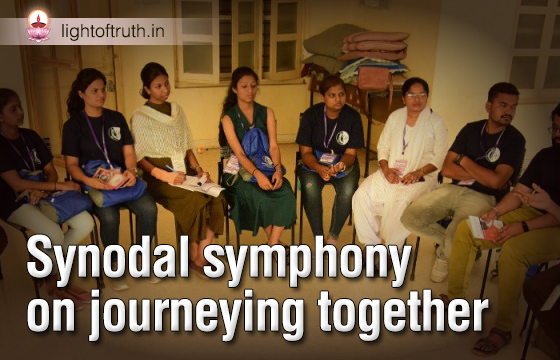
Synodal symphony on journeying together
Since its launch in all dioceses worldwide in October 2021, the synod 2021-2023 entitled ‘For a Synodal Church: Communion, Participation, Mission’ has evoked mixed responses ranging from excitement and optimism to indifference and cynicism.
The Synod inaugurations in the Indian dioceses of the Conference of Catholic Bishops of India (CCBI, Latin rite) were followed by consultations of cross-sections of people: lay faithful, youth, children, diocesan clergy, religious men and women, the elderly and infirm, seminarians, the poor and peripheral, lapsed Catholics and so on.
“The synod is an ecclesial event and its protagonist is the Holy Spirit. If the Spirit is not present, there will be no synod,” said Pope Francis during his ‘moment of reflection’ while launching the synodal consultations on October 9, 2021. Viewing how processes have unfolded in diverse dioceses, there is no doubt that the omnipresent Spirit “blows where it wills” (Jn 3:8).
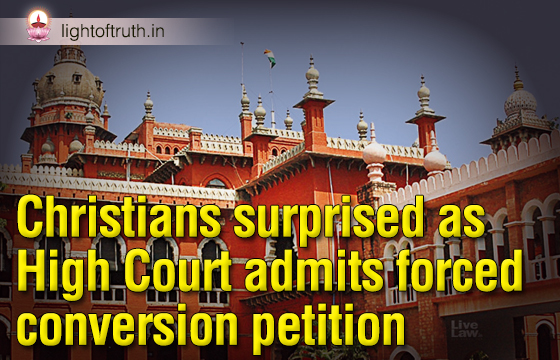
Christians surprised as High Court admits forced conversion petition
Christians in Tamil Nadu have expressed surprise that the state’s high court has admitted a public interest litigation to stop forcible conversion of students in schools.
The bench of Justices R. Madhavan and S. Ananthi of the Madras High Court on May 6 admitted the petition and posted the matter to a regular bench on June 6 after the summer vacation ends.
Jesuit Father Arockiasamy Santhanam, spokesperson for the National Lawyers Forum of Religious and Priests, says the vacation court should not have entertained the petition. “One wonders what urgency is found in this petition,” he added.
Father Devasagayaraj M Zackarias, a former secretary of the Office for Scheduled Castes and Backward Classes under the Catholic Bishops’ Conference of India, says he was surprised the High Court admitted the petition when the incidents it has quoted are still under investigation.”
The case, Father Zackarias laments, is nothing but a way to create unnecessary disturbance in the state where schools impart quality education, especially to the poor and the marginalized.

Nobel laureate and physicist Wilczek wins Templeton Prize
Frank Wilczek, the Nobel Prize-winning theoretical physicist and author renowned for his boundary-pushing investigations into the fundamental laws of nature, was honored Wednesday with this year’s prestigious Templeton Prize, awarded to individuals whose life’s work embodies a fusion of science and spirituality.
In a statement, the John Templeton Foundation praised the 70-year-old Wilczek for transforming “our understanding of the forces that govern our universe,” while also applying “the insights of his field to the great questions of meaning and purpose pondered by generations of religious thinkers.”
Established in 1972 by the late philanthropist Sir John Templeton, the prize is one of the world’s most lucrative individual awards, currently more than $1.3 million. Past winners include Jane Goodall, Mother Teresa, the Dalai Lama and Archbishop Desmond Tutu.
“It’s encouragement in a direction that I’ve really only taken up in a big way quite recently, although I’ve been building up to it for many years,” he said, “which is thinking about not just what the world is and how it came to be this way but what we should do about it.”
Over a long career, Wilczek has recorded many distinguished achievements. That includes the 2004 Nobel Prize in Physics, along with David J. Gross, and H. David Politzer, for their 1973 breakthrough explaining the unusual properties of the strong force, which binds fundamental particles known as quarks into protons and neutrons.
He has also authored several books that are informed by science but delve into the spiritual and philosophical. They include “ A Beautiful Question,” in which he asks, “Does the universe embody beautiful ideas?”; “ The Lightness of Being,” an examination of what humans are made of; and “ Fundamentals,” an exploration of radical life ex-tension, the longing for immortality, the limits of science and other topics.
“In studying how the world works, we are studying how God works, and thereby learning what God is,” he writes in “Fundamentals,” released this year. “In that spirit, we can interpret the search for knowledge as a form of worship, and our discoveries as revelations.”
Growing up Catholic, he embraced the idea that there was a grand plan behind existence. But as he learned more about science, he eventually lost faith in conventional religion and, in his words, “jettisoned detailed dogmas.”
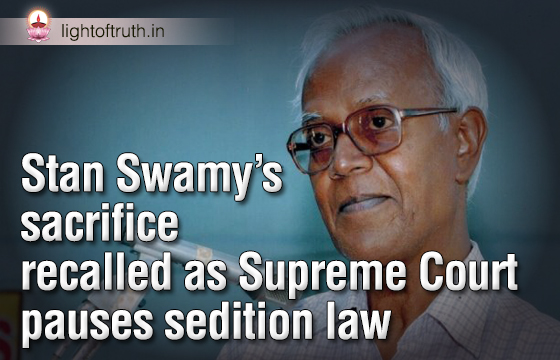
Stan Swamy’s sacrifice recalled as Supreme Court pauses sedition law
Christian activists in India on May 11 recalled “the sacrifice” of Jesuit Father Stan Swamy while welcoming the Supreme Court order to keep the country’s sedition law on abeyance. Father Stan, as he was popularly known, died July 5, 2021, in a Mumbai hospital as an undertrial prisoner.
A three-judge Bench led by Chief Justice of India N V Ramana also directed that an accused in a fresh case could seek bail and the court that deals with it would provide relief taking into account the apex court order.
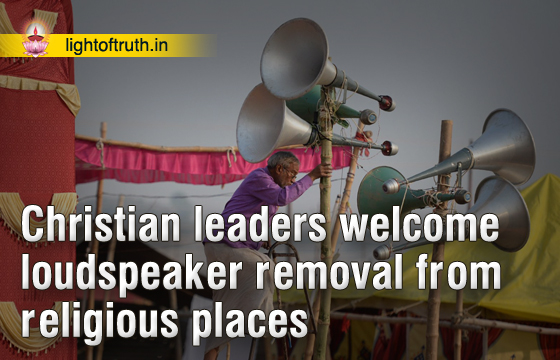
Christian leaders welcome loudspeaker removal from religious places
Some Catholic leaders in Uttar Pradesh have welcomed a government drive to remove loud speakers from religious places in the northern Indian state. “If the government is doing it in a non-partisan way and without religious prejudices, it is to be appreciated,” says Father Anand Mathew, who quoted some reports to point out that majority of the loudspeakers removed in the past decades were from the Hindu temple tops.
The Uttar Pradesh government on April 25 began a statewide drive to remove unauthorized loudspeakers from religious places and set the volume of others within permissible limits.
Additional Director General of Police (Law and Order) Prashant Kumar told re-porters that by May 1 morning they have removed a total of 53,942 loudspeakers and set the volume of 60,295 loudspeakers within permissible limits.
Kumar clarified that they are removing the loudspeakers from all religious places without any discrimination.
Meanwhile a senior home department official confirmed that the drive will continue in the coming days.
Those loudspeakers which have been placed without taking due permission from the district administration or the ones which are placed in excess of the permitted numbers are categorized as unauthorized, Kumar explained.
He said the administration also considered the High Court order regarding loudspeakers. After a 2017 government order on the matter, the High Court had asked it if loudspeakers at religious and public places were installed after taking permission in writing from authorities referring to the Noise Pollution (Regulation and Control) Rules, 2000.
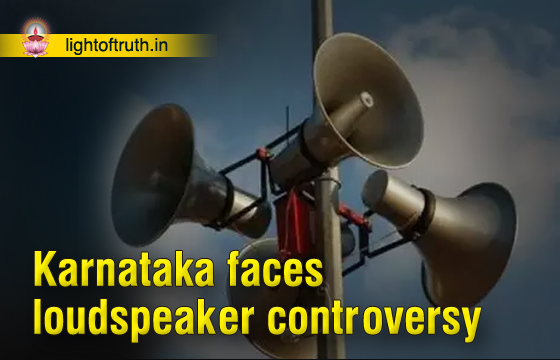
Karnataka faces loudspeaker controversy
People in Karnataka began from May 9 to get up at 5 am to pray, sing or curse.
Muslims in the southern Indian state start their day with Azaan announced through loud-speakers fit atop mosques. Hindus, on the hand, use the public address system to counter the Muslim call to prayer with “Suprabhata” and “Hanuman Chalisa” (hymns in praise of Lord Hanuman).
Pramod Muthalik, founder of the Sri Ram Sena (army of Lord Ram), on May 9 opened the Hindu prayer at 5 am in temples of Mysore temples. More than 1,000 Hindu temples in the state also did the same, he claimed.
A controversy over Muslim using loudspeakers to announce Azaan was reported from states such as Uttar Pradesh and Maharashtra. They have enacted laws to control the use of loud-speakers by any religious group. The Uttar Pradesh government of the Hindu nationalist Bharatiya Janata Party (BJP), has removed 54,000 unauthorized loudspeakers from religious places.
The Karnataka government, led also by the BJP, is yet to en-act a law on loudspeakers. How-ever, it has succeeded in controlling Muslim girl students wearing veil in schools. Muslim traders are reportedly barred from Hindu festival while people are urged to avoid food prepared according to Muslim customs or Malls owned by Muslims.
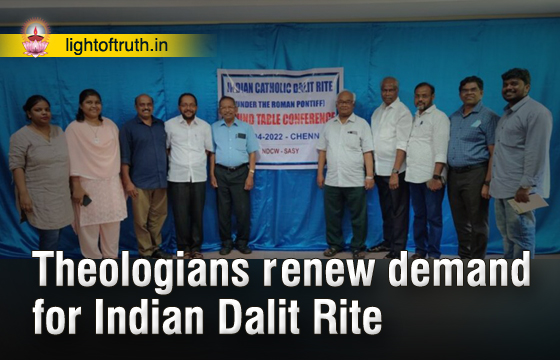
Theologians renew demand for Indian Dalit Rite
The demand for a Dalit Rite in the Catholic Church in India was reiterated at a conference of theologians, biblical scholars and canon law experts from the community. Caste is a stark reality and caste-based discrimination is rampant in the Catholic Church’s hierarchy, parishes and institutions, bemoans Reverend Vincent Manoharan, a theologian, while introducing the April 28-29 conference at St. Thomas International Centre, Chennai.
Dalits, he pointed out, are totally neglected in the Church despite the Dalit Empowerment Policy of the Catholic Bishops’ Conference of India that demanding to set it right.
The bishops issued the policy on December 13, 2016, that acknowledged that “caste discrimination is a grave social sin” and committed to ensuring that the practice of untouchability will not be tolerated within the Church. Reverend Manoharan also added that the Dalit representation is abominable in the Catholic Church and their voices are not heard adequately.
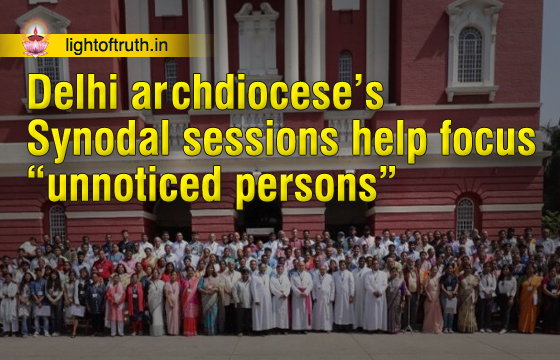
Delhi archdiocese’s Synodal sessions help focus “unnoticed persons”
Thousands of Catholics have attended the Delhi archdiocesan consultation meetings to prepare for the Rome Synod that began more than six months ago.
While Jesuit Father Stanislaus Alla, a theology professor, finds the process “truly historic,” Abp Anil J Couto of Delhi, who initiated it, says the Church in the archdiocese will not be the same after the exercise ends.
Father Alla, who teaches in Delhi’s Vidyajyoti College of Theology, has read through hundreds of pages of reports from various groups in the archdiocese and drafted the “Diocesan Syn-thesis” with his colleague, Presentation Sister Shalini Mulackal.
The latest archdiocesan Pre-Synodal meeting at the cathedral campus in New Delhi was attend-ed by 8-month-old Ayston Jez and 85-year-old Emeritus Abp Vincent Concessao of Delhi among more than 200 participants.
Archbishop Couto opened the April 29-May 1 with a prayer and inaugural address. Auxiliary Bishop Deepak Tauro of Delhi presented an overview of the proceedings. The meeting ended with a Mass on May 2.
8-month-old Ayston Jez with Leena Sunny, a Core Committee member, and Archbishop Anil Couto of DelhiThe archdiocese launched the Synodal process October 17, 2021, with a Mass led by Archbishop Couto.
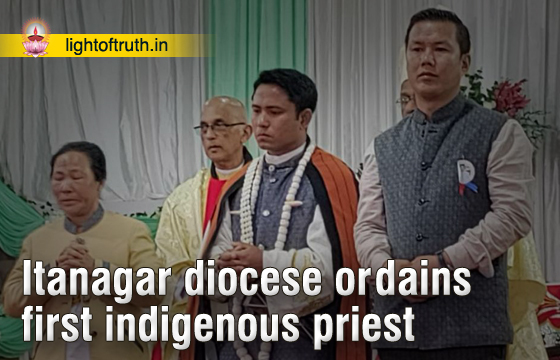
Itanagar diocese ordains first indigenous priest
Itanagar diocese in the north-eastern Indian state of Arunachal Pradesh May 7 ordained its first priest of indigenous origin
Bishop John Thomas of Itanagar ordained Father Roshan Bamin Peter, a member of the Apatani tribe, at Mary Immaculate Church, Hapoli, Ziro, his home parish in Lower Subansiri district.
“It is a proud moment for all of us in the diocese especially to the people of Apatani tribe,” Nani Yase Teresa, the president of Apatani Catholic Women Asso-ciation of Itanagar diocese. “It will inspire many young people of all tribes to become priests and nuns,” she added.