
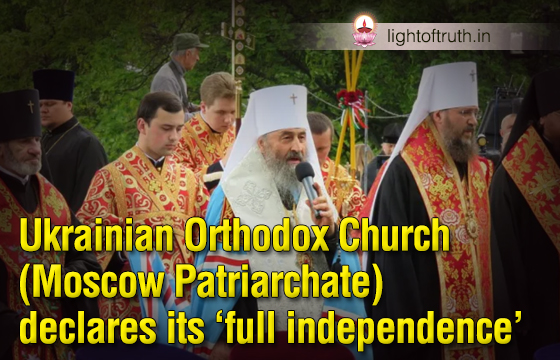
A council of the Ukrainian Orthodox Church (Moscow Patriarchate) on May 27 resolved on its “full self-sufficiency and independence,” distancing the Church from Russian Orthodoxy. The decision comes amid the third month of the Russian invasion of Ukraine, which has been prominently supported by Patriarch Kirill of Moscow.
“The Council adopted relevant amendments and additions to the Statutes on the administration of the Ukrainian Orthodox Church, indicating the full self-sufficiency and independence of the Ukrainian Orthodox Church,” the Church resolved May 27 in Kyiv.
The council also condemned the Russo-Ukrainian War, gave terms for dialogue with the Orthodox Church of Ukraine, and broached the possibility of making chrism, which as been considered a sign of autocephaly in the Russian tradition.
“The council condemns the war as a violation of God’s commandment Thou shalt not kill,” it said, and it expressed its “disagreement with the position of Patriarch Kirill of Moscow and All Russia regarding the war in Ukraine.”
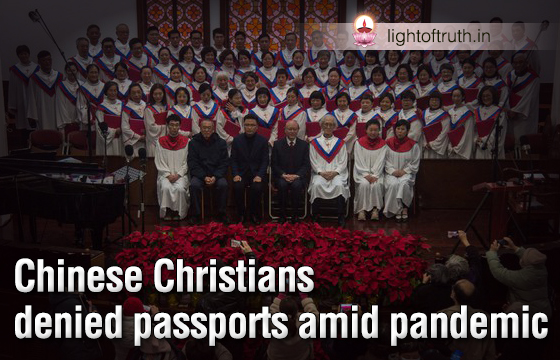
Chinese Christians denied passports amid pandemic
Christians in eastern China who wish to travel abroad for various reasons including emigration and studies are facing hard times as authorities have denied them passports, citing travel restrictions due to the Covid-19 pandemic.
Christians from several families in Zhejiang and Jiangsu provinces said immigration officials questioned the purpose of their passport applications and later rejected the applications after they discovered their religious adherence, Radio Free Asia (RFA) reported on May 26.
In Zhejiang’s Wenzhou city, which has a significant concentration of Protestant Christians, authorities have reportedly rejected the passport applications of many students seeking over-seas education, an education consultant said.
The scenario is similar in Jiangsu province as well.
“A bunch of students from Wenzhou with a church back-ground had been planning to go and study at overseas universities, but the government has refused to give them passports,” said Zhu, a Christian from Xu-zhou city in Jiangsu who would be identified only by his surname.
Pope Francis highlights danger of staid liturgies that ‘deny Vatican Council II’
Pope Francis is pushed in a wheelchair by his aide, Sandro Mariotti, as he leaves an audience with students and professors of Rome’s Pontifical Institute of Liturgy at St. Anselm, May 7 at the Vatican. The Pope said that the celebration of the liturgy and the study of it should lead to greater unity in the church, not division and squabbles.
There is an old saying: “During Holy Week, there is nothing more useless than a Jesuit.” The magnificent liturgies of that holiest of times requires a profound liturgical sense. Members of the Society of Jesus have never been known for their liturgical flair and Pope Francis is no exception. When he presides, it is in a very unembellished, straightforward manner.
Consequently, his remarks to the members of the Pontifical Liturgical Institute last weekend (May 7) were a bit surprising. No one should be surprised that a man of such spiritual solidity entertains deep spiritual sentiments about the liturgy, but to hear him share them was a rare insight into what makes the Holy Father tick.
Much of the attention has focused on his remarks about liturgical formalism. “I would like to underline the danger, the temptation of liturgical formalism: going after forms, formalities rather than reality, as we see today in those movements that try to go backwards and deny Vatican Council II itself,” the Pope said. “In this way, the celebration is recitation, it is some-thing without life, without joy.” (Emphasis in original.)
The key phrase there is “deny Vatican Council II.” We have all attended post-conciliar liturgies that lack joy. But it is when the liturgy becomes a weapon in the culture wars, when doubts are raised about Vatican II and its legitimacy, when liturgy becomes an ideological expression rather than an ecclesial one, that is where the Holy Spirit is shut out and the in-breaking of the divine mystery is nullified.
Francis did not mince words here: “When liturgical life becomes something of a banner of division, there is the odor of the devil, the deceiver, in there.”
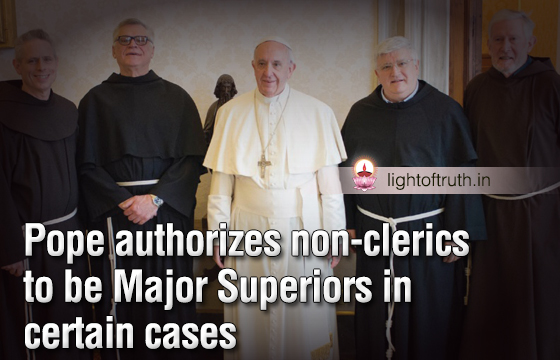
Pope authorizes non-clerics to be Major Superiors in certain cases
Pope Francis has authorised the Congregation for Institutes of Consecrated and Societies of Apostolic Life to grant dispensations that would allow non-clerics to hold the office of Major Superior in some cases.
The Holy Father did so in a rescript promulgated on May 25, concerning the possibility of a dispensation from Canon 588 §2 of the Code of Canon Law (CIC), which stipulates that that clerical institutes be governed by clerics.
Major superiors, along with their vicars, are those who govern an entire or a part of a clerical institute, and are call-ed to “devote themselves diligently to their office and together with the members entrusted to them are to strive to build a community of brothers or sisters in Christ,” according to the CIC.
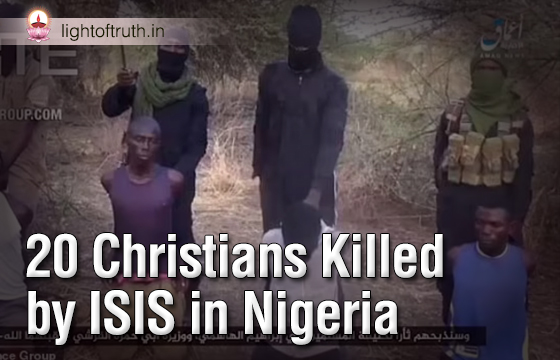
20 Christians Killed by ISIS in Nigeria
ISIS extremists executed 20 Nigerian Christians in a brutal knife attack to “avenge the killing of the group’s leaders in the Middle East.” The Islamic State posted footage of their executions in a vile warning to Nigerians, that they are there, are expanding their territory, and have the intent of imposing a draconian and barbaric rule. The militants carried out the merciless executions in Borno state where rival Islamist groups Boko Haram and Islamic State in West Africa (ISWAP) have been abducting, looting and killing on a huge scale.
Footage of the latest massacre shows one of the executioners saying in the Hausa language that the killings are a response to ISIS deaths in the Middle East earlier this year. It came a week after Islamic rebels killed at least seven people in an attack in northeast Borno.
Over 35,000 people have been killed and many more displaced in West Africa as a result of the extremist groups. The groups are clashing with each other, as well as the local and national governments that oppose them.
The ISIS insurgents attacked Kautukari village in the Chibok area at the same time that UN Secretary-General Antonio Guterres was in the state to meet with survivors of jihadist violence.
The Chibok area is 70 miles away from Maiduguri, the state capital, where Guterres met with former militants being reintegrated back into the society and thousands of people displaced by the insurgency.
Boko Haram and ISWAP were originally aligned but the groups splintered in 2016 and are now considered rivals. “They came in large numbers with superior firepower (and) took over the community,” said Hassan Chibok, a community leader.
Troops from a nearby military base were deployed to repel the attack but “the damage had been done,” Chibok said, adding that “casualties are up to 10.”
Another resident, Yana Galang, said at least seven people were killed in the latest violence before the Nigerian military intervened.
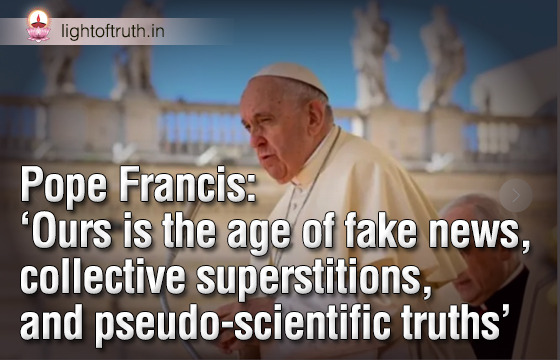
Pope Francis: ‘Ours is the age of fake news, collective superstitions, and pseudo-scientific truths’
Pope Francis said on May 25 that Catholics today are living in an “age of fake news, collective superstitions, and pseudo-scientific truths.”
Reflecting on the Book of Ecclesiastes at his general audience on May 25, the Pope suggested that the 21st century was marked not only by scientific knowledge but also what he called a “cultured witchcraft.”
“It is no coincidence that ours is the age of fake news, collective superstitions, and pseudo-scientific truths,” he said.
Speaking off the cuff, he went on: “It’s curious: in this culture of knowledge, of knowing every-thing, even of the precision of knowledge, a lot of witchcraft has spread, but cultured witch-craft.”
“It is witchcraft with a certain culture but that leads you to a life of superstition: on the one hand, to go forward with intelligence in knowing things down to the roots; on the other hand, the soul that needs something else and takes the path of superstitions, and ends up in witch-craft.”
The pope used the Italian word “stregoneria,” which can be translated as “witchcraft,” “sorcery,” or “black magic.”
The Pope’s live-streamed catechesis was the 11th in a cycle on old age that he began in February. He entered St. Peter’s Square in a white jeep, stopping to invite children in brightly colored clothes to join him for part of his journey among the pilgrims.
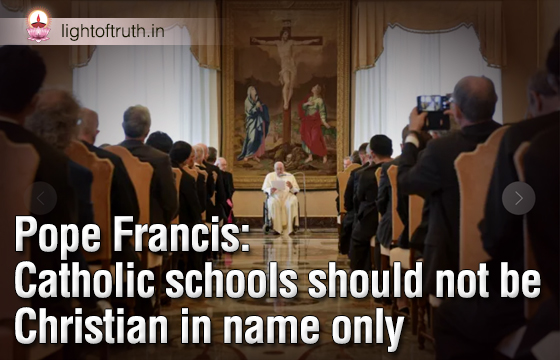
Pope Francis: Catholic schools should not be Christian in name only
Pope Francis said May 21 that Catholic schools should not be Christian in name only, but in fact.
Speaking to the De La Salle Christian Brothers, the Pope underlined that Christians educators must first of all be witnesses to the Gospel.
“The Christian educator, in the school of Christ, is first of all a witness, and he is a teacher to the extent that he is a witness,” Pope Francis said on May 21.
“And above all I pray for you, that you may be brothers not only in name, but in fact. And for your schools to be Christian not in name, but in fact,” he said.
The Pope met with the Christian Brothers as the religious institute is participating in its 46th General Chapter in Rome on the theme: “Building new paths to transform lives.”
“We know that the ‘way,’ the truly new path, is Jesus Christ,” Pope Francis said.
“By following him, by walking with him, our lives are trans-formed, and we in turn become leaven, salt, and light.”
The De La Salle Christian Brothers, formally known as the Institute of the Brothers of the Christian Schools, were founded by St. John Baptist de La Salle to provide Christian education to the young, especially the poor.
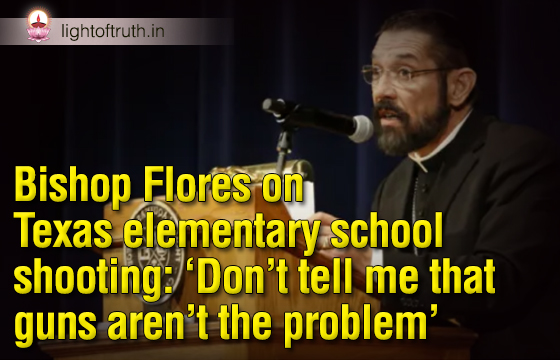
Bishop Flores on Texas elementary school shooting: ‘Don’t tell me that guns aren’t the problem’
Bishop Daniel Flores said on May 25 that he was sick of hearing people say that “guns aren’t the problem” after a gunman killed at least 19 children and two teachers at a Texas elementary school. “We sacralize death’s instruments and then are surprised that death uses them,” the bishop of Brownsville, Texas, wrote on Twitter on May 25, the day after the shooting.
Don’t tell me that guns aren’t the problem, people are. I’m sick of hearing it. The darkness first takes our children who then kill our children, using the guns that are easier to obtain than aspirin. We sacralize death’s instruments and then are surprised that death uses them.
“Don’t tell me that guns aren’t the problem, people are. I’m sick of hearing it. The darkness first takes our children who then kill our children, using the guns that are easier to obtain than aspirin,” Flores said.
It was one of many responses from Catholic bishops around the U.S. after an 18-year-old gunman opened fire at Robb Elementary School in Uvalde, Texas, about 80 miles west of San Antonio. Among the victims were 10-year-old students in the fourth grade.
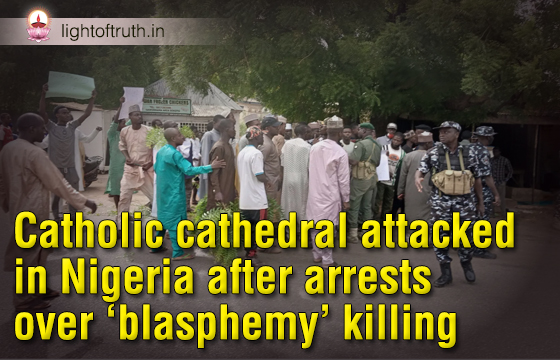
Catholic cathedral attacked in Nigeria after arrests over ‘blasphemy’ killing
A mob has attacked a Catholic cathedral in Nigeria amid protests demanding the release of two suspects in the killing of a Christian student.
The Diocese of Sokoto said in a statement that youths targeted Holy Family Catholic Cathedral in Sokoto, north-west Nigeria, after police arrested two students in connection with the murder of Deborah Samuel.
Samuel, a student at Shehu Shagari College of Education in Sokoto, was beaten and burned on May 11 after being accused of posting “blasphemous” state-ments about Islam in a WhatsApp group.
The Sokoto diocese said: “The Sokoto State Government has declared a 24-hour curfew to help stem the ongoing protests embarked upon by Muslim youth in the state capital today.”
“During the protest, groups of youths led by some adults in the background attacked the Holy Family Catholic Cathedral at Bello Way, destroying church glass windows, those of the Bishop Lawton Secretariat and vandalized a community bus parked within the premises.”
“Saint Kevin’s Catholic Chu-rch, Gidan Dere, Eastern By-pass, was also attacked and partly burnt; windows of the new hospital complex under constru-ction, in the same premises, were shattered.”
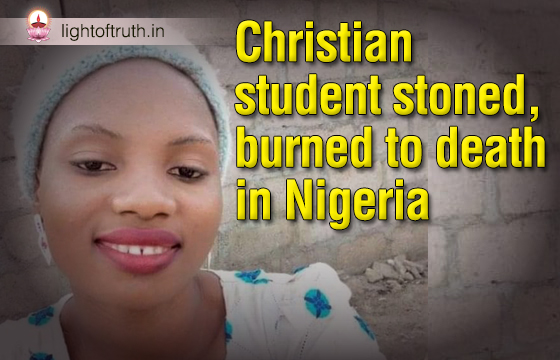
Christian student stoned, burned to death in Nigeria
A Christian student was stoned and then burned in Nigeria for allegedly sending a blasphemous WhatsApp message about Muslim prophet Mohammed during Ramadan. Deborah Yakubu studied at the Shehu Shagari College of Education in Sokoto, northern Nigeria. The college was closed for holidays when the alleged message want. When she returned to class, a group of students was waiting and attacked her, stoning her and then setting fire to her body.