
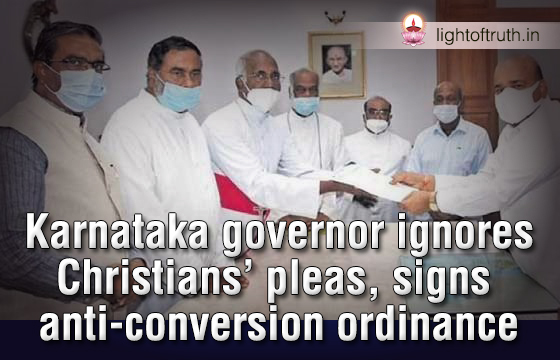
The Karnataka government has passed an ordinance to abolish religious conversions in the southern Indian state ignoring resistance from the Catholic Church and other groups.
Karnataka Governor Thaawar Chand Gehlot ordinance on May 17 signed the ordinance a day after a Catholic delegation headed by Archbishop Peter Machado of Bangalore appealed against the ordinance through a memorandum.
Father Faustine Lobo, the spokesperson of the Regional Bishops Council in Karnataka, said the governor signing the ordinance is a dark day for democracy in the state. “We are really saddened about this ordinance,” he told.
“It is not about conversion or no conversion, it is all about the government ignoring the contributions by the Christian community to the people of Karnataka,” said the priest who called the ordinance a “back door enactment.”
Father Lobo said a delegation of Catholic bishops had submitted a memorandum signed by Abp Machado to the governor on May 16 and “he had promised to study the ordinance before considering it for signing.”
“But he signed it today,” lamented Father Lobo who addressed a group of journalists on the matter.
The Karnataka governor gave his assent to the ordinance on the controversial Karnataka Protection of Right to Freedom of Religion Bill, 2021, popularly known as the anti-conversion bill.
With the governor’s approval, the ruling Bharatiya Janata Party is expected not to waste time to implement the bill which proposes stringent measures on religious conversion activities.
The bill was passed by the state legislative assembly but it was yet to be presented in the legislative council, where the ruling party is one seat short of majority. It is in this context, the government decided to go ahead with the ordinance.
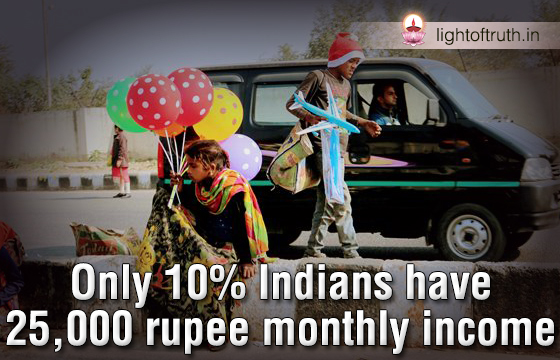
Only 10% Indians have 25,000 rupee monthly income
The latest State of Inequality in India Report indicates a vast income distribution disparity in the country.
The report prepared by Economic Advisory Council to the prime minister shows the need to address gaps to help the country achieve social progress and shared prosperity.
India has proved the overall condition of households, with access to necessities and adequate water supply and sanitation. However, the measures for in-come parity, poverty, and employment needs to be improved significantly, the report adds.
Top 1% of India’s population accounts for 5-7% of the national income whereas 15% of the country’s working population earns less than 5,000 rupees a month.
Those earning an average of 25,000 rupees a month fall into the top 10% of the total wages earned bracket, which accounts for about 30-35% the total income.
In another revelation on the inequality in India, the income of the top 1% shows a growing trend while that of the bottom 10% is shrinking.
According to the National Family and Health Survey (NFHS) 2015-2016 data, there is a huge gap in household wealth between rural and urban spaces.
Notably, more than 50% of the households fall in the bottom proportion of wealth concentration (about 54.9%).
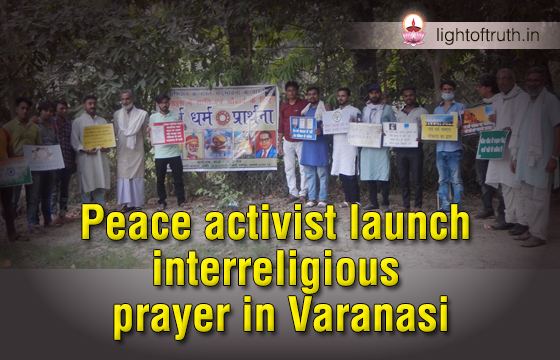
Peace activist launch interreligious prayer in Varanasi
Peace activists from various religions have launched a series of interreligious prayer services at different parts of Varanasi as sectarian tension over the Gyan Vapi mosque controversy gripped Hinduism’s most sacred city.
“These prayers are taken from ten different religious sources namely Hindu, Tao, Jewish, Zoroastrian, Jain, Buddhist, Christian and Muslim faith tra-ditions. They were sung regularly by Mahatma Gandhi in his ashrams along with his disciples and satyagrahis,” Father Anand Mathew, a cultural activist in Varanasi, told on May 23.
The Indian Missionary Society priest further said they use the Hindi version of those hymns translated by renowned Gandhian Narayan Desai. Father Mathew also distributed among the public those songs printed in a pocket size booklet
The prayer campaign was first launched May 20 in the cam-pus of Benares Hindu University on, with students who support peace, secularism and dialogue as participants. Later prayer meetings were also held in Maidagin and Shaheed Udyan Sigra.
Jagriti Rahi, a Gandhian who attended the prayer meetings, says common people of Varanasi do not want any more riots and curfews. The entire city now debates whether a stone found in the pool of ablutions in the mosque premise is a shivling (the phallic image of Lord Shiva) or an abandoned fountain.
She recalled the experiencing the pain from the wounds of riots immediately after the Babri Masjid violence and the consequent month-long curfew three decades ago.
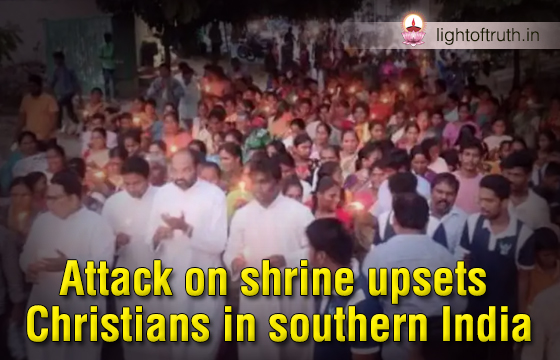
Attack on shrine upsets Christians in southern India
Unidentified vandals destroy-ed statues of Mother Mary, Infant Jesus and the Sacred Heart of Jesus at a hill shrine in the southern Indian state of Andhra Pradesh causing shock among the local Catholics. The incident happened on the intervening night of May 14 and 15. “We came to know about it through some Catholics who had been there early morning,” said Father Bala Subash Chandra Bose who is in charge of the shrine.
The newly constructed shrine complex at Edlapadu in the Guntur district was being readied for an inauguration, Father Bose told on May 18.
“Christians here are in a state of shock and disbelief,” the Guntur diocesan priest said. “We organized a protest march on May 15 evening to press for speedy investigations.”
However, three days after no one had been arrested and the priest said a peace march had been planned on the morning of May 19 to be followed by another protest march on May 22.
The shrine had become an unlikely religious flashpoint in 2021 with the pro-Hindu Bharatiya Janata Party (BJP) claiming it was being illegally erected at a spot where a carving of the Hindu deity Narasimha and footprints of Sita Maa (the wife of Hindu god Ram) existed originally. The claim made by Sunil Deodhar, BJP’s national secretary in charge of Andhra Pradesh, on Twitter was debunked by the Guntur district police, which also issued a video showing how the Catholic shrine and the Hindu deity existed on “two different hillocks” located around half a kilometer away from each other.
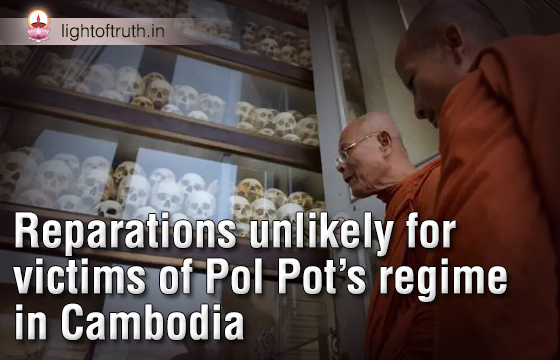
Reparations unlikely for victims of Pol Pot’s regime in Cambodia
Hopes of financial compensation for survivors of Pol Pot’s brutal regime that ruled Cambodia with an iron fist between 1975 and early 1979 are becoming less likely as the Khmer Rouge Tribunal continues to wind down.
The Extraordinary Chambers in the Courts of Cambodia (ECCC), which was sworn in 16 years ago and charged with prosecuting senior leaders of the regime for unleashing one of the worst mass killings in the 20th century, could secure only three guilty verdicts for crimes against humanity and genocide.
“Compensation could only work with a complete acknowledgement of responsibility,” said Ou Virak, president of the Phnom Penhbased Future Forum think tank. “There are far too many people who remained in power and too many powerful countries that need to be held accountable.”
Since the tribunal was only responsible for pursuing crimes inside Cambodia during the four-year regime, it meant China, which backed Pol Pot, and America’s involvement in the Indochina wars were not a consideration amid the mountains of evidence.
Instead, genocide museums, memorials, stupas and education programs will make up the legacy to be left behind by the ECCC. “Global investment in genocide museums here in Cambodia, potentially funded by countries who want to salvage their souls, could be a good starting point,” said Ou Virak.
Most senior leaders of the Khmer Rouge died violently or behind bars, either awaiting their trial or following their conviction. Only Khieu Samphan, the former head of state, remains alive and in jail awaiting his appeal for a genocide conviction. If that is over-turned, he will remain behind bars for a previous conviction and his role in the deaths of around two million people, more than quarter of Cambodia’s population.
“They seek to provide judicial recognition to victims of the Khmer Rouge, assist survivors to restore their dignity, heal trauma and injuries suffered by victims, and preserve their collective memories”
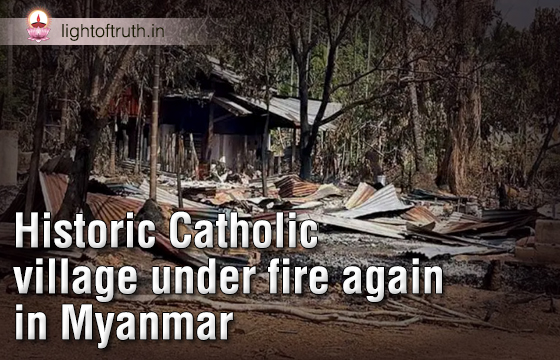
Historic Catholic village under fire again in Myanmar
The Myanmar military has continued to target a historic Catholic village in the country’s Bamar heartland while pressing ahead with attacks on religious buildings in predominantly Christian regions. At least 320 out of the estimated 350 households were burned down during a military raid on Chaung Yoe village in the Sagaing region on May 20, according to local sources.
Thousands of Catholic villagers were forced to flee their homes to nearby safe areas as junta troops set fire to one house after another. Houses in three nearby Buddhist villages were also set ablaze during the military raid on the same day.
Sources said Mary Help of Christians Church, convent and the priest’s house were not damaged. The latest attack came just four days before the annual celebration of Mary Help of Christians on May 24.
“We have no homes and no property. Where will we stay in the village when we return if the situation is deemed safe?”
“It’s so sad. I was in tears when I saw smoke coming out from my village as my house was also burned down,” said a Catholic woman who sought safety among her relatives in a nearby town.
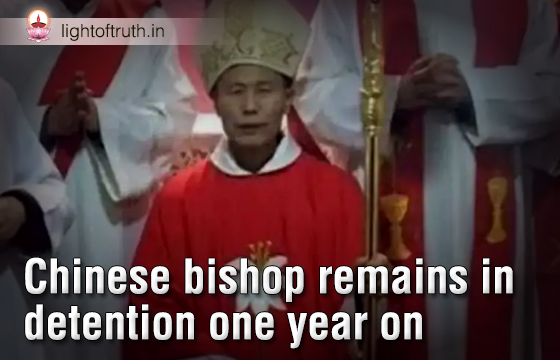
Chinese bishop remains in detention one year on
A Vatican-approved Chinese bishop remains in detention more than one year after his arrest for allegedly violating the communist country’s repressive regulations on religious affairs.
Bishop Joseph Zhang Weizhu of Xinxiang in Henan province was arrested on May 21 last year.
His arrest came a day after police arrested 10 priests and an unknown number of seminarians from a Catholic seminary in the diocese that was set up in an abandoned factory building.
About a year ago, authorities in Xinxiang shut down Catholic schools and kindergartens in line with a government ban on education by religious groups.
All those arrested were accused of violating China’s regulations on religious affairs and subjected to “political lessons” in detention, media re-ports said
The priests and seminarians were released after brief detention but remain under surveillance, while the seminary is still closed.
Since his secret ordination with a Vatican mandate in 1991, Bishop Zhang was under constant pressure and barred from carrying out his duties as Bishop.
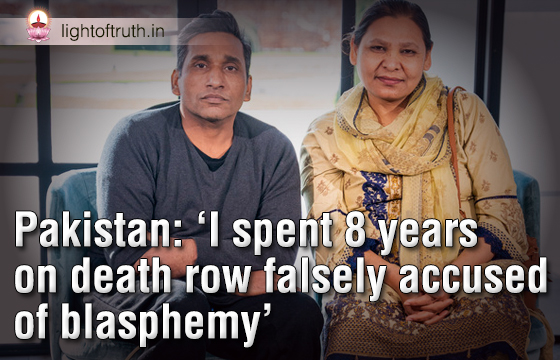
Pakistan: ‘I spent 8 years on death row falsely accused of blasphemy’
In July 2013, Shagufta and Shafqat Emmanuel, a Catholic couple in Mian Channu, a small town 155 miles south of Lahore, Pakistan, were arrested on false charges of blasphemy. After eight years on death row, separated from each other and from their four children, they were finally released on 3 June 2021 by the Lahore High Court. Free at last, Shagufta shares her story with ACN, in her own words.
“I was born into a family with a strong Christian faith. I regularly attended Mass and received Communion, and I was always very eager to go to the catechism and recite the rosary. My father and my mother taught me and my six brothers and sisters to be strong in our faith, and to be ready for all kinds of sacrifices or persecutions.
“Most families in our village were Muslim, but there was also a good number of Christians. We had very cordial relations with Muslims. I remember playing with Muslim girls and we visited each other’s homes and exchanged greetings and sweets during Christmas and Eid al-Fitr. My brothers also had very good Muslim friends. I do not remember any fight or dispute in the name of religion.
“A few years after marrying Shafqat Emmanuel we moved to Gojra, and my husband got a job there. Tragically he was paralysed by a stray bullet, while trying to break up a fight, about 12 years ago. Life was hard after that, but we were fortunate to get jobs at St John’s High School, in Gojra. After school hours, my husband used to repair cell phones, to make some extra money for family expenses.
“Then, one day in July 2013, we were terrified to see several police vans pull up, with dozens of officers. They raided our house and arrested my husband and I on charges of blasphemy in the form of an offensive message about Mohammed, sent via our mobile SIM card. The phone was registered in my name and was used by my husband as well. The offending message was written in English, a language neither my husband nor I speak or read. We were kept in police custody for one night; the next day we were transferred to jail.
“In jail, we were tortured. The officers told my husband that if he did not confess, they would rape me in front of him, and so he confessed, even though we were both innocent.
“We were in jail for eight months before a judge found us guilty and sentenced us to death. Our lawyer was not allowed to complete his closing arguments, and neither of us was heard.”
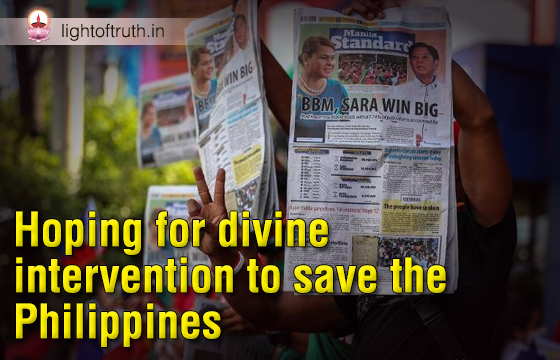
Hoping for divine intervention to save the Philippines
It has been five decades since the late Philippine dictator Ferdinand Marcos imposed martial law on Sept. 21, 1972. In this 50th year since the iron fist of repression was imposed, his son, Ferdinand “Bongbong” Marcos Jr., will soon be the country’s head of state. Sara Duterte, daughter of outgoing president Rodrigo Duterte, will serve as vice president.
Those who voted for them are rejoicing over the impending return of the so-called golden age, a mythical period of national prosperity, peace and order boastfully dubbed the “Bagong Lipunan” or “New Society.”
When I asked some of them why they were voting for Marcos and Duterte, they could not give clear answers. We can only hope against hope that they can answer this question honestly without being haunted by a not-so-erroneous conscience.
The apathetic others call on their fellow Filipinos to move on. Whatever the meaning of this call, they do not clearly comprehend it, sorry to say.
They can only heave a sigh of regret for their failure to combat the glaring impunity seen in the absence of punishment of human rights violators who roam free and enjoy positions of power.
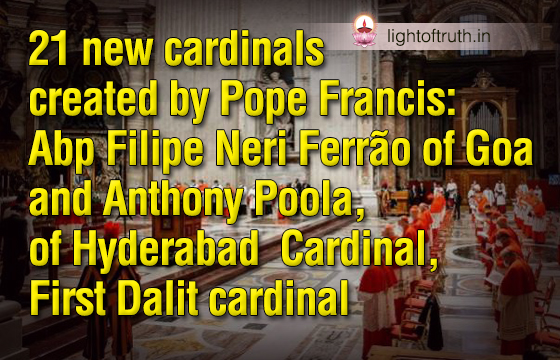
21 new cardinals created by Pope Francis: Abp Filipe Neri Ferrão of Goa and Anthony Poola, of Hyderabad Cardinals, First Dalit cardinal
There will be 16 cardinals under the age of 80 elevated at the next consistory, to be held Aug. 27. This will be the eighth consistory of Pope Francis’ pontificate, and the first of his to be held in August.
The last time a cardinal was made in August, a torrid month in Rome when all things slow down in the Vatican Curia, was on Aug. 24, 1807 when Pius VII created Francesco Guidobono Cavalchini a cardinal “in pectore”, announcing his name only in April 1808.
With these new cardinals, Pope Francis will have created 122. There are three members of the Curia: The cardinals are:
— Cardinal Jean-Marc Noël Aveline, 63, Archbishop of Marseille, who will become the first French diocesan bishop to get the honor during Pope Francis’ pontificate;
— Peter Ebere Okpaleke, 59, Bishop of Ekwulobia in the central region of Nigeria, who was created bishop in 2012 by Benedict XVI;
— Leonardo Ullrich, 77, Archbishop of Manaus, in Brazil’s Amazon region, a Franciscan who played a leading role during the Amazon Synod and the current Vice President of the recently created Amazonian Bishops’ Conference;
— Filipe Neri António Sebastião do Rosário Ferrão, 69, Archbishop of Goa, appointed bishop by St. John Paul II in 1993 and currently the President of Latin-rite bishops of India;
— Robert McElroy, 68, Bishop of San Diego (United States), whose diocese is suffragan to the Archdiocese of Los Angeles, led by the President of the USCCB, Archbishop José Gomez;
— Virgilio do Carmo Da Silva, 68, a Salesian, Archbishop of Dili (East Timor);
— Oscar Cantoni, 71, Bishop of Como (Italy), appointed in January 2005 by St. John Paul II, who is suffragan to Milan;
— Anthony Poola, 60, Archbishop of Hyderabad (India), a bishop since 2008 and the first dalit to become a cardinal;
— Paulo Cezar Costa, 54, Archbishop of Brasilia (Brazil), the fourth archbishop of the Brazilian capital to become a cardinal;
— Richard Kuuia Baawobr, 62, Bishop of Wa (Ghana), former Superior General of the White Fathers, and bishop since 2016;
— William Goh Seng Chye, 62, Arch-bishop of Singapore since 2013; — Adalberto Martinez Flores, 70, Archbishop of Asunción (Paraguay) and the first Paraguayan cardinal;
— Giorgio Marengo, 47, Italian Missionary of the Consolata and Apostolic Prefect of Ulan Bator in Mongolia, who will be the youngest cardinal in recent history, along with Karol Wojtyla, who also was created a cardinal at 47, during the consistory of June 26, 1967.