- Benny Nalkara, CMI
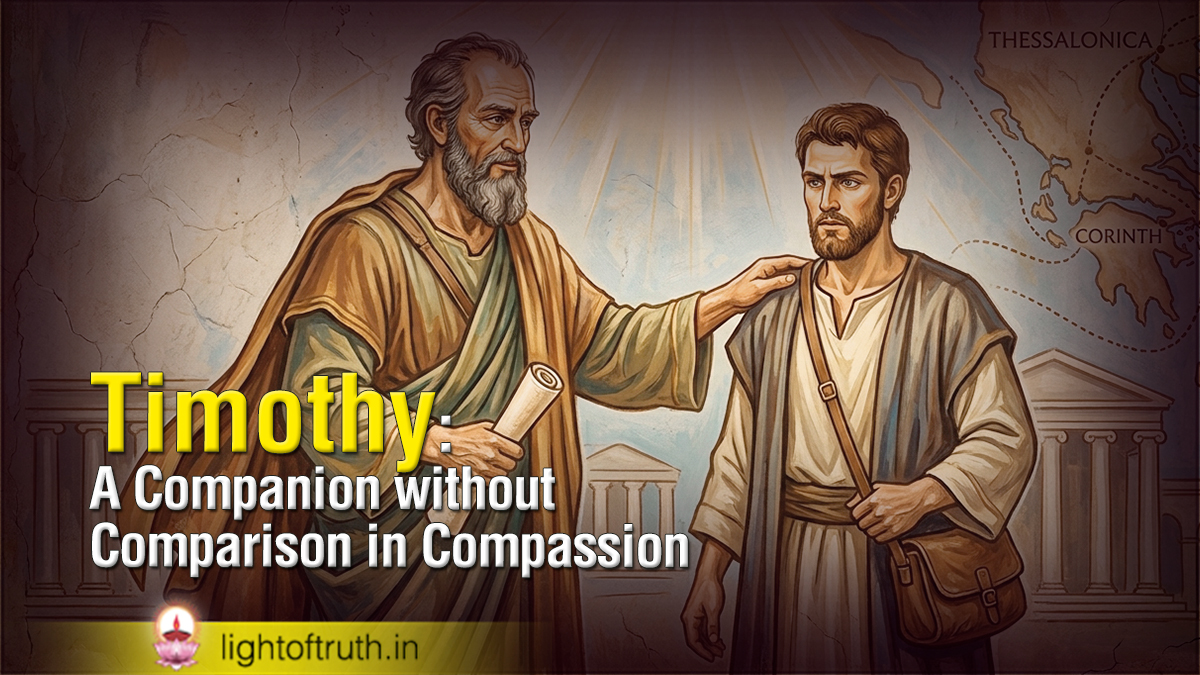
Paul’s testimonies on Timothy that “I have no one like him, who will be genuinely concerned for your welfare,” (Phil 2:20) and “he served with me like a son with a father (Phil 2:22),” reveals the genuineness and commitment of Timothy in the apostolic ministry and the high regard Paul had for him. Timothy is mentioned 24 times across 11 different Pauline epistles, making him the most frequently named companion in the Apostle Paul’s letters. He appears as a co-sender of multiple letters, a trusted emissary sent to resolve Church conflicts, and the specific recipient of two Pastoral Epistles.
Timothy is explicitly named alongside Paul in the opening salutations of six canonical letters, signalling his high authority and close alignment with Paul’s ministry: 2 Corinthians 1:1: named as “Timothy our brother” co-addressing the Corinthian church.Philippians 1:1: Co-sender where both are introduced as “servants of Christ Jesus.” Colossians 1:1: listed jointly with Paul at the beginning of the letter.1 Thessalonians 1:1: Included in the greeting along with Silvanus (Silas).2 Thessalonians 1:1: Again listed alongside Paul and Silvanus to the Thessalonian Church. Philemon 1:1: joined with Paul to address Philemon and the house church.
Paul frequently writes to Churches regarding Timothy’s impending arrivals, praising his character and urging congregations to respect his authority. 1 Corinthians 4:17: Paul sends Timothy to Corinth to remind them of “my ways in Christ,” calling him his “beloved and faithful child in the Lord.” In 1 Corinthians 16:10-11: Paul instructs the Corinthians to put Timothy at ease if he arrives, noting “he is doing the work of the Lord, as I am.” In 1 Thessalonians 3:2-6: Paul highlights sending Timothy to strengthen and encourage the Thessalonians in their faith during afflictions, and notes Timothy’s comforting report back. In Romans 16:21: included in the final greetings of Romans, where Paul explicitly refers to Timothy as “my fellow worker.”
In Philippians 2:19–22, St. Paul presents Timothy as an exemplary Christian leader whose life and ministry provide a model for all who serve the Church. Timothy is beyond comparison in compassion. Rather than highlighting extraordinary abilities, Paul emphasizes qualities of character, commitment, and service that every Christian leader should cultivate. Timothy was available for God’s mission. Although circumstances had previously required him to remain with Paul, he was ready to serve wherever he was needed. Paul also commends Timothy for his sincerity. He genuinely cared for the welfare of the Philippian believers, free from pretense or hypocrisy. His concern for others flowed from an authentic heart rather than from personal ambition. Effective leadership requires not only willingness but also availability to respond to God’s call at the right time. Timothy was an encouraging presence. His ministry strengthened and uplifted both Paul and the Christian communities. A true leader inspires hope, joy, and perseverance rather than discouragement or negativity.
Timothy was like-minded with Paul, sharing the same vision, values, and commitment to the Gospel. This unity of purpose enabled them to work effectively together. Successful ministry depends not only on competence but also on a shared mission and common spiritual outlook.
Closely related to this was Timothy’s deep pastoral care. He regarded ministry not as a position or profession but as a vocation of loving service. His concern extended beyond himself to the spiritual well-being of God’s people. Another distinguishing quality was his unselfishness. Unlike those who sought their own interests, Timothy consistently placed the interests of Christ and the Church above personal comfort or recognition. His servant leadership reflected Christ’s own self-emptying love. His decisions, priorities, and ministry were guided by the interests of Jesus Christ rather than by personal gain.
Paul further points to Timothy’s proven character. His faithfulness had been tested through hardships, challenges, and years of ministry alongside Paul. Genuine leadership is not demonstrated merely by talent but by steadfastness under trial and perseverance over time. Timothy exemplified a willingness to be mentored. Like a son learning from his father, he served alongside Paul, receiving practical formation through close companionship and shared ministry.
Timothy’s leadership was marked by availability, encouragement, unity of purpose, sincerity, pastoral concern, selflessness, Christ-centeredness, proven character, and openness to mentorship. These qualities made him not only an effective co-worker of Paul but also a timeless model of pastoral ministry and Christian leadership for the Church in every age. Today’s world is in urgent need of pastors like Timothy, who combine genuine compassion with an unwavering commitment to the mission of the Gospel.