
St. Paul concludes the Letter to the Ephesians with the exhortation: “Be strong in the Lord and in the strength of his power” (Eph 6:10). The letter reveals God’s plan to unite all things in Christ (Eph 1:9–10) and create a new humanity through his death and resurrection (Eph 2:13–16). Chapters 4–6 translate this vision into daily life, urging Christians to preserve unity, speak truth, forgive, walk in love, and fulfil their responsibilities. Ephesians 6:10–17 culminates in the image of spiritual warfare, shifting from relational household codes (husbands and wives, masters and slaves) to a metaphor of cosmic spiritual warfare.
In the ancient world, evil spirits were believed to threaten humanity and oppose God. Paul refers to these forces as “powers,” “authorities,” and “world-rulers.” As Ephesians is traditionally considered a captivity letter, Paul may have drawn inspiration from the armour of a Roman soldier guarding him. This familiar military imagery becomes a powerful metaphor for Christian readiness, protection, and perseverance. Paul takes this familiar military imagery of the armour of the Roman soldier part by part and translates it into Christian terms.
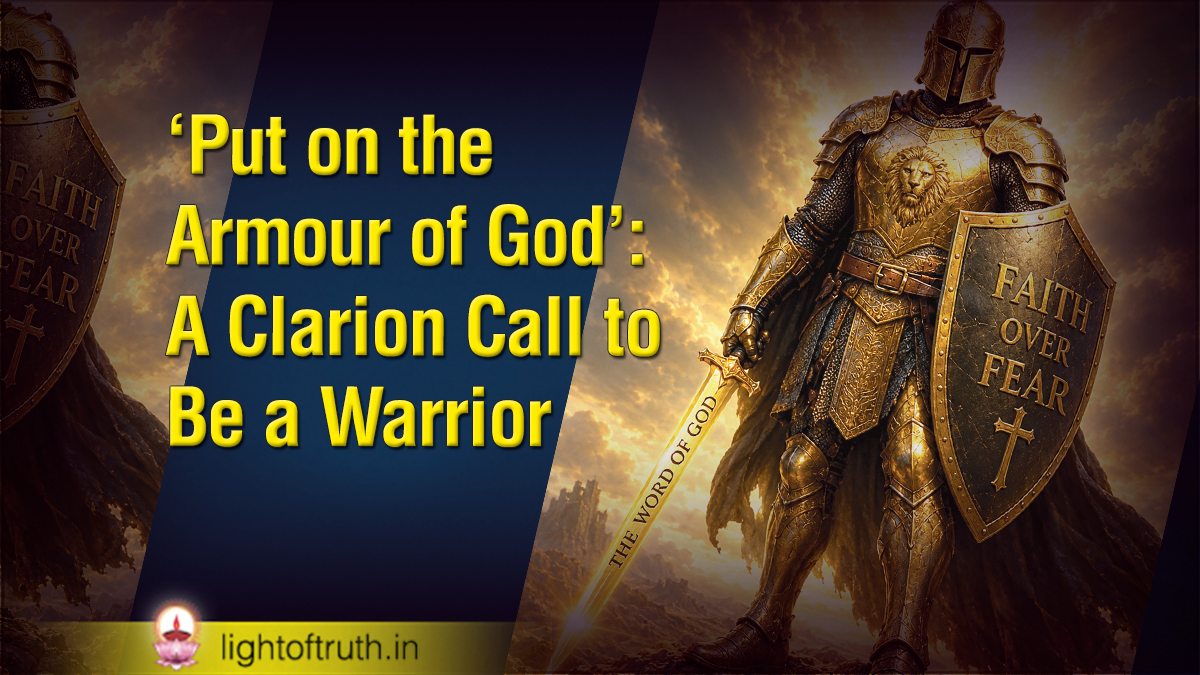
Paul starts with the call to “be strong in the Lord and in the strength of his power” (6:10). The Greek expression ‘endynamousthe en kyrio’ conveys the idea of being strengthened in the Lord. The emphasis is not on self-confidence, personal achievement, or natural ability, but on the power that comes from union with Christ. He urges the believers to “put on the whole armour of God, so that you may be able to stand against the wiles of the devil.” The expression ‘panoplia tou Theou’ means the complete armour or full equipment of God. Paul emphasizes the word “whole”: spiritual life requires an integrated commitment rather than occasional religious enthusiasm. The verb “put on” suggests deliberate action. The believers must consciously embrace the attitudes and practices that enable them to live faithfully. Three times Paul emphasizes the posture of “standing” (v. 13–14), a defensive, holding posture, withstand, stand firm, and stand therefore. In Roman warfare imagery, the ground has already been won by Christ (Eph 1:20–23 and 2:6); the believer’s role is not to attack territory frantically, but to hold the ground Christ secured.
The primary emphasis in verses 11–14 is on resisting and withstanding evil rather than attacking human opponent. There is the belt of truth. It was the belt which girt in the soldier’s tunic and from which his sword hung and which gave him freedom of movement. The Christian moves freely and quickly because he knows the truth. The Belt of Truth denotes integrity, reality, and alignment with God’s truth versus deception. There is the breastplate of righteousness. When a man is clothed in righteousness he is impregnable. Righteousness is the only way to resist accusations. There are the sandals of the Gospel of Peace (v. 15) which denotes the readiness and firm footing provided by the reconciliation found in the Gospel. There is the shield. The word Paul uses is for the great oblong shield which the heavily armed warrior wore. One of the most dangerous weapons in ancient warfare was the fiery dart. It was a dart tipped with tow dipped in pitch. The pitch-soaked tow was set alight and the dart was thrown. The great oblong shield was made of two sections of wood, glued together. When the shield was presented to the dart, the dart sank into the wood and the flame was put out. Faith can deal with the darts of temptation. With Paul, faith is always complete trust in Christ. When we walk close with Christ, we are safe from temptation. There is salvation for a helmet. It reminds us of the preservation and ultimate hope of deliverance guarding the mind to conquer sin in the days to come. There is the sword; and the sword is the Word of God. We can never win God’s battles without God’s words.
Finally, Paul speaks of the greatest weapon of all: prayer. Three things he says about prayer. (a) It must be constant, (b) It must be intense, Prayer demands the concentration of every faculty upon God, (c) It must be unselfish. The Jews had a saying, “Let a man unite himself with the community in his prayers”. Often, we pray more for ourselves than for others. We must learn to pray as much for and with others as we do for ourselves.
The passage is not an invitation to fear the devil or to view other people as enemies. Rather, it reminds Christians that the struggle for a faithful life involves forces and influences that oppose God’s truth, justice, love, and holiness. The Christian life is a spiritual struggle that requires not merely human strength, but the power of God. The armour of God symbolizes the spiritual dispositions, virtues, and divine gifts that enable believers to stand firm in faith, resist evil, and remain faithful to the Gospel. It offers a profound spirituality of perseverance. It teaches us how to remain faithful when confronted by temptation, discouragement, injustice, division, falsehood, and the challenges of contemporary life.




Leave a Comment