
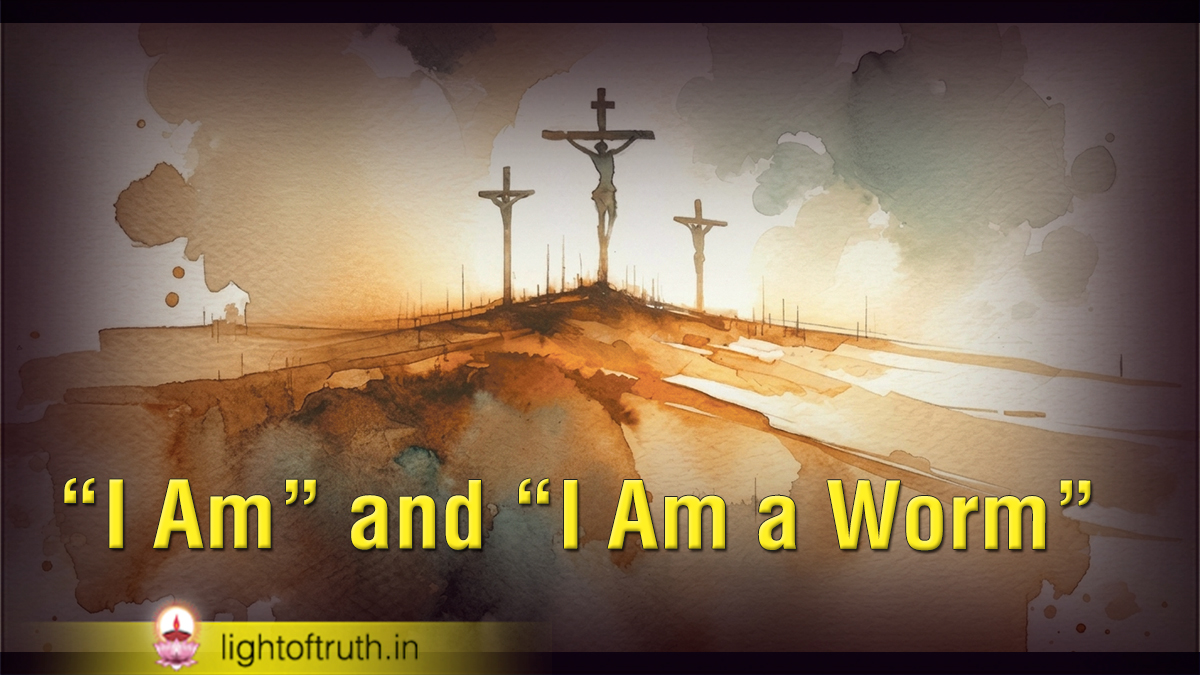
Cicero, the Roman orator and senator considered crucifixion as exceptionally cruel and disgusting punishment, and maintained that “the very mention of the cross should be far removed not only from a Roman citizen’s body, but also from his mind, his eyes, his ears.” However, this heinous form of punishment was not invented by the Romans. The Romans probably adopted it only in the 2nd or 3rd century B.C. This means, Psalm 22 had prophesied about the crucifixion of the messiah even before Roman started practicing it!
The pertinent text under consideration is Psalm 22: 16 (22:17 in some numbering systems): “they pierced my hands and feet.” The Christian tradition has consistently interpreted it as a prophecy about the crucifixion of Jesus. Although the bodies of the criminals were attached to the cross by driving the nails also on the groins; the most common form was to pierce it through the wrists of the hands and heels of the feet. The Christian interpretation of this verse is not, however, unquestionable. The Psalm was originally written in Hebrew and was written without vowels. The consonants used were k a r. When Jewish scholars decided to add vowels to the consonants, they vocalized this word as kaari meaning “like a lion.” According to this translation, Psalm 22:16 would read, “like a lion, my hands and feet.” Obviously, this sentence has no verb, so the reader must supply the intended meaning. But the Jewish translators of the Septuagint, the Greek translation of the Hebrew Bible produced some three centuries before Christ, opted for another Hebrew punctuation – kaaru – and translated their Greek text to mean, “They pierced.” Then this verse reads: “They have pierced my hands and feet,” establishing a clear parallel with the crucifixion. Later, as Christianity evolved, they adopted the Septuagint translation.
The parallels between Psalm 22 and the death of Jesus are so striking that some wonder whether the evangelists narrated Jesus’ death on the cross in the light of Psalm 22. For example, the evangelist might have placed verse 1 of Psalm 22 on Jesus’ lips to make him resemble the Psalmist or inserted the account of the soldiers dividing Jesus’ garments to make the crucifixion scene resemble Psalm 22:18 “They divide my garments among them.” Rather than assuming that the evangelists simply invented such details, it is more appropriate to say that they interpreted the death of Jesus through the Sacred Scriptures of Israel. The relationship between the Psalmist’s suffering and the experience of the crucified Jesus is uniquely profound and parallel.
The Psalmist laments, “But I am a worm and not a man” (22:6)! Although Jesus does not utter these words on the cross, Christians can see in the crucified Christ the extreme humiliation expressed through this image of a worm, a creature without bones: he is beaten, stripped, mocked, helpless, despised, and reduced to the lowest condition in the eyes of the world. Paul says that Jesus emptied himself, taking the form of a slave. The Psalmist portrays him as a worm. In the Gospel of John, Jesus says: “I am” (Jn 6: 20). In the Old Testament, Yahweh reveals himself as, “I am who I am” (Exodus 3: 14). Thus, when Jesus responds to his disciples with words “I am”, it is a claim to his divinity. He presents himself as the bearer of the divine name. This “I am” now becomes “I am a worm.” This is a powerful illustration of the extreme humiliation to which the Son of God submitted when he emptied himself.
In the midst of his immense sufferings, however, the Psalmist does not waver in his conviction about God. His undeserved suffering does not lead him to regard God as capricious or powerless in the face of human brutality. Instead, he addresses God as holy and enthroned! (V.3). He finds comfort in remembering that his forefathers also had similar miseries, but God delivered them when they cried out to him. In his own case, he remembers that God cared for him even before he began praying, watching over him in his mother’s womb and providing for when he was still nursing. The Psalm ends with praising God not because his afflictions are over but he is sure of his deliverance.
The author of the Psalm offers us a model of prayer. It includes the honest outpouring of one’s feelings and emotions, combines complains with hopeful petitions and it ends with divine praises arising from deep confidence in God’s deliverance.






Leave a Comment