
Catholic Sisters Help Children Living with HIV Build a Better Future
Faith Brings New Hope to Assam Village Once Known for Alcoholism
Cardinal Tagle: Friendship reveals the face of Jesus and the Church
Israel prepares ‘extensive’ West Bank operation after deadly shooting near Tal
Pope: Visit to Türkiye and Lebanon teaches that peace is possible
Thousands protest corruption in Philippines as Church leaders call for accountability
Pope: Nicaea invites Christians to unity in face of violence, conflict
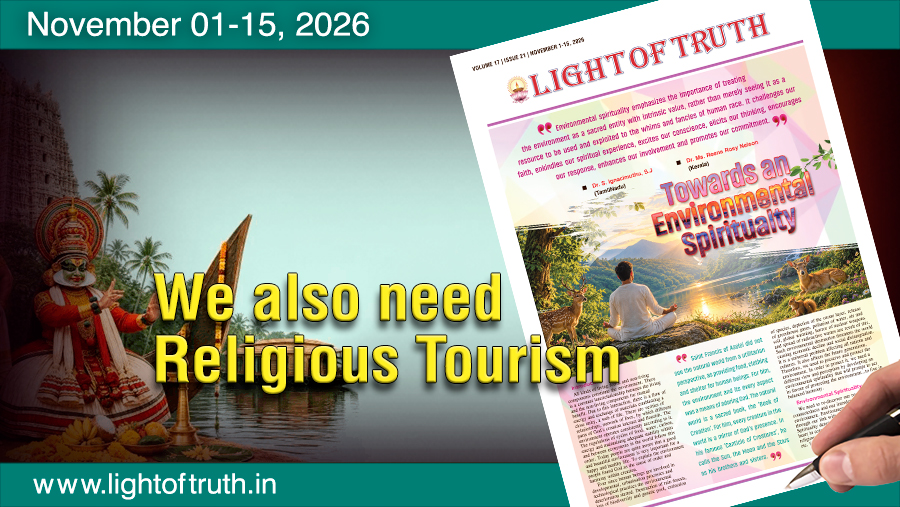
Technological advances, sustainability requirements, climate anxieties, and rapidly changing traveller expectations are fundamentally reshaping the future of travel and tourism. Growing environmental awareness, sophistications of daily life, traditional religious bindings and customs and also the need for leisure, company, and being together with family members seek a way out once in a month or in the weekends or at least on holidays according to the possibility. Understanding these factors and also the transforming life situations, changing outlook on faith and religion, cultural swings and globalization calls for an ongoing transformation in the pattern of life conventions. Concepts and attitudes on organized religions are also changing very fast. Old traditional practises and conventional rituals and rites are also giving way to more comfortable peaceful aptitudes and functions.
These facts and emerging new trends brings forward contemporary research exploring the trends, transformations, and opportunities shaping the future of ever moving and changing human nature especially in the matters of lifestyle and religious practises. Thus new range of themes, methods and perspectives are coming in in the whole life situations, religious and cultural practises. This calls for a new thinking and shift of emphasis in the religious life and practises of the society. For a long time and still now in certain countries and places religion and its practises are centred on the temple, mosque and the church. The community practises their religion in and around it extending to the societies and families. For the Christian and especially the catholic communities there are set patterned structures to practise their religion.
For every religion there are pilgrim centres, holy places where people huddle together for worship, rituals and rites. At present the societal trend is changing especially in the case of organized religions. This new trend leads the society to retrieve to religious tourism one of the earliest forms of tourisms. Religious tourism has taken place since the dawn of civilisation. Pilgrims travelled to pay homage to the sacred places and their guardians throughout the world. Tourism to sacred sites has merged with pilgrimage. In the past two thousand years and, more recently, in the past two hundred years wealthy people visited special sites of sacred ritual in different short distant and far distant places. Sites of religious significance have existed since biblical times and pilgrimage in the Judeo-Christian context is mentioned in the Bible itself. The story of Elkanah who travels annually to Shiloh to worship and sacrifice (1 Samuel 1:1-28) and in the New Testament Pentecost story where Jews from all over the world had come to Jerusalem for the Passover (Acts 2: 1-12). During the time of Solomon the king all Jews from other countries were expected to visit Jerusalem for Passover and the feast of unleavened bread.
In the case of Catholics, people frequenting churches are becoming less and less. They also are reluctant to be under the set patterns of institution or organization. This does not mean that they are agnostics or non-believers. They may frequent it when they feel like it or when they have time. Not frequenting the parish church and not becoming part of the institution does not mean that they are away from the Church. Since this phenomenon is seen in the European Church they are introducing spiritual tourism… It is not pilgrimage. Pilgrimage means people frequenting the holy places with a definite purpose or intention with some prescribed rites and rituals. Of course the pilgrim centres also can be apt places of spiritual tourism. For Lourdes, Fatima, Santa Rita of Cassia, San Giovanni Rotondo, Assisi, Vatican, Holy land, Santiago di campostella, Divino Amore are both pilgrim centres and also places of spiritual tourism.
In spiritual tourism people visits places not with a special purpose or intention but it is a travel for leisure and freedom where they can spend a whole day.They visit these places once a month or on weekends, either individually, with family, or in groups. There, they will have places for amusement, leisure, good food, places for play and jock for children, places for silence, nature friendly ambience, facility for Holy mass, confession, prayer, the possibility for counselling and spiritual consultation, centres of information, if possible some super malls for purchasing. This could be formed in every country according to the religious, cultural, historical importance. In India, especially in Keralam spiritual or religious tourism has immense possibilities. There are ancient traditions, Christian communities, different liturgical rites like Malankara, Syro-Malabar, Roman, different churches like catholic, Orthodox, Jacobite, Marthomma, CSI, and CNI. There are backwaters and natural beauty, hills and valleys. Most of the churches are either in the river banks or lake sides. If a network system is introduced and if different denominations come together they can very easily plan for the religious tourism routs including historical, cultural and devotional places with all the amenities and facilities. These will facilitate interactions, mutual knowledge, and the process of ecumenism.



Leave a Comment