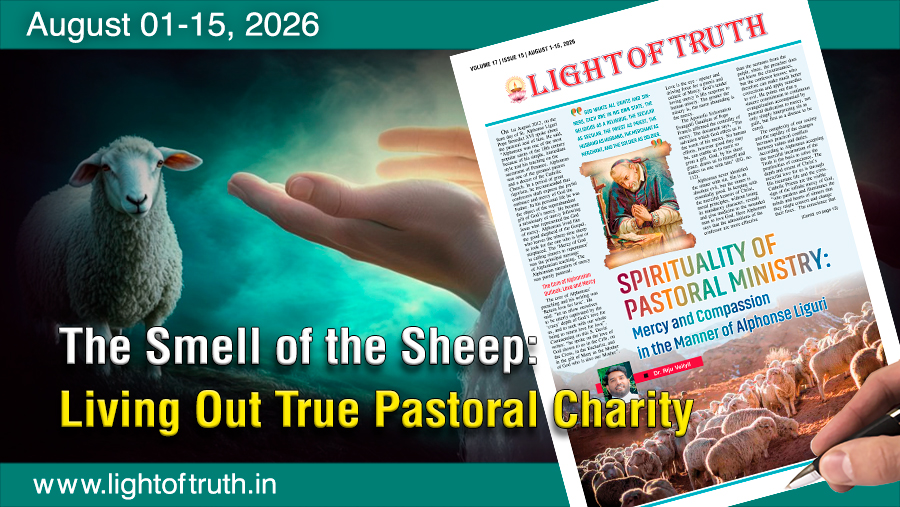
August 1 is the memorial day of St. Alphonsus Liguri a benevolent, compassionate pastor and Doctor of the Church lived in a time of rigidity in the matters of faith and morals. His pastoral attitudes revealed the compassionate, merciful nature of God. He was a man of Pastoral charity. A re – thinking of Alphonsus’ pastoral attitude is relevant in the present world with Social media revolution, technological developments and Artificial Intelligence. Structural renewal of parish matters, convents, priests group, women religious congregations are on move… The educational and healthcare institutions are running smart… however, even in the midst of all these positive factors there is a pastoral lag or low-spirited outlook is hovering over the parish communities and all over.
The earliest examples of Christian art we have, are wall paintings found in the catacombs of Rome where the figure of a young man with a lamb on his shoulders and feeding lambs at his side – the image of the Good Shepherd which we get, Jesus ascribe to himself in the Gospel. He dedicated his whole life for the mission and for the people. From the writings of St. Paul it is evident that, he was the one who dedicated himself for the people. Pope Francis pointing out the priest of the Catholic Church said “the shepherds must be persons with the smell of the sheep”.
From the good shepherd figure of Jesus all those who are entrusted to the care of Christian community received the name shepherd. ‘Pastoral Charity’ could be considered as a theological and also a technical term used to reveal the content or effort of the ministry genuinely met. In the religious context, ministries generally refer to the specific roles or ‘spiritual gifts’ used to serve a flock or a community. This service can be categorized according to the areas in which a genuine pastor enters. These areas are: Worship based: including the sacraments, sacramental services and other out-door and in-door activities related to liturgy; Missionary activities: involve bringing the gospel and providing humanitarian aid to different cultures and geographic regions, often by traveling and establishing new communities according to the need; Pastoral activities: focuses on shepherding, leading, and caring for the spiritual and emotional well-being of the worshipers. Pastors provide oversight, protection, and spiritual nourishment; teaching ministry: centres on the exposition and explanation of scripture and theology. As a teacher: he helps members understand doctrine, study the Bible, and mature in their faith; Administrative services: involves the organization and logistics of the parish. This includes managing staff, facility maintenance, finances, and ensuring that the church’s operations run smoothly.
Smooth functioning of the pastoral life turn out to be pastoral charity only when one understands this life as total gift of the self. In Presbyterorum ordinis, Optatam totius and later in Pastores dabo vobis and the other documents published from time to time from the Deciastery for the Clergy, have given emphasis on the ‘pastoral charity’ in pastoral life. In Pastores dabo vobis Pope John Paul II explains at length that the key to understanding how it is that the head is the servant: it is pastoral charity. He explains that Jesus presents himself as the Good Shepherd because “his whole life is a continual manifestation of his ‘pastoral charity’”. Jesus lives out this pastoral charity through the compassion he shows to the crowds, feeding them spiritually and physically, healing them, teaching them, and, ultimately, offering his life for them. This pastoral charity of Jesus gives to the priest the very meaning and definition of his identity: “By virtue of their consecration, priests are configured to Jesus the good shepherd and are called to imitate and to live out his own pastoral charity” (n. 22).Charity is love in action, the practical, concrete ways that love is lived out and realized. John Paul II defines this as “the virtue by which we imitate Christ in his self-giving and service.” He says that pastoral charity “is not just what we do, but our gift of self, which manifests Christ’s love for his flock. Pastoral charity determines our way of thinking and acting, our way of relating to people.
It makes special demands on the pastor, in how he spends his time, his attention to detail in caring for the people of God, meeting them in their moments of need, instructing them, preaching to them, leading them in divine worship, being truly and totally present to them. This is the way in which he lives his Priesthood with integrity, the way in which he fulfils what John Paul II calls “the essential and permanent demand for unity between the priest’s interior life and all his external actions and the obligations of the ministry” (n. 23).
In the new situation of Life the merciful and compassionate attitude propagated by Alphonsus Liguri imbibing the Spirit of God and Jesus is the principal way to keep the flock of Jesus Christ whether it is the parish diocesian, regional and universal Catholic community together. Selflessness. Accompaniment, Forgiveness, Interiority, humanitarian considerations are the characteristics of effective pastoral life.