Feasts and festivals are common in all over the world irrespective of countries, cultures, religion and ethnicity. Religious beliefs and festivals might have been started due to the transition of life style from nomadism to settled life, the life of hunting to agriculture. Social grouping, life in common, common worship have slowly come into existence. Most often historical or mythological events, commemoration of legends, memories of brave heroes of the clan or tribe become the cause of celebrations and worship. History and anthropology shows that the community leader and the religious leader was one and the same person since people were grouped according to clan, tribe and locality. Slowly mobility and migration changed the social situation of the people. Different nations developed, political strategies are formed, intermingling of the clans and tribes occurred and new social systems were formulated.
As ages passed by, religious leaders and powerful group leaders began to make use of their power for personal interests. Thus slowly the social, cultural and religious functions became resource of opportunities in the way it is planned and directed. In the Jewish history King Solomon’s reign was marked by a series of religious celebrations. He promoted these as a political strategy that aimed to unify the Jewish people and boost the economic status of the nation by strongly advocating the people that it is to maintain the covenant with God. He ordered that at least for the main Jewish feasts (Passover, Feast of unleavened bread, and Feast of Tents) those Jews who are able to travel must come to the Temple at Jerusalem the only Temple where the sacrifices and offerings are done. It helped to foster the national unity and all kinds of businesses flourished in and around the Temple and city.
As the nations and facilities developed, religious belief or observance of the customs became the opportunity for political manipulation. Religious and cultural practises and celebrations are politically and economically manipulated and slowly lead to the possibility of religious politics. In a community religion shapes one’s moral and ethical framework of life, while politics shapes rights, distribution of power in the society and obligations. When these two factors criss-crosses deliberately through policy or ideology it becomes religious politics. In such cases sometimes religion itself becomes the foundation of political ideology… It means that a government’s structures, laws, and policy decisions are guided by religious doctrine. It may sometimes lead to theocracy. There are many theocratic nations in this world.
In the religious political structure, religious identity is used to mobilize communities for political ends. The Catholic Church in this way used its influence for renewal and reformation especially for social justice and equality. In the same manner religion and religious identity can be used for political gain also. Political parties exploit religious weaknesses to consolidate their vote base. This can lead to polarization, communal tension, and violence known as communal riots.
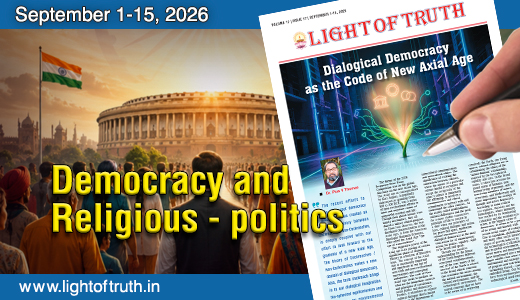
India is one of the most complex and edifying examples of religious politics in action. Though according to constitution India is a secular state. In India’s political arena religion has contributed for the mobilization of voters. Actually the self-identity of the voters are revealed when a religious environment is created. The religious environment matters heavily in a political strategy. In India the majority religion has a natural tendency to see their religious and national identity as closely intertwined. This fusion of religious and national identity is the mark of religious nationalism – and it carries significant political weight. When religion is used as the stamp of voting though is communalism…it becomes a political identity also. Unlike simple religious observance, communalism treats one’s religious community as a political alliance with interests opposed to those of other groups.
The word Rajarishi in the Indian religious concept is very explicit in this context. In this concept, the political leader or the leader of the country and the religious leader or Guru becomes the same person. The ideal concept is that a Rajarishi will rule the county with truthfulness and vision. In this the King becomes a father figure and shall reign the country in Dharma, Truth and Peace. Janaka was supposed to be the ideal king of this kind. The ruler and the religious leader will be one and the same.
The hidden danger in this is that it could be easily politically manipulated by false publicity, vested interests and political gains. Sometimes these Political leaders officiate religious functions also. It may create confusion and a kind of deification of the political leader by the common folk. Slowly democracy and its features will die out. The wide concept of secularism – respecting every religion, every kind of faith and culture ethnicity – shall wither away…