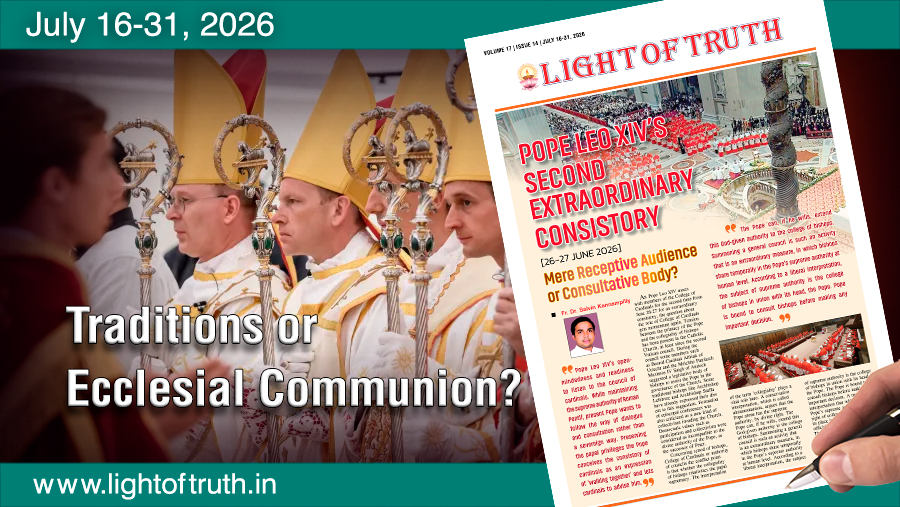
In the Catholic Church and in the world in general discussions and debates are on over the consecration of the bishops by the Society of St. Pious X without the canonical permission of Pope Leo XIV. What is wrong with them while they follow the Tridentine form of liturgy and life? Why the official Church didn’t give permission for them?
By consecrating four bishops without papal approval on 1 July 2026 at Écône, Switzerland, the Society of St. Pius X (SSPX) formally placed itself in schism from the Catholic Church. Despite Pope Leo XIV’s personal appeal to the leaders of the SSPX to refrain from consecrating four priests as bishops, the Society proceeded with the episcopal ordinations. Following these consecrations, Pope Leo XIV declared that the SSPX had entered into formal schism. Subsequently, the Dicastery for the Doctrine of the Faith (DDF) withdrew the faculties previously granted to SSPX clergy.
The Society of Saint Pius X (SSPX) is a traditionalist Catholic group that rejects the modernizing reforms of the Second Vatican Council. Their core beliefs include exclusive use of the Traditional Latin Mass or Tridentine Mass, staunch opposition to modernism, and the rejection of religious liberty and ecumenism. The SSPX was founded in 1970 by Archbishop Marcel Lefebvre. They consider the modern liturgy to be gravely flawed or unacceptable. Pope Pius X, was against the thought patterns of modernism. This helped them to view modernism as a grave synthesis of all heresies. They oppose the modern concept of religious liberty as taught by Vatican II.
Within the above said background remember the words of Pope John XXIII during the inauguration of second Vatican Council. “…it is necessary first of all that the Church should never depart from the sacred patrimony of truth received from the Fathers. But at the same time she must ever look to the present, to the new conditions and new forms of life introduced into the modern world which have opened new avenues to the Catholic apostolate”
Pope John also reminded in the very beginning of the Council that the doctrines of Faith is the same and what all things said and promulgated by all the ecumenical councils up to the Vatican II shall remain the same. But it is high time to understand the signs of the time, “a step forward toward a doctrinal penetration and a formation of consciousness in faithful and perfect conformity to the authentic doctrine, which, however, should be studied and expounded through the methods of research and through the literary forms of modern thought. The substance of the ancient doctrine of the deposit of faith is one thing, and the way in which it is presented is another”.
Actually the Church has the obligation to safeguard this spirit of Vatican II in conscience and in the unity of the Spirit. Society of St. Pius X went against this apostolic spirit. However from the very time of its origin as the Mother and Teacher, the Church consistently sought to restore communion through patience, and pastoral charity and kept the door opened for reconciliation. In January 2009 Pope Benedict XVI, motivated by his profound desire to promote the unity of the Church, remitted the excommunication of the four surviving bishops consecrated in 1988. The decree described this gesture as a “gift of peace,” intended to foster ecclesial charity. Pope Benedict expressed his hope that this act of mercy would strengthen mutual trust and facilitate the full reconciliation of the SSPX with the Apostolic See.
Pope Francis also demonstrated remarkable pastoral generosity towards the Society. During the Extraordinary Jubilee of Mercy (2015–2016), he granted SSPX priests the faculty to validly and licitly absolve sins during the Holy Year. At the conclusion of the Jubilee, he extended this faculty indefinitely as a pastoral provision for the spiritual welfare of the faithful.
Despite these significant gestures of goodwill, the Society of St. Pius X continued to reject essential aspects of the Second Vatican Council and remained outside full ecclesial communion. The episcopal consecration of four new bishops on 1 July 2026, carried out without papal approval, marked a decisive rejection of the reconciliation that the Holy See had patiently pursued for decades. This fact called for self-exclusion from the catholic communion. Actually, more than the ideological factors breaking away from the ecclesial communion incurred deep wound. One could assess that the society gave priority for their arguments on Tridentine traditions than the ecclesial communion.
In the history of the Church these types of ideological differences often happens. Whenever it happens in the Roman Catholic Church or within the individual ‘sui iuris eastern Churches it must be carried out taking into consideration of the priority of ecclesial communion. In the case of Society of St. Pius X, the Vatican took the compassionate and merciful position of the Church as mother and teacher but the SSPX slithered away and fell. If disputes of similar type occur in in any place in the universal church in general or in the synods sui iuris Churches the common factor must be the ecclesial communion and compassion and mercy from both parties or both sides. The arguments and discussions must be for the good and glory of the Church and not for the egoistic interests or self-interested dominance of one diocese or one province over the other. If pride, power and authority over dominates instead of the true conscience, inspiration of the Holy Spirit, truthfulness and sincerity over the matters it shall deteriorate the credibility of the Church community and the genuineness of the leaders. In the present issue of SSPX the Church as Mother and Teacher tried the level best in different occasions for reconciliation with patience, compassion and mercy.