When Pope Leo XIV officially visited the World Food Programme (WHP) in Rome, a corollary institution of United Nations (UN) addressing the executive board said: “On one hand, humanitarian action is increasingly burdened by bureaucratic procedures that can delay assistance to those in need. On the other hand, access to essential goods, including food, is too often influenced by economic or strategic considerations”. In his address the Pope was reminding the officials about overlooking the humanitarian aspects in the hectic sophistications and unbridled developments. Though Pope, the moral custodian of the world was telling WHP, this factor is dangerously growing all over the world especially in three main arenas of human life; health care, education and food supply. These three areas are affecting the very marrow of the society and also every human being. These factors one way or other affect the body and mind of each person.
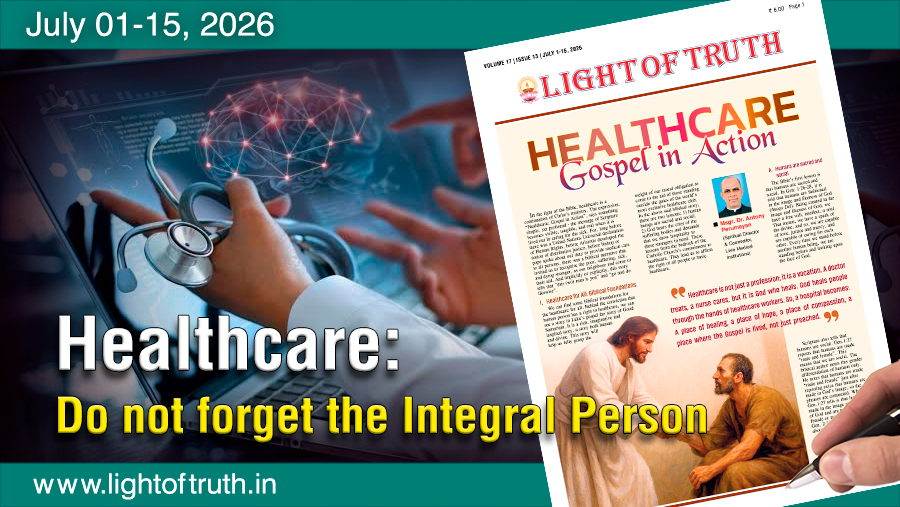
The healthcare scenario in general and especially in the Indian situation presents a spectrum of contrasting settings. At one end are the ostentatious structures delivering high-tech medical attention to the wealthy, mostly metropolitan Indian. At the other end are the dilapidated outposts in the remote reaches of the ‘other India’ trying desperately to live up to their identity as health sub-centres. It is not dissimilar in other Asian lands, Africa, Latin American countries and in many of the east European places. Observing the rapid pace of change one can presume, this scale is likely to widen further.
Healthcare system is one of the main places where life and emotions coincide; where using the given opportunity manipulations can be widely done. Avoidable body organ transplantations, sophisticated body analysis through various apparatus’, needless medicine dependency, appointment of the doctors on contract basis with demands, confusing and leading advertisements on medical care, unnecessary operations are now in a global move by the corporate agencies.
Affordable and non-affordable people are running on the same track in the matters of health care. Many are being cheated or trapped and fall in the hands of the health care corporate giants who are having no mercy and compassion. They see human beings and their situations as opportunities and patients as commodities to exact money.
In such a condition Christians have a great role to play understanding their ideal past. It is good at this juncture to remember the Christian contribution in the healthcare sector. Those who do not think of the love and brotherliness see people as things. They talk about the ‘economic man’ or the ultimate customer without an eternal destiny. They value people in terms of status and productivity, income and wealth. But human beings are not merely animals, objects, and consumers. God’s attitude about the value of a human being is far different from that seen in the secular world. Each human being is precious in God’s sight. Love or compassion is the mark of a relationship between persons. Love is desiring and doing the good of the other. The first hospital was built by St. Basil in Caesarea in Cappadocia about A.D. 369. “Care of the sick,” states the Rule of St. Benedict, who founded the great Benedictine Order in 527, “is to be placed above …every other duty, as if indeed Christ was being directly served by waiting on them.”
Delivering health care to everyone including the socially disadvantaged, the economically challenged, and the systemically marginalized was taken up as a project by WHO. It also means reaching the “everywhere,” which must include the remote areas in all the regions. Population in general are aware of the health problems. However when considering persons in particular one can realize that even the well-educated is not aware of many things.
In order to get away from the clutches of health care corporates first of all we have to promote community medicine and public health. Christian community must take the initiative and encourage discussion on this field. We should identify and analyse possible barriers to access in the financial, geographic, social, and system-related domains, and do our best to get our people thinking about the problem of access to good quality healthcare.
A consciousness of ‘cost and care needs’ to be built into the healthcare sector, from the smallest to the highest level. Education and campaigns must be done to avoid wasteful expenditure, options which demand high spending, unnecessary use of tests, and other puffed up procedures. The average medical student is not exposed to issues of cost of care during the course. They must be given the conviction that healthcare is a service and not a profession. Exposing young minds to issues of economics of healthcare will hopefully bring in a realization of the enormity of the situation, and the need to address it in whatever way possible.