Universal Church, as an institution is considered as the moral custodian of the world and humanity. Timely interventions and updating are being done in almost all realms of life with a scientific approach. This approach makes the institutional and religious face of the Church modernized and ever young. It is just like the flow of water that moves by the force through hills and brooks, dry lands and muddy places, dense woods and open settlements to reach its goal. She enterers into almost all the matters dealing with humanity, nature and universe. It tries to understand the mind and pulse of the society and individual passing through the historical process with changes and adaptations.
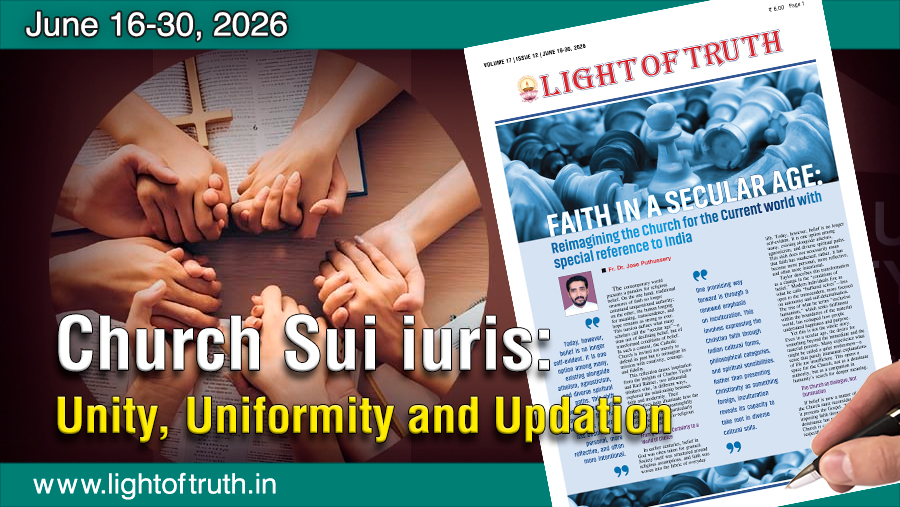
In the Universal Catholic Church there are various individual or particular churches with different rites and liturgy. The term rite refers to a liturgical, theological, and spiritual heritage. In Catholic understanding, a particular church (Latin: ecclesia particularis) is an ecclesiastical community headed by a bishop with its independence provided by the ecclesiastical law. Autonomous particular Church or Church Sui iuris is Church “having its own law.” These are aggregations of local diocesan churches that share a specific liturgical, theological and canonical tradition.
In the Catholic Church there are 24 individual churches belonging to several liturgical families. They are Churches in their own right. The largest in such autonomous particular Church is the Roman Church. The other 23 Catholic individual Churches are headed by bishops who have the title and rank of Patriarch or Major Archbishop. These Churches are equally important having the same status since they are developed and formed under some particular apostles of Jesus, with local liturgical traditions and culture.
Each church is missionary in nature. However, none of these Sui iuris Churches or individual Churches are growing after a certain period of time. Facing to the mission ad gentes, none of the Sui iuris Churches have natural growth except in their local cultural surroundings. Why it happens? Churches Sui iuris are sometimes like a caged bird. Sometimes they are caged by some external forces; sometimes they themselves make cages and live safely there. Each Church has passed through different historical circumstances and often moulded by political pressure, persecution, or pastoral misunderstanding. Some Churches are always in union with the Pope growing with their independent liturgical culture but are appalling to enter into the field of mission. These Churches did not think of transformation and adaptation, they remain fully in themselves.

This balance is not always easy to maintain, and it requires constant humility. Sui iuris Churches are sustained by a way of life. Their spirituality is not concentrated on intellectual mastery or constant innovation. It is engrossed on repetition, patience, and endurance. Daily prayer, fasting cycles, and liturgical rhythm form the backbone with due updating and natural growth according to the signs of the times. They have to prove that tradition can be lived without nostalgia and that modernization can exist without homogenization. If the Sui iuris Churches come to an understanding that unity is not built by erasing difference, but by sanctifying it. They must show that fidelity to tradition does not require isolation, and that communion does not require uniformity.

The Second Vatican council document Sacrosanctum concilium on Liturgy recommended to follow the ‘Tradition’ in a genuine way in every liturgical action. The document also prudently confirmed the need and necessity of updating and renewal in the missionary and cultural conditions. This sagacity is not much developed in the Sui iuris Churches. Many of the Sui iuris Churches are stagnant and some others are slowly moving towards the stagnancy. In a fast developing world were verities are sought and experienced; the youth, adolescents and even children are estranging from the religious functions due to its non-user-friendliness. Without much delay almost all the Sui iuris Churches shall become archaic and frozen.
So it is time for each individual Church Sui iuris to rethink making use of their canonical freedom and pastoral prudence to come out from the safer zones, self-boasting identities to the bare realities. Communion with Rome does not imply that Pope replaces the authority of local bishops or govern the individual Churches as a centralized administrator. Churches Sui iuris are self-governing churches, each headed by its own patriarch, major archbishop, or metropolitan, depending on the tradition. Theology of these Churches Sui iuris are not localized version of scholastic theology translated into a different liturgical language. It remains thoroughly individual in structure, prominence, and method. Its theology proceeds through mystery, prayer, and experience. These approaches are to be promoted. Unity does not require uniformity. Communion does not require expurgation. Affirming the individuality they follow the synodal nature of the Church. So they shall stand as living proof that traditions can remain faithful without being frozen.
This balance is not always easy to maintain, and it requires constant humility. Sui iuris Churches are sustained by a way of life. Their spirituality is not concentrated on intellectual mastery or constant innovation. It is engrossed on repetition, patience, and endurance. Daily prayer, fasting cycles, and liturgical rhythm form the backbone with due updating and natural growth according to the signs of the times. They have to prove that tradition can be lived without nostalgia and that modernization can exist without homogenization. If the Sui iuris Churches come to an understanding that unity is not built by erasing difference, but by sanctifying it. They must show that fidelity to tradition does not require isolation, and that communion does not require uniformity.