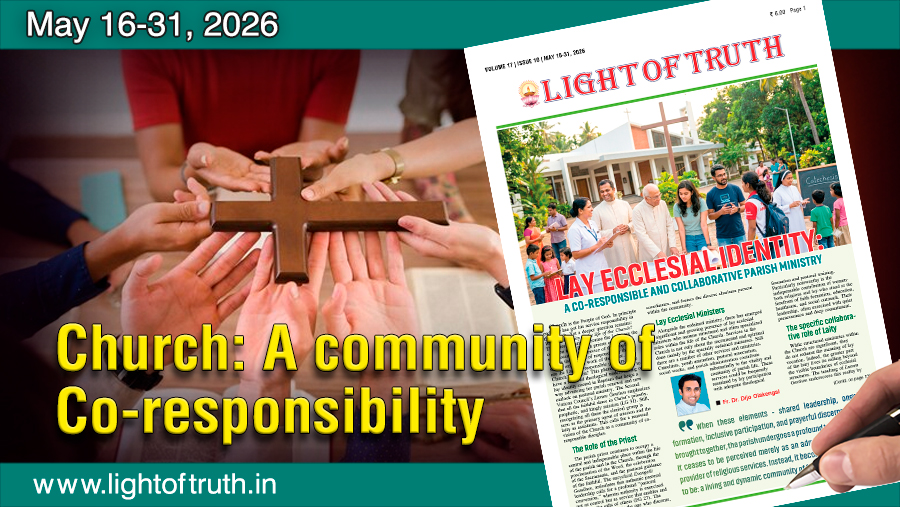
Absorbing inspiration from the Second Vatican Council, the concept of “co-responsibility” in the Church was introduced by Pope Benedict XVI. This was further developed and brought to the forefront with a synthesised document by the first session of the Synod on Synodality headed by Pope Francis. ‘Co-responsibility’ is an ecclesiological concept and a current pastoral reality. From time immemorial, there has been a hierarchical concept about the functioning of the Church. The overarching question was: How do we operate as a Church, the Body of Christ, with co-responsibility and what is the role of the laity in it? The answer to these questions has theological, pastoral and ecclesial dimensions. As 1 Corinthians 12:12-30 points out, we have to focus upon the question of the role each organ of the Body of Christ should play. How do the many parts relate to one another? How can this unity and specificity be maintained without coercion? How do we serve, support, and boost one another?
In the community of the ‘people of God’, lay people are the vast majority. The minority, ordained ministers, are at their service. However, due to excessive clericalism, the majority – the lay people – are kept away from the mainstream and from decision-making. This happens may be because of the fear and ignorance of the clergy, or because of the emphasis laid on clergy-centred provisions of the Canon Law. So, a clear awareness of the responsibility of the laity that baptism and confirmation have imparted to them is necessary.
The sublime concept of co-responsibility shall be seen, taking the relations that exist within the Holy Trinity as a model. The word used to describe the Trinitarian relationship is perichoresis i.e. a relation of subsistence where all are united and yet distinct. Taking inspiration from it we could say the relationship between the people of God (laity) and the clergy is one of co-responsibility. It is tied to our internal ecclesial communion. An ecclesiology of communion looks upon the different gifts and functions not as adversarial but as enriching and complementary.
In the broadest sense, ministry in the Church is understood as service (diakonia). There are different ministries. Within this broad understanding of ministry, differences help the organic growth of the whole body. It is true that according to the Code of Canon Law (c.129, paragraphs 1 & 2) those who receive the sacred orders are qualified for governance. The laity can cooperate in the exercise of the power of governance. Their ministry is appropriate to the common priesthood, which makes them collaborators with the clergy in the exercise of their pastoral ministry. This is the standard interpretation of the role of the laity that is always given.
Pope Benedict XVI contrasts the sense of “collaboration” with “co-responsibility. Co-responsibility could not be confused with collaboration. Both have distinctive characters in the interpretation of power and authority. “Co” means a fellow or partner such as in ‘co -worker’. If one goes by that meaning, co-working implies working alongside one another towards the one and the same end or mission. Cooperentur, work together, is one of the keywords in the vocabulary that was special to Vatican II.
Co-responsibility according to the mind of Pope Benedict XVI implies that all parties involved share power and authority, with each possessing the fullness of power in and of themselves. They work ‘with’ each other. In co-responsibility, there is room for appropriate autonomy. Collaboration, on the other hand, implies participation in a superior’s power. One works ‘for’ someone else, fitting into existing roles. The power and authority are not one’s own, but belong to another.
What we discuss here is the possibility of a co-responsibility of the lay people. The word responsibility means reliability, trustworthiness, and accountability. So, co-responsibility for the mission of the Church is the laity and the ordained taken together, jointly, mutually, to the same degree, exercising their respective priesthoods (baptismal and ministerial) reliably, trustworthily, and accountably. In the ministerial priesthood, the ordained minister does his priestly, prophetic and kingly (serving with responsibility) offices according to his ordained identity. In the same manner, the lay faithful does his/her duties in the Church according to the priestly, prophetic and kingly office received through baptism. These two are co-responsibly related.
Co-responsibility brings us around a mystery of communion, neither displacing nor rendering the hierarchy irrelevant: “Mystical communion is at once inward and outward; horizontal and vertical; earthly and heavenly; human and divine” (Dulles). A culture of accountability, both by the clergy and the Laity, is an integral part of a Church that promotes co-responsibility, with possible safeguards against it misuse. It makes room for voices. Co-responsibility makes clear we all have voices and perspectives on how to encounter the signs of the times and meet them, creating encounters of love that witness to Jesus Christ.