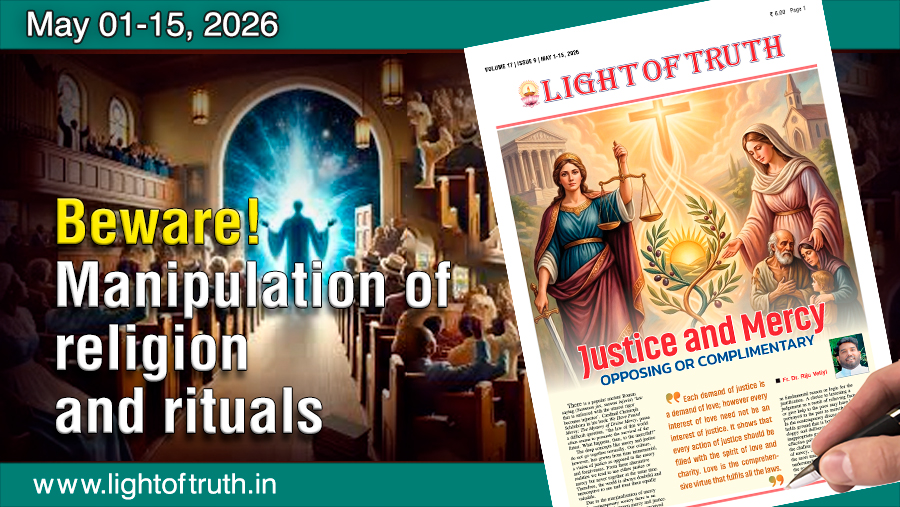
In any human society rituals and rites are the natural and authentic expressions of religious beliefs. Most of the repetitive rituals and styles are not only the result of emotions but are organized on the basis of philosophical, theological and cultural situations. So one can note that emotional intensity and life-oriented philosophical encryptions are inherent in such ritual systems. Human goodness, unity, universality, and peace in social and personal life are generally the human goals of religions and a life in accordance with it. Festivals, celebrations, gatherings, feasts, etc. are generally held in connection with religion and its practises. So there is no exaggeration to say that rituals control the dynamics of the individual and society.
The repetition of rituals can help to shape certain values and attitudes in individuals and in a society. When thinking at the emotional level, rituals and customs can be used to build relationships, helps to hold society and the community together, and form the limits between right and wrong, and create better or worse changes in the individual and community. This is useful to some extent to preserve the uniqueness or identity of an individual or society. These are by their superiors or leaders in the society and religion according to their principles and order.
In modern times religious and ritualistic practices are used to exercise power over the mind, heart and emotions, according to the needs. The identity of an individual is revealed through the rituals and rites he practises. Sometimes a specific language, (Hebrew, Sanskrit, Syriac) certain ritualistic practices (praying facing the sun, facing the east, worshiping facing the altar, burying the body in the ground, cremating the body) performance of ritual arts, (Margamkali, Kathakali, Theyyam, Chavittunatakam, etc.) some colours (green, yellow, white, and saffron) and symbols (Cross, various types of crosses, crescent moon, spear, and veal) are sometimes used to identify a particular community. It is believed that all of these will be useful in strengthening the bond of the community, fostering communal sentiment, making fearless progress, and maintaining unity in the community. Repeated actions of a ritual create a sense that, that action of the individual or society is right though such acts have little intellectual basis. The goal of rituals is to achieve transcendental experiences through sensual acts.
Even in this post-modern era the societies and groups which arise from religion and rituals have been used for power and superiority. Today, unfortunately religious leaders develop rituals and practises to protect certain vested interests of their own or their community. Along with that silence, opposition, elimination of undesirable situations, spurious and venomous statements and publications through social media are the different methodologies used to create divisions and unrest in the society to protect the interests. Human personal freedom and liberty is manipulated and those people who follow the same rituals and rites are in a way coerced to flock together to sustain power and to create new unity equations to become authorities. Political parties often use religious rituals and ceremonies to seize power and overthrow uninterested authorities.
Sometimes some religious leaders promote people to follow rituals with some specific goals in their mind. In countries where a certain religious community (religion) is at the forefront, politicians and religious leaders try to implement these ritualistic practices or religion based conventions with hidden agenda. Some of these aspects help for the good of the society, while others are to protect the interests of those in power and slowly to implement their interests.
Ritual actions are part of human culture and human religious life. They have spiritual, mental, personal, and social aspects as well. Rituals and customs are important for emotional and mental satisfaction and comfort, and it is the expression of beliefs. But it is easy to convert religious rituals into mental slavery and thereby into emotional blindness. When principles of God-oriented aspects diminishes in religions, honesty and truthfulness decreases. Any religious practises becomes performance and mere means of living for those who are very close to it. When the religion loses its heart the rituals and means are being distorted to achieve personal goals and community interests. Thus begins to use rituals and ceremonies for power, authority and money. There, instead of truth, partial truths and untruth will be proclaimed in ‘God’s name’ to manipulate the minds of the common folk. Therefore, those leaders either of religions or of countries are responsible to lead the society with an untainted mind and without any vested interest. Religion and religious customs should be used for the benefit of humanity and for the betterment of humanity.