Today, the word ‘development’ is an attractive term used in almost all spheres of life. The basic development of the country – structural, technological, resource creation etc – are mostly heard in political and cultural circles. The question is, even in the midst of these omnipresent publicities and advertisements on developments, do they permeate all areas of life and reach all categories of people, benefiting them objectively? Does it help all, especially the vast majority of the economically and educationally disadvantaged weaker sections of society? Do these lead to an integral development that encompass all? Do they help humankind as a whole? Most of the development that is happening is not distributive, but tend to be monopolistic.
Technological developments at all levels – media, electronics, food production, industrialization of agrarian production, education, travel, medicine, hospitality management, religion – every area is controlled by corporates. They decide what to eat, what to wear, how to communicate, what medicine to use, how to worship etc. They creep into our family’s privacy, individual freedom, choices, and they are omnipresent, from kitchen to the courtyard, from head to toe. Those who wield political power are hand-in-glove with these corporate giants, who have monopolised infrastructure projects. They construct truths to suit their convenience, relativizing objective truth, human dignity and moral values. This prompted the International Theological Commission to publish the document Quo vadis Humanitas? (Man, where are you heading?) on development and progress with the consent of Pope Leo XIV, as a follow-up to Gaudium et spes, a document published in 2019 by the Pontifical Biblical Commission on the Dignity of Man. “What is Man” (Ps 8: 5 – An Itinerary of Biblical anthropology).
In the Book of Genesis, the story of creation exalts the glory and supremacy of man. If we examine the description of creation closely, we can see a mixed account of God’s love for man and the responsibilities entrusted to him as an expression of this love. The responsibilities entrusted to man are to be fruitful and multiply, to fill the earth, to subdue the earth and to have dominion over all living things. Quo vadis Humanitas indirectly asks the world why it forgets these responsibilities in the affairs of life, since these responsibilities are valid until the end of time. In the biblical perspective, the physical and metaphysical levels of man are entirely the work of God. Thus, the Bible testifies that man is a harmonious union of the material and the metaphysical.
Man is the complete realization of the soul and body – the transcendental, supernatural realm of higher freedom and terrain creativity – which are united in man. Therefore, God’s plan for man is to lead him through historical paths and bring him to a transcendental and metaphysical realization. Man should therefore overcome the obstacles that are arising in the passage of time in order to appreciate his essence. Even though man is part of the biological heredity, there is clear evidence of an interior power that provides thrust for his growth towards the supernatural. He may go beyond the terrestrial to the celestial. Saint Paul says: everything finds its meaning in God and in Jesus Christ (Col 1: 16). Man is the glory of God. Man’s goals and needs depend on God. God decided where, when and how a person should be born and how s/he lives. The possibilities of human purpose are conceivable only as a part of God’s design. There is no coincidence in God.
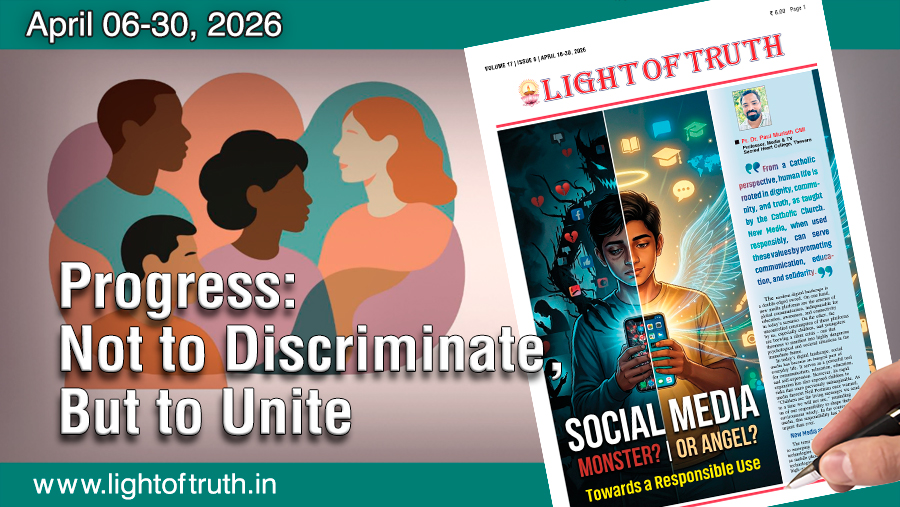
Man is a storehouse of peculiarities and differences. Problems, failures, sad and happy memories, superstitions, emotional experiences etc. directs him hither and thither. Although man seen as a human being is inherently one in terms of his bio-physical nature; he is also social and ritualistic. Man experiences discrimination and constant psychological and social oppression on account of the physical and mental conditions and false accusations that are prevalent. Gender differences, economic inequality, color differences, educational disparities, job standards, social distances, changes due to genetic predispositions, natural disabilities, mental attitudes, transgender life situations, attitudes towards immigrants etc. easily categorize people and create aversion or attraction as may be the case. Although humans are genetically unique, they are very reluctant to view themselves and others in such a unitive way at the socio–religious and cultural levels, even in this transhumanistic and posthumanistic world.
Despite the huge leap made in modernization through the use of technology, a kind of emptiness, a sense of spiritual poverty persists. The vision of oneness in humanity and divinity has been reduced to a cry in the wilderness. Quo Vadis Humanitas published by the Pontifical Theological Commission sheds a light of hope in the vision of man – his purpose and goal – in this fast developing technological world. It proposes to pay attention to the integral growth of humanity, devoid of discrimination and dehumanizing tendencies.