All posts by Sathyadeepam Weekly

Catholic women’s leadership forum tells young women: ‘You are a gift’

The 2026 GIVEN catholic Young Women’s Leadership Forum, taking place in Washington, D.C., this week, exists to help women understand their gifts and how to share them with the world. The five-day gathering is hosted by the GIVEN Institute – a non-profit organization dedicated to activating the gifts of Catholic young adult women for the Church and the world through faith formation and leadership.

The five-day gathering is hosted by the GIVEN institute – a non-profit organization dedicated to activating the gifts of Catholic young adult women for the Church and the world through faith formation and leadership. “We hope women will take away an understanding, on a much deeper level, that they are a gift. They are a beloved daughter of God,” said the executive director of GIVEN, Jennifer Cole-Schaefer. Women have “been given gifts that are specific to them, and God has a plan to use those gifts,” she said. “Itʼs all about receiving this idea that we are a gift, realizing what our gifts are, and responding in a way that only we can respond with our particular gifts”. The forum welcomes Catholic women, ages 21-35, who have been accepted into the institute’s leadership program, as well as mentors, volunteers, exhibitors, and sponsors. Acceptance into the program includes participation in GIVEN’s forum, followed by a year of accompaniment with a trained mentor. Participants cultivate a personalized “action plan” designed to serve the Church and their community. The “formation starts well before we get to the forum, but the forum is a really pivotal in-person experience,” Cole-Schaefer said. It’s after the forum that the real work begins – when women start to actualize their action plans, and they don’t do that alone. They do that through mentoring.” So we have a whole army of women with some life experience who’ve stepped forward and been trained as mentors to walk with our young women as they discern all the steps.”

Franciscan University professors urge SSPX to desist from Schism

More than 20 professors at the Franciscan University of Steubenville are calling on the Society of Saint Pius X (SSPX) to not proceed with its planned consecration of bishops on July 1. We write not as adversaries, but as fellow Christians who love the Church, which is built on Sacred Scripture and Sacred Tradition, and who, like you, long for the salvation of souls,” the professors wrote in an open letter to the SSPX, noting that if the group moves forward with the illicit consecrations, “it would cement and deepen the already existing separation between the Society and the See of Peter.

Whatever legitimate questions or grievances may exist, they are no excuse to create a schism,” the letter’s signatories assert. The letter is signed by 26 faculty and staff, with university professors of theology constituting the majority of the signatories. The treasures of Catholic Tradition do not belong outside communion with Peter; they belong at the heart of the Church,” the letter continues. “A new episcopal ordination outside the ecclesial hierarchy without the Apostolic mandate would create a new wound in the Body of Christ and place the gifts that God has entrusted to the Society, which belong to the Church and are ordered towards unity with her (Lumen gentium 8) outside of her maternal embrace. Please don’t do this,” the letter said. “Please don’t create this wound! Please, re-enter into dialogue with the Holy See and into full communion with the Church.

U.S. sends emergency response teams to Venezuela after massive Earthquake

The Trump administration is deploying U.S. emergency response teams to Venezuela in the wake of two high-magnitude earthquakes as local Catholic leaders mobilizes the Church’s support network.

 “Weʼre already deploying search and rescue teams from Fairfax County [Virginia] and Los Angeles,” Secretary of State Marco Rubio said. “There will be some others weʼll add,” Rubio said. “Thatʼs their most immediate need right now, is search-and-rescue efforts: They have [many] collapsed buildings. And so theyʼll need a lot of help in terms of digging through that.” The earthquakes took place on June 24, with the first 7.2-magnitude earthquake recorded at 6:04 p.m. local time, and the second 7.5-magnitude earthquake occurring just 39 seconds later, according to the United States Geological Survey.

“Weʼve already stood up our disaster response teams at the Department of State and our humanitarian efforts,” Rubio said. “Itʼs something we did very well in Jamaica, after that storm, and itʼs something weʼre really prepared to do now.” The update came after Rubio issued a statement earlier in the morning pledging to carry out U.S. President Donald Trump’s directive for “all agencies of [the U.S.] government” to “get ready to move quickly.” “The United States extends our deepest condolences to the people of Venezuela following the devastating earthquakes,” Rubio said. “Our hearts are with all those who have lost loved ones, those injured, and the courageous rescue workers working tirelessly in the aftermath.”

Bishop A. Elias Zaidan, chair of the U.S. Conference of Catholic Bishops’ Committee on International Justice and Peace called on the international community to “mobilize in support of the Venezuelan people, and to send the necessary humanitarian assistance to alleviate their suffering.”

Pope Leo XIV has sent an initial 100,000 euro donation to Venezuela in the aftermath of the earthquakes through the Apostolic Almonerʼs Office. Catholic Relief Services (CRS) said it is “working through Caritas Venezuela and the local Church to quickly deliver emergency shelter, food, safe water, medical care and other critical relief to those affected.” Archbishop Raúl Biord Castillo of Caracas told the aid group after touring affected parishes to assess the situation that “many of them have serious structural damage,” with the Cathedral of Caracas among the most affected. Bishop Pablo Modesto González Pérez of the Diocese of La Guaira described the impact of the earthquakes on the local seminary, telling Aid to the Church in Need: “We are without electricity and we have all been affected. In the seminary, many walls collapsed.” The bishop expressed gratitude that no priests were seriously harmed and noted the mobilization of the local Church in response to the disaster: “Many parishes have received people to spend the night in their facilities. We have already activated a solidarity network through the parish Caritas.”

Pope Leo XIV: The Eucharist is a powerful antidote to division

Pope Leo XIV said that the Eucharist is a “powerful antidote” to division in the world, calling on Catholics to “draw with faith from this source of divine life” and to allow themselves “to be transformed by the mystery we celebrate”.

Thus, by incorporating us into Christ, the Eucharist teaches us to adopt the very style of life of the Lord Jesus, which was marked by the free gift of Himself. This gift draws us into the dynamic of unity, offering a powerful antidote to the forces of division that undermine our world, our communities, our families, and our hearts,” The pope continued his catechesis on the documents of the Second Vatican Council, focusing on the Constitution “Sacrosanctum Concilium” on the sacred liturgy.

Leo highlighted the liturgical reform called for by the council fathers, especially the creation of the Lectionary, the book containing the biblical readings for liturgical celebrations. “The liturgical reform translated this request into the treasure that is the Lectionary, the book that gathers all the biblical readings for liturgical celebrations,” “This richness has been drawn from the purest source of the living Tradition, which combines fidelity with tradition; with openness to legitimate progress,” the pope added, citing “Sacrosanctum Concilium”.

Reflecting on the Mass, Leo said the faithful are invited “to listen to the Word of God and to be nourished at the Lord’s Table, where He offers Himself to the Father. The two parts of the Mass — the Liturgy of the Word and the Liturgy of the Eucharist — “are so closely connected with each other that they form but one single act of worship.”  The Eucharist opens us to an understanding of Scripture, just as Scripture for its part illumines and explains the mystery of the Eucharist,” the pope said, quoting Benedict XVI’s apostolic exhortation “Verbum Domini”

Leo also drew on the teaching of St. Augustine, who explained the mystery of the Body of Christ to the newly baptized by citing St. Paul’s words: “Now you are Christ’s body, and individually parts of it”. “It is your own mystery that you receive,” Augustine wrote, according to the pope. “To what you are, you respond: Amen, and your response is like your signature. You are told, ‘The Body of Christ,’ and you reply, ‘Amen.’ Be therefore members of the Body of Christ, so that your Amen may be true”. The pope said that through the Eucharist, Christians become what they receive: the Body of Christ. “Thus, the Eucharist is the sacrament of the Kingdom that is to come. It is the Bread for the journey that leads us to our heavenly homeland, until that blessed day when ‘God will be all in all”.

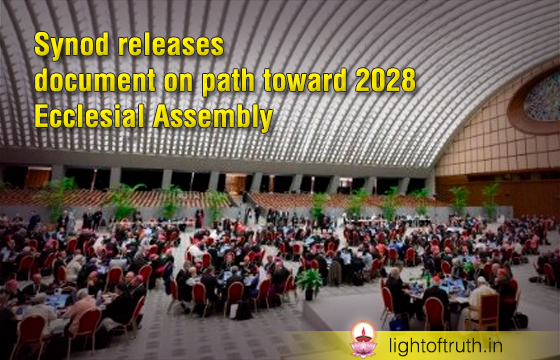
Church leaders gather in Rome to prepare for Synod Assemblies of 2027-2028

The General Secretariat of the Synod announces that leaders of the Church’s continental bodies are gathering in Rome to assess progress in implementing the Synod on Synodality and to prepare for the ecclesial Assemblies of 2027–2028.

The heads of the Church’s continental bodies have gathered in Rome this week for three days of meetings dedicated to the next phase of the Synod on Synodality, The meeting, brings together representatives of continental ecclesial organizations from Latin America, Africa, Asia, Europe, Oceania, the Middle East, and North America, accompanied by coordinators of the continental synodal teams.

According to the press release, the gathering comes as the Church continues the implementation phase of the Synod on Synodality following the conclusion of the XVI Ordinary General Assembly of the Synod in October 2024. That process, it notes, “will be marked by the ecclesial Assemblies of 2027–2028.”

Participants are meeting in light of the recent publication of Towards the Assemblies 2027–2028: Stages, criteria, and tools for Preparation, which is intended to guide the next stages of the synodal journey.

The gathering would focus on listening to “the principal developments in the implementation of the Final Document of the XVI Ordinary General Assembly of the Synod of Bishops,” while fostering the exchange of experiences from different regions of the world and identifying “common dynamics and issues requiring further shared reflection.”

Part of the programme is dedicated to accompanying local Churches and regional groupings of Churches as they continue to implement the synodal process. Particular attention will also be given to the role of communication in supporting that work. The final day of discussions will focus on the continental Assemblies, described in the press release as “one stage in the broader journey of ecclesial assemblies that will culminate in the Assembly of October 2028”.

Vatican Dicastery: Layperson cannot deliver homily at Mass

The Dicastery for Divine Worship and the Discipline of the Sacraments responds to a request made by the German Bishops, denying their petition for a layperson to preach the homily during Mass, even in exceptional cases, stating that the proclamation of the Word in the liturgical celebration is inseparable from the mission received sacramentally.

The Dicastery for Divine Worship and the Discipline of the Sacraments has issued a clarifying text regarding who is permitted to deliver homilies.

The German Bishops had requested “to permit, in exceptional circumstances, a duly commissioned lay member of the faithful to preach in place of the homily during the celebration of the Eucharist.”

While the Dicastery expressed appreciation for the pastoral concerns that inspired the request, it reaffirmed that the current discipline cannot be dispensed from by means of an indult, since the reservation of the homily to a priest or deacon is not a merely disciplinary norm but derives from the very nature of the liturgy.

In the text, the Dicastery reiterated that the homily, which forms an integral part of the Liturgy of the Word, is intrinsically linked to the proclamation of the Gospel and constitutes an exercise of the munus docendi entrusted to ordained ministers through the Sacrament of Holy Orders.

It added that the proclamation of the Word within the liturgical celebration is inseparable from the mission received sacramentally and from the unity that binds together Word and Sacrament in the Eucharistic celebration.

The letter also emphasised the importance of promoting the ongoing formation of ordained ministers so that the homilly may fully express its pastoral and spiritual effectiveness. Finally, the Dicastery recalled that the Church’s current discipline already provides for numerous forms of proclaiming the Word and preaching that may be entrusted to lay members of the faithful outside the homily and outside the celebration of the Eucharist, in accordance with canon law and the proper nature of these different forms of proclaiming the Gospel.

Pope to WFP: Conflicts are ‘fed’ more readily than people are nourished

Pope Leo XIV visits the UN World Food Programme headquarters in Rome and insists that food, water, and healthcare cannot be subordinated to geopolitical interests, calling for nations to work together with renewed multilateralism.

 “Together, we share the urgent task of confronting hunger and malnutrition, while also tackling the underlying structural causes that sustain them. To meet this task effectively, we must examine the challenges before us, their underlying causes, and the paths toward lasting solutions.” Pope Leo XIV expressed this during his address to the Executive Board of the United Nation’s World Food Programme at its Rome headquarters on Monday.

In his remarks, he stressed that multilateralism is essential and that basic needs like water, food, and healthcare cannot be subordinated to geopolitical interests.

The Pope thanked the intergovernmental institution for its dedication to saving lives in emergency situations and providing food assistance amid conflicts and natural disasters, noting their institution’s commitment resonates profoundly with the Catholic Church’s mission to uphold human dignity and to foster fraternity, rooted in the Gospel’s call to love our neighbor.

Today, crises have evolved from isolated events into persistent realities, marked by prolonged conflicts, chronic food insecurity, economic volatility, and growing climate vulnerabilities.

This reality, he noted, raises a fundamental question of “what configuration of the global order is capable of producing, reproducing, and, at times, normalizing such conditions?”

He said the issue is no longer limited to how to intervene, but rather “extends to understanding why the system constantly produces the very problems it is then forced to correct.”

He said that the international order has become increasingly fragmented, arising in part from the crisis of the multilateral system, observing that states have increasingly allocated their resources towards national security, economic growth, and domestic stability, disregarding the close link between these issues and multilateral cooperation. This trend, reveals a striking paradox, where “unprecedented global productive capacity exists alongside expanding zones of extreme vulnerability.”

“It is precisely within the gap between acknowledgement in principle and prioritization in practice,” he continued, “that we witness the progressive bureaucratization of solidarity alongside the quiet commodification of human life.” Humanitarian action is increasingly burdened by bureaucratic procedures that can delay assistance to those in need, but on the other, access to essential goods, including food, is too often influenced by economic or strategic considerations. Conflicts are “fed” more readily than people are nourished As a result, he lamented, those who do not generate quantifiable value risk becoming invisible. “This twofold dynamic,” he lamented, “creates a serious ethical challenge: the human person is no longer consistently placed at the centre of international action.”

Patriarchs of Jerusalem visit Gaza’s wounded faithful

Amid the rubble and suffering of a population exhausted by war, the Latin Patriarch of Jerusalem and the Greek Orthodox Patriarch begin meeting with clergy, religious communities, local Christian families, and people affected by the humanitarian crisis in the Gaza Strip.

Starting on June 22, Patriarch Theophilos III of Jerusalem, Greek Orthodox Patriarch of Jerusalem, and Cardinal Pierbattista Pizzaballa, Latin Patriarch of Jerusalem, began a pastoral visit to Gaza aimed at healing the wounds of thousands of men, women, and children worn down by the atrocities of war.

The two were accompanied by Dr. Josef Blotz, Grand Hospitaller of the Sovereign Military Order of Malta, and representatives of Malteser International, the Order’s humanitarian organization, which operates in many regions around the world.

In a statement, the Latin Patriarchate of Jerusalem said the visit “expresses the pastoral responsibility of the Churches of Jerusalem toward the local churches and toward the whole population of Gaza, where families continue to endure grave humanitarian suffering, fear, loss, and uncertainty.”

It also emphasized the indispensable value of prayer in a context devastated by suffering—one that seems to drain all hope.

“The presence of His Beatitude Patriarch Theophilos III and His Beatitude Cardinal Pizzaballa carries the prayer of Jerusalem to Gaza’s wounded faithful and to all who suffer, in a ministry of consolation, mercy and steadfast Christian witness rooted in the Gospel and in the sacred vocation of the Holy City.”

According to the official program, the Cardinal and the Patriarch are meeting with clergy, religious communities, local Christian families, and those affected by the ongoing humanitarian crisis. Through prayer and pastoral presence, they seek to offer spiritual strength, comfort, and renewed hope.

Their mission also aims to reaffirm the Churches’ commitment to healthcare, relief efforts, and the protection of human dignity.

The situation remains difficult, the Cardinal said, but the presence of Church leaders demonstrates the attention and concern the Churches continue to devote to Gaza, which remains a priority. Cardinal Pizzaballa had previously visited the people of Gaza on December 19, 2025. Two days later, on December 21, he celebrated Christmas Mass in advance at the Holy Family parish, attended by many faithful who were deeply touched by the celebration. During their time there, the two patriarchs appealed to world leaders to bring an end to the war and to begin a path of healing and reconciliation for the whole of the Holy Land.

A Family Where Faith Inspired Six Sisters to Religious Life

In the mist-covered hills of Venappara in Kerala, the Kallidukkil family became a remarkable witness to faith and vocation. Thomas and Thresiamma Kallidukkil raised their ten children in a home where daily prayer was as natural as breathing. Before dawn each day, the family gathered before their altar for the rosary, Scripture reading, and hymns.

This atmosphere of faith led six of their eight daughters to embrace religious life. Four joined the Sisters of the Adoration of the Blessed Sacrament, while two became members of the Franciscan Clarist Congregation.

The sisters recall that their parents never pressured them to become nuns. Instead, they led by example through their deep faith, hard work, and commitment to prayer. The presence of grandparents, visits from nun relatives, and the guidance of catechism teachers also played an important role in nurturing their vocations.

Stories of saints and missionaries inspired many of them. Some eventually dedicated their lives to education, formation, and missionary service in different parts of India, including Kerala and Gujarat.

Not every daughter chose religious life. Two daughters embraced married life after discerning their calling. One of them said she realized that religious life required a deeper personal call, while another expressed joy that her own son is now preparing for the priesthood.

The sisters emphasize that authentic vocation grows in freedom. Their parents guided them with love but never imposed decisions. Through prayerful witness rather than pressure, the Kallidukkil home truly became a nursery of vocations.

Over 800 Youth Join ANUBHAV 2026 Retreats in Jalandhar Diocese

More than 800 young people from across the Diocese of Jalandhar took part in ANUBHAV 2026, a series of ICYM Pro-Life Youth Retreats aimed at deepening faith, promoting Christian values, and encouraging spiritual renewal among youth.

The retreats were organized by the Youth Commission of the Diocese of Jalandhar under the leadership of Fr. Jibin, Director of the Youth Commission, with the support of DEXCO members. The programme was conducted at three locations and brought together youth from different deaneries of the diocese.

The first retreat was held at St. Joseph’s Catholic Church, Phagwara, from June 2 to 4. The second took place at St. Joseph’s Catholic Church, Abohar, from June 4 to 6, while the final session was organized at St. Francis Church, Amritsar, from June 6 to 8.

Formation sessions were led by members of the national team of Youth United for Christ (YU4C). Resource persons spoke on topics such as God’s love, Christian moral values, discipleship, personal holiness, healing, and the role of the Holy Spirit in daily life. Participants also reflected on contemporary issues affecting young people and discussed how to respond to them through faith.

Special healing and prayer sessions gave participants opportunities for reconciliation, spiritual growth, and personal reflection. The retreats also included sessions introducing The Chosen: Crucifixion, an upcoming theatrical release.

Bishop Jose Sebastian attended all three retreats and celebrated Holy Mass. He encouraged the youth to remain strong in faith and become committed witnesses of Christ.

Organizers described ANUBHAV 2026 as a fruitful initiative that inspired young people to live their faith with courage and conviction.