
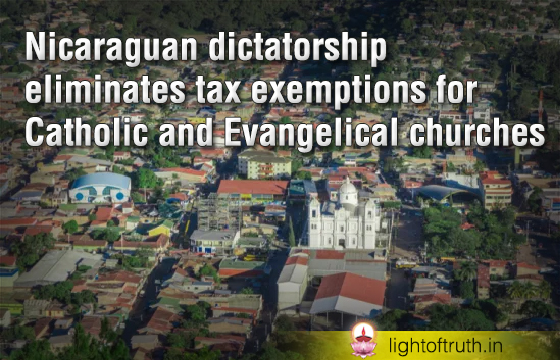
One day after cancelling the legal status of 1,500 NGOs in Nicaragua, the dictatorship of President Daniel Ortega and his wife, Vice President Rosario Murillo, eliminated the income tax exemption for churches.
Lawyer and researcher Martha Patricia Molina considers the measure a “fiscal blow” that will end up “financially suffocating the (Catholic) Church so that it falls under its own weight.”
The official government newspaper La Gaceta published Law 1212 on Aug. 22, which modifies three other laws: the law on regulation and control of non-profit organizations, the law on regulation of foreign agents, and Law 822 on tax coordination. The newspaper reported that this decision comes from the country’s legislature at Ortega’s initiative.
Article 5 of Law 1212 orders: “Repeal section 3 of article 32 of the Tax Coordination Law” of 2012, as well as its reforms.
Section 3 of article 32 stated that “Churches, denominations, confessions and religious foundations that have legal personhood, in terms of their income coming from activities and assets exclusively destined for religious purposes” were exempt from income tax.
An expert quoted but not identified by the newspaper La Prensa explains that with this decision by the dictatorship “all churches of any denomination will be subject to the fiscal terrorism to which the dictatorship has subjected the private sector and now religious institutions,” and they will have to pay between 10 and 30% in income tax.
Regarding this decision, Molina, author of the report “Nicaragua: A Persecuted Church?” which cited 870 attacks by the dictatorship against the Catholic Church since 2018, claimed that government authorities have already been to parishes asking for documents related to their accounts.
In “previous weeks, the regime’s authorities had visited parishes to request information on how they keep their accounts, they asked to see the general and minor ledgers, income and expenses, which is obviously not done this way in parish administration,” Molina wrote on X. “Now the priests will have to hire a CPA [certified public accountant] to keep all these accounts and also say who their main donors are,” she added.
All posts by Light of Truth
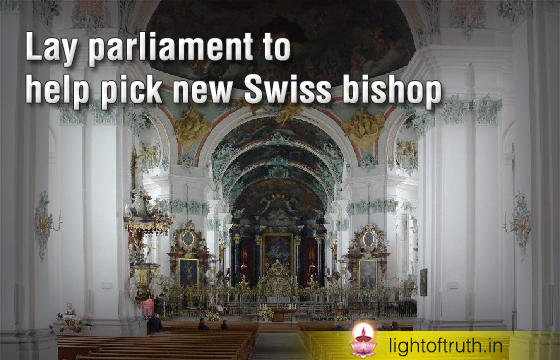
Lay parliament to help pick new Swiss bishop
One of the Catholic world’s most unusual episcopal selection processes is underway in the Swiss Diocese of St. Gallen, involving cathedral canons and a lay parliament, as well as the Pope, of course.
The St. Gallen diocese, in northeastern Switzerland, announced Aug. 15 that Pope Francis had approved the start of the process to find a new bishop after incumbent Bishop Markus Büchel submitted his resignation upon turning 75.
St. Gallen, which serves roughly 250,000 Catholics, is one of several dioceses in the German-speaking Catholic world where the cathedral chapter plays an important role in selecting new bishops.
Under the terms of an 1845 concordat and the 1847 bull Instabilis rerum humanarum natura, the Bishop of St. Gallen is appointed after a free election by the cathedral chapter within three months of a vacancy.
Candidates must be diocesan priests over the age of 35 with more than five years of priestly service. They must also have experience of administration or pastoral care in the diocese. Around 60 priests are currently eligible, with local attention focused largely on the 13 members of St. Gallen’s cathedral chapter.
Following the pope’s signal, the 13 canons have three months to prepare for the election of Büchel’s successor.
The process will begin with a three-week survey of Church groups, led by the Swiss Institute of Pastoral Sociology (SPI) in St. Gallen. Groups will be asked to identify the qualities needed in a new bishop. Consultations were also held during the last two changes of episcopal leadership.
After reviewing survey responses, the cathedral chapter will create a shortlist of six priests, which will be sent to Rome via the nuncio. The Vatican will scrutinize the list, vetting the candidates individually, before returning it to the cathedral chapter through the nuncio when they have finished.
The chapter will then schedule an election day in collaboration with the Catholic College (Katholische Kollegium), a lay parliament covering the Canton of St. Gallen, one of the 26 member states of the country officially known as the Swiss Confederation.
The lay parliament could play a significant role in the election of St. Gallen’s new bishop because it can declare that three of the six candidates identified by the cathedral chapter and scrutinized by Rome are “less favourable,” resulting in their elimination from the list.
The cathedral chapter then holds a ballot. After the chapter selects a new bishop, the candidate has a week to accept or decline. If he agrees, Pope Francis is expected to formally appoint the candidate as the new Bishop of St. Gallen.
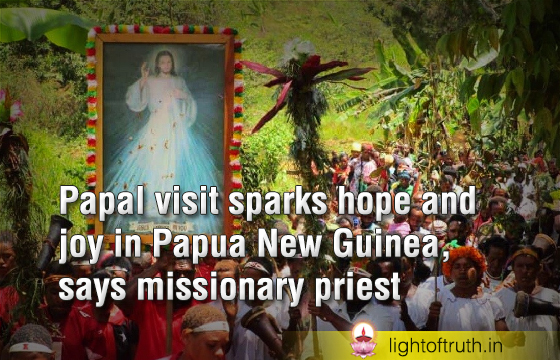
Papal visit sparks hope and joy in Papua New Guinea, says missionary priest
The anticipation is palpable for Pope Francis’ arrival in Papua New Guinea on September 6, especially in the coastal city of Vanimo, said Fr. Martín Prado of the Institute of the Incarnate Word. “Due to limited access to news and social media, not many people were aware that he was traveling. We are all very excited and working hard to be able to welcome the Pope as best as we can,” the priest said in an interview with the Aid to the Church in Need (ACN).
The local Catholic community is making extensive preparations, which include nightly prayers, organizing hymns, and culturally significant dances on the local football pitch, repurposed for the occasion. These gatherings have drawn large crowds, a testament to the vibrant faith and communal spirit in Vanimo, the priest said. “At some of the better attended evenings, we had thousands of people taking part.”
He also highlighted the unique blend of faith practices in the region, saying, “The faith of the Christians here is very much alive and very simple.”
“Many still interpret Christianity through the framework of their ancestral faiths, which makes it difficult for them to achieve a full understanding of Christianity,” he added.
The priest said missionary work in remote jungle locations has led to significant spiritual engagements, including baptisms and the introduction of the Gospel.
“In the jungle, for instance, we have had the opportunity to baptize entire families, to teach them to make the sign of the Cross, and to preach the Gospel for the first time,” he said.
Despite these successes, the melding of ancestral beliefs with Christian teachings presents ongoing challenges. Fr. Prado highlighted the community’s efforts to discern and educate.
“Our work, as missionaries, is to help Christians understand that these things do not go together and try to effect change,” he said.
Addressing the specific challenges faced by the youth, the priest highlighted the vague concepts of marriage and family life that diverge significantly from Western norms.
“Young people do not have models to follow or serve as inspiration, and only a few have the support and accompaniment of their parents to commit to their spouses for life,” he said.
The missionary priest called for global support through prayers and material aid. He stressed the importance of praying for vocations, noting the recent increase in local vocations.
“Since then, the number of priests has doubled. We have started to see local vocations, which we had never had before,” he said.

Pope Francis Promotes Sustainability with A New Solar Plant for The Vatican
In a significant movement towards climate sustainability and neutrality, Pope Francis announced the construction of a solar plant on the outskirts of Rime. The initiative’s objective is for Vatican City to function completely with renewable energy, which is a crucial step in the fight against climate change.
In an Apostolic Letter, Pope Francis highlighted the urgent need of a transition to a sustainable development model. According to the Holy Father, the new solar plant will significantly reduce greenhouse gas emissions and promote climate neutrality. The plant will be located in Santa Maria di Galeria, some 11 kilometers from Rome, where Vatican Radio’s broadcasting station is located. Not only will this project generate renewable electricity, but it will also be integrated with the land’s agricultural needs, combining modern technology with sustainable practices. The Pope has given full authority to two special Commissioners to supervise the plant’s construction, ensuring that the project is carried out efficiently and effectively. The energy generated by this solar plant will cover all the Vatican’s energy needs, eliminating dependence on non-renewable energy sources.
Solar energy plays an essential role in Pope Francis’ strategy to address climate change. Since his 2015 encyclical “Laudato Si’,” the Pope has been a firm defender of climate action and repeatedly appealed to the international community to take swifter and more decisive measures. In his writings, the Holy Father has pointed out the scientific consensus on global warming and extreme meteorological phenomena as key reasons to adopt cleaner energy sources. In addition to the solar plant, the Vatican is implementing other measures to reduce carbon footprint. For example, solar panels have been installed in several buildings and the fleet of official vehicles has been renovated with electric automobiles, including the famous Popemobile. These actions underscore the Vatican’s commitment to energy efficiency and the reduction of light consumption through renewable sources.
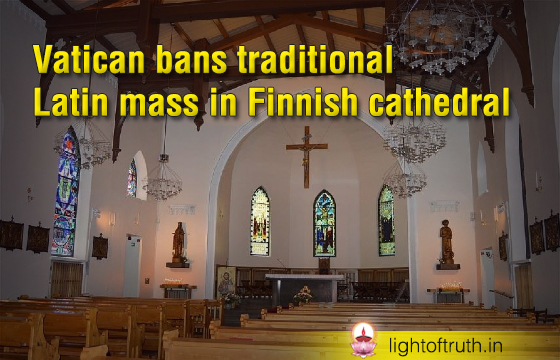
Vatican bans traditional Latin mass in Finnish cathedral
In a move that has sparked concern among traditionalist Catholics, the Vatican has ordered the relocation of Finland’s only Traditional Latin Mass (TLM) from its current location in the capital’s main cathedral to a smaller, more modern church. The Diocese of Helsinki announced on August 9 that, starting in September, the Latin Mass will no longer be celebrated at St. Henry’s Cathedral but will instead take place at St. Mary’s Church, following directives from the Vatican. The decision, as communicated by the Dicastery for Divine Worship, is rooted in the Vatican’s view of St. Henry’s Cathedral as a “model for the entire local church” and a “sign of unity.” This rationale implies that the cathedral, as a symbol of ecclesiastical cohesion, should not host the Traditional Latin Mass, which has been a point of contention within the broader Catholic Church. The Latin Mass had been celebrated at St. Henry’s Cathedral since 2007, following Pope Benedict XVI’s motu proprio Summorum Pontificum, which encouraged the wider use of the pre-Vatican II liturgy. St. Henry’s, a neo-Gothic structure built between 1858 and 1860, originally served the needs of Catholic soldiers in the Imperial Russian Army, at a time when Finland’s Catholic population was minimal. The cathedral’s exterior features statues of St. Henry, Finland’s patron saint, as well as St. Peter and St. Paul, underscoring its historical and spiritual significance.
The new venue, St. Mary’s Church, is located over five kilometers from the cathedral and was constructed in the 1950s with a modern architectural design.
The move is seen within the context of broader restrictions imposed on the Traditional Latin Mass following Pope Francis’s 2021 motu proprio Traditionis Custodes, which aimed to curtail the use of the old rite. Since the motu proprio’s release, the Vatican has been tightening regulations on diocesan Latin Masses globally. According to the Vatican’s liturgical office, only 57 parishes worldwide were granted permission to offer the Traditional Latin Mass in 2022. The Vatican’s reasoning for the relocation—citing the cathedral as a «sign of unity»—highlights the ongoing tensions between the Vatican under Pope Francis and segments of the Catholic community that favour the traditional liturgy.
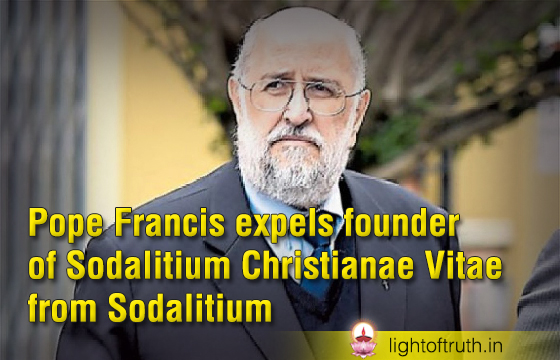
Pope Francis expels founder of Sodalitium Christianae Vitae from Sodalitium
The Sodalitium Christianae Vitae welcomes the decision of the Holy Father, Pope Francis, to expel Luis Fernando Figari Rodrigo from the Sodalitium, as announced by the Peruvian Con-ference of Bishops. This measure is a gesture of pastoral charity, justice, and reconciliation within our community and with all those who have been affected by the abuses committed by Mr. Figari. We are grateful for it with filial adherence as part of the path of renewal that our community has been pursuing for several years under the guidance and accompa-niment of the Holy See. With this measure, Mr. Figari is now dissociated from our community. The authorities of the Sodalitium have closely collaborated with the Holy See in the pursuit of truth and justice, following the investi-gation of various allegations reported since 2011.
In September 2014, the Sodalitium imposed disciplinary measures on Luis Fernando Figari after receiving testimonies of abuses, which were approved by the Holy See. In 2016, he was declared persona non grata by the Sodalitium. In 2017, the Holy See imposed new disciplinary mea-sures, which were confirmed in 2018 after dismissing the appeals that Mr. Figari submitted.
After much reflection and dialogue, in December 2019, I requested the Holy See to expel Mr. Figari from the Sodalitium.
In 2019, the V General Assembly of the Sodalitium in Brazil expressed an institutional apology to all the victims who have suffered any kind of abuse by Luis Fernando Figari and entrusted me, as Superior General, to assess the pertinence of initiating a canonical process for his expulsion.
As part of the mandate entrusted by the Holy Father to the Special Mission Scicluna-Bertomeu sent to our community and the collaboration we have been developing with it, the Dicastery for Institutes of Consecrated Life and Societies of Apostolic Life issued the decree of expulsion, which has the approval of Pope Francis. As we have stated previously, Luis Fernando Figari is the historical founder of the Sodalitium of Christian Life but is not a spiritual reference for our community or the Sodalite Family.

Pope Francis Receives in Private Audience Innocent Man Who Spent 33 Years in Prison
In an emotional private meeting, Pope Francis received Beniamino Zuncheddu, a Sardinian shepherd, who spent over three decades in prison for a crime he didn’t commit. The meeting, which took place in the Apostolic Palace’s Library, represents a powerful act of reconciliation and hope for a man who, after 33 years in prison, was finally exonerated early this year. Zuncheddu, who in 1991 was accused of committing a tripple murder when he was only 26, faced a long and torturous legal process that kept him behind bars until January 2024, when Italy’s Court of Appeal acknowledged his innocence. For years he endured inhuman conditions in various prisons, sharing crowded cells and facing great physical and emotional challenges. But his faith and love for his family gave him the necessary strength to surmount each day.
In his audience with the Holy Father, Zuncheddu presented his book entitled “Io Sono Innocente” [“I Am Innocent”], written together with his lawyer. In this work he talks not only about the injustice he suffered, but also about his internal journey of forgiveness and healing. Despite the profound pain caused by the false accusation, Zjuncheddu decided to forgive the one who erroneously singled him out as culpable, thus showing notable spiritual and moral strength.
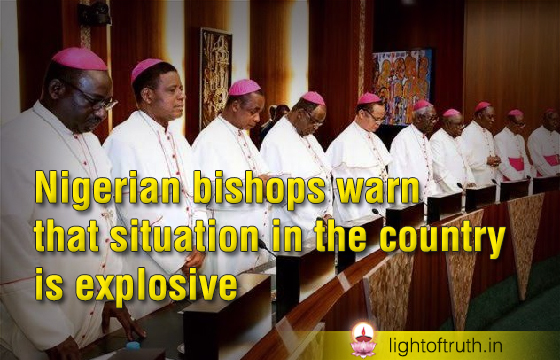
Nigerian bishops warn that situation in the country is explosive
The Catholic Bishops of Nigeria have warned that unless the government seriously addresses the issues of widespread poverty, hardship and corruption, the African nation should be ready to contend with more protests in the near future.
The alarm was launched on August 25 by Archbishop Lucius Ugorji of Owerri, the President of Catholic Bishops Conference (CBCN) as the bishops gathered in Auchi, Edo State, for their second general Assembly this year.
In recent weeks Nigeria has been facing significant unrest due to widespread protests against President Bola Tinubu’s economic reforms to address the nation’s growing debt burden and budget deficit.
The protests, that began in early August under the hashtag #EndBadGovernance, are driven by growing frustration over severe economic hardships, including soaring inflation, a weak currency, and the removal of fuel subsidies. These issues have led to a dramatic increase in the cost of living, with many Nigerians struggling to afford basic necessities like food and transportation. President Tinubu’s economic reforms, which were intended to stabilize the economy, have instead exacerbated the situation for many Nigerians, leading to widespread discontent.
The protests, however, have turned violent in some areas, particularly in northern states like Kaduna, where several demonstrators have been killed. Curfews have been imposed in various states, including Kano and Plateau, to curb the unrest.
Commenting these developments at the opening of the assembly, Archbishop Ugorji, condemned the violence by some rioters, but also the killing of some protesting youths by security forces. He remarked that: “As long as the nation is afflicted with poverty, hardship and corruption, and as long as the future of youths in our nation remains bleak, we continue to experience protest.”
He, therefore, criticized the federal government’s response, in particular that of some government officials who, “rather than address the ill”, are shifting their responsibility on others, “looking for a scapegoat”.
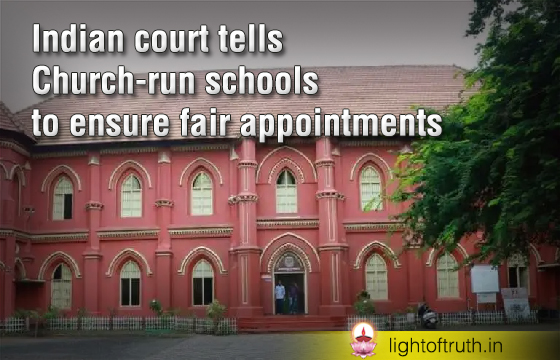
Indian court tells Church-run schools to ensure fair appointments
A top court has asked a Protestant diocese in southern India to appoint teachers irrespective of their caste, religious, and denominational backgrounds since their salaries are paid from the state exchequer.
The Madurai bench of the Madras High Court in Tamil Nadu state declared unconstitutional a list of prospective teachers prepared by the Tirunelveli diocese of the Church of South India (CSI) for appointment in schools managed by the diocese. The court said the list violated the principles of secularism. “When the salary is paid out of the state exchequer, the elementary principles of secularism demand that the appointment process is thrown open to all eligible candidates,” said Justice G R Swaminathan in his Aug. 8 order. A copy of the order was released to the media two days ago. “The appointment process as of today is patently discriminatory. To say that only a candidate of a particular religious denomination is entitled to apply for a post runs counter to constitutional morality,” said Swaminathan. The order came during the hearing of a petition filed by C Manohar Thangaraj, the treasurer of Tirunelveli Diocese. The petition accused the bishop of making unilateral appointments based on the diocesan priority list rather than inviting applications from eligible candidates. The court also stressed the need for transparency in the selection process, saying, ” Of course, all this can come to naught if the recruitment process is rigged and predetermined.” India’s constitution allows minority groups like Christians and Muslims to run educational institutions. The respective state governments pay the salaries for teachers in aided schools.
The Church in India runs more than 50,000 educational institutions, including schools and 400 colleges, six universities, and six medical schools. Catholic Church officials called the court order “a matter of concern.” A minority-run education institution has the right to appoint its staff from “the respective community on a priority basis,” noted Father Thankachan Jose, former national president of the All-India Association of Catholic Schools. Thankachan told UCA News on Aug. 26 that a minority education is bound to give priority to the community. “Provided there is no qualified or skilled candidate within, we may seek to appoint a candidate from outside,” the priest said. But “priority is given to a candidate from the community.” Father Maria Charles, secretary of the Catholic Bishops’ Council of Indian office for education, said Catholic schools do not restrict jobs only to Catholics or Christians. He told UCA News they “will take a call after consulting with our legal team.”
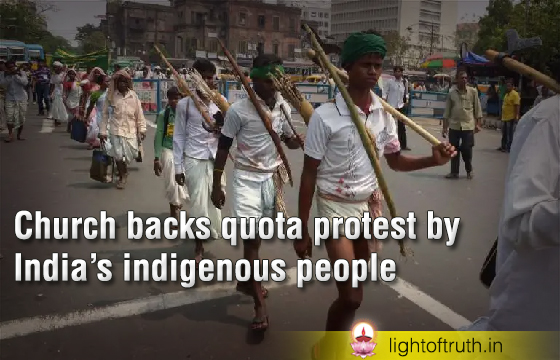
Church backs quota protest by India’s indigenous people
Church leaders have warned the government against diluting India’s affirmative action policy that gives job and education quotas to the country’s marginalized people following a top court order on Aug. 1. They have backed a day-long nationwide protest on Aug. 21 by former untouchables (Dalits) and tribal people under the aegis of the National Confe-deration of Dalit and Adivasi (tribal) Organizations (NACDA-OR) against a Supreme Court order that asked the government to identify a “creamy layer,” or wealthy group, benefiting from the affirmation action that India initiated after independence from Britain in 1947. A few of them have indeed been educated and secured government jobs. But if their success stories are removed, there would be no one left to raise concerns, said Bishop Sarat Chandra Nayak, chairman of the Catholic Bishops’ Conference of India (CBCI) Office for Scheduled Castes (SCs) and Other Backward Castes (OBCs). We agree with NACDAOR’s demand for a new law to keep the reservation quota intact following the court order, added Bishop Nayak. Grouped under Hinduism, Dalits in India are categorized as Scheduled Castes (SCs) and tribal people as Scheduled Tribes (STs) by the constitution. The former untou-chables are eligible for a 15% quota, and indigenous people are eligible for 7.5% of government jobs and places in educational institutions and legislative bodies, including the Lok Sabha (India’s lower house). “Calling for creat-ing a creamy layer is not in tune with the spirit and principles of the constitution,” the prelate told on Aug. 21. After all, “there is no provision for a creamy layer in their reservation quota,” asserted Bishop Nayak while supporting the Bharat Bandh (all-India protest) against the court order.
A constitutional bench of seven judges issued the order on August 1, allowing sub-classi-fication within the castes and tribes.
“The state must evolve a policy to identify the creamy layer among the Scheduled Castes and Scheduled Tribes and exclude them from the fold of affirmative action,” the judges told the government in the order. Scheduled Castes and Scheduled Tribes comprise about 16.6 percent of India’s 1.4 billion people. Under the Hindu caste system, they are treated as inferior and, hence, destined to toil for the other three upper castes in the hierarchy. Though they do not follow Hindu rituals and customs, Britain grouped them under Hinduism when it conducted a census in the Indian subcontinent during its colonial occupation. Christians in India number nearly 25 million and 60 percent of them are from marginalized groups and ethnic communities. However, they have been excluded from the affirmative action policy despite repeated demands and court cases.
There are many pro-Hindu groups and right-wing intellectuals in the country who oppose the seven-decade-old affirmative action. “This seems to be a ploy against reservation,” Bishop Nayak warned. Father Nicholas Barla, who recently resigned as secretary of the CBCI Office of Scheduled Tribes, termed the Supreme Court order inappropriate. Barla told UCA News on Aug. 21 that there is no strong base for a creamy layer as the government has failed to implement the reservation policy in letter and spirit. “Let the government come out with the data to show how effectively it has implemented the reservation policy,” the priest demanded. The nationwide protest, supported by nearly 21 Dalit and ethnic organizations, was peaceful and normal life was largely unaffected. However, it evoked a mixed response in Bihar, Rajasthan and Jharkhand. Transport services were partly hit in Odisha, four northern Indian states known for their strong tribal communities and Dalits. Political parties like the Rashtriya Janata Dal, the Bahujan Samaj Party, the Congress, the Jharkhand Mukti Morcha and the Left have supported the protest. The federal government, led by Hindu right-wing Bharatiya Janata Party of Prime Minister Narendra Modi, said it was against creating a creamy layer in the reservations quota.