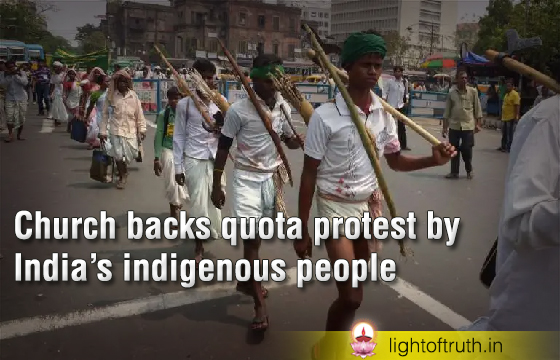
Church leaders have warned the government against diluting India’s affirmative action policy that gives job and education quotas to the country’s marginalized people following a top court order on Aug. 1. They have backed a day-long nationwide protest on Aug. 21 by former untouchables (Dalits) and tribal people under the aegis of the National Confe-deration of Dalit and Adivasi (tribal) Organizations (NACDA-OR) against a Supreme Court order that asked the government to identify a “creamy layer,” or wealthy group, benefiting from the affirmation action that India initiated after independence from Britain in 1947. A few of them have indeed been educated and secured government jobs. But if their success stories are removed, there would be no one left to raise concerns, said Bishop Sarat Chandra Nayak, chairman of the Catholic Bishops’ Conference of India (CBCI) Office for Scheduled Castes (SCs) and Other Backward Castes (OBCs). We agree with NACDAOR’s demand for a new law to keep the reservation quota intact following the court order, added Bishop Nayak. Grouped under Hinduism, Dalits in India are categorized as Scheduled Castes (SCs) and tribal people as Scheduled Tribes (STs) by the constitution. The former untou-chables are eligible for a 15% quota, and indigenous people are eligible for 7.5% of government jobs and places in educational institutions and legislative bodies, including the Lok Sabha (India’s lower house). “Calling for creat-ing a creamy layer is not in tune with the spirit and principles of the constitution,” the prelate told on Aug. 21. After all, “there is no provision for a creamy layer in their reservation quota,” asserted Bishop Nayak while supporting the Bharat Bandh (all-India protest) against the court order.
A constitutional bench of seven judges issued the order on August 1, allowing sub-classi-fication within the castes and tribes.
“The state must evolve a policy to identify the creamy layer among the Scheduled Castes and Scheduled Tribes and exclude them from the fold of affirmative action,” the judges told the government in the order. Scheduled Castes and Scheduled Tribes comprise about 16.6 percent of India’s 1.4 billion people. Under the Hindu caste system, they are treated as inferior and, hence, destined to toil for the other three upper castes in the hierarchy. Though they do not follow Hindu rituals and customs, Britain grouped them under Hinduism when it conducted a census in the Indian subcontinent during its colonial occupation. Christians in India number nearly 25 million and 60 percent of them are from marginalized groups and ethnic communities. However, they have been excluded from the affirmative action policy despite repeated demands and court cases.
There are many pro-Hindu groups and right-wing intellectuals in the country who oppose the seven-decade-old affirmative action. “This seems to be a ploy against reservation,” Bishop Nayak warned. Father Nicholas Barla, who recently resigned as secretary of the CBCI Office of Scheduled Tribes, termed the Supreme Court order inappropriate. Barla told UCA News on Aug. 21 that there is no strong base for a creamy layer as the government has failed to implement the reservation policy in letter and spirit. “Let the government come out with the data to show how effectively it has implemented the reservation policy,” the priest demanded. The nationwide protest, supported by nearly 21 Dalit and ethnic organizations, was peaceful and normal life was largely unaffected. However, it evoked a mixed response in Bihar, Rajasthan and Jharkhand. Transport services were partly hit in Odisha, four northern Indian states known for their strong tribal communities and Dalits. Political parties like the Rashtriya Janata Dal, the Bahujan Samaj Party, the Congress, the Jharkhand Mukti Morcha and the Left have supported the protest. The federal government, led by Hindu right-wing Bharatiya Janata Party of Prime Minister Narendra Modi, said it was against creating a creamy layer in the reservations quota.

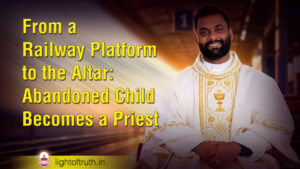
From a Railway Platform to the Altar: Abandoned Child Becomes a Priest
Twenty-eight years ago, a frightened five-year-old boy was found alone at Shoranur railway station. He had no memory of his parents or a family to