All posts by Light of Truth

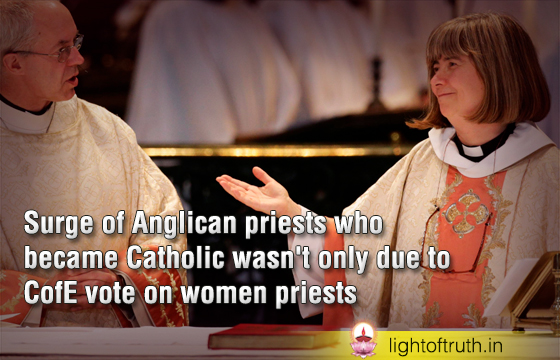
Surge of Anglican priests who became Catholic wasn’t only due to CofE vote on women priests

A new study has revealed the scale of Anglican clergy who entered into full communion with the Catholic Church over the past three decades, with hundreds of vicars and even entire groups of ministers making the journey to Rome.

The research, published on 20 November by St Mary’s University, Twickenham, shows that roughly a third of all Catholic priests ordained in England and Wales between 1992 and 2024 were formerly Anglican, marking what scholars describe as one of the most significant shifts in the religious landscape since the Oxford Movement.

The report finds that about 700 clergy and religious from the Church of England, the Church in Wales and the Scottish Episcopal Church, have been received into the Catholic Church since the early 1990s. Among them were 16 Anglican bishops and two from the Continuing Anglican movement, a cluster of churches with an Anglican identity but outside the Anglican Communion. The trend is long-running but began in earnest following the Church of England’s vote in 1992 to ordain women priests, an event that the study identifies as a watershed moment for many.

Prof Stephen Bullivant, co-author of the study from the Benedict XVI Centre for Religion and Society, said the findings showed “unequivocally a surge” in conversions after the contentious Synod vote. The legislation passed by a margin of just two votes after hours of debate, as demonstrators gathered outside Church House in Westminster to voice both support and opposition.

Prof Bullivant said those Anglcian priests who subsequently entered the Catholic Church did so “for various reasons”, but acknowledged that “the Synod vote on women priests was a big one in the 1990s”. For others, he said, the decision emerged from deeper spiritual reflection: “Some had reached a point in their lives where they felt that the time was right, this was something which had been on their conscience for a long time.”

The report also points to Pope Benedict XVI’s state visit to Britain in 2010 as another catalyst. During that visit, he beatified Cardinal John Henry Newman, himself a former Anglican priest whose reception into the Catholic Church in 1845 reshaped the ecclesial landscape of Victorian England. “Cardinal Newman is a real hero among Anglicans and Catholics,” Prof Bullivant said. “However, most of these people [converts] have a long and very personal journey.”
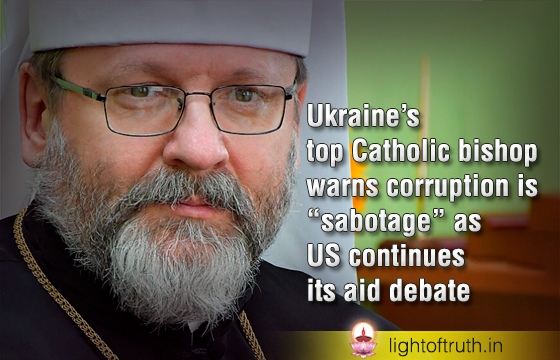
Ukraine’s top Catholic bishop warns corruption is “sabotage” as US continues its aid debate

Major Archbishop Sviatoslav Shevchuk has issued one of his starkest warnings of the war, condemning what he called a destructive network of corruption uncovered within Ukraine’s energy sector.

In his weekly video message, delivered in the 196th week of the Russian invasion, the head of the Ukrainian Greek Catholic Church said the revelations had caused “anguish” across the country as investigators alleged that officials siphoned off about $100 million from state-owned energy companies.

“Our law enforcement agencies have uncovered a criminal corruption scheme that was destroying Ukraine’s energy system,” he said. “We share the pain of our society and, fulfilling the prophetic role of the Church, we consistently denounce and condemn the phenomenon we call corruption.”

His remarks came amid sustained military pressure, with heavy fighting around Pokrovsk and renewed Russian attempts to push further into Ukrainian territory.

The Major Archbishop praised the “heroic resistance” of Ukrainian troops holding the line both in the east and near Zaporizhzhia, but said the domestic scandal had deepened the nation’s distress at a time when many households already struggle with shortages of heat and electricity. Corruption in wartime, he said, amounted to an assault on Ukraine’s survival, describing it as “a gross act of sabotage”.

He stressed that the exposure of the scheme by Ukrainian authorities was a sign of institutional resolve. He called it “encouraging” that state bodies were confronting the problem directly and urged continuing vigilance. “We hope that the Ukrainian state, our government, will consistently fight and stop this phenomenon,” he said.

He added that Ukrainians themselves, through civil society, parish life and public engagement, were shaping “the necessary public opinion, which has declared zero tolerance for any manifestations of this evil — moral, social, economic — in our society”. Corruption, he insisted, was not only a moral wrong but “a crime against Ukraine”.

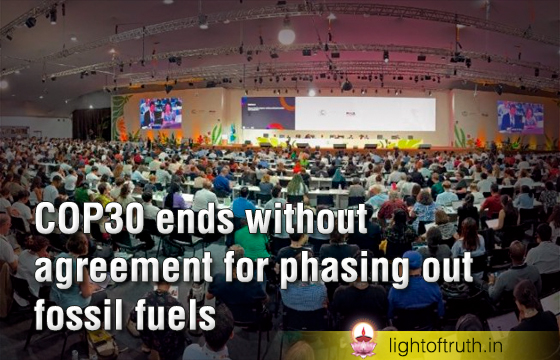
COP30 ends without agreement for phasing out fossil fuels

The halls of COP30 are empty, and as the final gavel fell, there was a sense that something essential had slipped away. What began with remarkable promise under Brazil’s presidency concluded instead with “disappointment, and, for many, the unsettling feeling of having watched the multilateral climate process take a step backwards”. “It’s been my fifteenth COP,” says Professor John Sweeney, emeritus climatologist from Maynooth University in Ireland, “and this one followed very predictable lines.” But this year’s conclusion, he stresses, is marked less by the expected frustrations and more by the collapse of ambitions many thought finally within reach.

Sweeney explains that Brazil had laid significant groundwork ahead of the summit. Hosting the conference in the Amazon carried a symbolism and urgency that the world could not ignore. The presidency hoped to produce clear commitments on forest protection, fossil fuel phase-out, and finance for vulnerable nations. Yet, as negotiations stretched deep into the night and into the weekend, the final text emerged stripped of its strongest language.

“The big winner,” Sweeney says in an interview with Vatican News “is sitting in Washington.” A meeting between the United States and Saudi Arabia, days before the final plenary, appeared to seal the fate of the communiqué: any mention of fossil fuels was removed. For the vast majority of nations pressing for decisive language on the root causes of climate change, it was a bitter defeat.

For the first time in 30 years of UN COPs, the White House had no official representation at the event in Belém. A decision that had a negative impact on the outcome of the Conference. Outside, the conference venue had battled other disappointing, somewhat climate reflecting realities, such as flooding, leaks, and even fire – all symbolic interruptions that did not go unnoticed by observers.

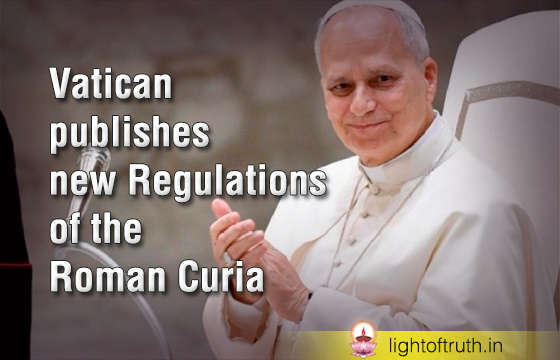
Vatican publishes new Regulations of the Roman Curia

The new General Regulation and Personnel Regulation of the Roman Curia, promulgated by Pope Leo XIV and set to take effect on 1 January 2026, signal a significant recalibration of how the Church intends to govern itself from within. Wrapped in the language of pastoral service and missionary identity, the two documents amount to a blueprint for a more accountable, transparent, and professionally structured central administration.

 Although presented as provisional — ad experimentum, for a five-year period — the reforms are, in substance, anything but experimental. They reflect a clear continuity with the major constitutional overhaul initiated by Pope Francis in 2022 through Praedicate Evangelium, a text that reconfigured the architecture of the Curia but left its internal operating rules to be rewritten by a future pontificate. Leo XIV, elected on 8 May as the late Francis’ successor, has now taken up that unfinished work.

 The new General Regulation applies to every organism forming the Curia: the Secretariat of State, the dicasteries, the tribunals, and the economic bodies entrusted with the Vatican’s finances. It creates a more coordinated administrative culture, beginning with something as banal — yet long overdue — as shared timetables. A minimum 36-hour work week is now mandated for all Curial institutions, coupled with regular meetings convened by the Secretary of State to harmonize their activities. It is a small but symbolic gesture toward a Curia that is meant to function as a single service body rather than a cluster of autonomous fiefdoms.

Where the regulations take a sharper tone is in matters of personnel. In a city-state often accused of opaque hiring practices and internal loyalties, the new rules impose strict barriers against nepotism. No office may employ close relatives of current staff, and recruitment is restricted to candidates whose professional competence is matched by a lived commitment to the Catholic faith, sound moral character, and — explicitly — a clean criminal record. These criteria apply to all staff, including the increasing number of lay men and women who now hold technical and administrative posts.

 Leadership appointments, from prefects of dicasteries to their secretaries, remain the prerogative of the Pope, but the regulations codify a five-year term for such roles, reinforcing the reform-era principle that no Curial office is held indefinitely. Lay employees, meanwhile, will enter on probationary contracts lasting at least one year and no more than two, another step intended to professionalize a workforce historically shaped more by ecclesiastical custom than by modern personnel practices.

Transparent governance — a hallmark of Francis’ pontificate — receives particular emphasis. Every senior official must submit a biennial declaration confirming that he or she holds no assets in offshore financial centres and no stakes in companies that contradict Catholic social teaching. The omission of such declarations, or the submission of false ones, is now classified as a serious disciplinary offense.

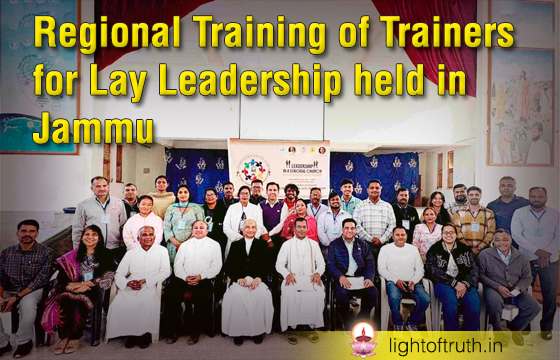
Regional Training of Trainers for Lay Leadership held in Jammu

The Commission for Laity organised a two-day Regional Training of Trainers (ToT) for lay leaders of the Northern Region at Maithri Bhavan, the Diocesan Pastoral Centre (DPC), Jammu, under the Diocese of Jammu–Srinagar. The training, held from 7 to 8 November, revolved around the theme “Leadership in a Synodal Church.”

A total of 40 lay leaders from four dioceses—Archdiocese of Delhi, Jammu–Srinagar, Shimla–Chandigarh, and Jalandhar—participated in the programme. The event was graced by Dr. Sahaya Thatheus Thomas, Chairman of the Laity Commission, Northern Region, and Dr. Ivan Pereira, Bishop of Jammu–Srinagar. Both prelates, along with other regional leaders, lit the ceremonial lamp to inaugurate the training.

In their addresses, both bishops underscored the vital role of lay leaders in fostering a truly Synodal Church. The sessions were led by Fr. Anthony Fernandes, National Executive Secretary for Laity, and Ms. Seanna Rodrigues, a professional trainer. Their inputs centred on pastoral and people-oriented leadership, exploring topics such as Mindfulness and Self-Values for Synodal Leadership, Servant Leadership, Creative Collaboration in Ministry, and Jesus’ Model of Leadership. The training encouraged active participation through group discussions and diocesan-level planning.

Adding a touch of camaraderie, cultural activities and team-building games enlivened the two-day programme, fostering fellowship and collaboration among the participants. The training concluded with diocesan teams presenting concrete action plans aligned with the National Pastoral Plan 2033, focusing on strengthening pastoral leadership at parish, deanery, and diocesan levels. The Regional ToT proved to be an enriching and empowering experience, equipping lay leaders to serve more effectively in the spirit of synodality.

Bishop appeals for prayers for jailed priest

Bishop Niranjan Sualsingh of Sambalpur in Odisha has urged his faithful to join in prayer for a diocesan priest arrested following a motorcycle accident. The Bishop’s November 11 circular asked Catholics and people of goodwill “to keep Father Paul Adapoor in their prayers, that he may be strengthened by faith and delivered from his present trials.”

Expressing deep concern, the Bishop wrote, “It is with great sadness that I inform you about an unfortunate incident involving Fr. Paul Adapoor, the Parish Priest of Meghpal Parish.” On November 9 at around 2:00 p.m., Fr. Paul was returning from Sambalpur to Meghpal when his vehicle was involved in an accident near Hiro village, under the jurisdiction of Jujumura Police Station. A motorcyclist, allegedly under the influence of alcohol, collided with Fr. Paul’s vehicle and died at the scene.

Following the accident, a crowd gathered at the scene. In the ensuing tension, Fr. Paul was physically assaulted by some members of the mob. The police intervened promptly, rescued him, and took him to Jujumura Police Station for his safety and to complete the necessary legal formalities. A case has been registered under Sections BNS 281 and 106/1, but regrettably, Section 105 has also been falsely added. Due to this additional charge, Fr. Paul was denied bail and was sent to Sambalpur Jail on November 10.

“We are in close contact with the concerned authorities and are taking all necessary legal steps, including applying for bail at the District Court. We remain confident that truth and justice will prevail and that Fr. Paul will be released soon,” the Bishop assured.

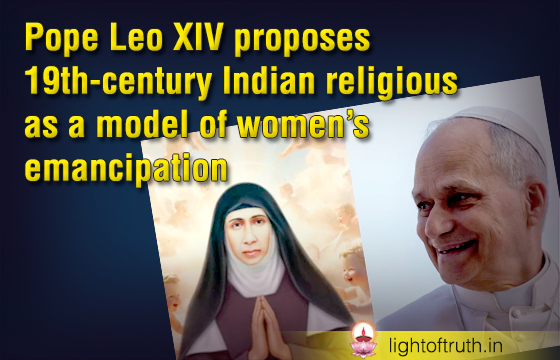
Pope Leo XIV proposes 19th-century Indian religious as a model of women’s emancipation

Pope Leo XIV spoke of the beatification this week of Mother Eliswa Vakayil, a 19th-century Indian religious and founder of the Third Order of the Teresian Discalced Carmelites, highlighting her “courageous commitment to the emancipation of the poorest girls.” “The witness of Mother Eliswa Vakayil,” the pope affirmed during his greetings in Italian at the end of his general audience on Nov. 12, “is a source of inspiration for all who work in the Church and in society for the dignity of women.”

The beatification ceremony on Nov. 8 was held in the square in front of the Basilica-Shrine of Our Lady of Ransom in Vallarpadam, Kochi, in the Indian state of Kerala, and was presided over by Cardinal Sebastian Francis, Archbishop of Penang, Malaysia.

Before thousands of faithful and men and women religious from across the country, the cardinal emphasized that the new blessed represents “a beacon of hope” for all “consecrated women, for all mothers, and for all those who suffer in silence and yet choose to love,” according to Vatican News.

During the homily at the beatification, the cardinal emphasized the “inclusive vision” of Mother Eliswa Vakayil, with which she “was ahead of her time and is a true expression of synodality in action: walking together in communion.” The new blessed, he added, “shows the way” to the Church on its synodal journey “listening, discerning, and walking together.” 

The foundation of her “unwavering faith,” he affirmed, “lies in her spirituality, vision, and mission, all rooted in her identity as a faithful disciple of Jesus Christ through baptism, the very heart of synodality.” With the official recognition of her holiness, the Church proposes Mother Eliswa Vakayil  as a model of evangelical life embodied in service to the poor, in the promotion of women, and in the building of fraternal communities.

Church leaders express sorrow over deaths in Delhi car blast

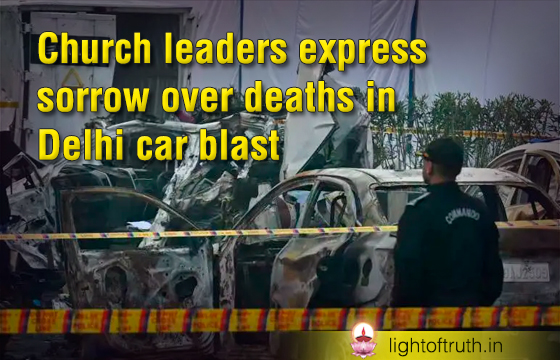
Church leaders in India have expressed deep sorrow over the reported loss of 13 lives in a powerful explosion near Delhi’s historic Red Fort on the evening of Nov. 10. The explosion took place around 6:52 p.m. inside a car near a traffic signal in a crowded area, injuring around 24 people and damaging other vehicles, said Federal Home Minister Amit Shah

Authorities are investigating the cause of the explosion, which is suspected to have been triggered either by a CNG (compressed natural gas) cylinder or a low-intensity improvised explosive device (IED). Officials have yet to formally confirm the cause of the blast or name suspects, but they appear to be treating the explosion as a potential act of terrorism, not just a criminal or accidental blast, according to media reports.

The entire area around the 17th-century Mughal fortress, visited by thousands of tourists every day, and where Indian prime ministers give their Independence Day speeches each year, has been sealed off. India’s national capital and other major cities have been placed on high security alert.

“The Catholic Church in New Delhi joins others to condole the lives lost in the blast and pray for the speedy recovery of the people who are injured,” said Father Savarimuthu Sankar, spokesperson of Delhi archdiocese. He hoped that the federal government would take all the necessary steps to uncover the truth behind the blast and maintain peace. “The Church has always stood for peace and promotes brotherhood among all faiths, and hopes innocent lives are not lost in mindless violence,” Sankar said.

A C Michael, the convenor of the ecumenical United Christian Forum, said civil society needs to work closely with the government of the day to ensure social harmony in the country in difficult times. “It is the responsibility of the incumbent government to maintain harmony in the country,” said the Catholic lay leader, who is a former member of the Delhi Minorities Commission. Michael said that politicians should avoid making statements that “create unnecessary divisive feelings among the citizenry.”

Indian tribal Christian women launch hunger strike over police inaction

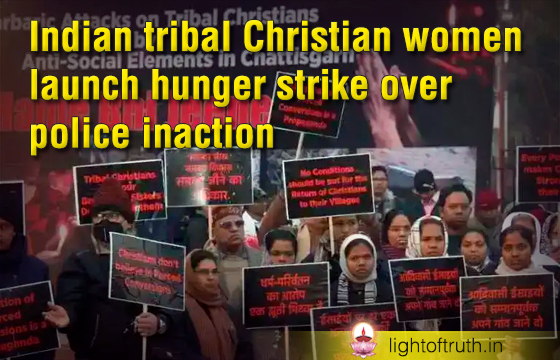
Three Christian tribal women, who were intimidated and assaulted by Hindu activists at a railway station in central India’s Chhattisgarh state four months ago — an incident that also led to the arrest of two Catholic nuns — have begun a relay hunger strike demanding justice.

The women, joined by their families and supporters, launched an “indefinite relay fast” on Nov. 10 outside the Narayanpur district headquarters. “The women were forced to take this extreme step as police failed to register a case against their attackers–Hindu activists,” said Phulsingh Kachlam, district secretary of the Communist Party of India (CPI), which is backing their protest.

The Chhattisgarh State Women’s Commission, a statutory body, had on Oct. 8 directed the state’s Director General of Police to file a case based on the women’s complaints. The official was given two weeks to comply and report back. But the order remains unimplemented. “Nothing has been done,” one of the women said, speaking on condition of anonymity. “We will continue our fast until we get justice.” Their demand is straightforward, she said — to register a police case documenting the incident.

The July 25 assault took place at Durg railway station, where the women and two nuns from the Assisi Sisters of Mary Immaculate — Sisters Vandana Francis and Preeti Mary — were stopped by Hindu activists, including some women.

Christian leaders say Hindu groups target Christians in their attempt to turn India into a Hindu-only nation. Last year, the United Christian Forum, a New Delhi-based ecumenical rights group, documented 165 anti-Christian incidents in the state — the second-highest number in India. Christians make up less than 2 percent of Chhattisgarh’s roughly 30 million people.

Dalit Liberation Sunday Observed Across India

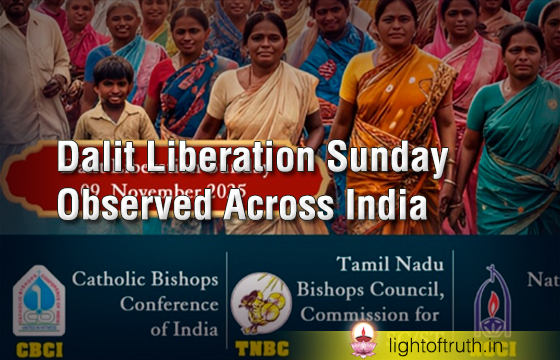
Dalit Liberation Sunday, observed annually on the second Sunday of November, was celebrated across India on November 9, reaffirming the Church’s commitment to justice and equality for Dalit Christians.

Speaking to Catholic Connect News, Fr. Vijay Kumar Nayak, Secretary, CBCI Office for Scheduled Castes/Backward Classes (CBCI), explained that the observance was officially approved by the CBCI in 2016 “for the cause of Dalits.”

“Dalit Liberation Sunday is approved by the Catholic Church from 2016 onwards. The Catholic Bishops’ Conference of India has dedicated the second Sunday of November for this purpose,” Fr. Vijay Kumar Nayak said.