All posts by Light of Truth

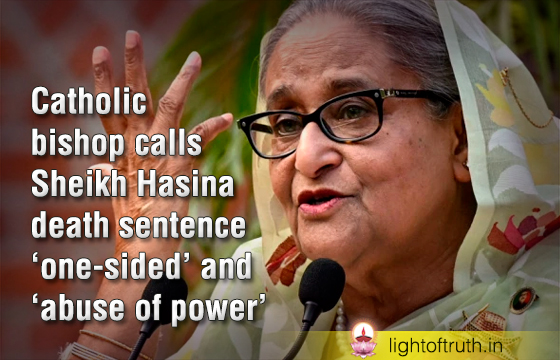
Catholic bishop calls Sheikh Hasina death sentence ‘one-sided’ and ‘abuse of power’

The secretary of the Bangladesh Catholic Bishops’ Conference has criticized the death sentence given to ousted Prime Minister Sheikh Hasina as unilateral and politically motivated, reaffirming the Church’s opposition to capital punishment.

Bishop Ponen Paul Kubi, CSC, of the Mymensingh Diocese, told CNA that the verdict handed down Nov. 17 by Bangladesh’s International Crimes Tribunal was “one-sided” and that “the accused had no lawyer and that the current government used political power to give this verdict.”

“The Catholic Church has never supported the death penalty,” Kubi said. “I think that even if Sheikh Hasina committed a crime, she should be punished in a way that is remedial.”

Describing the verdict as an abuse of power, Kubi added: “If we judge in a hurry and give a verdict as we wish, we are no longer living in civilization, we have gone back to the primitive era.”

The Bangladesh International Crimes Tribunal found Hasina, 78, guilty of crimes against humanity related to the deadly crackdown on student-led protests in July and August 2024. The court sentenced both Hasina and her former home minister, Asaduzzaman Khan Kamal, to death in absentia. Former Inspector General of Police Chowdhury Abdullah Al-Mamun was sentenced to five years in prison after turning state witness.

The 453-page verdict, broadcast live on state television beginning around 12:30 p.m. local time Monday, found Hasina guilty on three of five charges, including ordering the use of drones, helicopters, and lethal weapons against protesters, and failing to prevent mass killings.
How an American missionary empowered Bangladesh’s Christian community

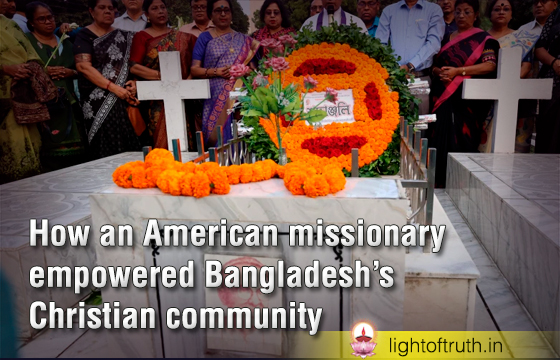
On the 37th anniversary of his death, Bangladesh’s Christian community honoured an American Holy Cross priest and microcredit pioneer who transformed their economic future — Father Charles Joseph Young, whose cooperative credit union has grown from 50 members and barely any money in 1955 to 46,000 members with $122.6 million in capital today.

On Nov. 14, the country’s most respected cooperative, the Christian Cooperative Credit Union Ltd., Dhaka — known as Dhaka Credit — and other cooperatives marked Young’s death anniversary with events including tributes at his grave, a Mass, and public discussions on his life and impact.

“If Dhaka Credit had not stood by me today, I would not have been a successful businesswoman and entrepreneur,” said 45-year-old Shukli Kubi, a Garo tribal mother of two.

Kubi, originally from a rural area in Mymensingh Diocese in central Bangladesh, came to Dhaka in search of a livelihood and started working in a beauty parlour for just 500 taka (the equivalent of $4 today) about 15 years ago. After gaining experience, she has now opened a parlour of her own and is considering a loan from Dhaka Credit to expand.

“I easily took a loan from Dhaka Credit to buy at least 150 decimals of land in the village and opened a beauty parlour in Dhaka, where 10 employees are now working,” she said.

Many workers in Kubi’s parlour have gone on to open their own, albeit on a smaller scale, and she is planning to expand further. “I tell people, save some money in Dhaka Credit and take a loan to buy land for yourself or start a business like me,” Kubi said.

Dhaka Credit is a cooperative run by lay Christians in Bangladesh, founded in 1955 under Young’s leadership. The organization, which started with only 50 members and a capital of 25 taka (the equivalent of about $0.20 today), now has 46,000 members and a capital of about $122.6 million. It operates the Divine Mercy Hospital Ltd., a 300-bed facility — the first hospital established by lay Christians in the country — with more than a thousand employees.

At the time of its founding, Catholics in Bangladesh were financially vulnerable and often forced to take loans from landlords at high interest rates. Young established the credit union movement to lift the Christian community out of poverty, explained Michael John Gomes, president of Dhaka Credit. Gomes noted that, due to Young’s influence, more than 250 cooperatives now exist in parishes across the country.

To keep Young’s legacy alive, Dhaka Credit established the Father Charles J. Young Foundation, which benefits people of all religions in Bangladesh. The foundation seeks to create employment for poor and educated unemployed youth via skills training, educational support, and research.

Philippine bishops urge military not to destabilize the Marcos government

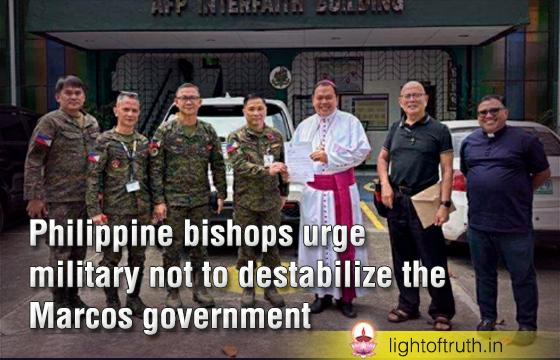
Catholic bishops urged the Philippine military to refrain from any destabilizing efforts against President Ferdinand Marcos Jr. amid alleged flood control controversy involving government officials and others. On Nov. 14, former congressman Elizaldy “Zaldy” Co accused Marcos and his cousin and former House Speaker Martin Romualdez of alleged involvement in the insertion of 100 billion pesos ($1.69 billion) in the 2025 national budget.

The presidential palace denied Co’s charges and said that Co must return to the Philippines from the United States and “sign everything he said under oath with the proper judicial authorities.” Meanwhile, some former military officials, groups, and political parties have called for the resignation of Marcos.

In the aftermath of Co’s alleged revelations and calls for Marcos’ resignation from others, Cardinal Pablo Virgilio David, president of the Catholic Bishops’ Conference of the Philippines (CBCP), said Co should return to the Philippines and appear before the court to clarify his allegation with evidence.

“We likewise caution against the political exploitation of these allegations, especially when released at sensitive moments that may inflame public sentiment or be used to influence political outcomes. The Filipino people deserve clarity, not conjecture; truth, not rumour; and accountability, not manipulation,” the cardinal said. He also appealed to all to trust in the institutions tasked with safeguarding democracy.

On Nov. 15, Cardinal Jose Advincula, archbishop of Manila, called on the military “to stay faithful to your oath to the flag and our country” in a statement.

“In moments of mass gatherings and public discourse, we do not let emotion prevail over reason. We must always adhere to the rule of law and resist any calls for extra-constitutional means to solve our problems. Our loyalty must be to our country and its democratic principles, not to individuals, and certainly not to other self-serving motivations,” Advincula said.

“I urge all public servants, especially military and police, to honour their oath to the flag and our country, not to any one person. Your fidelity to the constitution is vital for the stability and integrity of our republic,” he said. According to Advincula, the Philippines’ present challenges “demand not just pragmatic solutions but a profound spiritual response. I plead with everyone to examine our consciences, reform our lives, and live according to God’s will.”

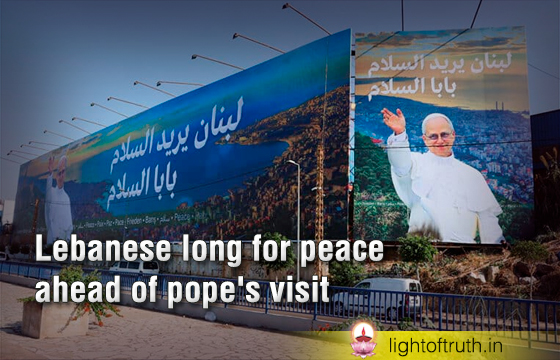
Lebanese long for peace ahead of pope’s visit

Lebanese Catholics yearn for the upcoming visit of Pope Leo XIV to achieve something lost in recent years. Signs bearing the pontiff’s photo along newly rebuilt roadways express their longing: “Lebanon wants peace.”

Indeed, Pope Leo comes as pilgrim of peace, with the motto for his visit to Lebanon taken from Jesus’ Sermon on the Mount: ‘Blessed are the peacemakers.'”

Pope Leo’s choice making Lebanon his first pastoral visit after marking the 1,700th anniversary of the Council of Nicaea in Turkey — underscores the importance the Vatican places on its influential Catholic community in the Middle East, Catholic leaders said of the Nov. 30-Dec. 2 papal trip.

But they added the pontiff also recognizes the need to undergird its Christian community as war, economic crisis and deadly disasters have taken a huge toll on the tiny Mediterranean country recently.

“This is a critical moment for Christians in all the Middle East; not only Lebanon,” said Michel Constantin, who is Catholic Near East Welfare Association-Pontifical Mission’s regional director for Lebanon, Syria and Egypt.

“Lebanon is still the only place in the region where Christians have a substantial presence in politics, governance, and economics. The president and army chief are Catholic, while Christians have a big say in the judicial system. Although they have lost a lot and they are still losing,” he told OSV News.

The Maronite Catholic Church is the largest and most powerful Christian denomination in Lebanon. By convention, the country’s president is always a Maronite.”While the Maronite community is prominent in Lebanon and it has contributed to the country since 1920 until now, the pope is coming to visit the Catholic family together, a visit for the whole church,” Father Jean Younes, secretary general of the Assembly of Catholic Patriarchs and Bishops of Lebanon, told OSV News.

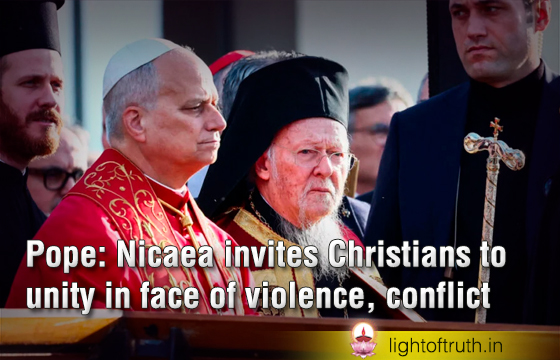
Pope: Nicaea invites Christians to unity in face of violence, conflict

At the site of ancient Nicaea, Pope Leo XIV joined around 27 other leaders of Christian Churches to commemorate the 1,700th anniversary of the First Ecumenical Council in the Church’s history. The ecumenical prayer service took place on the second day of the Pope’s Apostolic Journey to Türkiye.

In his address, the Pope thanked Patriarch Bartholomew I, Ecumenical Patriarch of Constantinople, for his “great wisdom and foresight” in calling for Church leaders to celebrate this important anniversary together. He also expressed appreciation to the Heads of Churches and Representatives of Christian World Communions for attending the event.

Pope Leo recalled that the Council of Nicaea was held in 325, saying it invites all Christians, even today, to ask ourselves who Jesus Christ is for us personally. “This question is especially important for Christians,” he said, “who risk reducing Jesus Christ to a kind of charismatic leader or superman, a misrepresentation that ultimately leads to sadness and confusion.”

The Council was held to respond to the Alexandrian priest Arius’ claim that Jesus was only an intermediary between God and humanity, saying He was not fully divine and ignoring the reality of the Incarnation. “But if God did not become man, how can mortal creatures participate in His immortal life?” asked Pope Leo. “What was at stake at Nicaea, and is at stake today, is our faith in the God who, in Jesus Christ, became like us to make us ‘partakers of the divine nature’.”

The Council of Nicaea, he said, agreed upon the Christological confession we now call the Nicene Creed, which is professed by all Christian Churches and Communities.

The Symbol of Faith, as it is known, was of “fundamental importance in the journey that Christians are making towards full communion.” “Faith ‘in one Lord Jesus Christ, the Only Begotten Son of God, born of the Father before all ages… consubstantial with the Father’ (Nicene Creed),” he said, “is a profound bond already uniting all Christians.”

The Pope invited Christians to embrace that existing bond of unity and journey ever deeper in “adherence to the Word of God revealed in Jesus Christ, under the guidance of the Holy Spirit, in mutual love and dialogue.” By overcoming divisions and reconciling with one another, Christians can bear more credible witness to Jesus Christ and His proclamation of hope for all, he said. Pope Leo XIV went on to say Christian unity is greatly needed in our world filled with violence and conflict.

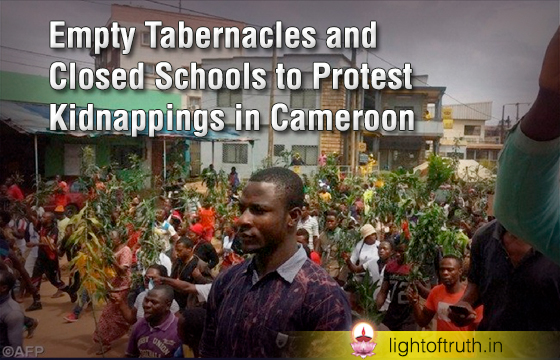
Empty Tabernacles and Closed Schools to Protest Kidnappings in Cameroon

In response to the increasing number of kidnappings of religious figures in the English-speaking region of Cameroon, Archbishop Andrew Nkea of ​​Bamenda has issued an unprecedented ultimatum. The latest kidnapping of a priest, Father John Berinyuy Tatah, prompted the Cameroonian Prelate to write a Pastoral Letter on November 23rd, threatening to close all Catholic institutions in the Ndop Deanery if the priest is not released by Wednesday, November 26th. On Saturday, November 15th, the priest and his assistant were kidnapped by a group of armed men, after the opening Mass of the Pax University Institute in Ndop. The kidnappers presented themselves as separatist fighters from «Ambazonia,» the self-proclaimed state that claims independence for the Anglophone regions of Cameroon. Days later, four priests and a layman attempted to negotiate the release of the hostages, but they too were taken captive. On the 20th , all were released except for Father John Berinyuy Tatah, for whom a ransom is being demanded. In response to this, the Archbishop of Bamenda declared in a Pastoral Letter that the position is clear: the Church never pays ransoms. The ultimatum issued by the Archbishop states that if the priest is not released, all parishes, schools, and Catholic institutions in the Deanery of Ndop — the northern part of the diocese where the kidnapping took place –, will be closed. Since neither the Archbishop himself nor the Christians he serves can guarantee the safety of the priests and religious personnel in the Deanery, the Blessed Sacrament will be removed from all churches, chapels, and oratories, leaving each tabernacle with its doors open.

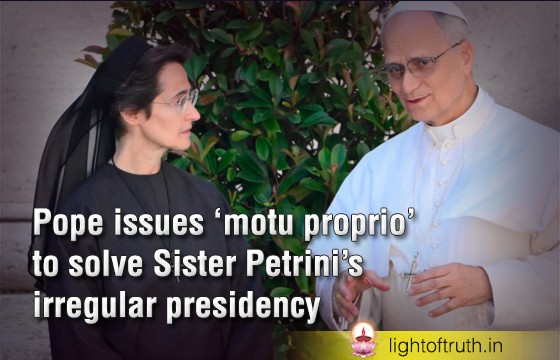
Pope issues ‘motu proprio’ to solve Sister Petrini’s irregular presidency

Pope Leo XIV has issued a motu proprio to restore legal clarity to the Vatican’s civil administration by formally permitting Sister Raffaella Petrini FSE to serve as President of the Pontifical Commission for Vatican City State. The document, signed on 19 November and released 21 November, amends the 2023 Fundamental Law so that the Commission “is composed of Cardinals and other members, including the President, appointed by the Supreme Pontiff for a five-year term”.

The motu proprio – Latin for “on his own impulse”, and which in Vatican parlance describes an official act taken without a formal request from another party – allows lay men, lay women, or religious sisters to lead the Commission by abrogating the Fundamental Law of Vatican City State Article 8, Section 1.

In his letter, Pope Leo speaks of “governance needs that are proving increasingly complex and pressing”, arguing that the governorate must operate in “a form of shared responsibility” consonant with the principles of Praedicate Evangelium.

The change by Leo replaces the previous wording, which required the president to be a cardinal, a stipulation that rendered Sister Petrini’s appointment in February legally irregular.

Her elevation was first revealed live on Italian television, before being confirmed officially on 15 February. It was widely noted at the time that the law, as it stood, did not permit a woman religious to hold the office.

Observers pointed out that the appointment was, in the words used by commentators close to the process, legally unthinkable. Even within the Vatican, concern focused less on the suitability of Sister Petrini, who is widely respected for her administrative expertise, and more on the suddenness of the decision and the absence of the necessary juridical framework.

By issuing the new motu proprio, Pope Leo has now regularised the situation and implicitly acknowledged the flaw. The revision solves the problem by, in effect, confirming that no such amendment had been promulgated, while also tackling the issue that the original text basically did not allow a president who was not a cardinal.

The Pontifical Commission has long been associated with the legislative life of the world’s smallest state. Its presidency has until now been tied to the cardinalate, reflecting both tradition and assumptions about seniority.

The motu proprio only took a sentence to amend the irregularity, but it marks a decisive early step in the pontificate of Leo in terms of trying to restore order and clarity with the Vatican.

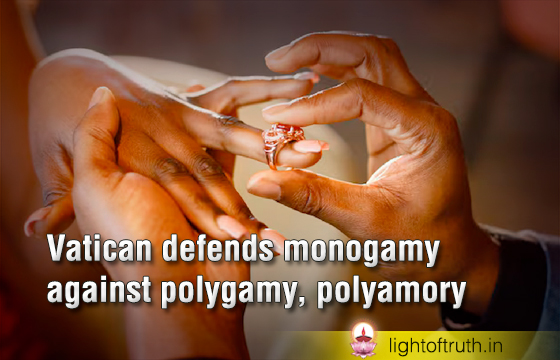
Vatican defends monogamy against polygamy, polyamory

The Dicastery for the Doctrine of the Faith unveiled a newly approved text on marriage, it did so with a disarming simplicity: the mystery of two lives becoming one. Yet behind that biblical intuition lies a complex cultural moment that the Holy See considers too critical to ignore. The document, titled “Una caro (one flesh). In Praise of Monogamy,” was endorsed by Pope Leo XIV on November 21 and later presented to the press, marking a deliberate intervention in the global conversation on love, commitment, and the human desire for belonging.

The Note proposes a vision of monogamy rooted not in rule-making but in anthropology. Marriage, it states, is built on an unbreakable exclusivity, the kind that turns two people into a single story without dissolving their individual identities. In an era fascinated by limitless autonomy and ever-expanding relational models, the text argues for the enduring value of a love that chooses one person—and continues choosing them across time.

Cardinal Víctor Manuel Fernández, prefect of the Dicastery, outlines three motivations behind the document. First is the technological ethos shaping contemporary culture, a worldview that risks convincing individuals that boundaries are simply obstacles and that relationships can be endlessly customized. Second is an honest dialogue with African bishops, who have insisted that the continent’s cultures, commonly associated with polygamous traditions, in fact contain profound testimonies favouring monogamous union. Third is the Western rise of polyamory, no longer hidden but increasingly promoted as a public alternative to traditional partnership. Against this backdrop, the Note offers a counterproposal: the beauty of unity. Drawing from Christian theology, it connects the marital bond to the love between Christ and the Church, not as an abstract metaphor but as a source of strength for daily fidelity. Though primarily addressed to bishops, the Dicastery hopes the text will also serve engaged couples, young adults navigating relational complexity, and spouses seeking depth in their commitment.

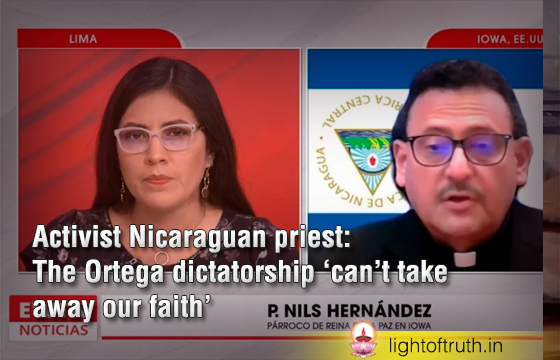
Activist Nicaraguan priest: The Ortega dictatorship ‘can’t take away our faith’

Nils de Jesús Hernández, 56, has lived in the United States for 36 years, far from his native Nicaragua. Forced to leave the country in 1988 in the midst of the civil war, he serves a parish in Iowa where he ministers to the Hispanic community and speaks out for the Nicaraguan people.

Hernández, known as the “vandal priest” for having led a student strike and supporting the 2018 protests in Nicaragua, is now the parish priest at Queen of Peace Church in Waterloo, Iowa, in the Archdiocese of Dubuque. “Vandal priest” was the defamatory, derisive label the dictatorship gave to him for his role in the protests, but the title has now turned into a sort of badge of honour.

After being declared a target of the government at the age of 19 when he was a candidate for the priesthood, Hernández said in an interview with “EWTN Noticias,” the Spanish-language broadcast edition of EWTN News, that leaving the country “meant that I was never going to return to Nicaragua. Leaving my parents, my family, everything that was familiar to me: my language, my culture, my food, everything; that is, everything that is one’s own … that was the cruelest thing I was experiencing.” The priest said he inherited his fighting spirit from his mother, who also helped with the student protests at the time.

“I believe that the persecution against the Church in Nicaragua is becoming much more aggressive, with confiscations [of Church property] that they have carried out and continue to carry out,” the priest lamented. According to Hernández, the dictatorship wants to “eradicate the Church.”

“But I always say the following: They will steal all the buildings, they can close all the churches they want to close … but they cannot take away the faith from the hearts of every Nicaraguan, because wherever there is a Nicaraguan in Nicaragua, even though they are being repressed and oppressed, there is the Catholic faith, because all of us Nicaraguans are devoted to Mary and we trust in the will of God.”

“We also have great faith that the Lord will prevail and will be victorious, because the Lord triumphed on the cross and overcame death with his resurrection,” he said. “We will be returning to Nicaragua triumphantly, because we will indeed return to Nicaragua, because this dictatorship will not last forever. They’re old and they’re not going to continue [in power] for all eternity,” he predicted.

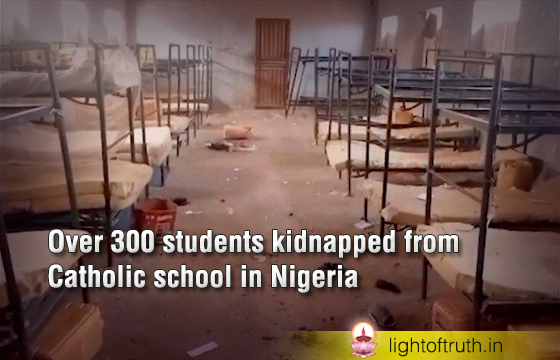
Over 300 students kidnapped from Catholic school in Nigeria

More than 300 students and teachers at the Catholic school of St. Mary in the Agwara district were forcibly taken and abducted by masked militiamen who stormed in on motorcycles and pick-up trucks. The mass abduction, in Niger State, in western Nigeria, carried out by an unidentified armed commando, marks the latest such tragedy. The episode comes just one week after the kidnapping of 25 female students in Kebbi State and the attack on the Church of Eruku, in the western state of Kwara, on 18 November. No group has yet claimed responsibility for the act committed during the night or issued ransom demands, but it is plausible that Boko Haram terrorists are behind it.

In a statement of the Diocese of Kontagora, sent to the Vatican’s Fides news agency, Diocesan Secretary Jatau Luka Joseph states that a security staff member was seriously injured during the attack, which is believed to have occurred between 1 a.m. and 3 a.m. local time. “The Diocese of Kontagora,” the statement reads, “strongly condemns the attack and expresses deep concern for the safety of the kidnapped children and their families. Security agencies were immediately informed and have launched coordinated efforts to ensure that the hostages may return safely.”

In Nigeria, mass kidnappings for extortion are quite frequent. In the central and north-western states of the country, Africa’s most populous nation and also one of its richest in oil, they are usually committed by criminal gangs that authorities generically refer to as “bandits.” The northern part of the country has also been grappling for nearly twenty years with a jihadist insurgency that, according to the United Nations, has caused 40,000 deaths and over two million displaced people.