All posts by Light of Truth

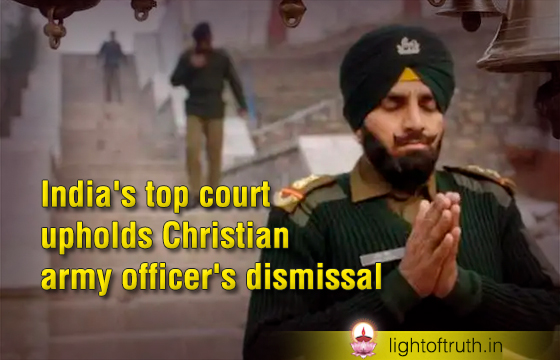
India’s top court upholds Christian army officer’s dismissal

India’s Supreme Court has rejected the appeal of a Christian army officer who was dismissed for refusing to take part in a regimental religious ceremony at a Sikh temple. The court called his behaviour “gross indiscipline.” On Nov. 25, the top court upheld a Delhi High Court ruling that confirmed the dismissal of Samuel Kamalesan, a Protestant officer who declined to enter the inner prayer area of a gurdwara during a weekly parade. The High Court had said he placed his religious beliefs above a lawful military order. Chief Justice Surya Kant questioned the officer’s conduct, saying such behaviour was unacceptable in the armed forces. The bench, also including Justice Joymalya Bagchi, refused to overturn the earlier judgment.

Kamalesan had joined the army as a lieutenant and served as a troop leader in a Sikh-majority squadron. In March 2021, four years after joining, he was dismissed without pension or service benefits. As a troop leader, he was expected to lead his unit into the gurdwara’s sanctum sanctorum during weekly prayers. He refused, saying his Christian faith did not permit him to take part in rituals of another religion. His lawyer argued that it was only a single incident and requested his reinstatement. He also said the officer regularly attended multi-faith prayer spaces common in army stations. However, this regiment had only a gurdwara and a Hindu temple. A Catholic lawyer commented that faith and military discipline are separate issues, and no one should be forced to take part in a religious ritual they do not believe in. He also questioned why a secular army requires participation in religious ceremonies. Regimental religious parades have been part of army tradition for many years.
CBCI Urges Nation to Uphold Constitutional Values on Constitution Day

Extending its greetings to all citizens on the occasion of Constitution Day, the Catholic Bishops’ Conference of India (CBCI) encouraged every section of the population to uphold the foundational principles of Justice, Liberty, Equality, and Fraternity. These values are essential for the well-being of the democratic Republic and call for renewed commitment and careful preservation, the statement said. The CBCI stated that the Indian Constitution, as envisioned by its framers, stands as a beacon of justice, equality, and fraternity. It noted that the Constitution reflects the shared aspirations of a diverse and pluralistic society, ensuring that every citizen enjoys dignity, rights, and opportunities irrespective of religion, caste, or creed.

Constitutional guarantees provided to all sections of society, including religious minorities and other socially vulnerable groups, should be valued and effectively implemented, the CBCI emphasized. The CBCI affirmed that a credible electoral process is at the heart of any democracy. It noted that concerns raised by different sections of the population regarding electoral processes should be addressed. The CBCI called upon the government to take necessary steps to ensure the independence, functional neutrality, and efficacy of democratic institutions. Reaffirming its commitment to uphold the spirit of the Constitution, the CBCI stated that it would continue working for the upliftment of the marginalized, fostering interfaith dialogue, and contributing to the nation’s progress. The CBCI encouraged all citizens to rededicate themselves to the ideals of justice, liberty, equality, and fraternity. It called for collective efforts to build a more inclusive, compassionate, and progressive India under the guidance of the Constitution.

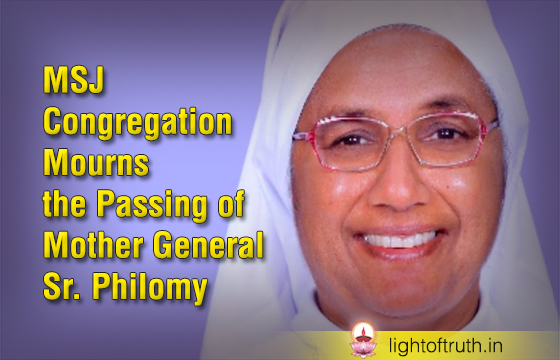
MSJ Congregation Mourns the Passing of Mother General Sr. Philomy

The MSJ Congregation has announced the death of Mother Philomy, who, according to Sr. Merina, Assistant General of the Congregation, was “called by God to her eternal reward.” In a message shared with members, Sr. Merina expressed the community’s profound grief, stating, “With deep sorrow and grief we share that our beloved Mother Philomy was called by God to her eternal reward. Kindly remember her in your prayers and pray for the repose of her soul.” The congregation and its wider community have extended their prayerful condolences to all MSJ members as they come to terms with this loss. Many have joined in praying for the repose of Mother Philomy’s soul, commending her to the peace of the risen Lord.

Hundreds attend Venerable Agnelo’s 98th death anniversary

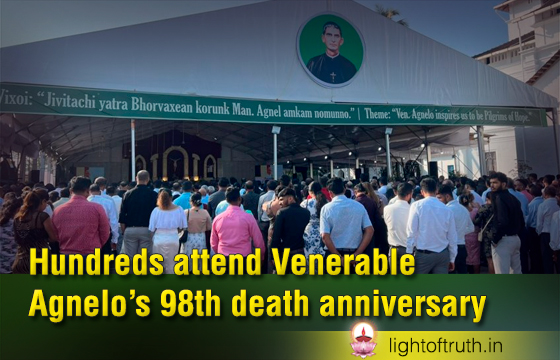
Thousands gathered at the Pilar hillock in Goa on November 20 to commemorate the 98th death anniversary of Venerable Agnelo de Souza, the saintly priest of the Society of Pilar. The day, revered as Venerable Agnelo’s Day, drew pilgrims from across Goa and beyond. Auxiliary Bishop Dominic Savio Fernandes of Bombay presided over the feast day Mass. He was assisted among others by Bishop Emeritus Alex Dias of Port Blair and Pilar superior general Father Nazareth Fernandes.

Bishop Fernandes, in his homily, expressed joy at the commemoration of the saintly priest, saying that the Church rejoiced because God had blessed Goa with “a priest of extraordinary holiness from its own soil.” He explained that the celebration was not only about remembering Venerable Agnelo but about taking him as a model: “We take him as our model so that we too may live with the same steadfast hope that shaped his entire life.”

Karnataka Church mourns Jesuit educationist’s sudden death

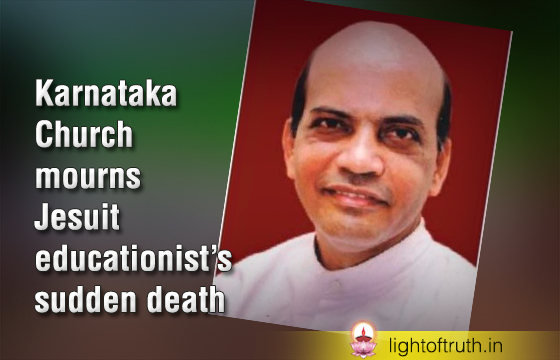
Jesuit Father Swebert D’Silva, a prominent educationist and renowned visionary in the southern state of Karnataka, died November 20, following a massive cardiac arrest. He was 68. He died at 1:15 pm at St Philomena Hospital in Bengaluru, Karnataka capital. His sudden death has deeply saddened colleagues, students, alumni, and well-wishers across Karnataka. “It was a life of selfless service, boundless love and unwavering faith”, said Jesuit Father Praveen Martis, the vice chancellor of the St. Aloysisus University in Mangaluru.

Father D’Silva had also served as the rector and pro-chancellor of St Joseph’s University, Bengaluru. Jesuit Father Victor Lobo, the vice chancellor of St Joseph’s University, requested everyone to pray for the repose of his soul and expressed his condolences in a message. Several members of the Jesuit community shared their tributes, acknowledging the confrere’s steadfast commitment to education, social service, and pastoral care. He was serving as the director of Arrupe Nivas, Bengaluru, at the time of his death. Father Dionysius Vaz, Jesuit’s Karnataka provincial, highlighted Father D’Silva’s transformative leadership in shaping St Aloysius College into a deemed-to-be university, blending infrastructure development with value-based education.

Goa Police Ban Event Linking Kamasutra With Christmas After Public Outcry

Police in Goa have stopped a controversial event after strong protests from the Catholic Church, NGOs and civil society groups, who said the program wrongly linked sexuality with the holy Christmas festival. The event, titled “Tales of Kamasutra and Christmas Celebration,” was planned for Dec. 25–28 in Panaji. But on Nov. 23, police ordered organizers to cancel it after a poster showing explicit content went viral on social media. In a statement, Goa Police said they had directed organizers to stop the event and remove all related advertisements from social media. The Church in Goa condemned the program, saying it deeply hurt Christian sentiments.

Cardinal Filipe Neri Ferrao, Archbishop of Goa and Daman, said Christmas is a sacred time of joy and peace. Linking it with unrelated and explicit themes was “deeply offensive” and disrespectful to millions of believers. The Catholic Association of Goa (CAG) also filed a formal complaint, calling the event “illicit, obscene, and insulting.” CAG president Cyril A Fernandes said the organizers appeared to promote sexual activities under the name of spirituality, which could harm Goa’s reputation as a family-friendly place. Social activists also demanded action. Arun Pandey of the NGO Arz said authorities should check for possible violations of laws related to obscenity or exploitation.

The organizers, Osho Ludhiana Meditation Society, later apologized. They said their intention was to hold a tantra-based meditation retreat, not a sexual event. They admitted the poster caused misunderstanding by placing the words “Kamasutra” and “Christmas” together. The group has now cancelled the event and withdrawn all posters, saying they never meant to hurt religious feelings.

Odisha Church thrilled over new auxiliary bishop for Cuttack-Bhubaneswar

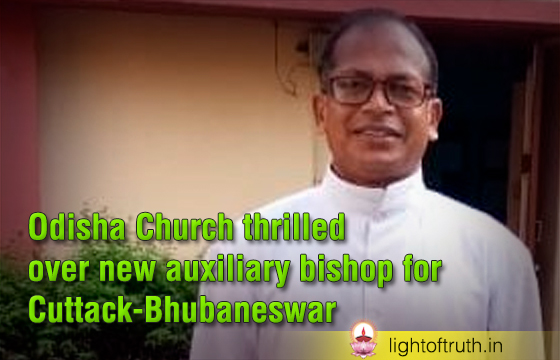
Pope Leo XIV on November 22 appointed Father Rabindra Kumar Ranasingh as the auxiliary bishop of the Archdiocese of Cuttack-Bhubaneswar. “It is with profound joy and gratitude to God that I hereby formally announce to you the good news of the appointment of our new Auxiliary Bishop,” said an official letter from Divine Word Archbishop John Barwa of Cuttack-Bhubaneswar. The archbishop said the appoint signals the Pope’s “pastoral concern for our local Church and its growing needs.”

He said the auxiliary bishop will greatly strengthen the archdiocese’s pastoral outreach, support its clergy, religious, and faithful, and enhance the mission entrusted to it by Christ. “I invite all of you to join me in prayer for our bishop-elect as he prepares to assume this sacred responsibility in the service of the Church. May the Holy Spirit grant him wisdom, strength, and a shepherd’s heart to lead God’s people with humility and dedication,” the archbishop added.

The bishop-elect is, at present, the parish priest of Sacred Heart Church, Jatni and dean of Cuttack deanery. He was born on July 9, 1972, as the first of seven children of Janas and Helena Ranasingh in Kasabasa, a village in Odisha’s Kandhamal district. Three of his four sisters are nuns and the other is a nurse. He studied philosophy at Jnanadeepa Vidyapeeth in Pune and theology at Khristo Jyoti Institute of Theology at Sambalpur in Odisha. He was ordained a priest on April 18, 2001 at Daringbadi Parish in Kandhamal. The bishop-elect has a doctorate from the Pontifical Urbaniana University, Rome. Father Pradosh Chandra Nayak, the vicar general of the Cuttack-Bhubaneswar archdiocese, welcomed the appointment terming the bishop-elect as the right choice with proper qualification.

Hindu hardliners oppose Christ the King festival in eastern India

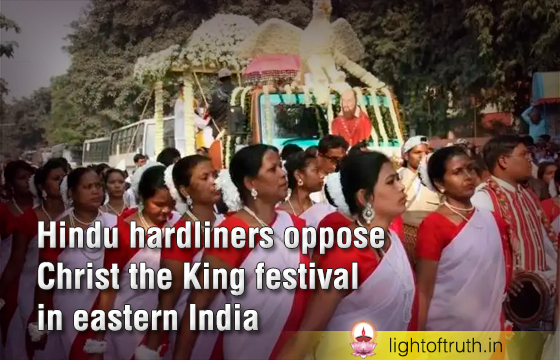
A forum backed by Hindu hardliners organized a protest march against the tribal Christian celebration of the Christ the King festival in Jharkhand, causing frustration and fear among the Christian community already facing rising pressure for their faith. The protest was held on Nov. 23 in Ranchi by the Janjati Suraksha Manch (JSM), a group supported by the Rashtriya Swayamsevak Sangh (RSS), the main umbrella body of Hindu right-wing organizations. The RSS and its political arm, the Bharatiya Janata Party (BJP), claim that Christian celebrations are attempts to convert tribal people. JSM activists alleged that the festival was another example of “forced conversion” and demanded that it be banned in the state.

Christian leaders strongly rejected the accusations, calling them part of a growing campaign to spread fear among tribal Christians. “Tribal Catholics have been celebrating the Christ the King festival for more than twenty years. This is the first time such a protest was deliberately held on the same day to disturb peace,” said Ratan Tirkey, a tribal Christian leader. He said the organizers wanted attention and attempted to create suspicion against Christians. Another leader, Praween Kachhap, said groups like JSM aim to control tribal land, culture, and traditions. He pointed out that most JSM members support the BJP, and such protests are used to create division among tribal communities. Local tribal leader Prabhakar Tirkey said it was wrong to blame Christian missionaries for harming tribal culture. “In reality, they have helped protect tribal languages and identity,” he said.

Jharkhand has seen a rise in hostility toward Christians, especially after a strict anti-conversion law was passed in 2017. The law carries a penalty of three years in jail and a heavy fine. Christians form about 1.4 million of the state’s 33 million people, most of them belonging to tribal communities.

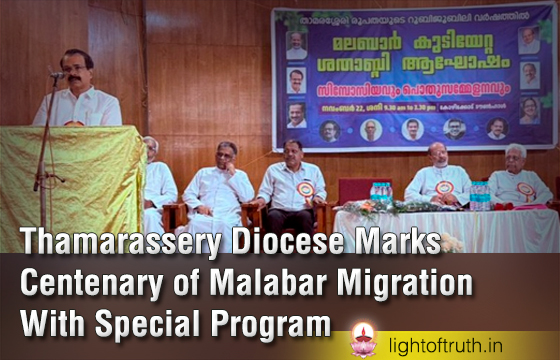
Thamarassery Diocese Marks Centenary of Malabar Migration With Special Program

The Thamarassery Diocese in Kerala organized a special event to mark 100 years of the historic Malabar Migration, when thousands of Christian families moved from southern Kerala to the Malabar region in search of land and better opportunities. The program, held on November 22 at Kozhikode Town Hall, also formed part of the diocese’s 40th anniversary celebrations. Church leaders, political representatives, scholars, and members of the community came together to remember the sacrifices and contributions of the early migrant families. The Malabar Migration refers to the movement of Saint Thomas Christians—mainly from the Travancore region—to Malabar between the two World Wars. These families left due to shortage of cultivable land and economic struggles, and they helped develop Malabar’s agriculture, infrastructure, education, and health systems.

George Kurian, Union Minister of State for Minority Affairs, praised the migrants for transforming the region with innovative farming methods like intercropping and for their hardworking and peace-loving nature. He also thanked the local communities of Malabar for welcoming the settlers with generosity. Presiding over the meeting, Bishop Mar Remigiose Inchananiyil said the migrants “rewrote the history of Malabar” through their faith and determination. He announced that the diocese will observe a Migration Remembrance Day every year and plans to set up a Migration Museum within the next decade. Scholars P. J. Vincent and Joy Varghese presented papers on the history and socioeconomic impact of migration, followed by a panel discussion. At the public meeting, M. K. Raghavan, Member of Parliament, highlighted the key role of the Church in Kerala’s social and educational progress. He encouraged Church institutions to start new-generation courses to meet modern needs. Archbishop Varghese Chakkalakal of Calicut reminded the audience that societies grow when they value their history. MLA Thottathil Ravindran added that today’s achievements are the result of the hard work of migrant ancestors and must be passed on to the younger generation.

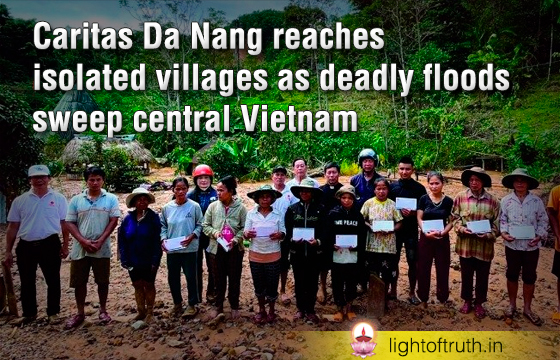
Caritas Da Nang reaches isolated villages as deadly floods sweep central Vietnam

Caritas Da Nang has pushed into some of the most isolated flood-hit communities in central Vietnam as successive floods and landslides continue to devastate the region.  The social action arm of the Diocese of Da Nang said its teams have been “steadfast on the road” for nearly three weeks, combining urgent relief with early recovery efforts for people trapped by rising waters and collapsing mountain slopes.

In recent days, central provinces have “continued to bend under successive floods and severe landslides,” Caritas Da Nang reported, adding that water returned to communities that had only just begun to dry out.  Beginning on November 17, water levels in the Vu Gia and Thu Bon rivers climbed again to between alert level 2 and alert level 3, causing deep and widespread flooding. Caritas teams have travelled through mud-clogged mountain routes to reach villages cut off for days. 

In A Teep village in Quang Nam province, Caritas workers found the entire residential area of 15 ethnic minority households buried under thousands of cubic metres of earth and rock. Only rooftops remained above the mud. Residents told the team that 10 homes were completely buried and five seriously damaged, but all 50 people survived after a timely evacuation.During the same mission, Caritas delivered food to 76 families in a nearby hamlet that had been isolated for two weeks with nearly all reserves depleted. 

In A Soo village, Caritas Da Nang director Father Simon and Father Joseph Pham Thanh Binh of Caritas Saigon brought food to 50 families stranded by landslides.  The organization also delivered a generator to the Tay Giang sub-parish of Dong Vinh Parish. Across multiple districts, Caritas has been distributing warm clothing, blankets, mattresses, bicycles, food, and essential supplies through its Zero-Dong Supermarket model.