
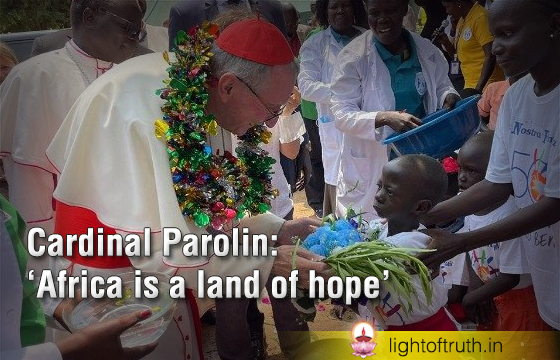
A “moment of joy,” reaffirming the need for our “personal” commitment. This is how Card. Pietro Parolin, Secretary of State, described to Vatican Media the Eucharistic celebration he presided over Monday afternoon, 27 May, in Rome’s Marian Basilica of Santa Maria Maggiore on the occasion of the 61st Africa Day.
In his homily, Card. Parolin cited the words about Africa from Benedict XVI and, before him, St.John Paul II in the post-synodal Apostolic Exhortation Ecclesia in Africa in 1995, highlighting the continent’s challenges, difficulties, and “contrasts” but also its aspects of hope.
“This celebration has a personal aspect for me because I feel close to Africa,” the Cardinal told to Vatican Media on the sidelines of the celebration, recalling, “I have been able to visit several countries over the years and have had contact with both the Church and governments and authorities.” “For me,” he shared, “it is a moment of joy to be here and share in the joy and prayer.”
“I believe,” added the Secretary of State, “that Africa must succeed on its own; it has the strength, it has the resources, it has wealth of all kinds, but it also needs sincere friends from the international community who work for the people, for peace, for reconciliation, and for development.” International community support, Card. Parolin emphasized, is necessary because the continent “finds itself in very difficult situations” amid many “very violent conflicts that cause much suffering to many people.” “Just think of the East of Congo,” he said.
While the Cardinal expressed his conviction “that there is a possibility to emerge,” he recognized that “the principle is always the same: the people and their well-being must be put first.” “If material interests are prioritized, then certainly people are sacrificed, and there is no chance for peace,” he said. “However, if there is justice, if there is access for everyone to even material wealth-and this is the task of both local authorities and the inter-national community,” he added, “then things can improve.”
From its part, Card. Parolin reassured, “The Holy See helps at the level of the African Church because we are one family, and also through the Nunciatures and through the direct interest that the Pope shows towards Africa.” “Where we can,” he insisted, “we try to lend a hand.”
All posts by Light of Truth
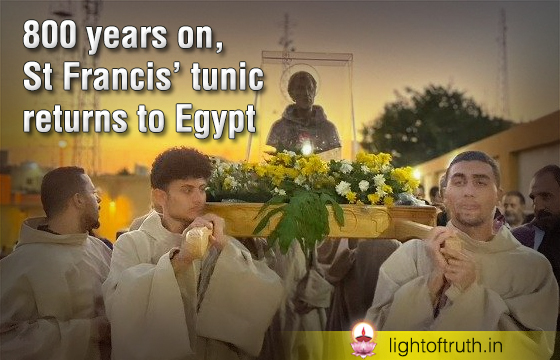
800 years on, St Francis’ tunic returns to Egypt
When Saint Francis made his renowned journey to Egypt in 1219, he was wearing the humble tunic which went on to become characteristic of his followers. Now, 800 years later, that tunic – or part of it – has made a return to the country. A piece of the garment – which counts as a second-class relic of the saint – arrived in Cairo on the 23rd May. It then made its way to Alexandria, and will also visit Minya, Assiut, Qena and Luxor before returning to Italy on the 2nd June.
The relic belongs to Francis-can friars from the Italian region of Tuscany, who are bringing it to various countries in celebration of the 800th anniversary of St. Francis’ stigmata.
Speaking to Vatican News, Anthony Amen, a youth representative for the Egyptian Francis-cans, said that the event aimed to “bring back the spirituality of Saint Francis.” He added that he hoped the encounter with the relics would inspire the Church in Egypt to “follow in St Francis’ steps.”
St.Francis’ visit to Egypt is now best remembered for his encounter with Sultan al-Kamel, who was at the time the ruler of Egypt. In the midst of the Crusades, the saint travelled behind enemy lines to meet with the Muslim leader, and remained with him for several days.
Amen said that the visit of the relic was “always a reminder for us to take the initiative to sustain dialogue between us and the other.” He said that relations between Christians and Muslims in Egypt had taken a “huge step forward” in the past ten years, during the leadership of President al-Sisi. And, he said, much progress had also been made just in the past couple of years precisely because of the 800th anniversary of Francis’ encounter with the Sultan.
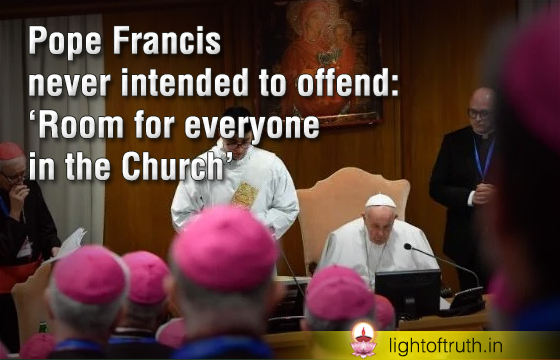
Pope Francis never intended to offend: ‘Room for everyone in the Church’
The Director of the Holy See Press Office, Matteo Bruni, has issued a clarification on May 28 regarding alleged statements made by Pope Francis during a private meeting with the Italian episcopate. The clarification comes in response to reports claiming that the Pope made a definitive «no» to homosexuals in seminaries and used derogatory language in the process.
“Pope Francis is aware of the recent articles regarding a closed-door conversation with the bishops of the CEI [Italian Bishops’ Conference]. As he has stated on many occasions, ‘There is room for everyone in the Church, for everyone! No one is useless; no one is superfluous; there is room for everyone. Just as we are, everyone.’ The Pope never intended to offend or express himself in homophobic terms, and he apologizes to those who felt offended by the use of a term, as reported by others.”
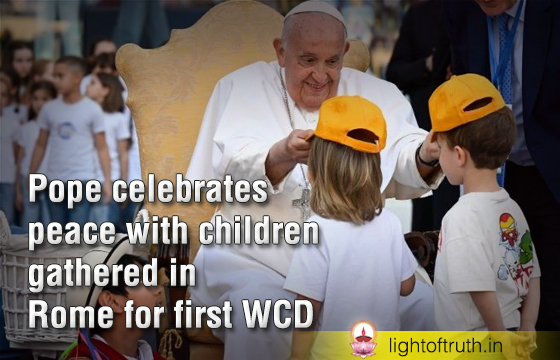
Pope celebrates peace with children gathered in Rome for first WCD
Some 50,000 children hailing from several countries around the globe gathered in Rome’s Olympic Stadium on May 25 to meet Pope Francis and reflect with him on their importance in the world’s future, as part of the first ever World Children’s Day (WCD). Peace was the main theme of the event.
The Pope addressed the young lively audience with a brief introductory speech in which he called for responses from the children. He opened his address by noting that in children “everything speaks of life and the future”, and by reaffirming that the Church, “as a mother”, welcomes them and accompanies them “with tenderness and hope.
He explained that he was inspired to convene the World Children’s Day by the meeting he held with children in the Vatican on November 7 on the theme “Let’s Learn from Boys and Girls.” “I realized that our conversation had to continue and extend to more children and young people,” he said.
The Pope then engaged in a series of questions with the children, starting from the many wars raging in several parts of the world. “Are you sad about the wars?”, “Is war a nice thing?”; “Is peace beautiful?” he asked, inviting the young audience to pray for children who suffer from wars, cannot go to school, are hungry, or neglected.
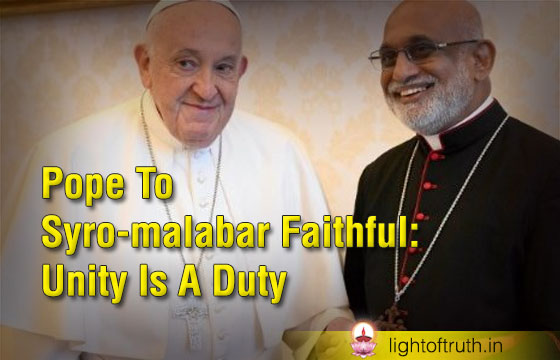
Pope To Syro-malabar Faithful: Unity Is A Duty
Pope Francis met on May 13 with Major Archbishop Raphael Thattil, the head of Syro-Malabar Catholic Church. The Pope’s address to Archbishop Thattil ranged over a number of topics, from the ancient history of the Church in Kerala to the liturgical dispute which has been raging there for a number of years.
Pope Francis began his address by reflecting on the ancient faith of the Syro-Malabar Church. “The faithful of your beloved Church”, he said, “are known not only in India, but throughout the whole world, for the ‘vigour’ of their faith and piety.” Referring to the fact that, for many years, Western missionaries attempted to force Kerala’s Christians to conform to European traditions, Pope Francis said that “some members of the faith” committed “unfortunate acts against you”, because of their “insensitivity” to the history of India’s ancient churches. The Syro-Malabar Church, the Pope added, is particularly important today, in times where it is common to “sever the roots connecting us to the past.” “The Christian East”, he said, “allows us to draw from ancient and ever new sources of spirituality; these become fresh springs that bring vitality to the Church.”
Referring to the ongoing liturgical controversy, the Pope said, “let us meet and discuss without fear, this is fine, but above all, let us pray, so that the light of the Spirit, which reconciles differences and brings tensions back into unity, may resolve disputes. There is one certainty: pride, recriminations and envy do not come from the Lord and never lead to concord and peace. Showing a grave lack of respect for the Blessed Sacrament – the Sacrament of charity and unity – by arguing about the details of how to celebrate the Eucharist, the pinnacle of his presence among us, is incompatible with the Christian faith. The guiding criterion, the truly spiritual one that derives from the Holy Spirit, is communion: this requires us to do a self-examination of our dedication to unity and our faithful, humble, respectful and obedient care for the gifts we have received.”

The Goa Bench Of The Bombay High Court Grants Relief For Protestant Pastor, Wife
The top court in a western Indian state has revoked an official order that prohibited a Protestant pastor and his wife from living in their village home following allegations of religious conversion. The Goa bench of the Bombay High Court on May 8 set aside the district collector’s order, which banished Pastor Dominic D’Souza and his wife Joan Mascarenhas D’Souza from their residence in Siolim village in north Goa. The couple runs an independent Church called the Five Pillars Church. The North Goa district collector, the highest government official in the district who also has executive magisterial powers, issued the order against the couple on March 14 under the Goa Maintenance of Public Order and Safety Act. He ordered them to leave North Goa for six months. They were accused of using black magic and converting B Vadivel, a Hindu and native of southern Tamil Nadu state, who currently lives in Goa. The conversion incident happened in January and Vadivel filed a police complaint against the couple. The police filed multiple cases against the couple based on which the order was issued.

Hailstorm Wreaks Havoc In India’s Manipur
One person was killed and over 15,000 houses, including churches, were destroyed after a hailstorm struck strife-torn Manipur state in northeast India on May 5. Initial reports reveal a man had died and 15,425 houses were destroyed, said state Chief Minister N Biren Singh. The state government has sanctioned a financial package to arrange relief materials, he told reporters on May 6. The government has opened 42 relief camps to accommodate the people whose houses were damaged. At least six churches were damaged in the hilly areas after their roofs flew away in the storm, said a Church official who did not want to be named. “We are now taking stock,” he said and added that the situation was not conducive to undertaking relief works. “We will, however, try our best to help our people who already lost everything in the ethnic violence,” the Church official told on May 7. The worst-hit places are Imphal West and Imphal East districts in the valley where up to 11,000 houses were damaged, the chief minister noted. Valleys in the state are inhabited by the majority Meitei community while indigenous Kuki-Zo Christians live in the hilly districts. In Churachandpur, a tribal stronghold and the nerve center of sectarian strife, 540 houses perished in the hailstorm.
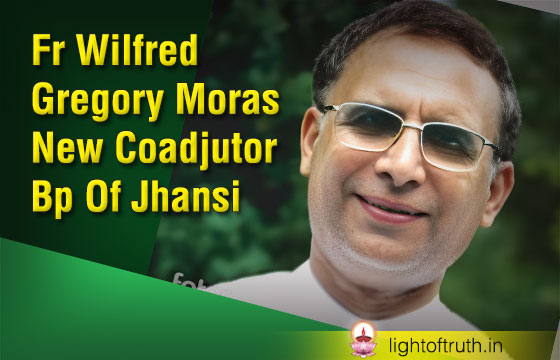
Fr Wilfred Gregory Moras New Coadjutor Bp Of Jhansi
The Holy Father Pope Francis has appointed Fr Wilfred Gregory Moras (55), of the clergy of Lucknow, as the Coadjutor Bishop of the Diocese of Jhansi, Uttar Pradesh. Currently he is the ector of the St. Joseph’s Regional Seminary, in the diocese of Allahabad. Fr Wilfred Gregory Moras was born on 13 February 1969 in Neerude, in the diocese of Mangalore and studied Philosophy and Theology at St. Joseph’s Regional Seminary in the Diocese of Allahabad. He was ordained priest on 27 April 1997 for the Diocese of Lucknow.

Christians Decline India’s Ruling Party’s Offer To Clean Church Premises
The pro-Hindu Bharatiya Janata Party, which runs the government in the Christian-majority Nagaland state, has offered to clean church premises to mark the death anniversary of a Hindu leader, but Chri-stians have declined the offer. The BJP offered to clean church compounds on May 11 as a build-up to mark the 70th death anniversary of Syama Prasad Mookerjee. A prominent Hindu leader from the colonial-era Bengal region, Mookerjee died on June 23, 1953.”We feel obligated to politely decline the kind gesture offered to clean church compounds on May 11,” said the Nagaland Baptist Church Council (NBCC), the largest denomination in Nagaland where Christians account for 87.93 percent of the state’s 1.97 million people.”We may as well direct your good office to pursue another avenue of service,” the council said in a statement on April 30.The council alleged that Christians have been facing unprecedented violence after Prime Minister Narendra Modi came to power in New Delhi, leading the BJP victory in the 2014 national elections. The council urged the party to exercise caution while issuing such directions. The BJP is sharing power in Nagaland. Mookerjee was one of the founders of Bharatiya Jana Sangh, a precursor of the BJP, and a minister in the interim government from 1947 to 1950. Its state chief, Benjamin Yepthomi, had directed party members to clean church compounds to mark Mookerjee’s death anniversary. The influential Baptist council warned against political parties championing religious subjects. The Nagaland Christian Revival Church Council (NCRCC) also issued a statement on May 1 urging parties to refrain from “politicizing sacred spaces for partisan gains.” “Let us uphold the values of tolerance, respect, and religious freedom that are fundamental to our society,” it stated. India’s seven-phased polls to elect 543 members of the Lok Sabha (lower house) started on April 19 and will conclude on June 1. The results will be declared on June 4. Nagaland, one of India’s eight northeastern states, sends one lawmaker to the Lok Sabha. In neighboring Manipur, the sectarian strife involving tribal Christians has been going on since May 3 last year. The death toll in the communal conflict has reached 220 and more than 500 places of worship have been set on fire. Earlier Reverend N. Paphino, president of the NCRCC, asked the pro-Hindu party to prioritize “protecting persecuted Christians across India instead of focusing on Nagaland for the sake of a campaign.”
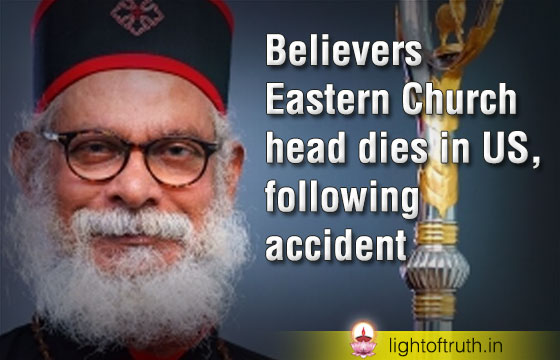
Believers Eastern Church head dies in US, following accident
Moran Mor Athanasius Yohan (formerly known as K P Yohannan), head of the Bishop of Believers Eastern Church, died on May 8 at Dallas in the US. He was 74. The Church leader was hospitalized after he sustained serious wounds in a car accident. A press statement from the Church headquarters said the death occurred due to a sudden cardiac arrest.
He was born on March 8, 1950, in a Mar Thoma Syrian Church family in Kerala, India. He was the founder and president of the Gospel for World, earlier known as Gospel for Asia, a large non-profit missions organization with a focus on India and Asia. He was also the founding Metropolitan Bishop of Believers Eastern Church (Earlier Believers Church) with the religious title and name of Moran Mor Athanasius Yohan I.