
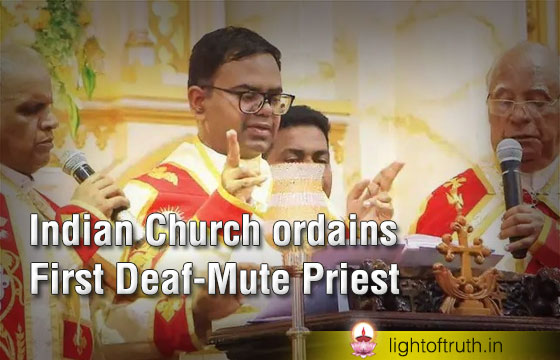
History was made when an archdiocese in the southern Indian state of Kerala ordained India’s first speech and hearing-impaired priest. Archbishop Andrews Thazhath of Trichur on May 2 ordained Holy Cross Deacon Joseph Thermadom at Our Lady of Dolours Basilica in Thrissur, Kerala’s cultural capital. He is the second speech and hearing-impaired priest in Asia and 26nd in the world.
All posts by Light of Truth
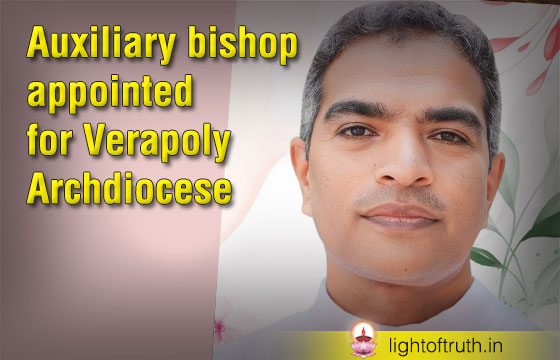
Auxiliary bishop appointed for Verapoly Archdiocese
Pope Francis has appointed Father Antony Valunkal as the auxiliary bishop of the archdiocese of Verapoly in Kerala. The 54-year-old bishop-elect is currently the rector and parish priest of the National Shrine Basilica of Our Lady of Ransom in Vallarpadam, Kochi.
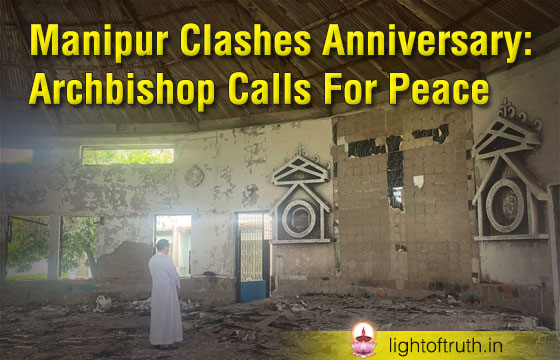
Manipur Clashes Anniversary: Archbishop Calls For Peace
Archbishop Linus Neli of Imphal has called all Catholics in the eastern Indian state of Manipur to hold intense fast and prayer for reconciliation and peace May 3-5.
“Let us persistently pray for the day when people of all ethnicities and religious commu-nities can live together peacefully in this beautiful land of Manipur,” says a statement the archdiocese issued in early May.
An ethnic clash that broke out May 3, 2023, between the Meitei and Kuki commu-nities led to the death of hundreds and the displacement of 60,000 people. The Meitei people make up 53% of Manipur’s 2.8 million, population; the Naga people make up 24%, the Chin-Kuki-Mizo people make up 16%. Hindus and Christians each make up about 41% of the population, while Muslims make up just over 8%.
The conflict was triggered by an affir-mative action controversy in which Christian Kukis protested a demand by mostly Meitei Hindus for a special status that would let them buy land in the hills populated by Kukis and other tribal groups, and get a share of government jobs. Ethnic violence has been a decades-old problem in Manipur state, where 700 people were killed in 1993 and the govern-ment took a year and a half to restore nor-malcy in the region.
The archdiocese’s statement said that while the situation may have relatively relaxed, “we know only too well the present scenario of ethnic segregation and several hundreds of our people still languishing in great distress, pain and uncertainties in relief camps and in undesirable conditions.” The archbishop recalled the most horrifying and harrowing days – particularly May 3-5, 2023 – saying, “we should fall on our knees to intensify our prayers for genuine reconciliation and peace with justice among all fellow human beings.”
“Like many responsible communities and organisations, the Catholic Church in Manipur has been in the forefront in humanitarian interventions, in peace dialogue, and in con-stant prayer for early solution,” he continued. Quoting Isaiah 57:18-19 from the Bible, Neli asserted, “it is our firm confidence that God will hear our prayers and heal our land, guide and comfort our people, and give peace to those who are far away and peace to those who are near.”
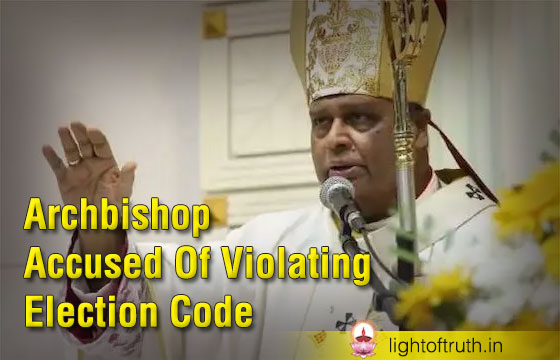
Archbishop Accused Of Violating Election Code
A pro-Hindu group has sought action against a Catholic arch-bishop, accusing him of violating the country’s poll code by trying to influence voters on religious grounds amid India’s ongoing national elections. The Legal Rights Protection Forum (LRPF), aligned with Prime Minister Narendra Modi’s ruling Bharatiya Janata Party, wants the Election Commission of India to take action against Archbishop George Anthonysamy of Madras-Mayla-pore in southern Tamil Nadu state. The forum’s April 29 complaint was about an editorial Anthonysamy wrote in the arch-diocesan fortnightly The New Leader Weekly. While highlight-ing India’s current socio-political situation, he also referred to the plight of Christians and Muslims under Modi’s rule since 2014.
The forum alleged it was an attempt “to influence voters on religious lines,” so Anthonysamy violated the election code. In his guest editorial, Anthonysamy, president of the Tamil Nadu Bishops Council, wrote that Chri-stians, who comprise 2.3% of India’s 1.4 billion people, must ensure 100% voting. “Let us all vote,” he wrote, calling the ele-ction a “significant one… an ele-ction between two contrasting ideologies.” Editor Father Antony Pancras said they stood by the guest editorial and denied the allegation it violated the poll code. “The archbishop indeed tried to inform people about the plight of the country’s people, especially the minorities,”

India’s Hindu Nationalists Seek Law To Control Population
A Hindu nationalist group in India, the world’s most populous country, has demanded a law to control population growth over perceived fears that Muslims could outnumber the majority Hindus. “Hindus generally settle down for one or two children… [but] there are people who say children are Allah’s gifts. This is a matter of deep concern,” said Shriraj Nair, spokesperson of the Vishwa Hindu Parishad (VHP or World Hindu Council). Nair said the Indian government “should immediately bring in a Population Control Bill.” He referred to the recent findings of a report by Prime Minister Narendra Modi’s Economic Advisory Council (EAC), which said the Hindu population declined by nearly 8 percent between 1950 and 2015 while Muslims grew at a record 43% in the 65 years.
“Demography decides your destiny… It’s high time Hindus awakened to this reality. Wher-ever Hindus slipped into minority, what has happened, we all know. Let’s learn from history,” Nair posted on X on May 9.
The EAC report authored by Shamika Ravi, Abraham Jose, and Apurv Kumar Mishra, said that the population of Sikhs went up by 6.58% and Christians by 5.38% in the same period.
“Migration, legal or illegal, is also responsible for change in demography in various parts of the world. But we are not talking migration or birth rate, we are talking conversion,” she added.
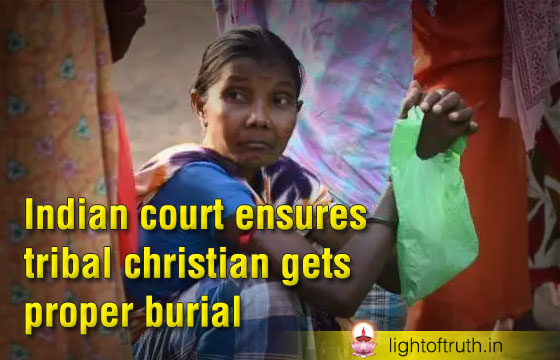
Indian court ensures tribal christian gets proper burial
An Indian court had to inter-vene to ensure a proper burial for a tribal Christian after residents of his predominantly Hindu villa-ge objected to Christian burial in the village. Fifty-four-year-old Isvar Korram, an indigenous Christian, died on April 25 while undergoing treatment at a hospital in central Chhattisgarh state’s Jagdalpur city, which is the headquarters of Bastar district. But villagers from his native Chhindbahar, a remote village in the hilly, forested district, told his family not to bring back his body and bury it according to Christian rites. “This is not the first time that indigenous Christians were denied permission to bury their dead in the region,” said Bishop Vijay Kumar Thobi of the Protestant Church. Bastar is known as a stronghold of the Maoist rebels, who say they are fighting for the rights of the poor and have been engaged in an armed insurgency for many decades. Local church leaders said the villagers “opposed a Christian burial on the plea that it will prove a bad omen” for them. “This time, we decided to file a case in the Bilaspur High Court [the state’s top court] seeking a direction to bury Korram in his village,” Bishop Thobi told.
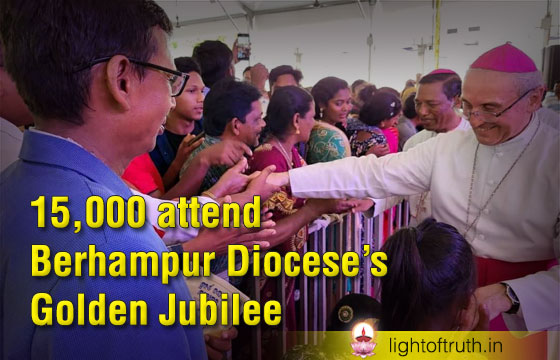
15,000 Attend Berhampur Diocese’s Golden Jubilee
Around 15,000, including Apostolic Nuncio Archbishop Leopoldo Girelli, on May 9th attended the golden jubilee celebrations of Berhampur diocese in the eastern Indian state of Odisha. “I am glad and happy to be with you and for you to celebrate this jubilee Mass,” the nuncio said in homily during the jubilee Mass at St.Peter Parish Mohana under Berhampur diocese. The Vatican ambassador expressed happiness that the diocese, founded by the Congregation of the Missions in 1974, now has 71,000 Catholics in 26 parishes, served by 29 women and 10 men religious congre-gations, and 379 catechists, besides the dio-cesan clergy. The seed your ancestors sowed 50 years ago has produced plenty of fruits, he added.
As many as 10 bishops and more than 100 priests and nuns too attended the celebrations. Catholicism was first introduced in the region back in the 17th century when it was under the care of Madras-Mylapur archdiocese. By 1845, Odisha came under the diocese of Visakhapatnam. The first missionaries were the Fransalians, who worked in the hilly region of Ganjam and Phulbani and the coastal belt of Berhampur and Cuttack. The Cuttack Mission was declared self-governing by Pope Pius XI on July 18, 1928, and Vincentian Father Valerian Gumes was appointed its administrator and ecclesiastical superior. In 1937, the mission was raised to the status of a diocese. On January 24,1974, the Cuttack Mission was divided into the Cuttack-Bhubaneswar archdiocese and the diocese of Berhampur. Berhampur’s first prelate was Vincentian Bishop Thomas Thiruthalil, who served the diocese until 1990. He was succeeded by Bishop Joseph Das who served the diocese during 1993-2007. The current bishop is Sarat Chandra Nayak.

Logos and mottos for pope’s visit to asia released
The Holy See Press Office has released the official logos and mottos for the Pope’s upcoming visit to Asia. The Pope’s journey to the continent – which will include stops in Indonesia, Papua New Guinea, Timor Leste, and Singapore – is scheduled to take place on September 2-13, 2024.
Pope Francis will land in Jakarta, Indone-sia, on September 3, remaining until the 6th.
The logo for this visit features the Pope with his hand raised in blessing, standing in front of a golden “Garuda”, a sacred eagle, which has been depicted in a manner reminiscent of traditional Indonesian “batik” fabric. Inlaid is a map of Indonesia, an archipelago characterized by a great variety of ethnic and social groups, languages, cultures and religious beliefs. The Apostolic Journey has been given the motto ‘Faith – Fraternity – Compassion’.
Next, the Pope will travel to Papua New Guinea, where he will remain until Sept. 9.
The centrepiece of the logo for this visit is a cross, depicted in colours meant to evoke Papua New Guinea’s sunrises and sunsets. On the cross, a Bird of Paradise, symbolising Papua New Guinea, can be seen. The motto for this Apostolic Journey is “Pray”, inspired by the disciples’ request to Jesus: “Lord, teach us to pray” (Lk 11:1).
From Papua New Guinea, Pope Francis will travel to Timor Leste, remaining until September 11. In the centre of the logo for this journey, we see Pope Francis with his hand raised in blessing. Behind him is the globe, from which a map of Timor Leste emerges. Above, written in an arc, is the motto of the papal visit, “May your faith be your culture”, an exhortation to the Timorese people to live out their faith according to their culture and traditions.
The Pope’s final stop will be the island nation of Singapore, which he will visit on September 11-13. The logo for this Apostolic Journey depicts a stylized cross, inspired by the star that guided the Magi, by the Eucharist and by the five stars of the flag of Singapore. On either side of the Cross is the motto of the Apostolic Journey: “Unity–Hope.”
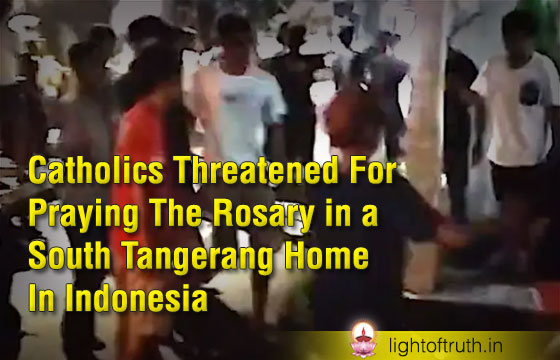
Catholics Threatened For Praying The Rosary In A South Tangerang Home In Indonesia
Catholic students from Pamulang University (UNPAM) were threatened by Muslim extre-mists as they prepared to pray the rosary. A group of armed Mus-lim men broke into the home of a Catholic family in South Tange-rang[I] that was hosting students. Shouting threats, the attackers ordered the university students to stop the prayer activity and dis-perse as soon as possible.
It seems that the hostilities were fomented by a man called Diding. “If you perform any praying, do it in your church as we local Muslims are used to do it in our mosque; not in a resi-dential house like this,” Mr Di-ding said, according to witnesses. “A dozen UNPAM students were reciting the rosary at the home of a local Catholic,” said a political activist known as Mr A. “We were at the police’s command post until at 3 am to demand perpe-trators be held accountable for last night’s hostile deed,” Mr A told. Speaking to local media, Chief Superintendent Alvino Cahyadi said police were looking into the case after a video about the incident was posted on social media. Some female students suffered minor injuries.
A similar incident took place in 2014, when Julianus Felicianus, a Catholic, opened his home to the community near Yogyakarta to pray the rosary, an activity that many Christians engage in, in the month of May. A group of Mus-lims targeted the Catholic gather-ing and Felicianus received threats, including death threats, from several people.

Card Chow In Guangdong: New Bridge With Catholics In Mainland China
Exactly one year after his historic visit to Beijing in April 2023 (almost 30 years after the last one), a delegation of the Diocese of Hong Kong led by Card Stephen Chow Sau-yan made a new, important visit to Catholic communities in mainland China.
From 22 to 26 April, the Chinese cardinal – together with Auxiliary Bishop Joseph Ha Chi-shing, Vicar General Fr Peter Choy Wai-man, and a small group of priests and lay people involved in pastoral care – travelled to Guangdong province where they held meetings in the dioceses of Guangzhou and Shantou as well as the Church of Shenzhen.
This is a very significant aspect of the task of building bridges, the cardinal laid out in his ministry for the Church of Hong Kong. Guangzhou and Shenzhen are large metropolises in southern China. With Hong Kong, they constitute the huge metropolitan area of the Pearl River Delta, which are increas-ingly becoming a single commu-nity through large-scale infra-structural development under-taken by Beijing.
For Card Chow, this was his first visit to these dioceses and on his return he relayed his impre-ssions to the diocesan weekly Sunday Examiner. He said, for example, that he was struck by the large number of parishes that a priest has to serve in China, citing as an example two parish priests who serve 31 parishes in Shantou.