

South Asia and Southeast Asia have been facing an exceptional heat wave, which in several countries has caused the mercury to rise above 40 degrees Celsius, with peaks of up to 45.
From Bangladesh to Thailand, passing through vast regions of India, Myanmar, Cambodia and the Philippines, there have been casualties due to the high temperatures. Governments have run for cover by decreeing the closure of schools. But there is also another aspect on which it becomes particularly significant to dwell on this day of 1 May: the effect that increasingly prohibitive weather conditions have on the world of work.
It was precisely to the incidence of this problem in the countries now affected by the exceptional heat wave that the Global Labour Institute, the research institute of the American University of Cornell that analyses working conditions in the supply chains of global markets, devoted an interesting study a few months ago. Entitled ’A Higher Level? The Climate Crisis, the World of Fashion and its Effects on Workers’, the survey deals with the impact of two phenomena such as rising temperatures and increasingly frequent flooding on the lives of workers in the textile and footwear industries in Bangladesh, Cambodia, Pakistan and Vietnam, four countries that alone account for 18% of world production in these sectors.
They come to an extremely alarming conclusion: without adequate mitigation measures, not only will the health of local workers become more and more at risk every day, but also the very productivity of the companies is destined to collapse, with the real risk of a ‘cut and run’ approach that would entail very high social costs.
All posts by Light of Truth

Benoit Thun, The Missionary Who Brought The Cistercians To Vietnam To Be Raised To The Honours Of The Altars
The closing session of the diocesan phase of the process of beatification of Fr Benoît Thun (1880-1933) came to an end today in the Lateran Palace. This is a “moment of celebration for the whole Church” in Rome as well as in Vietnam, said Bishop Baldassare Reina, the vicegerent of the Diocese of Rome.
Born Henri François Denis, the French missionary arrived in Vietnam in 1903 where he founded in 1918 the monastery of Our Lady of Annam in PhýÛc Sõn, Archdiocese of Hu¿, the country’s first male monastic community.
As required by canon law, the documentation concerning the holiness of this servant of God still highly venerated in Vietnam were sealed and handed over to the Dicastery for the Causes of Saints, in a ceremony attended by Dom Mauro Giuseppe Lepori, Abbot General of the Cistercian Order, and Dom John XXIII, Abbot President of the Cistercian Congregation of the Holy Family, the branch founded in Vietnam by Fr Benoît Thun.
A native of Boulogne-sur-Mere (France), Fr Henri François Denis was ordained a priest for the Mission Étrangères de Paris on 7 March 1903. He left for Vietnam a few months later, assigned to the mission in Hu¿, where he took the name Thun, which in Vietnamese means obedience.
He adapted to the local culture, interacting with people to serve them, without any air of superiority. Eventually, as he pursued his missionary apostolate, he felt strongly called to bear witness to the Gospel with a monastic style.

Pope To Anglican Bishops: ‘Patient Dialogue’ Needed On Papal Primacy
Speaking to the Primates of the Anglican Communion, Pope Francis says that even the very earliest Christians had their disagreements. On 2 May, participants, including the Archbishop of Canterbury, Justin Welby, met with Pope Francis in the Vatican.
Pope Francis began his address by thanking Archbishop Welby for his presence, noting that he “began his service as Archbishop of Canterbury around the same time that I began mine as Bishop of Rome.” “Since then,” the Pope added, “we have had many occasions to meet, to pray together and to testify to our faith in the Lord. Dear brother Justin, thank you for this fraternal cooperation on behalf of the Gospel!” He stressed in particular the pair’s joint trip to Sudan in 2023, which, he said, was “really beautiful.”
Pope Francis went on to thank the gathered bishops for having chosen Rome, the “City of the Apostles Peter and Paul”, as the location for their meeting this year. “I realise”, the Pope said, “that the role of the Bishop of Rome is still a controversial and divisive issue among Christians.” He quoted Pope Gregory the Great’s definition of the Bishop of Rome as servus servorum Dei, or ‘servant of the servants of God’, suggesting that it accurately captures the reality that the Pope’s authority can never be detached from his service to the Christian community. “For this reason,” Pope Francis stressed, “it is necessary to engage in ‘a patient and fraternal dialogue on this subject, a dialogue which, leaving useless controversies behind’, strives to understand how the Petrine ministry can develop as a service of love for all.” Thankfully, the Pope noted, “positive results have been achieved in the various ecumenical dialogues on the question of primacy as a ‘gift to be shared’.”

Pope: Couples Need Church’s Help
“Your work is precious to the Church,” Pope Francis told the international leaders of the Teams of Our Lady International Catholic Movement for Christian Married Couples, as he thanked them for their commitment to help families, especially many “striving to live Christian marriage as a gift.”
The Christian family, the Pope warned, “is currently facing a true ‘cultural storm’ in this changing era, threatened and tempted on various fronts.” For this reason, the Holy Father emphasized the value of the efforts to accompany couples closely so that they do not feel alone in the difficulties of life and in their marital relationship. “In this way,” he said, “you are an expression of the Church ‘going out,’ which draws close to people’s situations and problems and spends itself without reserve for the good of families today and tomorrow.”
“It is a true mission today to accompany couples!” the Pope said. “To safeguard marriage, in fact, means to safeguard an entire family, it means to save all the relationships generated by marriage: the love between spouses, between parents and children, between grandparents and grandchildren.” It means, the Holy Father suggested, saving that witness of “a possible and forever love,” in which “young people struggle to believe.”
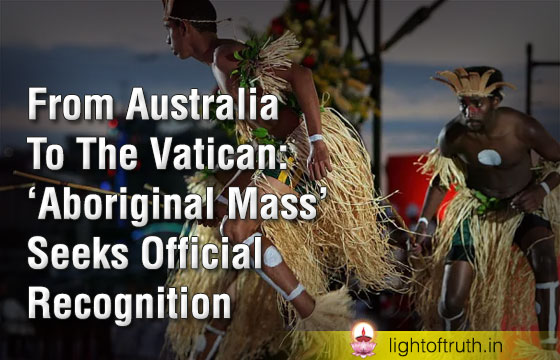
From Australia To The Vatican: ‘Aboriginal Mass’ Seeks Official Recognition
On May 7, Australia’s Catho-lic bishops officially approved a liturgy used in a remote Western Australian diocese that incor-porates elements of Abori-ginal language and culture. The liturgy has been celebrated for over 50 years in the Diocese of Broome, where some 13,000 Catholics live in nine parishes across an area about the size of Texas, with a total population of just over 50,000. The Mass of the Land of the Holy Spirit – in Latin, “Missa Terra Spiritus Sancti” – now awaits the Vatican’s official recognition after the Australian Catholic Bishops’ Conference passed the motion at its plenary meeting in Sydney on May 7.
Bishop Administrator Michael Morrissey of Broome said the decision was a milestone. “After a lengthy period of engagement, it’s a significant acknowledgment by the Australian bishops.” Two Indigenous elders, Maureen Yanawana and Madeleine Jadai, presented the Mass to the bishops and shared its impact on their community. “Singing at the top of our voices brings us peace,” Yanawana shared during the presentation at the bishops’ meeting in Sydney’s Mary Mac-Killop Place, highlighting the spiritual enrichment it brings.

Conference In Rome Addresses Dangers Of AI And Child Pornography
“What dangers does arti-ficial intelligence (AI) present for the safety of children in digital environments?” was the topic addressed by a conference organized by the S.O.S Il Tele-fono Azzurro Foundation and the Italian Embassy at the Holy See as part of the National Day against Pedophilia and Child Pornography, which is observed in Italy every May 5.
According to its website, Il Telefono Azzuro (“The Blue Telephone”) “offers a hotline service, managed by 114 Children’s Emergency, through which it is possible to report illicit or potentially harmful content for children and adolescents.”
Disturbing statistics were reported at the event: In 2023 there were more than 275,000 child pornography websites on the internet with approximately 11,000 photos generated by AI in just one month.
However, these figures could be even higher, Vatican News noted, given that this new phenomenon “is difficult to quantify concretely.”
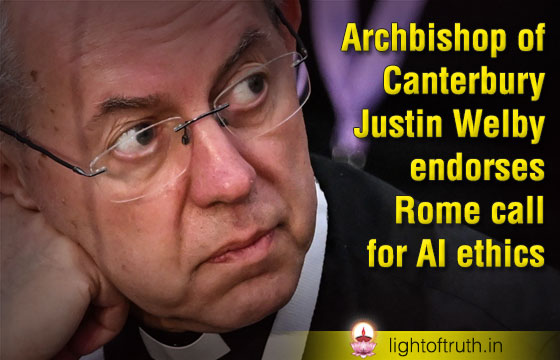
Archbishop of Canterbury Justin Welby endorses Rome call for AI ethics
The Archbishop of Canter-bury, Justin Welby, has joined other illustrious leaders, ethicists, and university professors in signing the ”Rome Call” for the ethical development of artificial intelligence. Archbishop Welby, leader of the Anglican Communion, endorsed the initiative on 30 April at a ceremony in Rome at the headquarters of the Pontifical Academy for Life, according to a note from the Academy and its Renaissance Foundation. The Call for AI Ethics is a document that “aims to foster a shared sense of responsibility for human dignity amid rapid technological advancements.”
“I am delighted to support the Rome AI Call, which emphasises the dignity of every human being amid technological change,” Archbishop Welby said when signing the document on behalf of the Church of England. “While we can’t predict the future, we do know that there will continue to be rapid developments in science and technology and we need to be prepared,” he noted. While recognizing the enormous potential AI can offer “in improving human capability,” he emphasised that we must also strive “to protect, preserve and cherish the dignity of the human person.” The enormous advances made in AI, therefore, “cannot be the sole property of its developers, or any single part of the human race,” but benefit all in serving the common good, safe-guarding climate, and aiming at sustainable development.
“So much of how we under-stand Artificial Intelligence,” Archbishop Welby concluded, “comes down to how we under-stand the nature of being human” and our working together “to ensure that the dignity of every human being, created by God, not for profit or productivity, is central to all we do.”
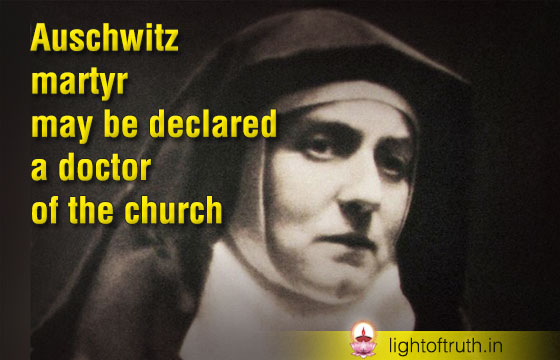
Auschwitz martyr may be declared a doctor of the church
Pope Francis received an official request from the superior general of the Discalced Carmelites, Fr Miguel Márquez Calle, on April 18 in a private audience at the Vatican to recognise the theological legacy of the saint who was martyred in Auschwitz. If accepted, Stein, also known by her religious name St Teresa Benedicta of the Cross, could become the fifth woman to be declared a doctor of the Church, a title that recognises a substantial contribution to the Church’s theology and moral life.
With the petition, the Vatican Dicastery for the Causes of Saints can officially begin the required process to grant Stein the title. The Carmelites first launched an inter-national commission to gather the necessary documentation required by the Vatican in 2022, a year that marked both the 100th anniversary of Stein’s baptism and the 80th anniversary of her martyrdom. A title that was proposed for her at the time was “doctor veritatis” because of her relentless intellectual pursuit of truth, which after her conversion she recognised in the person of Jesus Christ.
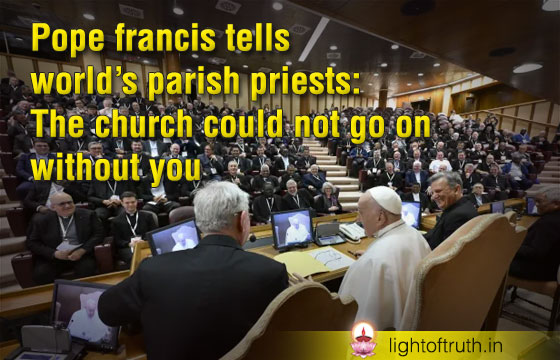
Pope francis tells world’s parish priests: The church could not go on without you
Pope Francis published a letter addressed to all parish priests in the world with his advice for building a missionary Church in which all the baptized share in the mission of proclaiming the Gospel.
“Parish communities increasingly need to become places from which the baptized set out as missionary disciples and to which they return, full of joy, in order to share the wonders worked by the Lord through their witness,” Pope Francis wrote in the letter published on May 2.
The pope presented the letter to 300 priests participating in the Synod on Synodality’s “World Meeting of Parish Priests” during an audience at the Vatican, saying that their meeting is “an opportunity to remember in my prayers all of the parish priests in the world to whom I address these words with great affection.” “Before all else, I would like to express my gratitude and appreciation for the generous work that you do each day, sowing seeds of the Gospel in every kind of soil,” Pope Francis wrote. “It is so obvious as to sound almost banal, but that does not make it less true: the Church could not go on without your dedication and your pastoral service,” he added.
In the letter, Pope Francis offered three suggestions to parish priests for building “a synodal and missionary Church.” The first is for priests to live out their “specific ministerial charism in ever greater service to the varied gifts that the Spirit sows in the people of God.” He said that by nurturing the many and varied charismatic gifts of the laity, priests will “feel less alone in the demanding task of evangelization” and “will experience the joy of being true fathers, who do not dominate others but rather bring out in them, men and women alike, great and precious possibilities.”

Christians And Buddhists Must Walk Together ‘For The Sake Of Peace’
In a message entitled “Christians and Buddhists: Working together for Peace through Recon-ciliation and Resilience” released on 6 May, Cardinal Ayuso, the Prefect of the Dicastery for Interreligious Dialogue, reflected on how the teachings of both traditions highlight the need for collaborative efforts in healing the wounds of humanity and the earth.
Quoting Pope St. Paul VI’s timeless plea, “Never again war, never again war,” the Cardinal said it serves as an urgent reminder of how “the continuing escalation of conflicts worldwide calls for renewed attention to the critical issue of peace and deeper reflection on our role in overcoming the obstacles standing in the way of its growth.”
Noting that pursuing peace demands “vigorous efforts” on the part of all, Cardinal Ayuso pointed to the need “to strengthen our commitment to work for recon-ciliation and resilience.” The Cardinal remarked on how the quest for lasting peace requires acknowledging that true recon-ciliation cannot occur without addressing the underlying causes of conflicts and he emphasized the importance of equity and justice in political, economic, and cultural spheres.