

Catholicism must rid itself of the “heresy of triumphalism” if it is to become more synodal and better able to evangelise in a secular age, according to noted Czech theologian and philosopher Msgr Tomas Halik.
“We see ourselves as a soci-etes perfecta,” or a perfect soci-ety, that is too self-sufficient, said Msgr Halik, who was recently chosen by the Vatican’s Synod office to help lead an April 29-May 2 gathering for some 200 parish priests from all over the world. The gathering was orga-nised in response to concerns that Pope Francis’ Synod on Synodality included only a few parish priests among the more than 400 delegates that participated in the first session of the assembly in October 2023. Msgr Halik praised Francis’ synodal efforts and his commit-ment to root out a culture of cleri-calism, where priests see them-selves as more powerful than the laity.
But, he said, he would also point to “ecclesial triumphalism,” which he said is a prideful, wide-spread attitude defined by a Catho-licism that is closed off from the world around it. In an address to the parish priests in attendance at the Synodal gathering, Msgr Halik lamented that “some Chri-stians, alarmed by the rapid changes of the world, want to make the Church an island of unchanging certainties.” “There are still places where the parish priest sees himself as the pope of his parish. But the Church confers the gift of infallibility on only one of its members, and then only under strictly limited conditions,” he continued. “And if even a Pope relies on several consultative councils to help him make his decisions, how much more should a parish priest listen to those he has been sent to serve?” Msgr Halik said he was encouraged by the open and frank discussions that took place during the gathering.
All posts by Light of Truth
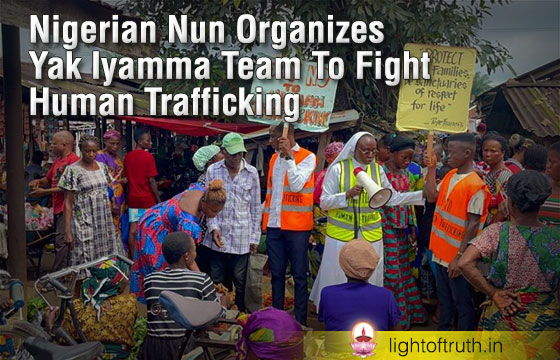
Nigerian Nun Organizes Yak Iyamma Team To Fight Human Trafficking
Trafficking in persons has been a cruel reality in Nigeria since the 1980s, one that is un-fortunately still present. In response to an appeal made by the Bishops of Nigeria and Major Superiors to join in the fight against human trafficking, Sister Anthonia M. Essien, HHCJ, and her team have launched awareness raising programs in rural villages in Akwa Ibom State.
Sr. Anthonia M. Essien is a member of the Congregation of the Handmaids of the Holy Child Jesus in Nigeria. She is a Professor of Sociology of Religion and the current Deputy Vice-Chancellor at the University of Uyo, Nigeria. Despite her busy schedule as a university Professor, Sr Anthonia responded to the plight of trafficked victims by whole-heartedly joining in the fight against human trafficking, through awareness and skills acquisition programs. “I was moved by the stories of the victims. I could not sleep. I had to do something for them,” said Sr. Anthonia.
Since 2021, Sr. Anthonia has carried out several pastoral activities in rural villages in Akwa Ibom State, raising awareness among the people on the ills of trafficking in persons. She works actively in collaboration with local law enforcement agencies to facilitate the arrest of traffickers, and ensuring that they face the law. Her efforts recently resulted in the rescue of several children and teenagers who had been sold to traffickers within the country. “I was shocked to learn that some of the children had been sold by an adult known to them,” Sr. Anthonia said. “My first response, when the father of two of the children told me they were missing, was to get the police and the State anti-trafficking department involved. Their prompt response led to the rescue of the children.” Sr. Anthonia came up with the idea of a Community Action Group – local donors and stakeholders – to involve the local community in the Yak Iyamma project for the prevention of human trafficking.

Vatican To Publish New Document On Marian Apparitions
The Holy See Press Office announced that Cardinal Víctor Manuel Fernández, the prefect of the Dicastery for the Doctrine of the Faith (DDF), will unveil new norms for discernment regarding “apparitions and other super-natural phenomena” on Friday, May 17.
In an interview with the National Catholic Register Cardinal Fernandez said that the document will provide “clear guidelines and norms” for discernment. The new norms will be the first time that the Vatican’s doctrinal office has issued a general document on apparitions in four decades. Pope Paul VI approved norms on “the discernment of presumed apparitions or revelations” in 1978.
The Catholic Church calls for “great prudence” in examining the facts related to presumed apparitions of revelations. According to the 1978 norms, it is the Church’s responsibility to first judge the facts before permitting public devotion in the case of an alleged apparition.
“Throughout the ages, there have been so-called private revelations, some of which have been recognized by the authority of the Church. They do not belong, however, to the deposit of faith,” paragraph 67 of the Catechism of the Catholic Church states. “It is not their role to improve or complete Christ’s definitive revelation, but to help live more fully by it in a certain period of history. Guided by the magisterium of the Church, the sensus fidelium knows how to discern and welcome in these revelations whatever constitutes an authentic call of Christ or his saints to the Church.”
Under Pope John Paul II, the Vatican Congregation for Divine Worship and the Discipline of the Sacraments issued a lengthy document on popular piety in 2001 that reiterated the Church’s teaching that private revelations do not belong to the deposit of faith.
Youth taught to use social media to become Good Samaritans
A workshop organized by the Tamil Nadu Church’s online televi-sion channel has taught young people to use social media to help society” We have to decide whether to beco-me Good Samaritans or indifferent bystanders,” said Fr Jenith Sekar, the technical manager of Madha TV and the coordinator of the April 12-13 workshop on “Storytelling in the Digital Age.”The priest pointed out that social media is a gift of the mo-dern era that offers “a great oppor-tunity to express our inherent sense of fraternity, to become Good Sama-ritans who bear the pain of other people’s troubles rather than provo-king greater hatred and bitterness “round 45 young people from vari-ous dioceses in Tamil Nadu attended the April 12-13 workshop at Kaviri Communications Centre in Tiruchira-ppalli. Madha TV, the online Catho-lic Satellite Television of the Tamil Nadu Bishops’ Council, organized the workshop to form socially respon-sible and committed young media warriors in the digital age.
Pakistan’s oldest priest passes away at 97
Christians and Muslims paid tributes to Father Melito Dias, the oldest Christian clergy in Pakistan, who passed away on April 18 at the age of 97. Dias died at the Holy Family Hospital in Karachi due to old age complications, the Pakistani Catholic bishops’ National Commi-ssion for Justice and Peace (NCJP) confirmed on April 19. Born in Kara-chi, the capital of Sindh Province, on Feb. 27, 1921, Dias studied at Church-run St.Patrick’s High School. He was ordained a priest on Aug. 24, 1954, in Kandy city of Sri Lanka with permission from Karachi Catho-lic Archdiocese. He was first posted at the Minor Seminary at Quetta in Balochistan province and then at St. Patrick’s High School, his alma mater. He also served the parish of St. Joseph’s in Sindh’s Larkana city. An ardent fan of Pakistan’s national sport, field hockey, Dias was selected to play for the Sindh Provincial Hockey team during his days as a student at St.Patrick’s High School. However, Dias decided to move to Sri Lanka for missionary experience instead of travelling to India with the hockey team to play a tournament. After returning to Pakistan from Sri Lanka, Dias taught in several schools including the Quetta Grammar School, St.Patrick’s High School in Karachi and St.Lawrence’s School. He was head hockey coach during his stint with St.Patrick’s High School, mentoring students into budding athletes.
Archbishop Seeks Local Help As Indian Govt Blocks Foreign Aid
An archbishop in southern India has sought financial support from his people after the government canceled its license to receive foreign funds following Catholic fishermen’s protest against a seaport that threatened their livelihood. Archbishop Thomas J Netto of Trivandrum (now Thiruvananthapuram), based in the capital of southern Kerala, sought his lay Catholics’ contribution in a pastoral letter on April 21.
“The archdiocese fell into ‘serious financial crisis’” after the pro-Hindu federal government, led by the Bharatiya Janata Party (BJP) of Prime Minister Narendra Modi “canceled its permit to accept foreign donations,” Netto said. The archdiocese’s license was canceled in February 2023 after Netto and senior priests joined a 140-day protest by the local people, most of them Catholics, who opposed the project, saying it would cause large-scale coastal erosion and threaten their shelters and livelihoods. The protest was called off on Dec. 6, 2022, after the government promised compensation. The multi-million dollar project, constructed under the public-private partnership model, was scheduled to be commissioned in 2019 but was delayed due to issues related to land acquisition. The government “froze our bank accounts last year after the agitation in Vizhinjam. The situation continues even now,” the archbishop said. Netto said in the pastoral letter that the archdiocese needs around 20 million rupees (some US$240,000) each year to train priests and care for retired clergy. However, the archdiocese’s coffers are empty.
“We are unable to manage the daily expenses. Therefore, the archbishop sought help,” said vicar-general Father Eugine H Pereira. Pereira told on April 23 that the Church’s outreach programs for economically weak families have suffered greatly.
The archdiocese had two license numbers to receive foreign funds — one for the archdiocese and one for its social service wing — and they were active until March 2022. In February 2023, the licenses were revoked, citing diocesan officials’ involvement in the protest. The port, called “India’s gateway to international transshipment” due to its proximity to international shipping routes, became partially operational in October 2023 with the arrival of a Chinese ship carrying massive cranes. The government promised to meet most of the protesters’ demands. It agreed to pay a monthly rent of 5,500 Indian rupees to families of fishermen who had lost their homes due to the port construction and expedite the ongoing rehabilitation work. “The government is yet to fulfill the promises,” noted Father Pereira.
Six Women’s Congregations Empower Youth At Risk In Bengaluru
Members of six women congregations have come together to empower “youth at risk” in Bengaluru, a southern Indian city with more than 3 million youth. “This is the perfect example of synodality in action as envisaged by Pope Francis,” said Apostolic Carmel Sister Maria Nirmalini, leader of the Conference of Religious India, representing the country’s more than 130,000 Catholic women and men. The “Sisters Led Youth Initiatives” project is jointly implemented by the members of the Apostolic Carmel, the Daughters of Mary Help of Christians, the Missionary Sisters of Mary Help of Christians, the Salesian Missionaries of Mary Immaculate, the Poor Handmaids of Jesus Christ, and the Sisters of St Joseph of Tarbes. “Our aim is to make youth dream high, think better and act great,” said Sister Jane Wakahiu, head of the Catholic Sisters Initiative, which supports nearly 1,200 young people under the program. The Kenyan nun was speaking at the March 19 graduation ceremony for the first batch, mostly women who were trained in vocational skills by the six congregations. “Women religious in India have played significant roles in empowering youth at risk, especially the vulnerable women in society,” observed Wakahiu, a member of the institute of the Little Sisters of St. Francis. Sabrina Wong, a project officer who oversees the project in India, finds the program’s uniqueness in the “beauty of various religious congregations working together to empower the youth.” Nirmalini, who is also the superior general of her congregation, told GSR that the women congregations in India will experiment more with such collaborative projects as part of its strategic plan. On the occasion, the Conference of Religious Women India released its strategic plans for the next five years.
The 2024-29 plan stresses projects and programs to empower youth, women and underprivileged populations in India, to be implemented as a partnership project of nuns from different congregations. Nirmalini, who chaired the graduation ceremony, said the program reinforces the feeling that “we are not alone” and “we are for everyone.” She applauded the congregations for coming forward to empower the weaker sections.
Catholic School Vandalized, Priest Assaulted In Telangana
Paramilitary personnel have been deployed at a Catholic school in the southern Indian state of Telangana after right wing Hindu activists vandalized it and assaulted a priest. The attackers on April 16 accused the school management of hurting religious sentiments by questioning a few students who had attended class with religious dress instead of the uniform. A mob wearing saffron colored shirts and shawls entered the premises of the St. Mother Teresa English Medium School in Kannepally, a village in Mancherial district, some 275 km northeast of Hyderabad, the state capital. The mob shouting “Jai Shree Ram” threw stones at the statue of St Mother Teresa installed at the school’s main gate and destroyed the security office. They then marched inside the school campus, destroying the gate and entered the school’s first and second floors and broke window glasses, flower pots and the office room. They assaulted Father Jaimon Joseph, the school manager who, however, was saved by other school officials.”They slapped my face and punched my stomach. Someone even hit me from behind,” Father Joseph, a member of the Missionary Congregation of the Blessed Sacrament, told on April 17.
The priest denied “as totally baseless” the allegation that the school had not allowed students to wear their religious dress. The school is managed by the congregation’s Zion province, based at Kozhikode, Kerala, another southern Indian state. It comes under the Adilabad Syro-Malabar diocese and the bishop’s residence is around 160 km northwest of the school. Father Joseph narrated. Meanwhile, the state district administration has beefed up security around the schools deploying 18 Central Reserve Police Force personnel. The priests also lodged a complaint with the police. Father Joseph said they have learned that the police have registered a case against the principal and others for allegedly hurting religious sentiments among other charges. “But we are not officially informed of it,” he added. Christians make up close to 2 percent of Telangana’s 35 million population.
Skip Velankanni pilgrimage to vote: Cardinal Ferrão
Card. Filipe Neri Ferrão, archbishop of Goa-Dama, has urged his people to refrain from undertaking a pilgrimage to the Marian shrine at Velankanni in Tamil Nadu a day before the general elections in Goa. “It is universally recognized, espe-cially in a democracy, that the responsibility to make choices in political life rests with each individual, guided by a properly formed conscience,” the cardi-nal said in the circular addressed to the clergy, religious and faithful in Goa. The cardinal’s April 15 message comes against the backdrop of several people expressing concern on social media that many Catholics may end up missing out on the opportunity to vote due to the election schedule. Goa, which elects two Lok Sabha members, is scheduled to vote on May 7. In his circular, the prelate reminds Catholics and “people of good will” to fulfill their ci-vic responsibility by exercising their vote.” In this connection, I see it as my bounden duty, as the head of the Church in Goa, to call the attention of our Church members to the fact that, in the Catholic tradition, responsible citizenship is a virtue, and participation in poli-tical life is a moral obligation’,” he said quoting “The Joy of the Gospel”, apostolic exhortation by Pope Francis in November 2023.
This obligation, the cardinal said, is rooted in “our baptismal commitment to follow Jesus Christ and to bear Christian witness in all we do.” “In this context, I appeal to every eligible voter to participate in the democratic process by casting the vote, not only as a right, but chiefly as a duty towards the nation. He also reminded the faithful “about their duty to pray for our country which we do on every Sunday at Mass.” He has requested parish priests, chaplains and superiors of religious houses in Goa to organize special prayer services on May 3, the first Friday of the month, or on May 5, for the success of the elections.
Discuss, Discern And Vote: Bishop Udumala
The Catholics of Warangal diocese, in the southern state of Telangana, on April 21 received a pastoral letter from Bishop Bala Udumala during the Sunday liturgy. The bishop, who is also the chairman of the Telugu Catholic Bishops’ Council’s Commission on Theology and Doctrine, called for an urgent conversation among the laity, religious and clergy across the Telugu states on the need to involve themselves in participatory processes to strengthen democracy and on the need to vote in the elections. Telangana goes to polls on May 13.
The four-page pastoral letter discusses various challenges facing the nation. The letter also urges the Church’s associates and friends and well-wishers, be they teachers in our institutions or the parents of the students or the others, to become responsible citizens. A trained moral theologian, Bishop Udumala infuses ethical principles such as dignity and rights, justice and solidarity into the pastoral. He reminds how millions across the country are left behind and how they continue to be exploited and discriminated against in one way or the other.
He exhorts fellow Christians to enter into civic space, as executives and legislators, as judges and public servants, and shape it for the better. On the general elections now underway in the country, Bishop Udumala states that each person is indispensable and each vote counts. Will the person standing for the elections uphold the Constitution of India and abide by the values enshrined in the Preamble. “We need to ask ourselves as we choose whom to vote,” he alerts. Referring to the Chri-stians in Manipur, the bishop states that being in solidarity with their suffering and seeking justice for them is fundamental to Christian vocation.
The Church endorses and accompanies Dalits and Adivasis and others who relentlessly seek justice, making the cause its own, the letter says.