
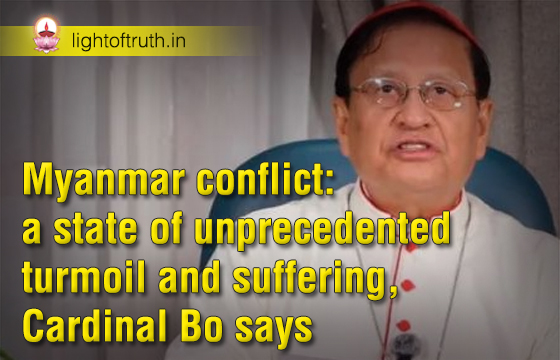
In an interview with ACI Prensa, CNA’s Spanish-language news partner, Cardinal Charles Maung Bo, Archbishop of Yangon in Myanmar, said there is an “unprecedented state of turmoil and suffering, which seems to have no end” in the country resulting from a coup d’état at the beginning of 2021 in the midst of the COVID-19 pandemic.
The conflict has already left more than 100 places of worship bombed or damaged, the cardinal said, and the violence has spread in many areas of the territory. In addition, he said that almost 3 million people have been displaced and are in urgent need of assistance, which has been arriving little by little thanks to the work of the Catholic Church and other nongovernmental organizations such as Religions for Peace.
Although Myanmar is a pre-dominantly Buddhist country, the constitution guarantees religious freedom. However, Bo pointed out a worrying reality: “The last de-cade saw the emergence of funda-mentalist forces that targeted mi-nority religions.”
The situation has been exa-cerbated by recent political unrest affecting people of all faiths who are suffering the consequences of an expanding civil war. “Peace is the common prayer of all the religions,” the cardinal emphasized.
All posts by Light of Truth
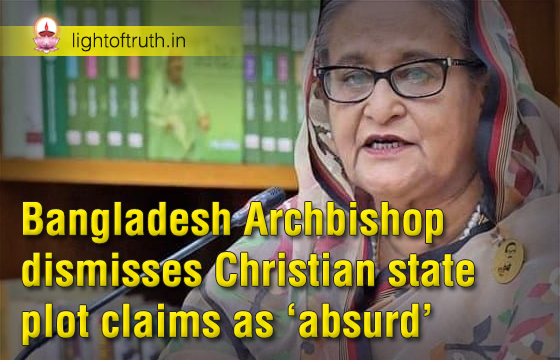
Bangladesh Archbishop dismisses Christian state plot claims as ‘absurd’
“We, the Christians of Bangladesh, and their leaders – the Catholic Bishops’ Conference of Bangladesh (CBCB) and the United Forum of Churches (UF-CB) are surprised and worried,” said a joint statement issued on Sunday.
In today’s globalised and secularised world, the idea of a “Christian state” is absurd, said the statement signed by Abp Bejoy D’Cruze of Dhaka, the president of CBCB and UFCB.
The reaction came after Bangladesh’s Prime Minister Sheikh Hasina accused Christians of plotting to carve out a “Christian state” of their own by taking parts of Bangladesh and Myanmar. “Like East Timor …they will carve out a Christian country taking parts of Bangladesh [Chattogram] and Myanmar with a base in the Bay of Bengal,” national English newspaper The Daily Star quoted Ms Hasina as saying on May 23.
She said the government is under pressure to allow a foreign government to use a base in the Bay of Bengal, which she rejected without naming the country. “Many have their eyes on this place. There is no controversy here, no conflict. I won’t let that happen. This is also one of my crimes [in their eyes],” she said, adding that this is why the Awami League Government is always in trouble.
The alleged plot is neither supported nor accepted by Christians, he said.
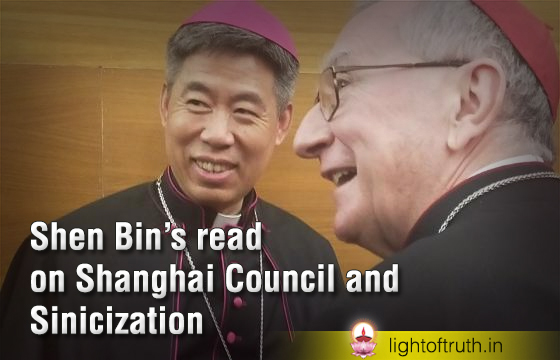
Shen Bin’s read on Shanghai Council and Sinicization
This year marks one hundred years since the Council of Shanghai, the first Plenary Council of the Church in China. For the occasion, the Pontifical Urbaniana University in cooperation with the Agenzia Fides organised a conference, which was held today, to highlight the historic event a century ago, but also to look at today’s challenges, starting with the notion of “sinicisation” of religions, an issue central to Chinese President Xi Jinping’s religious policy.
Pope Francis also underlined the importance of the council in 1924, which brought together the bishops and apostolic prefects present in China at the time, in a video message.
A lot of curiosity surrounded the first official visit in Rome of the current bishop of Shanghai, Msgr Joseph Shen Bin, at the centre of tensions last year after Chinese authorities unilaterally transferred him to China’s foremost epis-copal see, a situation later settled by Pope Francis’s decision to appoint him as well.
Bishop Shen was joined by important academics and Church officials from the People’s Republic of China, who brought their vision of what happened a century ago, as well as their views about the relationship between the “inculturation” of the faith promoted by the doctrine of the Church and “sinicisation”, processes seen as two circles that overlap but also diverge.
This also comes with the need for dialogue in the perspective of fraternity to avoid the risk of fuelling “new self-referential closures”, as Card Luis Antonio Tagle, pro-prefect of the Dicastery for Evangelisation, put it this in his conclusion. “The stories of our Chinese brothers and sisters have something important to show to the universal Church,” Card Tag-le said. “There may be misunderstandings, but [they are] never half-hearted with respect to the Church’s journey in China.”
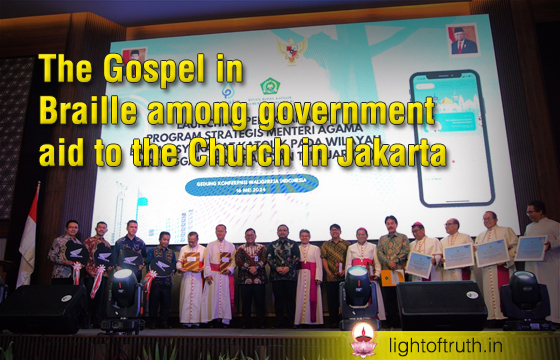
The Gospel in Braille among government aid to the Church in Jakarta
Instruments and institutions at the service of the disabled. And permits for the construction of two new churches in the archdioceses of Jakarta and Pelambang. These are the new projects put in place in agreement with the local Church by the Indonesian Ministry of Religious Affairs, through its Directorate for Catholics (Bimas Katolik Kemenag), presented in a meeting held with the Bishops’ Conference.
In particular, the government will take care of the dissemination of a Braille translation of the Gospel of Mark for the visually impaired and the establishment of two Catholic high schools to train catechists prepared to serve the disabled in the district of Nagekeo, located on the island of Flores, in eastern Nusa Tenggara province, and on the island of Nias, in Sumatra province.
‘Our agency has a primary focus on the neglected people in the remote areas of the country,’ explained the Director of the Directorate for Catholics, Mr Supraman, ‘providing a financial aid package to establish or renovate places of worship and to procure essential tools for apostolate in education or other areas. The project for the disabled is being carried out in cooperation with the Ministry of Social Affairs.
Expressing his thanks, the President of the Indonesian Bishops’ Conference, Bishop Antonius Subianto of Bandung, commented: ’We really have things in common: the good spirit of helping others, especially the neglected people.
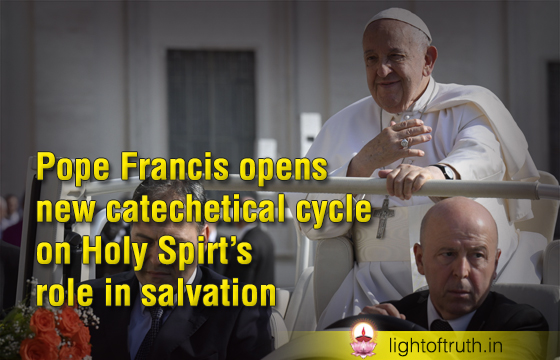
Pope Francis opens new catechetical cycle on Holy Spirt’s role in salvation
Pope Francis on May 29 opened a new catechetical series during his weekly general audience, focusing on the theme of creation across history and the role of the Holy Spirit in the story of salvation.
Titled “The Spirit and the Bride: The Holy Spirit Guides God’s People Toward Jesus Our Hope,” the new cycle will unfold across three main themes: the Old Testament, the New Testament, and “the time of the Church.”
“The Spirit of God, who in the beginning transformed chaos into cosmos, is at work to bring about this transformation in every person,” the pope said during the general audience held May 29 in St. Peter’s Square.
The first part of the series will begin with an overview of creation according to the Old Testament, but it will not be “biblical archaeology.” The pope explained that it will instead focus on how the promise given in the Old Testament “has been fully realized in Christ.” “It will be like following the path of the sun from dawn to noon,” he added. Quoting from the first two verses from the Book of Genesis, Francis observed that “the Spirit of God appears to us here as the mysterious power that moves the world from its initial formless, deserted, and gloomy state to its ordered and harmonious state.” Referencing the division between the “confused” and the “beautiful and ordered,” Pope Francis observed that it is God who “makes the world pass from chaos to the cosmos.”
The pope underscored the Holy Spirit’s role in creation and as a protagonist in the story of salvation by pointing to the Psalms and the New Testament. “The Apostle Paul introduces a new element into this relationship between the Holy Spirit and creation,” the pope said. He speaks of a universe that ‘groans and suffers as in labour pains.’ The pope emphasized that St. Paul understands the “cause of the suffering of creation in the corruption and sin of humanity,” which has alienated man from God and is a theme still present today.
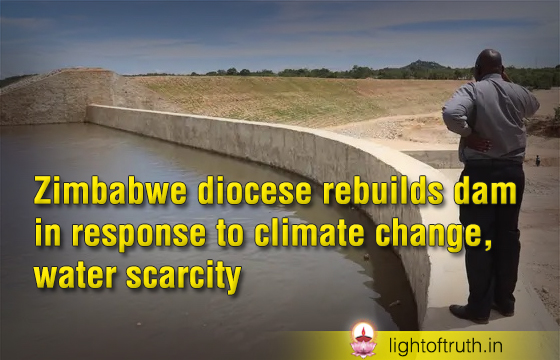
Zimbabwe diocese rebuilds dam in response to climate change, water scarcity
Catholic diocese in Zimbabwe has rebuilt its own dam as part of faith-based responses to water challenges brought by climate change. The Diocese of Gweru in the country’s low rainfall Midlands province says the Holy Cross Dam, reconstructed at the beginning of this year, will go a long way toward reviving long abandoned agriculture projects.
The dam is also expected to create a greenbelt for local farming communities and drive other downstream economic activities to help support long-term sustainable development. Gweru is in Midlands, one of the country’s 10 provinces that have in recent years experienced below average rainfall, sending agriculture pro-duction into a tailspin that has left thousands of households threatened by hunger.
The construction of the Gweru Diocese dam comes at a time when the Catholic international aid agency Caritas is also helping rural communities with the rehabilitation of a defunct dam as part of efforts to cushion against cli-mate-induced water stress. The government has touted more dam rehabilitation and dam construction as the answer to escalated food production after successive poor harvests due to below normal rainfall.
The government sees dams as a way to power the country’s vast irrigation infrastructure, with the minister of finance media, “When it comes to investment in irrigation, we are going to accelerate investments now that we have the water bodies. We have to impound water. So, it’s an ongoing program to complete dams under construction.” The government says so far that 12 large dams are under construction across the country.
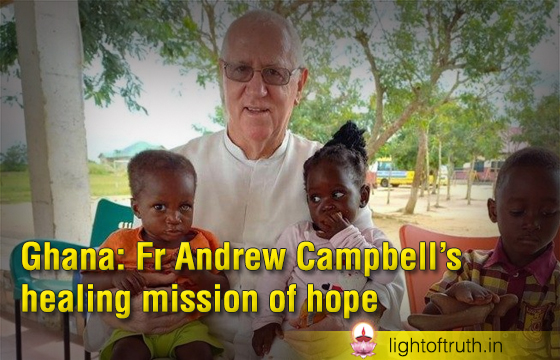
Ghana: Fr Andrew Campbell’s healing mission of hope
On 27 May 2024, Pope Francis received in private audience the Irish SVD priest, Fr Andrew Campbell, a missionary who has lived and worked in Ghana for the last 53 years. Inspired by Saint Theresa of Kolkata, India, Fr Andrew Campbell has dedicated his life to working with the poor and marginalized of Ghana. He has had great impact, especially working with street children, those suffering from disabilities such as Leprosy, and those generally disadvantaged by society.
“I was working at the age of 13 as a Labourer. So, I know what it is like to go without education. I don’t want anybody to go through what I went through. …there are a hundred thousand street children in the City of Accra living on the streets. They range from little kids onwards…. But with the Lepers, I am actually living with them. I help them, ensuring everything is okay: their health and food. I care for these needs while living with them,” Fr Campbell said.
Speaking to Vatican News after meeting with Pope Francis, Fr Campbell expressed his great joy at the encounter. “I can’t put words to it. It was so wonderful meeting him (Pope Francis). This man has always attracted me with his love for the poor,” Fr Campbel said.
It all started when someone suffering from Leprosy gave Fr. Campbell a bag of Mangoes. He failed to eat them, fearing he could contract the disease himself. Then, his conscience got the better of him. He went to see where those suffering from Leprosy were staying. He was appalled by the conditions and, from there, started an apostolate to Ghana’s marginalised.
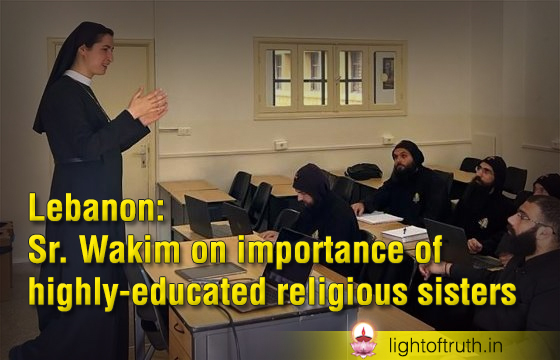
Lebanon: Sr. Wakim on importance of highly-educated religious sisters
Sister Suzanne Wakim is one of many religious sisters who teach in Lebanon’s Catholic universities. She teaches philosophy in four universities, and her students include people of different faiths, among them Muslims. She is an expert in Pope Benedict XVI’s anthropological and philosophical thought, and her work on the topic is the first on the late Pope to be written in Arabic. Sr Wakim began teaching in 2021. She has a sense of mission, and wants to do something good for the Church. She has written four academic publications over the past three years. Among other things, she explores the topic of teaching ethics in universities.
As the religious sister high-lighted, today it is important to read and study, to educate oneself. “I also encourage the younger religious sisters to develop their interests and broaden their horizons; people need educated sisters,” she said. “We cannot focus only on our religious duties; today we are in contact with many educated people, which is why it is important to grow also in our education.” This also changes the congregation’s image. Sr Wakim added that when she was presenting one of her articles for publication, someone asked her who would read it. “Today, we read too little and do not educate ourselves enough, often simply out of laziness,” she added. The religious sister speaks Arabic and English, and she is learning Italian. For work, she has also dabbled in Greek and Syriac. With her family she also speaks Aramaic. “The biggest challenge is finding a balance among all my responsibilities,” she confided.
Sr Suzanne Wakim belongs to the Salvatorian Sisters of Our Lady of the Annunciation. She teaches at Holy Spirit University of Kaslik, Saint Joseph University of Beirut, Antonine University of Baabda, and the Saint Paul Institute of Philosophy and Theology of Harissa, in Lebanon. She also teaches at a school managed by her same religious congregation: the High School Department of Notre Dame de la Délivrance of Hadath.
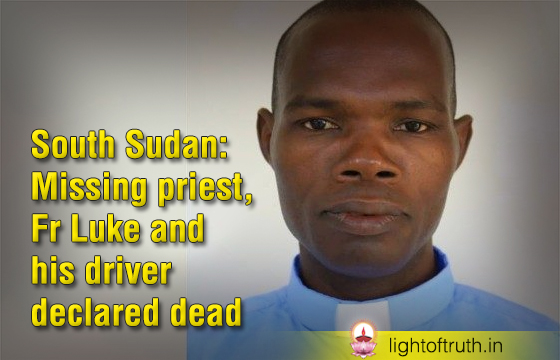
South Sudan: Missing priest, Fr Luke and his driver declared dead
South Sudan’s Diocese of Tombura Yambio has officially declared a mi-ssing priest, Fr Luke Yugue Mbokusa, and his driver, Mr Michael Gbeko, formally dead. “It is with deep sadness and heavy hearts that we inform you of official Funeral Prayers for our priest and colleague, Rev. Father Luke Yugue, and his driver, Michael Gbeko, who went missing on 27 April 2024, when on their way from Nagero County to Tombura County. The funeral prayers will start on Thursday, 23rd– 25th May 2024, and end with a funeral Holy Mass on Saturday (25 May 2024) at St Mary, Mother of God Catholic Parish,” said the local Ordinary. He urged parishes in the diocese to observe the days of the funeral as announced.
Bp Kussala continued, “From that darkest Saturday, 27 April, when Fr Luke Yugue and Michael Gbeko went missing, we have made so many enquiries to find them alive or dead, but sadly to no avail. As we go into this funeral peri-od, our quest for Search, Truth, and Jus-tice will not stop,” he assured. Bp Kussala was quick to appeal for calm and took time to dissuade any unilateral violent acts of revenge. He told the faithful of the diocese, friends and family that despite their pain and loss, they needed to hold fast to the tenets of the Gospel, their faith and let the law take its course.
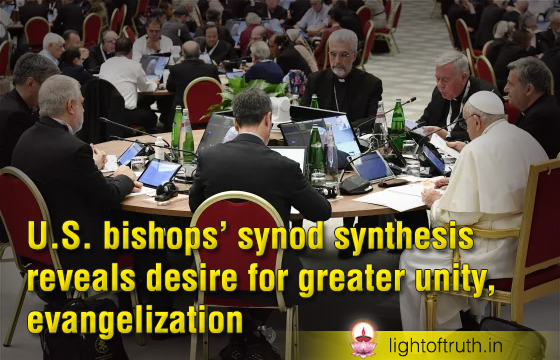
U.S. bishops’ synod synthesis reveals desire for greater unity, evangelization
A synthesis of feedback received from 35,000 U.S. Catholics as part of the ongoing Synod on Synodality reveals that amid political and theological polarization, many lay Catholics desire unity, both among themselves and among the clergy.
“This document reflects the sense that there exists among Catholics in the United States a deep desire to rebuild and strengthen our communion as the body of Christ,” Bishop Daniel Flores of Brownsville, Texas, chairman of the United States Conference of Catholic Bishops’ (USCCB) doctrine committee, wrote in the report’s introduction. “Rebuilding trust where it is frayed involves practicing the humanly graceful art of listening to each other and speaking together. The more we do this, the more we realize that it is the Lord who never fails us. He responds to us and knows well how to accomplish his will through the communion of his imperfect and often wounded servants.”
As synthesized in the May 28 report, many of the reports from the listening sessions expressed a wish for an “increased focus on formation for evangelization… a need for stronger catechesis and formation, focusing specifically on programs for evangelization, Catholic social teaching, and the role of the family.”
Also emphasized was the importance of clerical and lay Catholics working together. “It is important for laypeople to rely on their pastors and help their pastors, and it is important for pastors to rely on their laypeople.”
Participants noted that parishes with “numerous small faith communities, Bible studies, and prayer groups prove most successful in welcoming and integrating people from diverse backgrounds” in a manner “beyond superficial welcoming.” The role of Catholic schools in evangelizing the community was also widely recognized.