
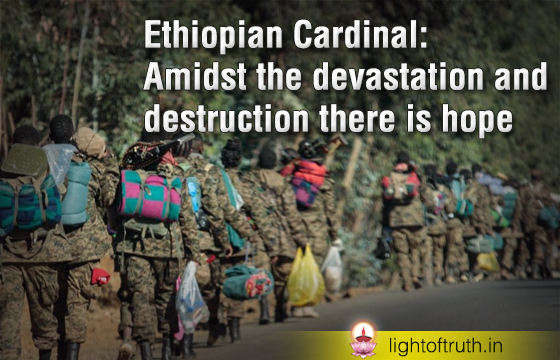
Card. Berhaneyesus Demerew Souraphiel, Metropolitan Archbishop of Addis Ababa, has always been involved in addressing the humanitarian crises that have risen in Ethiopia as a result of past and ongoing conflicts. In a recent interview with Fides News Agency, he stated that “there are various conflicts in Ethiopia, but we must never lose hope.”
Discussing the internal conflicts in the country, Cardinal Souraphiel spoke of the suffering caused to the population. He noted that the Tigray war has ended, with the signing of a peace treaty in Pretoria, but that even so, humanitarian needs are desperate. Likewise, humanitarian needs in Oromia are severe, affecting both the displaced and those who remain amidst the war. Similar situations are unfolding in the Amhara region, where recent conflicts between the federal government and the Fano militia have exacerbated the crisis.
Cardinal Souraphiel emphasised the Church’s efforts, through Caritas Internationalis, to provide aid to as many affected individuals as possible. He stated, “The Catholic Church is a small reality in Ethiopia, but it seeks to reach the largest number of displaced persons and those living in war zones to offer them aid.”
Addressing the psychological and spiritual “wounds” caused by the wars, Cardinal Souraphiel underscored the extremely vast and varied impact on the population, especially on women, children, the elderly, and those who have been forced to fight. “Every war leaves many people affected not only in the body but also in the soul and spirit,” he noted. The Church aims to offer assistance in social, psychological, and spiritual fields, with a particular focus on trauma care. The cardinal said special attention is given to children and their mothers, many of whom cannot attend school, and to women who have been victims of rape.
All posts by Light of Truth
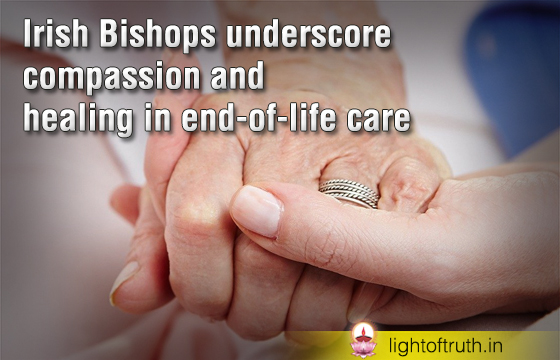
Irish Bishops underscore compassion and healing in end-of-life care
The Irish Catholic Bishops’ Conference has published a pastoral statement entitled “Freedom to Live Fully, Until Death Comes” to inform people of faith and goodwill who wish to protect and support human life with dignity and compassion, especially in the last weeks of terminal illness.
The pastoral letter came out at the end of June 2024, in view of national discussions following the Irish parliament’s “Final Report of the Joint Committee on Assisted Dying” published in March, in which the government introduces legislation allowing for assisted dying in certain circumstances.
The pastoral statement consists of a text, but also a 35-minute video that explains and illustrates the Church’s teachings on end-of-life care, and especially its focus on the compassionate care needs of the whole person. Bishop Kevin Doran of Elphin Diocese and Chair of the Irish Bishops’ Council for Life spoke to Vatican News, and said the aim of the video was to better convey the human reality of these issues.
The video is entitled “Through the Valley” and features a collection of reflections and conversations with the terminally ill, family members of people who have died with terminal illness, and healthcare professionals. Bishop Doran believes, “this medium of film helps to capture…a human story which is so important in getting across the message that it is actually possible to live fully and richly, even in terminal illness and even in palliative care.”
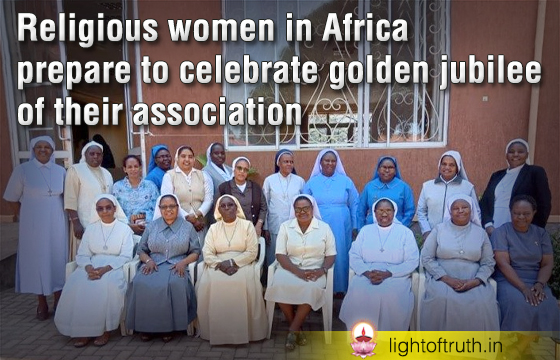
Religious women in Africa prepare to celebrate golden jubilee of their association
Malawi’s religious women will host golden celebrations of the Association of Consecrated Women in Eastern and Central Africa (ACWECA) from 19 August to 24 August 2024 in Lilongwe, Malawi. It will also be the 19th Plenary Assembly of the Association. ACWECA is the umbrella body of Catholic consecrated religious sisters in countries of the Eastern and Central Africa. The ACWECA region comprises 10 countries: Sudan, South Sudan, Malawi, Tanzania, Kenya, Uganda, Ethiopia, Eretria, and Zambia. Zimbabwe is an affiliate member.
ACWECA Secretary General, Sr. Bridgita Samba Mwawasi, says all is set for Malawi to host the long-awaited 19th Plenary Assembly at the Golden Peacock Hotel in Lilongwe. She said preparations for the two-tier celebrations are now at an advanced stage. Malawi will host at least 200 delegates during the Plenary. These include the ACWECA executive board, staff, and the council of delegates, which has voting rights.
A team of observers comprising representatives of the International Union of Superiors Generals (UISG), religious women from outside the ACWECA region, and donor partners are also expected at the Assembly.
“After a colourful official opening Mass on 19 August at Lilongwe’s CIVO Stadium, the major part of the Plenary Assembly shall be the discussions of the theme: ‘Transformative holistic formation for authentic living towards a deeper evangelization in the ACWECA region and beyond.’ Then, we will also celebrate the Golden Jubilee,” Sr. Mwawasi said.
Some of the topics to be discussed during the Plenary Assembly include revitalising consecrated life and religious identity today and holistic religious formation in view of living the congregations’ charism and gospel values. Other topics include mental health and self-care in religious congregations.
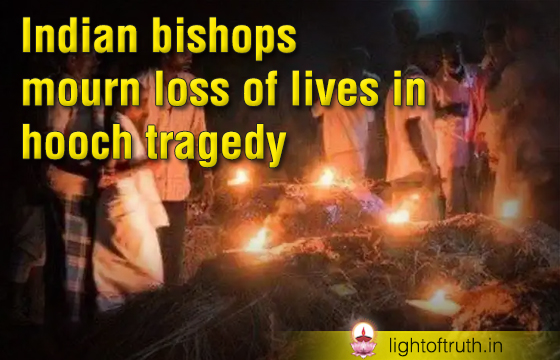
Indian bishops mourn loss of lives in hooch tragedy
Consumption of spurious liquor led to the death of 57 people, most of them daily wage laborers, and left 150 others battling for life in a hospital in a southern Indian state. The Catholic Bishops’ Conference of India (CBCI) expressed its “profound sorrow and condolences to the families of those who tragically lost their lives after consuming methanol-mixed liquor in Tamil Nadu [state].” Many of those who died were Dalits or formerly untouchables from Kallakuruchi town and its nearby villages who worked as daily labourers. “Our thoughts and prayers are with the victims and their families during this heartbreaking time,” the CBCI said in a June 21 statement. The Catholic bishops also sought action against those involved in the illicit liquor trade that led to the tragedy. The state police’s crime investigation department has arrested seven suspects so far since the tragedy on June 19. The victims, among them two women and a transgender person, consumed the spurious liquor in the evening after a hard day’s work. “Among the dead are a few Protestant Christians,” said a Catholic priest in the Arch-diocese of Pondicherry-Cuddalore which covers the Kallakuruchi town and its surrounding area. However, the exact number of Christians who died or are in serious condition could not be ascertained due to the highly tense situation, he said. “It is still ex-plosive despite heightened security,” the priest who wished to be anonymous told.
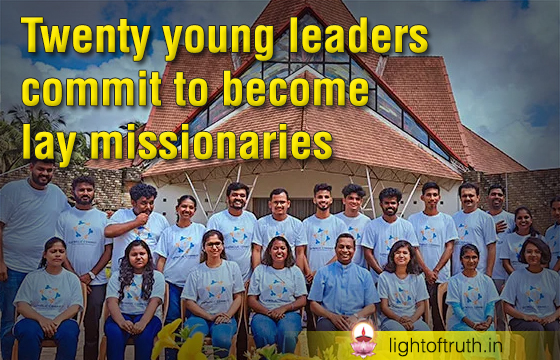
Twenty young leaders commit to become lay missionaries
As many as 20 young people from seven Indian states have committed to becoming lay missionaries through the Communio missionary training programme. The commitment ceremony took place on June 23 at St. Francis Assisi Church at Tallur, Udupi diocese, Karnataka. The second batch of the missionary training programme organized by Communio in collaboration with the Youth Commission of the Conference of Catholic Bishops of India was inaugurated by Father Stephen Alathara, Deputy Secretary General, CCBI, and the Director of Communio. Earlier in March 2024, the Youth Commission trained 30 youth for their missionary journey. The Communio Missionary Training Programme that began on June 22 will conclude on June 27 when the trainees take the missionary pledge before Bishop Gerald Isaac Lobo of Udupi. The selected volunteers, chosen for their diverse linguistic, cultural, and environmental backgrounds, are being immersed in the local culture by staying with twenty families from St. Francis Assisi parish.

Churches appeal Indian president to save Manipur Christians
Christian groups in the strife-torn Manipur state in northeast India have jointly appealed to Indian President Droupadi Murmu to stop the violence against a tiny group of Christians who live among native Hindu Meitei people. An estimated 35,000 Meitei Christians face “total cleansing and obliteration” in all the valley districts of the hilly state, according to their memorandum submitted to Murmu on June 26. The All Manipur Christian Organization (AMCO), a forum of all Christian groups in the state cutting across denomi-national differences, said Meitei Christians are facing violence from people of their ethnicity.
The Meitei people make up 53 percent of Manipur’s 3.2 million population. They are mostly Hindus, but some have followed various Christian denominations for decades. How-ever, they became the target of Meitei violence after a riot broke out 14 months ago between Meitei people and predominantly Christian Kuki tribal people, the Church leader told. “Since the mayhem and violence started, more than 360 Christian churches have either been razed to the ground, demo-lished or vandalized, out of which 249 churches belong to the Meitei minority Christian com-munity,” said the memorandum. “What is extremely saddening and heart-wrenching is the fact that all the displaced Meitei Christians are still not allowed to practice Christianity as their faith,” it said.
“The Meitei Christians, who are being threatened and harassed, are not allowed to practice their faith,” the memorandum said. It stressed that freedom of religion is “a guaranteed fundamental right of each citizen of our secular nation.” The Meitei Christians should be given “the necessary protection and assurance by the government of India and state government that they would no longer be disturbed from any angle in practicing the faith they choose,” it said. The memorandum also appealed to Murmu to take immediate action to “rebuild the places of worship, fostering healing and restoring the fabric of unity among the people.” It said that the reconstruction of these churches will serve as a symbol of resilience and reaffirm our commitment to diversity and harmony.
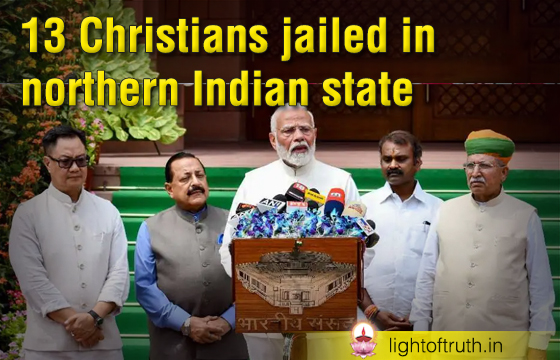
13 Christians jailed in northern Indian state
A Protestant pastor along with his wife, and three other pastors are among 13 Christians jailed in separate incidents in a northern Indian state over allegations of religious conversion. “It is an alarming situation. Within 20 days, 13 people went to prison because of their faith in Jesus Christ,” said a Christian leader who is helping Pastor Sanjay Kumar and his wife, Sunita Devi, to secure bail. The pastor and his wife, who are parents of three children, were arrested in Azamgarh on June 21 by police in Uttar Pradesh. The state, governed by the Bharatiya Janata Party (BJP), has a sweeping anti-conversion law in place. The series of arrests began on June 7 with Abhishek Masih and Anil Masih in Barabanki district. This was followed by the arrest of ` Durgesh Chauhan on June 9 in Ayodhya district.
On June 16, Pastor Paul, who was identified by a single name, and Nandlal Rajbhar were arrested in Ghazipur district followed by the arrests of Ram Chander, Anuj Kumar, Sarvesh Kumar and Hitna, identified by a single name, in Sitapur district on June 19. The latest to be arrested on June 23 were Pastor Sarju Prasad from Ayodhya district and Pastor Naresh Kumar from Hardoi district.The Christian leader said most of them were participating in house prayer meetings when the police arrived after being alerted by local villagers suspecting conversion activities. The police arrested and produced them in local courts seeking they be placed in custody for further investigations. “More than a dozen Christians are being accused of religious conversion even though there isn’t a single person whom they converted,” said a Church leader. He felt the police action may be “the fallout of the general election where Modi and his party lost seats in Uttar Pradesh,” resulting in their reduced majority in parliament.
Uttar Pradesh government is headed by Yogi Adityanath, a Hindu monk-turned-politician. The draconian anti-conversion law was enforced by his government as an ordinance in 2020. It was adopted by the state assembly the following year as the Uttar Pradesh Prohibition of Unlawful Conversion of Religion Act 2021.Since the enactment of this law, Church leaders said close to 450 Christians, including Catholic priests and pastors, have been jailed in the state. Christians make up a mere 0.18 percent of Uttar Pradesh’s more than 200 million people.
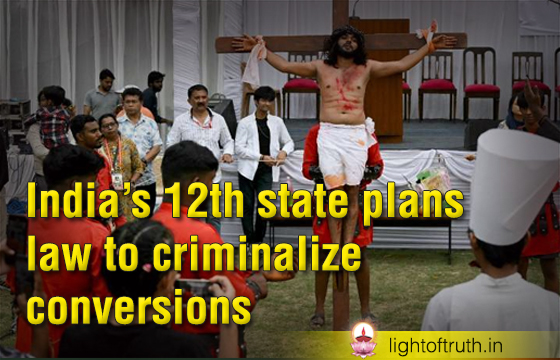
India’s 12th state plans law to criminalize conversions
Yet another Indian state has announced plans to enact a draconian anti-conversion law, which is often used to harass Christians in the country. The Bharatiya Janata Party (BJP) government in the north-we-stern state of Rajasthan dis-closed its intent to curb religious conversions in an affidavit filed before the Supreme Court, the country’s top court, on June 18. The affidavit was filed in response to a public interest litigation by Delhi-based lawyer and BJP Ashwini Kumar Upadhyay seeking stringent steps by federal and state governments to control fraudulent religious conversions, which he called “a nationwide problem.”
The petition alleged the involvement of Christians in fraudulent religious conversion. Eleven Indian states, most of them ruled by the BJP, have enacted the draconian law, ironically named as freedom of religious acts. But Rajasthan “lacks a specific legislation” to curb conversions, according to the affidavit filed by the state government. After defeating the secular Congress party, the BJP formed a government in Rajas-than in December last year. “There is no doubt enactment of an anti-conversion law will make Christians vulnerable to hardline Hindu groups,” said a Catholic priest based in Rajasthan. According to Christian leaders, Hindu nationalist groups and activists may misuse the anti-conversion law to target them with impunity. “Laws are made when there is a need for them. But in this case, there is no such need,” said A.C. Michael, a Catholic leader based in Delhi. Michael, a former member of the Delhi state minority commission, said that the proposed law “will only make the life of Christians difficult.” Christians face severe atrocities in the neighboring state of Uttar Pradesh, ruled by the BJP. The draconian anti-conversion law was first enforced as an ordinance in 2020 and adopted by the state assembly the following year as the Uttar Pradesh Prohibition of Unlawful Conversion of Religion Act 2021. Since the implementation of the law, close to 400 Christians, including Catholic priests and pastors, have been jailed in the state under the sweeping law. “We cannot rule out a similar situation in our state,” said a priest attached to the Udainagar diocese in Rajasthan. India’s top court is hearing public interest petitions challenging the constitutional validity of the anti-conversion laws passed by the states.
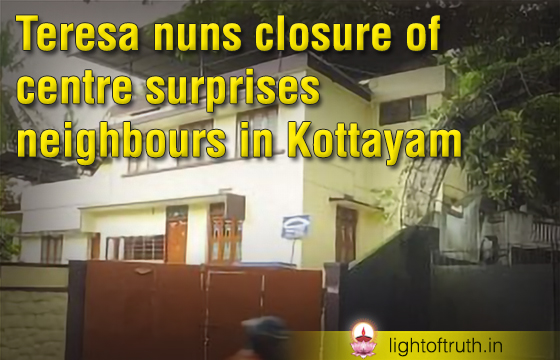
Teresa nuns closure of centre surprises neighbours in Kottayam
Neighbours of Shanti Bhavan (home of peace), a Missionaries of Charity centre in Kerala’s Kottayam town, have expressed surprise at the closure of the centre that had served the poor and destitute for half a century. The centre, opened by Mother Teresa in 1974, was closed June 21.
“We do not know why they closed and left the place,” said Jolly Varghese, a social worker in Kottayam. “Before they left, the sisters transformed their 55 inmates to other centers,” the Catholic layman told Matters India June 23. He said he knew the nuns for 45 years. “I was born and brought up in Kottayam town and have seen them coming to our colonies for charitable works. They wiped the tears of the poor, giving them food and medicine,” Varghese recalled. He said people used to bring people they found lying helpless on the street to the nuns. “The sisters welcomed them with love. We have brought many destitute people here,” he add-ed. He said he was shocked to see the centre’s gate closed when he was “passing by un-expectedly this way. It breaks my heart.” He said the neighbours would have stopped the closure if they were informed early.
His wife Nimmy said they had experienced the nuns’ kindness many times. ”Once we were going to the church in an auto with our two children, when we found a man on the street in a very bad shape. We took him to Shanti Bhavan and requested the sisters to attend to him. They gladly offered to help, and after the Mass we took him to another centre. There are several cases when sisters cooperated with us,” she added. The nuns have apparently given the keys of the centre to the diocese of Vijayapuram.
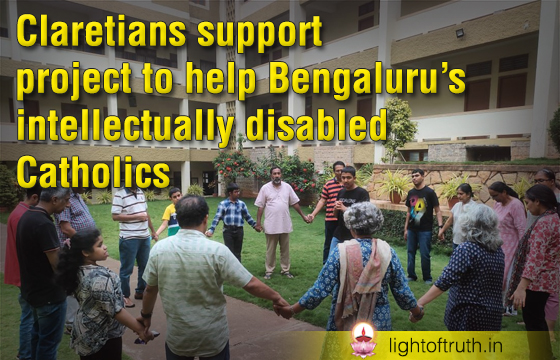
Claretians support project to help Bengaluru’s intellectually disabled Catholics
Catholic parents of some intellectually disabled children in Bengaluru got a boost with the Claretians offering support to an exclusive housing project for their community living. “Since four years, we have been dreaming of this project as we were really worried about our disabled children’s future after our death,” Merly Thomas, one of the parents, told a June 23 meeting at Claretian Seminary in the southern Indian city. Merly, a member of the Bangalore Archdiocesan commission for differently abled, says the Claretian support now helps them build the common living facility where children with intellectual disabilities and their parents can live with dignity. Claretian Father George Kannanthanam, who brought his congregation to the project, says he had seen parents of many differently able children worried about what would happen to their children when they are no more. The priest impressed upon his provincial to allot two acres of land for such families at Gauribidanur, on the outskirts of Bengaluru city. Kannanthanam, who had earlier served as the first secretary to the Bangalore diocesan commission for the disabled, said the Hope Society that functions under the Claretians will give wings to the project. The Archdiocese of Bangalore was first in India to set up a commission to ensure better participation of persons with disabilities in the life of the Church, he recalled.