
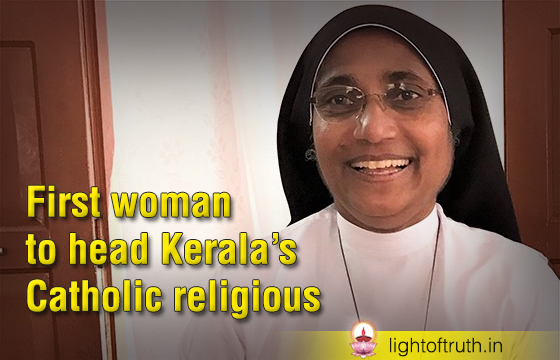
Sister Ardra Kuzhinapurathu is the first woman to head the major superiors of Kerala, the southern Indian state that has produced the largest number of Catholic religious men and women in the country. She became the president on June 7, 2023, at a joint meeting of the Kerala Catholic Bishops’ Council and the religious superiors. The Kerala unit is part of the Conference of Religious India, the national association of the major superiors, with more than 130,000 members, among them 103,000 women. Sister Kuzhinapurathu spoke to Global Sisters Report about various challenges faced by the religious congregations in India – dwindling vocations, aging members and the culture of working together.
All posts by Light of Truth
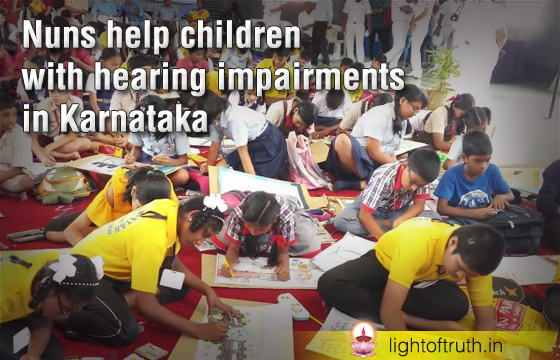
Nuns help children with hearing impairments in Karnataka
Prasad James cannot hear the roar of the sea, but can paint the beauty of the waves. “I have painted the charming Karwar beach, its waves, fishermen with their boats, tourists, and the beautiful sunset,” James told Global Sisters Report in sign language, translated by his teacher, as he showed his works. The sixth grader is among 48 children currently studying in Asha Niketan (House of Hope) Deaf School, a residential school for children who cannot hear or speak managed by the Sisters of the St. Joseph of Chambery, a French congregation, for the Karwar Diocesan Development Council. The center, founded in 1996 near a beach in Karwar on the Goa-Karnataka border, is the first Church-managed school for children with hearing impairments in Karnataka state’s northern region. It now caters even to villagers of Maharashtra, Karnataka’s northern neighbor. “Children seem to enjoy their silent world, but we really struggle to get into that world,” said Sister Tresa Irudayasamy, one of three nuns who live on campus and teach the stu-dents in sign language. The nun, who’s been the hostel warden for four years, has built a good rapport with the children, but said she still struggles in the classroom to teach them. “We use our universal language of love and care mostly, and it works better than our sign language,” she told GSR with a smile.
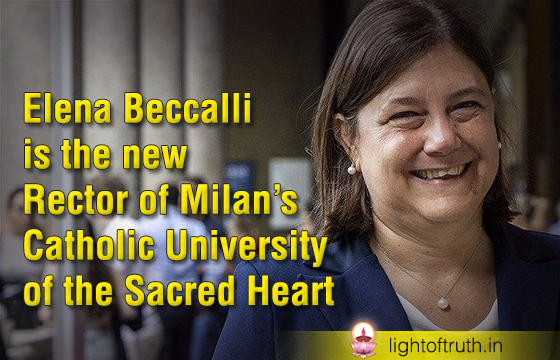
Elena Beccalli is the new Rector of Milan’s Catholic University of the Sacred Heart
For the first time in the history of the University of the Sacred Heart in Milan, a woman has been appointed Rector. Elena Beccalli will take over on 1 July, after the painful death on 23 May of her predecessor Franco Anelli. Beccalli was a student at the university that she is now preparing to lead for four years, from 2024 to 2028. She was appointed by the Board of Directors who met on 20 June. The decision of the Board of Directors follows the appointment of Professor Elena Beccalli, already serving as Dean of the School of Banking, Finance, and Insurance Sciences, by the University’s 12 Faculty Councils on 22 May, with 636 preferences out of a total of 685, corresponding to around 93% of those voting.
“Università Cattolica del Sacro Cuore is a ‘universal’ academic institution by vocation, where dialogue and confrontation are open, free, interdisciplinary, and oriented towards the creation of networks and strategic alliances. It is a University that can offer with accuracy, creativity, courage a forward-looking approach to contemporary challenges, thanks to the coordinated efforts of its vibrant academic community”, Professor Beccalli said in thanking the academic staff and the Board of Directors.
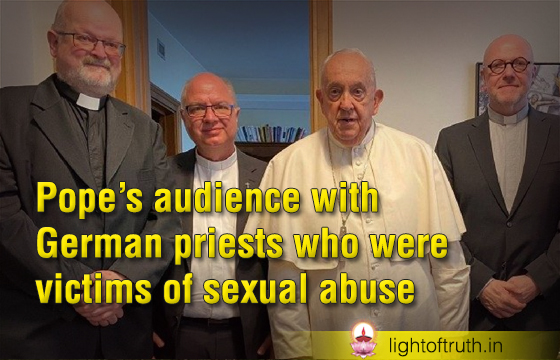
Pope’s audience with German priests who were victims of sexual abuse
Father Liudger Gottschlich, a priest from the Archdiocese of Paderborn, has dedicated over three decades to supporting survivors of abuse, drawing from his own experience as a victim of abuse by a priest at the age of eleven. On Tuesday, June 25, he was part of a special audience with Pope Francis at the Pope’s residence, Casa Santa Marta, in the Vatican. The meeting, described as occurring in a “unique atmosphere,” was a poignant moment for Fr Gottschlich and his fellow priests who have also experienced abuse. “As priests who have been victims ourselves, we are in a challenging position within the Church,” Gottschlich explained in an interview with Vatican Radio. He highlighted the isolation often felt by these priests, noting that their presence serves as a constant reminder of unresolved issues within the Church, which can make others uncomfor-table. Fr Gottschlich shared that the encounter with Pope Francis was unlike their usual experiences within the Church. “Generally, we don’t receive much support or backing. There is often a desire for us to be invisible,” he said.
However, this meeting was different. Conducted in the Pope’s private living room, the conversation was intimate and personal. “We found him very interested, very open, and also very encouraging and strengthening. This is something not commonly experienced with our superiors in the dioceses.”
Reflecting on the meeting, Fr Gottschlich emphasized the Pope’s strong encouragement for their work. “The Pope urged us to use our own wounds to aid in pastoral work and to act as healers wherever possible,” he said. The Pope’s encouragement was a significant takeaway, reinforcing the importance of not remaining silent and keeping the issue of abuse alive within the Church. Father Gottschlich also addressed the common assertion that abuse predominantly occurs within families, with the Church representing only a small percentage. He argued that this perspective is too narrow.
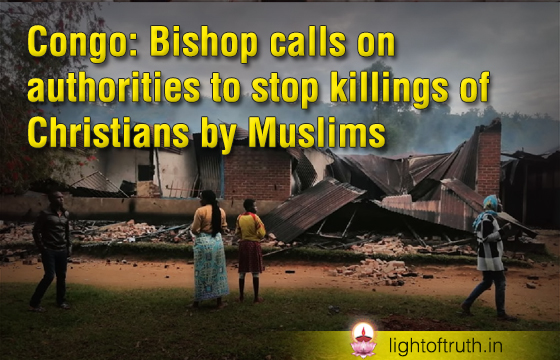
Congo: Bishop calls on authorities to stop killings of Christians by Muslims
A congolese bishop has made a fresh plea for the country’s leaders to stop the armed conflict following the massacre of around 150 people – including at least 80 Christians – by an Islamist rebel group earlier this month. Denouncing the “serious and ongoing violations of human dignity” on Tuesday (18th June), Bishop Melchisedec Sikuli Paluku of Butembo-Beni called on authorities to “put an end to the plight of the Congolese people”.
The terrorist group known as Allied Democratic Forces (ADF) – which is affiliated with Daesh (ISIS) – carried out the killings in villages in North Kivu Province in the eastern part of the Democratic Republic of Congo (DRC) between 4th and 8th June. Media outlets reported that an on-line post by Daesh indicated that one of the attacks specifically targeted Christians. In his statement, a copy of which was sent to Catholic charity Aid to the Church in Need (ACN), Bishop Paluku condemned the atrocities committed “against the peaceful population [which has been] left defenceless”. According to the bishop the extremists “raped girls and women; kidnapped people of whom there is no trace today, and killed many others”.
He added that ADF militants torched homes, medical facilities, businesses and vehicles, forcing survivors to flee the area. The bishop went on to call on “the authorities of the country to put an end to the Calvary of the Congolese people, in general, and of the population of the Diocese of Butembo-Beni, in particular.”
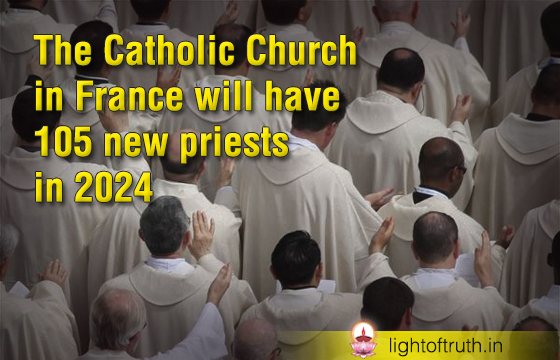
The Catholic Church in France will have 105 new priests in 2024
The French Bishops’ Conference (CEF) reported that, in 2024, 105 new priests will be ordained, 17 more priests than in 2023, when 88 new priests were ordained in the European country. An article published on the CEF website said the vast majority of priestly ordinations are celebrated during the month of June, particularly on the Sunday before the solemnity of Sts. Peter and Paul, which the Catholic Church celebrates every year on June 29.
Of the 105 new priests, 73 are diocesan, 16 belong to religious orders, 10 are members of communities, two belong to societies of apostolic life, while the remaining four “were ordained in the institutes under the former Ecclesia Dei commission, celebrating according to the Roman Missal of 1962 [before the reform of Vatican II].”
At a press conference, Bertrand Lacombe, the archbishop of Auch and a member of the council for ordained ministers and laypeople in ecclesial mission, highlighted two aspects to be considered regarding the new priests: “the essential mission of the priest in the Church and the meaning of this mission today within an increasingly secularized French society” and “the ongoing reflections of the bishops as well as the initiatives launched in the dioceses to raise up vocations.”
The French prelate wished a “beautiful ministry to the priests who are responding to the spiritual expectations of our time: The adventure is worth the effort and gives light to the world!”
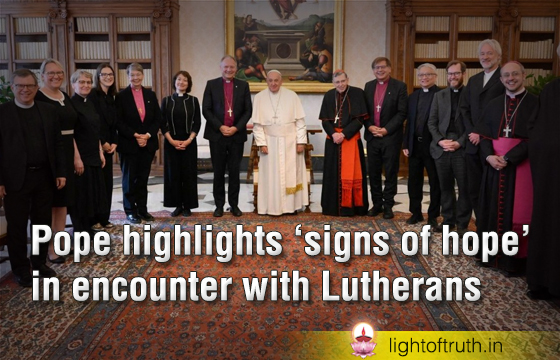
Pope highlights ‘signs of hope’ in encounter with Lutherans
Pope Francis welcomed a delegation of leaders from the Lutheran World Federation to the Vatican, describing their visit as “an important gesture of ecumenical fraternity.” Recalling an earlier meeting with Lutherans, in 2021, Pope Francis highlighted the upcoming anniversary of the First Council of Nicea as “an ecumenical event.” The Nicene Creed “is an ecumenical bond that has its centre in Christ”, the Pope said, quoting the Common Word issued by LWF General Secretary, Rev. Dr. Anne Burghardt and Cardinal Kurt Koch from the Dicastery for Promoting Christian Unity during the Federation’s recent General Assembly in Krakow. “In this context,” he said, “you rightly recalled a beautiful sign of hope, which has a special place in the history of reconciliation between Catholics and Lutherans.”
Pope Francis then turned to the earlier Joint Declaration on the Doctrine of Justifi-cation, signed 25 years ago, in which Catholics and Lutherans agreed on the common goal of “confessing Christ in all things.” “Jesus Christ is the heart of ecumenism,” the Pope said. “He is divine mercy incarnate, and our ecu-menical mission is to bear witness to this.” That Declaration is “another sign of hope in our history of reconciliation,” he said, as he invited Catholics and Lutherans to celebrate the anniversary of its signing “as a celebration of hope.”
Then, noting “our common spiritual ori-gin” in “one baptism for the forgiveness of sins” Pope Francis called on Lutherans and Catholics to “confidently continue as pilgrims of hope” in the ongoing dialogue “of truth and charity.” Concluding his remarks, the Holy Father recalled a story about Orthodox Bishop John Zizioulas, who would say, jokingly, that the union of Christians would be achieved only on the day of Judgment at the end of time. “But in the meantime,” Pope Francis said still quoting the late Bishop, “we have to walk together: journeying together, praying together, and performing works of charity together.”
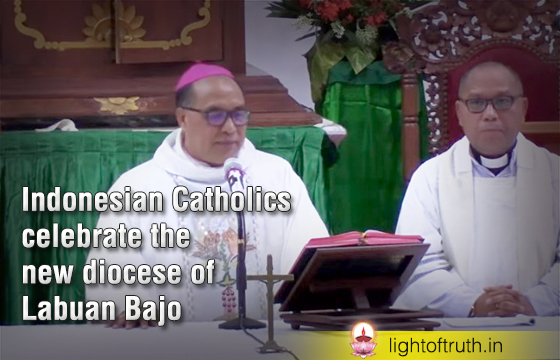
Indonesian Catholics celebrate the new diocese of Labuan Bajo
Indonesian Christians are celebrating a new diocese in the country. On 21st June, in fact, Pope Francis erected Labuan Bajo, in the Catholic-majority area of Flores Island, in the province of East NUsa Tenggara (Ntt), and appointed as its first bishop the Reverend Maksimus Regus, of the Ruteng clergy, until now rector of the local Catholic University of St. Paul. Hundreds of faithful and dozens of priests attended the announcement made by Bishop Siprianus Hormat, Bishop of Ruteng, in the Church of the Holy Spirit in Labuan Bajo, in an atmosphere of joy that involved the entire community.
The new diocese of Labuan Bajo covers an area that is now a popular tourist destination, but until a few years ago, it was still a remote area in the westernmost sector of the Indonesian archipelago that was predominantly mountainous.
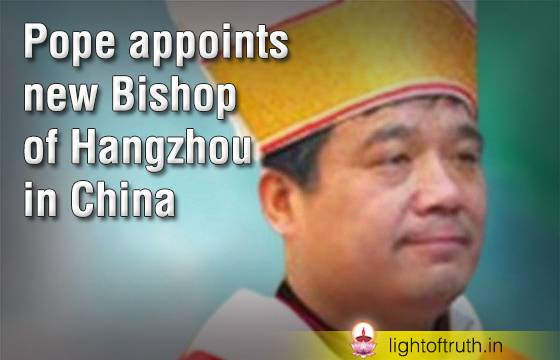
Pope appoints new Bishop of Hangzhou in China
Giuseppe Yang Yongqiang is the new bishop of Hangzhou, the capital of Zhejiang province in China. “As part of the dialogue concerning the implementation of the Provisional Agreement between the Holy See and the People’s Republic of China.” A Statement released by the Holy See Press Office last Saturday, June 22, “On June 12, 2024, the Holy Father appointed Giuseppe Yang Yongqiang as bishop of Hangzhou (Zhejiang province, China), transferring him from the See of Zhoucun (Shandong province, China).” The solemn Eucharistic liturgy for the bishop’s installation in his new episcopal seat will be celebrated in Hangzhou Cathedral on Thursday, June 27. Giuseppe Yang Yongqiang was born on April 11, 1970, in Boxing (Shandong), into a Catholic family. In 1987, he entered the Holy Spirit Seminary in Jinan. He conducted his philosophical and theological studies at that seminary and at Sheshan Seminary in Shanghai.
On June 15, 1995, he was ordained a priest. After serving as a parish priest, he was sent to further his education at the National Seminary in Beijing. Subsequen-tly, he served as a lecturer at the Holy Spirit Semi-nary. Appointed coadjutor bishop of Zhoucun, he was consecrated on November 15, 2010, and on February 8, 2013, he succeeded Bishop Ma Xuesheng in leading that diocese. On June 12, 2024, Pope Francis appointed him bishop of Hangzhou.
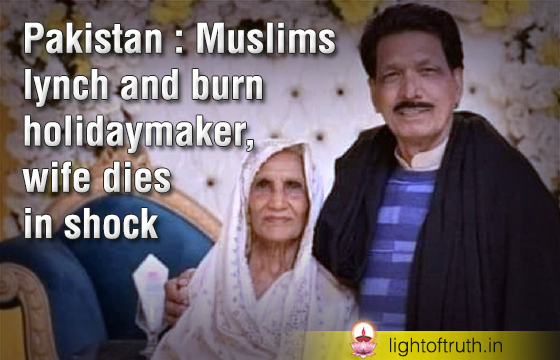
Pakistan: Muslims lynch and burn holidaymaker, wife dies in shock
A new tragedy linked to blasphemy has unfolded in Pakistan, where cases of lynching mobs acting with impunity in the name of religion are becoming more and more frequent amid the inaction of the authorities and the silence of international community. The latest incident occurred on June 22 in the Swat Valley. The victim, Mohammad Ismail, was on vacation when he was attacked and torched alive for burning pages of the Qur’ân. Such a story clearly illustrates how Pakistan state is incapable of guaranteeing safety and security to its citizens. Instead, powerful groups rule, their violent ideology contributing to the list of innocent victims, people like Mashal Khan, Shama and Shahzad, Priyantha Kumara, Nazir Masih, and now Mohammad Ismail.
Another victim is Allah Rakhi, the widow of 72-year-old Christian Nazir Masih, who died from the effects of the traumatic experience of seeing her husband killed. Since 1987 when blasphemy became an offence, dozens of people have been reportedly lynched by mobs, based on specious charges used to settle personal scores, exact revenge, justify extrajudicial killings, and target religious minorities, like Christians and Ahmadis. In this latest case, police had arrested Mohammad Ismail and charged him with blasphemy for burning Arabic-language papers. But an angry mob came to the Madyan Swat police station demanding the officers hand over the man to be executed on the spot. When police refused, a group stormed the station. After injuring some agents and vandalising the premises, they took the victim from his cell to lynch, and burnt him alive while shouting extremist slogans.