
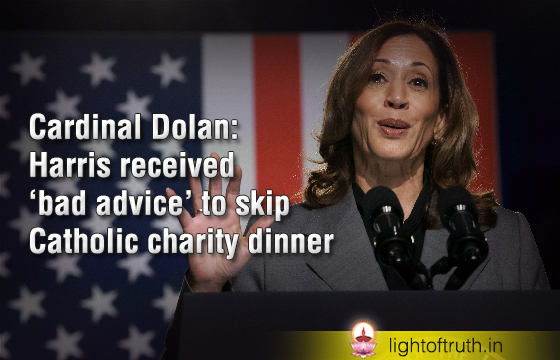
Cardinal Timothy Dolan said on 24 September that Vice President Kamala Harris’ decision to skip the Al Smith dinner, a prominent Catholic charity event in New York, wasn’t a wise political move.
While Republican presidential nominee Donald Trump said Harris’ decision to skip the dinner reveals her “anti-Catholic” sentiments, Dolan, who leads the Archdiocese of New York, blamed bad advice.
“Different people are reading motives into it; I don’t know the motives,” he said, speaking on his podcast. “She simply said she’s got to use it for campaigning. This isn’t a campaign event, but it certainly is good visibility, you know, I mean it’s a national audience and everybody covers it; now the news is that she’s not there. So, I don’t know who’s advising her but she’s not getting good advice.”
The $5,000-a-plate charity event taking place on Oct. 17 is hosted by the Archdiocese of New York; the Alfred E. Smith Memorial Foundation Dinner has been attended by nearly every major presidential candidate since 1960.
According to Dolan, President Joe Biden had committed to attending the dinner earlier this year before dropping out of the race. Harris’ campaign team, however, reportedly notified the archdiocese on Saturday that she would not be attending the event.
Instead of attending the event, Harris’ team has said she will use the time to campaign in critical swing states, according to the New York Post.
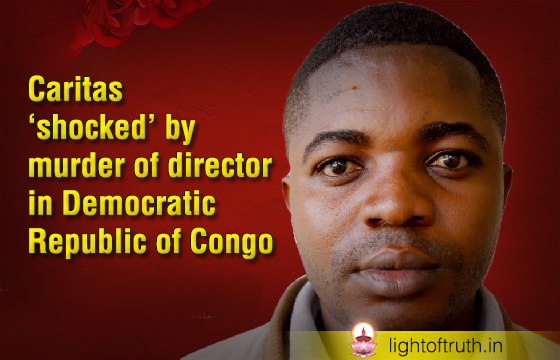
Caritas ‘shocked’ by murder of director in Democratic Republic of Congo
The director of Caritas in Congo was shot and killed by an armed militant group while approaching a roadblock, Caritas Internationalis announced.
In a statement published on social media Sept. 23, Caritas International said it was “shocked by the news of the death of our colleague, Dieudonné Barondezi, director of the Caritas branch in Kalonge, in the Democratic Republic of Congo.”
“Dieudonné was shot in the head on Sept. 19 at a roadblock, in the village of Cholobero, by members of an armed group who demanded he pay the toll, even though, as a humanitarian, he was not obliged to do so,” the Catholic charitable organization said. Barondezi was taken to a hospital following the shooting, where he was declared dead. “Let us pray for him, his family, and all humanitarians worldwide who lose their lives to help others,” Caritas said.
Barondezi’s death is the latest in a string of violent attacks targeting humanitarian aid workers in the country, where armed rebel groups continue to fight against Congolese forces for control of gold and other resources.
According to a July report by The Associated Press, the United Nations Office for the Coordination of Humanitarian Affairs in Congo called for the protection of aid workers in the region where some 170 security incidents targeting humanitarian workers were reported.
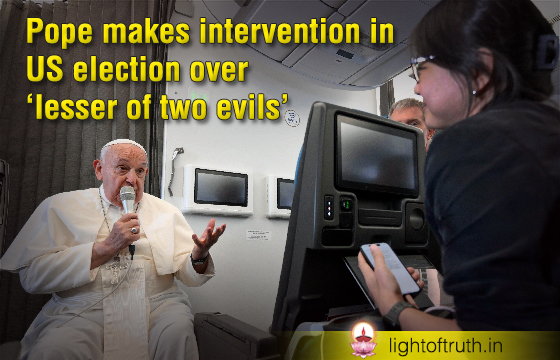
Pope makes intervention in US election over ‘lesser of two evils’
Pope Francis waded into the U.S. presidential elections during his press conference on the flight back to Rome on Septem-ber 13, saying of the choice between Vice President Kamala Harris and former president Donald Trump, “One must choose the lesser of two evils. Who is the lesser of two evils? That lady or that gentleman? I don’t know.
“They are both against life. The one who throws away the migrants as well as the one who kills children,” the pope said. “Both are against life.” Trump has indicated he plans a mass deportation of migrants if he regains the White House, and Harris has promised to try and restore abortion rights nationwide if she is promoted by voters.
Pope Francis said Catholics had to form their consciences when deciding for whom to vote. The U.S. bishops, in adopting a new introductory statement to their quadrennial document on voting, “Forming Consciences for Faithful Citizenship”, were less even-handed in their app-raisal of the two major political parties. Last year, they voted to state that abortion is “our pre-eminent priority” in the 2024 election, repeating phrasing first used in the 2020 version of the statement. Previous iterations of the document had refrained from such explicit emphasis on one issue, because that level of specificity is precisely where conscience formation is required. It is not clear that this year’s federal elections will have any consequence on national abortion policy, given the evenly divided Congress, so making that issue a priority strikes many observers as odd.
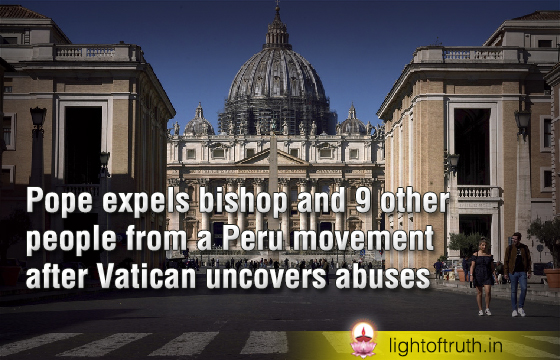
Pope expels bishop and 9 other people from a Peru movement after Vatican uncovers abuses
Pope Francis took the unusual decision to expel 10 people – a bishop, priests and laypeople – from a troubled Catholic move-ment in Peru after a Vatican inve-stigation uncovered “sadistic” abuses of power, authority and spirituality.
The move against the lead-ership of the Sodalitium Chri-stianae Vitae, or Sodalitium of Christian Life, followed Francis’ decision last month to expel the group’s founder, Luis Figari, after he was found to have sodo-mized his recruits. The decision was announced by the Peruvian Bishops Confe-rence, which posted a statement from the Vatican embassy on its website.
The statement was astoni-shing because it listed the abuses uncovered by the Vatican investi-gation and the people responsible: It reported physical abuses “in-cluding with sadism and viol-ence,” sect-like abuses of consci-ence, spiritual abuse, abuses of authority, economic abuses in administering church money and the “abuse in the exercise of the apostolate of journalism.”
The later was presumably aimed at a Sodalitium-linked journalist who has attacked critics of the movement on social media.
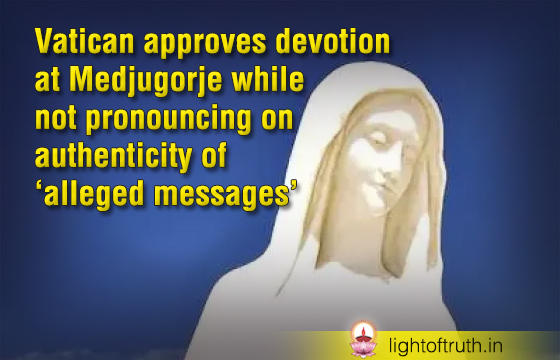
Vatican approves devotion at Medjugorje while not pronouncing on authenticity of ‘alleged messages’
In a highly anticipated report on the alleged decades long apparitions of the Blessed Virgin Mary in Medjugorje, the Vatican’s doctrinal office on 19 Sept. endorsed prudent devotion to Mary at the popular pilgri-mage site in Bosnia and Herze-govina yet withheld any decla-ration on whether the alleged visions are supernatural in origin.
The Sept. 19 note from the Dicastery for the Doctrine of the Faith (DDF), signed by prefect Cardinal Víctor Manuel Fernández and approved by Pope Francis in an Aug. 28 audience, grants a “nihil obstat” to the spiri-tual experience at Medjugorje. The authori-tative judgment means that pilgrims may continue to visit and pray at the site, as some 40 million people from around the world have done since the apparitions allegedly first began 43 years ago.
Six children, who are now middle-aged, first reported experiencing visions of the Blessed Mother, originally on a hilltop near the rural village of Medjugorje, on June 24, 1981. The Vatican’s report notes that the remote site, formerly part of Yugoslavia, is now widely “perceived as a space of great peace, recollection, and a piety that is sincere, deep, and easily shared.”
While it offers no definitive judgment on the supernatural authenticity of the alleged apparitions, the Vatican’s report highlights the abundant good fruits that have come from Medjugorje.
“The positive fruits are most evident in the promotion of a healthy practice of a life of faith, in accordance with the tradition of the Church,” the report states.
It points to “abundant conversions, a frequent return to the sacraments (parti-cularly, the Eucharist and reconciliation), many vocations to priestly, religious, and married life, a deepening of the life of faith, a more intense practice of prayer, many reconciliations between spouses, and the renewal of marriage and family life.”
“It should be noted,” the report emphasizes, “that such experiences occur above all in the context of pilgrimages to the places associated with the original events rather than in meetings with the ‘visionaries’ to be present for the alleged apparitions.”
Fernández presented the report in a two-hour-long press conference at the Holy See Press Office on Sept. 19. The prelate quoted Cardinal Joseph Ratzinger’s 1985 statement that emphasized separating the question of supernatural origin from spiritual fruits.
Fernández pointed out that Ratzinger said even if modern critical thinking might question some aspects, “this doesn’t detract from the fact that those pilgrimages were fruitful, useful, important for the life of the Christian people.”
On this view, he added, Pope Francis said there was “no magic wand” to determine the authenticity of the phenomena, but “the spiritual pastoral fact cannot be denied.”
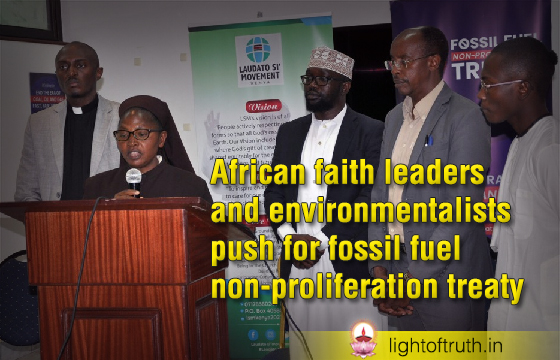
African faith leaders and environmentalists push for fossil fuel non-proliferation treaty
Faith leaders and climate activists in Africa announced their support on September 20 for an international treaty to halt the production and use of fossil fuels, the main cause of climate change, analogous to non-proliferation treaties governing the production of nuclear weapons.
“As people of faith, we have a moral duty to protect God’s creation,” said Ashley Kitisya, the African coordinator of the Laudato Si’ Movement, the global network of Catholics working to ameliorate climate change in the spirit of Pope Francis’ encyclical of the same name. “The Fossil Fuel Treaty gives us a tangible way to act on this duty by advocating for the preservation of our environment for future generations.”
Kitisya spoke at a media briefing organized as part of the Season of Creation, an event observed annually by Christian denominations and Christian climate activists from Sept. 1 to Oct. 4. Following the Greek Orthodox Ecumenical Patriarch Dimitrios’ declaration in 1989 of Sept. 1 as a day of prayer for creation, the World Council of Churches and Roman Catholic Church leaders joined the movement and sponsored prayer and action to call attention to climate change.
The 2024 theme, “To Hope and Act with Creation,” urges Christians and the world at large to reflect on what organizers say is a sacred responsibility in caring for the Earth. The Fossil Fuels Non-Proliferation Treaty Initiative began in September 2022, when Vanuatu, a tiny Pacific island state, called for the negotiation of such an agreement at the U.N. General Assembly. In December of that year, Tuvalu, another state in the South Pacific, made a similar call at the plenary of the United Nations Climate Change Conference.
Since then, momentum has grown, with the Vatican, the European Parliament and 101 Nobel Laureates endorsing it. “We are making progress, but there is still so much work to be done. We must continue to build momentum, to engage more communities of faith, and to push for governments and international bodies to recognize the urgent need for this treaty,” said Kitisya.
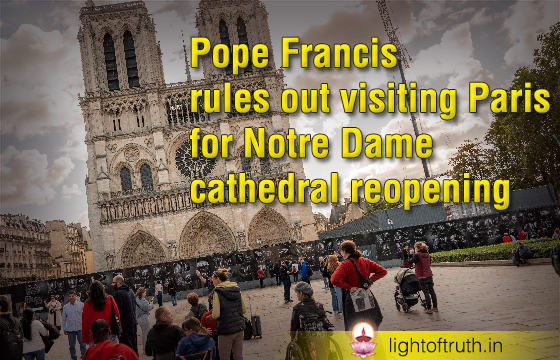
Pope Francis rules out visiting Paris for Notre Dame cathedral reopening
Pope Francis definitively ruled out the possibility of visiting France for the reopening of the Notre Dame cathedral on his re-turn flight on September 13 from Southeast Asia. Speaking during an in-flight press conference on the papal plane today, the pope resolutely stated: “I will not go to Paris.” French President Emmanuel Macron invited Pope Francis to visit Paris for the long-awaited reopening of the historic cathedral, which is set to take place on 8 December, the solemnity of the Immaculate Conception. Pope Francis traditionally celebrates the Marian feast with the city of Rome in the piazza at the foot of the Spanish Steps. In 2019 the world mourned the damage done to the medieval Paris cathedral by a fire that devastated the 315-foot-tall oak spire and timber roof of the eight-centuries-old cathedral.
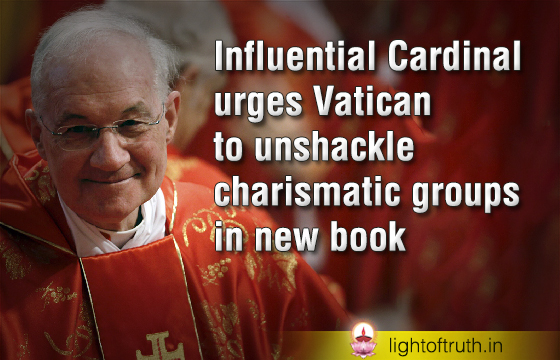
Influential Cardinal urges Vatican to unshackle charismatic groups in new book
In his new book, “Word, Sacrament, Charism: Risks and Opportunities of a Synodal Church,” Cardinal Marc Ouellet challenges the Church to worry less about creating something new, and more about treasuring what is already there.
“The Church is experiencing a moment of listening to the Holy Spirit,” Ouellet told journalists during a presentation of the book, soon to be translated into English, on 24 September. The cardinal was referring to the synod on the theme of synodality, a three-year-long project that has involved all members of the church, from faithful to pastors and bishops.
Ouellet’s new book hopes to offer a new perspective for synodal discussions by suggesting that the church should promote and enable charisms, intended as gifts by the Holy Spirit that are given to every baptized Catholic. “My book would like to reawaken the interest in charisms in the church,” Ouellet said, “but they often don’t find the space to develop because they are not valued and recognized.”
“A clerical culture doesn’t leave much space for charisms,” said Ouellet, adding that there is a “generalized mentality by faithful who don’t see the work of the Holy Spirit among all the people of God.” The Vatican’s Code of Canon Law isn’t equipped to address the needs of charismatic movements, the cardinal said, adding that if the law “is applied rigidly there is a risk that charisms will be extinguished.”
Loosening the grip on charismatic movements would allow these groups to thrive and evangelize, the cardinal said. “Not just the visible and spectacular ones,” he said, “but also humble and discreet charisms of service: listening, welcoming, compassion, visiting the sick and the poor, catechists and reconciliation operators.”
Pope Francis has shown the way to do this in the church, Ouellet said, by allowing lay men and women to hold positions of power and influence in the church. In his 13 years at the head of the Vatican congregation overseeing bishops, Ouellet said he saw first-hand how the contributions of everyday faithful and their charism could be easily discarded. He also praised the Synod on Synodality’s inclusion of laity and lower-level clergy — one-quarter of the participants were not bishops — which he said teaches the bishops how to work closely with other faithful in the church.
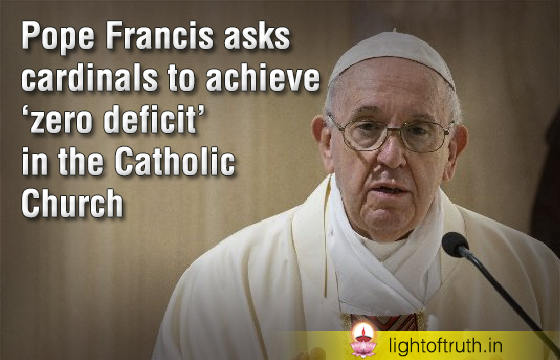
Pope Francis asks cardinals to achieve ‘zero deficit’ in the Catholic Church
Pope Francis has called on cardinals to work to achieve the goal of “zero deficit” in the economy of the Catholic Church through cost reduction, the search for external resources, and evangelical generosity.
In a Sept. 16 letter released by the Vatican Press Office, Pope Francis recalled that 10 years ago the reform of the Roman Curia began in the spirit of the principle “Ecclesia semper reformanda” (“the Church always reforming”). During this time, he pointed out, “despite the difficulties and, sometimes, that temptation of immobility and inflexibility in the face of change, many results have been accomplished in these years.”
Focused on the economic reform of the Holy See – “one of the topics that has most chara-cterized the general congrega-tions prior to the conclave,” he pointed out – Pope Francis said “an extra effort is now required from everyone so that a ‘zero deficit’ is not just a theoretical goal but an actually achievable objective.”
This objective is based on the awareness that “the economic resources at the service of the mission are limited and must be managed with rigor and seriousness so that the efforts of those who have contributed to the patrimony of the Holy See are not wasted.”
Along with the objective of not going into debt, the pontiff pointed out “the need for each institution to strive to find external resources for its mission, setting an example of transparent and responsible management in the service of the Church.”
In addition, Pope Francis called for setting an example on the cost reduction front by trying to avoid “the superfluous” and selecting priorities well, “favouring mutual collaboration and synergies.”
“We must be aware that today we are faced with strategic decisions that we must take with great responsibility, because we are called upon to guarantee the future of the mission,” the Holy Father indicated.
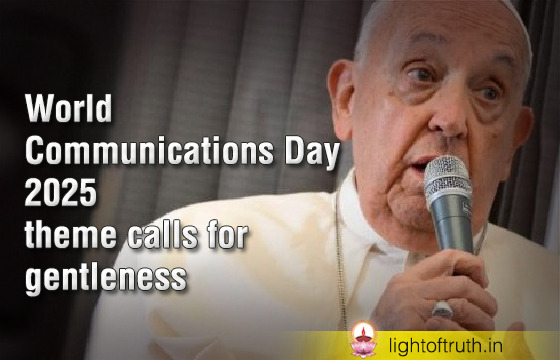
World Communications Day 2025 theme calls for gentleness
The Holy See Press Office released the theme Pope Francis has chosen for the Church’s 59th World Communications Day in 2025, Share with gentleness the hope that is in your hearts (cf. 1Pt 3:15-16).
The introductory text accompanying the theme notes that the topic aims to bring attention to the fact that in today’s world, ”too often communication is violent, aimed at striking and not at establishing the conditions for dialogue.” This calls for efforts “to disarm communication, to cleanse it of aggression.”
The theme description notes that the prevailing standard seems to be that of competition, opposition, and domination as can be seen in television talk shows to verbal wars on social media. It adds that for Christians, “hope is a person, and He is Christ.” And this hope is tied to community, since “when we speak of Christian hope we cannot disregard a community that lives the message of Jesus in such a credible way as to give a glimpse of the hope that it brings, and is capable of communicating the hope of Christ with deeds and words even today.”
World Communications Day is usually celebrated on the Sunday before Pentecost. Pope Paul VI established the Day in 1967 in the wake of the Second Vatican Council as an annual celebration that encourages reflecting on the opportunities and challenges that the media offer and how the Church can better communicate the Gospel message.