
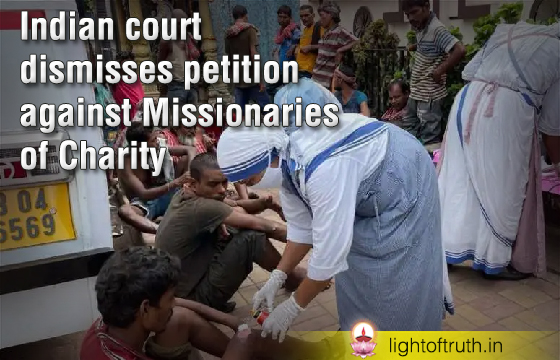
A petition seeking a special probe into shelter homes, including those run by the Missionaries of Charity (MC), in a central Indian state has been dismissed by the country’s top court. “Yes, we are aware of the case; but don’t want to comment on it,” said a nun from the Mother House, the headquarters of the congregation started by St. Mother Teresa, in the eastern Kolkata city, on Sept. 25. The petition was filed by the National Commission for Protection of Child Rights (NCPCR) in 2020, two years after MC sisters were accused of selling babies from their shelter homes in the central state of Jharkhand. In 2018, a raid was ordered by the then Bharatiya Janata Party (BJP) government in the state. That same year, Jharkhand police arrested a nun from the Kolkota-based congregation and sent her to jail for close to three months following a complaint from a couple over payment made while adopting a child. The NCPCR said it approached the top court after the new state government made continuous attempts to sabotage its probe. Its counsel said the child rights panel wanted a “court-monitored, time-bound” probe into all shelter homes in Jharkhand. The Supreme Court on Sept. 24 dismissed the petition saying it “is totally misconstrued.” “Don’t drag the Supreme Court into your agenda,” a bench of Justices B V Nagarathna and Nongmeikapam Kotiswar Singh told the child rights panel, which reports to the federal government of Prime Minister Narendra Modi.
The ruling BJP used the allegations against the MC nuns to target other shelter homes and sought scrapping of the congregation’s license to receive foreign funds. In 2019, the right-wing party lost power and a secular regional party came to power in Jharkhand.
“It is shocking to learn that a federal statutory body like the NCPCR can file a frivolous petition before the top court,” said A. C. Michael, a Catholic leader based in the national capital New Delhi. On the other hand, the court should appoint a special team to probe the NCPCR as it often oversteps “into areas beyond its jurisdiction to harass Christian institutions,” added Michael, a former member of the minority commission in the Delhi government. Christian leaders have accused the NCPCR under its current chairperson Priyank Kanoongo of conducting raids on their institutions in violation of the laid down norms and registering false cases against bishops, priests, and nuns.
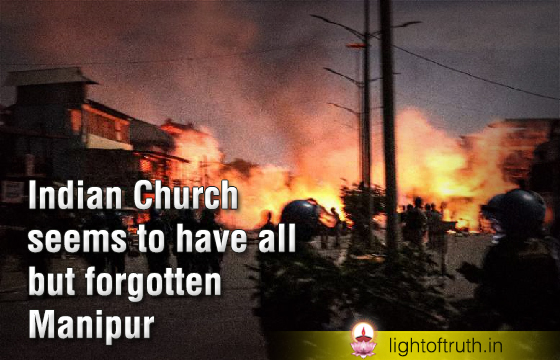
Indian Church seems to have all but forgotten Manipur
The sensitive border state of Manipur “is engulfed in violent anarchy,” says M.G. Devasaha-yam, a retired bureaucrat from India’s elite civil service cadre, who previously served as an army officer seeing action in war and engaging in internal security matters. Devasahayam, a guiding force of an exceptionally influen-tial group of retired civil servants and judges who have taken on the government of Prime Minister Narendra Modi, this week cau-tioned that the decision to arm police with mortars and machine guns is not the way to a “Manipur solution.” He quotes another retired army officer living in the state, Lieutenant General L. Ni-shikanta Singh, saying Manipur is now “stateless” where life and property can be destroyed by anyone at any time, “as it happens in Libya, Lebanon, Nigeria, Sy-ria.” “It seems that Manipur has been left to dissolve in its own juice. Is anyone listening?” he adds. Among those not listening is the Indian prime minister, who was in New York recently to add-ress the United Nations General Assembly. He attends such inter-national events regularly and torus other pasts of India but has not visited Manipur once. He has also failed to announce any action program on restoring peace and providing relief to the more than 60,000 people living in refugee camps in the state or scattered elsewhere in the country without any livelihood, and often with little food or medicines. The fact that most of the 250 or so dead are Christians and over 400 churches have been destroyed in the state has helped consolidate the argument that the persecution is both ethnic and targeted against Christians.
All the Kuki-Zo-Hmar are Christians, of Catholic and several Protestant denominations. The government says it is just ethnic strife. Amnesty International in a recent report on Manipur found “a picture of a state missing-in-action” despite the claims of “timely intervention” and a promise of financial aid. The London-based rights group accused the state government of a “violation of UN Guiding Principles on Internal Displacement.”
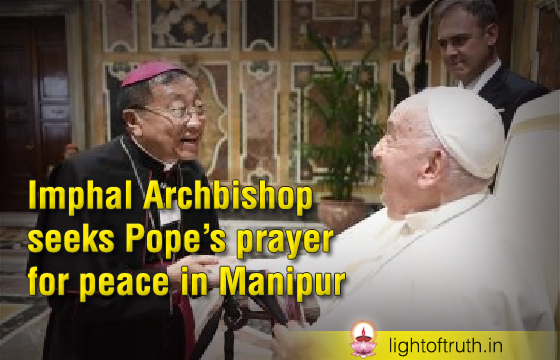
Imphal Archbishop seeks Pope’s prayer for peace in Manipur
Abp Linus Neli of Imphal has requested Pope Francis to pray for the people of Manipur state in north-eastern India. The archbishop made the plea on September 21 during an audience with the Pope. He was in Rome to attend the September 15-22 formation course for newly appointed bishops organized by the Dicastery for Evangelization. In a message shared with the people of Manipur via social me-dia, Abp Neli expressed his heart-felt prayers for his community, emphasizing the urgent need for God’s intervention to restore peace in the troubled region. He conveyed to the Pope the dire si-tuation in Manipur and requested the pontiff to pray that the people there might live in harmony, em-bracing forgiveness and recon-ciliation. Ethnic violence, raging in Manipur since May 3, 2023, has led to the deaths of at least 220 people and driven thousands to relief camps. “It is difficult, yet forgiveness and love for ene-mies are the only ways forward, as our divine Saviour Christ tau-ght us on the cross at Calvary,” Abp Neli stated, urging people to recognize their shared huma-nity amid the ongoing turmoil. The unrest in Manipur started after the Manipur High Court directed the local government to study the possibility of extending the reservation for tribal commu-nities to Meiteis, the largest ethnic group in the state. The special economic advantages and quotas in government employment and education is currently enjoyed by the Kuki community. The ruling has intensified pre-existing ten-sions between the two groups, deepening ethnic divides and triggering widespread turmoil.
The unrest has had serious repercussions for Manipur, which borders Myanmar. Around 60,000 people have been displaced, with numerous families compelled to abandon their homes in search of safety. Reports suggest that thousands are still living in precarious conditions, exacerbating the humanitarian crisis in the area. Archbishop Neli became the head of the Catholic Church in October 2023 during the challenging time for the community. Many homes, buildings, and churches have been destroyed, impacting both the local people and the church. In response, many supporters have stepped up to help those affected by the violence. Archbishop Neli’s request for the Pope’s prayers highlights the urgent need for peace and reconciliation in Manipur. The 67-year-old prelate has encouraged the Catholic community to keep Manipur in their prayers during October, the month of the Rosary. In a separate message to Matters India, the archbishop said he also appealed to the Pope to pray and bless for Myanmar in civil war, Bangladesh in political instability. The Pope “showed great concerns of such gravity and he encouraged us not to lose heart,” Archbishop Neli said.
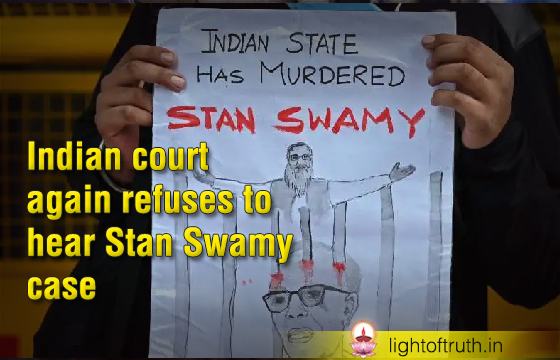
Indian court again refuses to hear Stan Swamy case
The top court of India’s Maharashtra state has, for an eighth time, refused to hear a plea seeking to clear late Jesuit Father Stan Swamy from an anti-terror case that includes a plot to kill Prime Minister Narendra Modi.
Justice Revati Mohite-Dere of the Bombay High Court recused herself from hearing the plea on Sept. 20 that wanted to remove Swamy’s name from the seven-year-old Elgar Parishad-Bhima Koregaon case filed against 16 leading activists in the country. The legal term recuse means that a person is unqualified to perform legal duties because of a potential conflict of interest or lack of impartiality. The judges have rescued themselves from hearing the case on seven earlier occasions. However, a lawyer following the case told that these judges have not explicitly expressed their potential conflicts of interest in the case. Petitioner, Jesuit Father Frazer Mascarenhas, based in Mumbai, Maharashtra’s capital, said “this was the eighth bench in the high court refusing to hear the case.” No bench in the high court is willing to hear the case “because it is clearly in our favour,” said Mascarenhas, whom the Jesuits appointed as a delegate to file the case in December 2021 after Swamy’s custodial death on July 5, 2021. “We still do not know why eight benches refused to hear this case. It is a clear case of justice being denied to Father Swamy,” Mascarenhas said. The judges fear “retribution from the government,” Father Mascarenhas told on Sept. 23. The 84-year-old Swamy was arrested on Oct. 8, 2020, from his residence in Ranchi in eastern Jharkhand state. He was accused of offenses such as sedition, having links with the outlawed Maoist group, and being part of a conspiracy to kill Modi. He died in a Mumbai hospital as a prisoner on July 5, 2021, after being denied bail on medical grounds despite suffering from multiple age-related ailments.
Rights activists say Swamy was arrested because he opposed the policies of the Bharatiya Janata Party (BJP) government in his state and marshalled tribal people to oppose them. A recent report by Massachusetts-based Arsenal Consulting, a digital forensics firm, disclosed Swamy was arrested based on evidence planted on his computer’s hard drive by hacking it. Along with 15 others, Swamy was accused of a role in instigating mob violence in Bhima Koregaon in Maharashtra on Jan. 1, 2018, which left one dead and several others hurt. All the accused persons in the Bhima Koregaon case are leading academics, writers and human rights activists like Arun Ferreira, Vernon Gonsalves, Sudha Bharadwaj, Anand Teltumbde, Gautam Navlakha, and poet Varavara Rao. In 1818, the battle of Bhima Koregaon was fought between the Maratha confederacy and the British East India Company, whose forces included members of the Dalit community. The celebration of the 200th anniversary by Dalits turned violent as they were opposed by pro-Hindu groups.
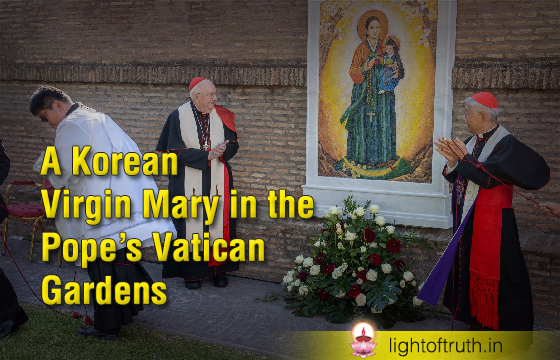
A Korean Virgin Mary in the Pope’s Vatican Gardens
In a powerful gesture of unity and hope, the Korean Catholic commu-nity has introduced a new mosaic of the Virgin Mary, symbolizing their enduring plea for peace across the globe. The mosaic, titled “Our Lady of Korean Peace”, was blessed in the Vatican Gardens on September 20, a date that holds profound significance as the Church commemorates the martyrdom of Saint Andrew Kim Tae-gon, Korea’s first priest, and his companions. The installation serves as both a tribute to these martyrs and a call for reconciliation in today’s turbulent world.
The mosaic’s imagery is rich with symbolism. The Virgin Mary, dressed in a traditional Korean “hanbok”, stands as a figure of maternal care and divine protection. Her red top represents divine motherhood, while her turquoise skirt reflects peace. She cradles the Child Jesus, who is dressed in colorful attire, symbolizing the youth of Korea, and holds a globe in his hand, signifying his dominion over the world. The Virgin also clutches a rosary and stands triumphant over a serpent, symbolizing her victory over evil. Above, the Holy Spirit in the form of a dove carries an olive branch, underscoring the ever-urgent plea for peace in regions stricken by conflict, such as Ukraine, the Middle East, and the Korean Peninsula.
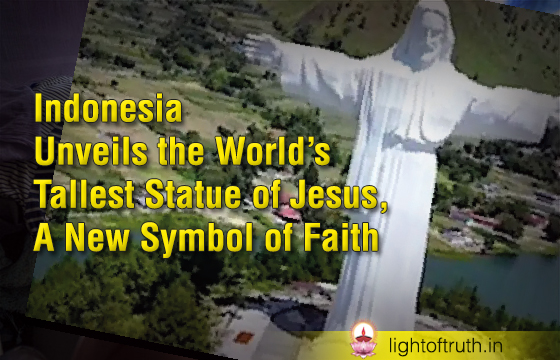
Indonesia Unveils the World’s Tallest Statue of Jesus, A New Symbol of Faith
In a stunning display of faith and craftsmanship, Indonesia has unveiled the world’s tallest statue of Jesus Christ, rising majesti-cally above Sibeabea Hill in North Sumatra. Towering at 61 meters, the “Jesus Christ the Saviour” statue now stands as a new global landmark, surpassing Rio de Janeiro’s famous “Christ the Redeemer” by over 20 me-ters. This monumental structure overlooks the scenic Toba Lake in Samosir Regency, blending natural beauty with spiritual significance.
The statue was officially inaugurated on September 19 by Bishop Antonius Subianto Bunja-min, President of the Indonesian Bishops’ Conference, in a cere-mony that drew both local and international attention. Just weeks before, on September 6, Pope Francis himself blessed a minia-ture version of the statue during a special event at the Vatican embassy in Jakarta. The Pope also signed a prayer plate that now sits at the base of the tower-ing statue, echoing his words: “What is admired about Jesus the Saviour is his infinite love.”
The unveiling of this statue is more than a ceremonial act—it is a testament to Indonesia’s co-mmitment to interfaith harmony, despite being a predominantly Muslim nation. In this spirit, the statue serves as a symbol of inclusivity and a beacon for all who seek solace and spiritual reflection.
Bishop Bunjamin re-marked during the inauguration, “This is a hill blessed by God, expected to be a place where people’s faith can grow stronger.” Located in an area of Indonesia with a significant Christian population, North Sumatra is home to more than a million Catholics and over four million Protestants, according to the Central Statistics Agency. The statue thus holds deep meaning for the region’s Christian community, who now have a monumental representation of their faith that also draws thousands of tourists and pilgrims each year.
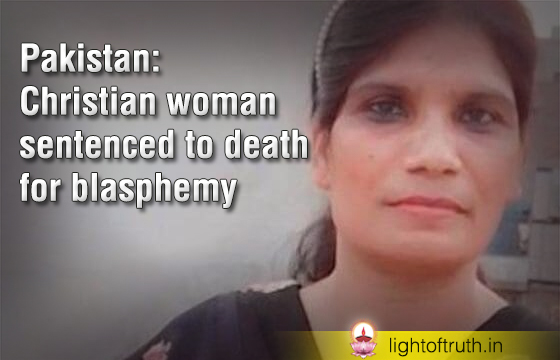
Pakistan: Christian woman sentenced to death for blasphemy
Shagufta Kiran, a 40-year-old Pakistani Christian woman, has been found guilty of blasphemy and sentenced to death under Article 295-C of Pakistan’s Penal Code, which punishes offences against the Prophet Muhammad.
The charge stems from a message shared on the social media platform WhatsApp. According to Fides News Agency, Kiran’s lawyer, Rana Abdul Hameed, reported that the judgment was handed down by a lower court judge in Islamabad, under the Prevention of Electronic Crimes Act (PECA). Along with the death sentence, Kiran has been fined 300,000 rupees (approximately 1,000 US dollars) following a legal process that lasted three years.
Her defence team argued that Kiran was not the author of the offensive content but had simply forwarded it in a group chat without reading it, yet this defence was insufficient to prevent her conviction.
Shagufta Kiran, who is a wife and mother to four children, was arrested by the Federal Investigation Agency (FIA) on July 29, 2021, in Islamabad for sharing blasphemous content in a WhatsApp group in September 2020. She is currently being held in the Central Adyalaa prison in Rawalpindi, where she will remain until her sentence is carried out.
Her lawyer has announced plans to appeal the decision to the Islamabad High Court. He emphasized that “the person who originally wrote the incriminating message is still free, while the one who merely shared it without endorsing it is condemned.” There is a strong belief that Shagufta has been targeted because she is Christian, making her an easy and vulnerable scapegoat.
In Pakistan, there is an increased focus on monitoring potential blasphemy offences online, with Islamic organizations viewing such actions as a growing threat that must be met with the harshest penalties. FIA’s Cyber Crime Wing is tasked with monitoring and reporting online content deemed blasphemous, leading to further police action.
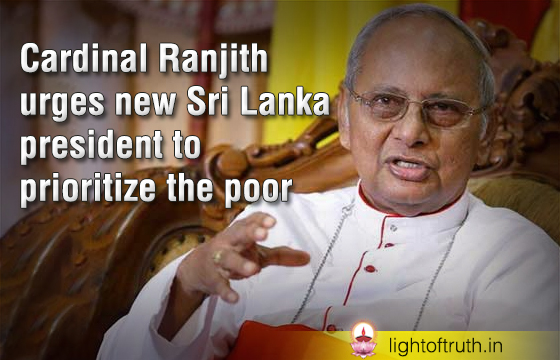
Cardinal Ranjith urges new Sri Lanka president to prioritize the poor
During a meeting at the Archbishop’s House in Colombo on September 23, Card. Ranjith congratulated President Dissana-yake on his electoral victory. He emphasized the significant res-ponsibilities awaiting the new president, particularly in addre-ssing the challenges faced by the nation. He offered the President his blessings and full support for the tasks ahead and stressed the importance of prioritizing the welfare of the impoverished seg-ments of society.
In response to a query from the press, Cardinal Ranjith high-lighted President Dissanayake’s pledge to thoroughly investigate the Easter attacks, ensuring that the truth would be uncovered and justice served.
President Dissanayake’s day continued with visits to other reli-gious landmarks, including the Dawatagaha Mosque in Colom-bo, where he participated in cere-monies and received further ble-ssings. Sri Lanka’s new leader assumed the presidency on Mon-day, ushering in promises of change for a nation that has been predominantly ruled by powerful political dynasties and is currently recovering from its most severe economic crisis in over seventy years.
Millions cast their votes for Dissanayake, an opposition parliamentarian, drawn by his commitment to combat corruption and support the country’s tenuous economic revival.
During his inaugural address at the president’s office, Dissanayake, aged 55, pledged his dedication to protecting and promoting democracy, acknowledging the challenging times ahead. “Our politics needs to be cleaner, and the people have demanded a different political culture,” he said. “I am ready to commit to that change.”
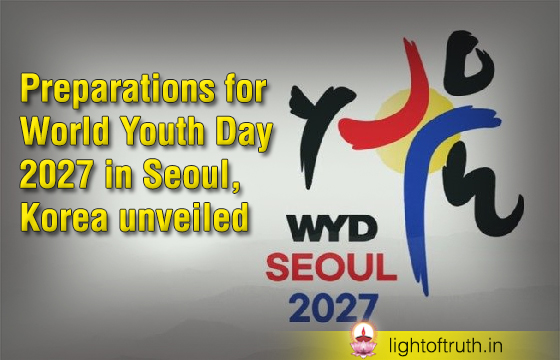
Preparations for World Youth Day 2027 in Seoul, Korea unveiled
On Tuesday 24 September at the Holy See Press Office, orga-nizers and promoters of the next global gathering of youth pre-sented World Youth Day (WYD) 2027 to be hosted by the Catholic Church in Seoul, South Korea.
The theme for this 41st World Youth Day (2026 and Seoul 2027) is taken from John’s Gospel, re-calling Jesus’ words: “Take courage! I have overcome the world.” (Jn 16:33). Also announ-ced was the theme for the 40th World Youth Day coming up before that in 2025, also from John’s Gospel when Jesus says: “You also are my witnesses, because you have been with me” (Jn 15:27).
Presenting details of the Seoul global celebration of faith were Cardinal Kevin Farrell, Prefect of the Dicastery for Laity, Family and Life, the Vatican office over-seeing the WYD events; Arch-bishop Peter Soon-Taick Chung of Seoul, South Korea, and Pre-sident of the Local Organizing Committee of Seoul 2027; Bishop Paul Kyung Sang Lee of South Korea, General Coordinator of WYD Seoul 2027; and Ms. Ga-briela Su-Ji Kim, a young Korean who participated and previous World Youth Days who shared her experiences and hopes.
In his address Bishop Kyung-sang Lee thanked Pope Francis for the choice of the theme, “Take courage! I have overcome the world.” (Jn 16:33), saying it “re-sonates deeply with the circum-stances faced by the Catholic Church of Korea and the chall-enges confronting today’s youth.”
He also noted that “Korea stands in a unique context distinct from previous World Youth Day hosts, characterized by the harmonious coexistence of diverse religious traditions” that can offer a unique and rich experience for youth from around the world. In reference to the division of Korea, he said “the Church has diligently worked to resolve the conflicts inherent in this division over the past seven decades, seeking peace and unity for the Korean people.”
In addition to presenting organizational details and events for promoting WYD 2027, Bishop Kyung-sang Lee presented the logo for the event, noting that central to the logo is a cross with the red and blue colours symbolizing Christ’s triumphant victory over the world. The left element, reaching upward, signifies God in Heaven, while the right element, pointing downward, symbolizes Earth, illustrating the fulfilment of God’s will on Earth through their unity, all inspired by traditional Korean art.
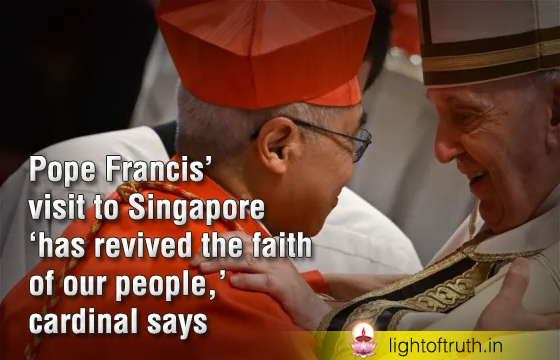
Pope Francis’ visit to Singapore ‘has revived the faith of our people,’ cardinal says
“I believe his visit has revived the faith of our people. His visit has caused many of our Catholics to work together,” said Cardinal William Goh, archbishop of Singapore, in an interview with Vatican News about Pope Francis’ recent visit to the country.
“It’s a very rare occasion when all Catholics come together to work side by side. All of them have been very enthusiastic and have felt that it is a great privilege to be part of this entire organizing committee, to plan and work for the success of the papal visit,” he added.
For the cardinal, the papal trip will inspire the intention to “build ourselves as one Church,” to unite around the figure of the bishop of Rome, and to further promote the message of the Gospel among those who need it most.
It is precisely the quest to bring the good news to all humanity that prompted the pope to visit Asia, Goh explained. An effort to make the Catholic Church “truly a sacrament of the mercy and compassion of Jesus toward others.”
“I think that these types of messages, such as reaching out to the marginalized, to the poor, to those who suffer, to the vulnerable, and respecting other religions, the dignity of life, the protection of the family, and young people, respecting young people and encouraging young people to be bold, without forgetting the elderly either, all these messages that the Holy Father constantly speaks about resonate throughout the world, even for us Singaporeans,” the cardinal reflected.
Furthermore, he said the country’s Catholics are grateful because the pope “has rejuvenated” their faith, which in the long term will imply “a more dynamic and lively desire” for fraternity and to lead others to Jesus.