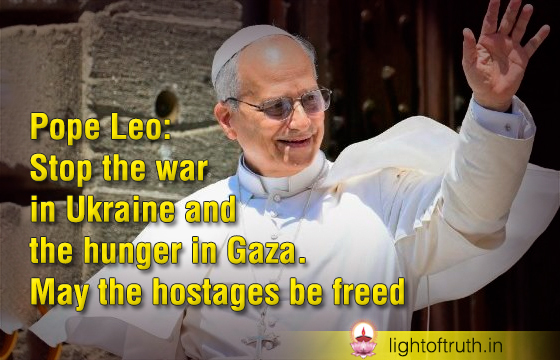
Pope Leo: Stop the war in Ukraine and the hunger in Gaza. May the hostages be freed

Pope Leo spoke on the ceasefire and peace agreement in Ukraine, a resolution of the humanitarian crisis and hunger in Gaza, and the release of Israeli hostages there. These objectives of the Holy See’s “soft diplomacy” for issues that “cannot be resolved through war,” were expressed by Pope Leo XIV on 13 August. He shared this message with journalists upon his arrival in Castel Gandolfo on 13 August where he will spend a second period of a summer break until August 19. While greeting the many people gathered to welcome him at the gates of Villa Barberini – his residence during these days – the Pope responded to questions from media reporters about international current events.

When asked what he expects from the upcoming 15 August summit between U.S. President Donald Trump and Russian President Vladimir Putin, Leo XIV replied: “We must always seek a ceasefire. The violence, the many deaths, must stop. Let’s see how they can come to an agreement. Because after all this time, what is the purpose of war? We must always seek dialogue, diplo-matic efforts, not violence, not weapons.” 

And when asked if he is concerned about the possibility of the population of Gaza being deported, the Pope said: “Very much (con-cerned). The humanitarian crisis must be resolved. We cannot go on like this. We know the violence of terrorism, and we honour the many who have died, as well as the hostages – they must be freed. But we must also think of the many who are dying of hunger.”
Finally, when asked what the Holy See is doing to stop these and other conflicts, the Pope responded: “The Holy See cannot stop them… but we are working, let’s say, on ‘soft diplomacy,’ always inviting, encouraging the pursuit of nonviolence through dialogue and seeking solutions – because these problems cannot be solved by war.”
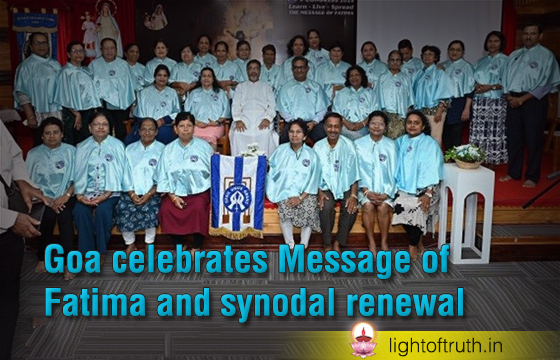
Goa celebrates Message of Fatima and synodal renewal

The World Apostolate of Fatima (WAF), a Public International Association of the Faithful of Pontifical Right, held a two-day Marian Congress on July 15–16 in Pilar, Goa, marking 70 years of the Apostolate’s mission in the region. The event, guided by the message of Fatima, gathered clergy, religious, and laity to renew their commitment to prayer, evangelisation, and synodal engagement.

More than 150 participants joined the overnight programme, with nearly 300 attending the Eucharistic celebration on the second day. The Congress featured spiritual reflections, catechesis, practical workshops, and communal prayer, all centred on deepening Marian devotion and strengthening parish life through lay involvement.
Cardinal Filipe Neri Ferrao, Archbishop of Goa and Daman, presided over the Midday Eucharistic Celebration on the second day. In his homily, he underscored the urgent call of Our Lady of Fatima to pray the Rosary daily for peace in the world, a message as relevant today as it was over a century ago. 

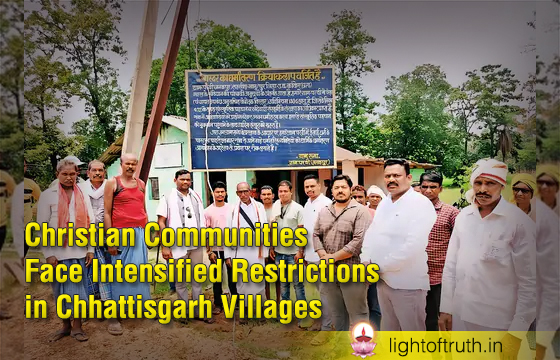
Christian Communities Face Intensified Restrictions in Chhattisgarh Villages

Hindu right-wing groups in Chhattisgarh’s Kanker district have escalated their campaign against Christians, with two tribal villages—Kudal and Junwani—banning the entry of pastors and priests. On August 5, the Sanatan Samaj organized a protest in Bhanupratappur, leading to a complete shutdown of local businesses. Demonstrators submitted an 11-point memorandum demanding government action to curb Christian religious activities, effectively challenging constitutional rights to religious freedom and movement.

Village councils in Kudal and Junwani passed resolutions prohibiting Christian from entering. Warning signs posted at village borders cite the Fifth Schedule and the Panchayats (Extension to Scheduled Areas) Act, 1996, as justification for the ban. Local leader Rajendra Komra accused Christian pastors of persuading tribal villagers to convert, claiming they exploit the simplicity of rural communities. These restrictions, however, violate constitutional guarantees of religious expression and mobility. Media reports indicate that 18 families in these villages had embraced Christianity in recent years, though five later reverted under community pressure.

Allegations suggest conversions were encouraged through access to education, healthcare, and financial aid—yet no evidence was presented to support these claims.
During the protest, speakers made sweeping accusations against Christian missionaries, alleging foreign funding was being used to promote conversions through social services. Municipal council president Nikhil Singh Rathore called religious conversion a “sensitive issue,” urging Hindu unity. Deputy Chief Minister Vijay Sharma announced plans to strengthen the Chhattisgarh Freedom of Religion Act, 1968, following consultations across 52 meetings. This move signals potential legal tightening amid growing hostility toward Christian communities, who are already facing systemic exclusion and threats to their constitutional rights.

Nun-lawyer slams habit-linked attacks, urges church to defend missionaries

Sister Sujata Jena, a lawyer and member of the Congregation of the Sacred Hearts of Jesus and Mary, has denounced recent allegations of religious conversion by nuns in tribal areas as “unfounded and politically motivated.”

In an interview with Matters India, Sr. Jena, who serves in Odisha, issued a pointed challenge to Church authorities: “If you’re going to insist that we wear habits everywhere, then be ready to defend us when we’re attacked on the streets.”

Her remarks follow a disturbing incident in her state Odhisha which occurred at Khordha Road Railway Station on the night of May 31, when Sister Rachana Nayak of the Holy Family Congregation was detained for nearly 18 hours along with four girls and her younger brother. The group was forcibly removed from the Rourkela Rajarani Express by Bajrang Dal activists, who falsely accused them of trafficking and religious conversion. Despite the girls affirming their Catholic faith and voluntary travel, the group was held until human rights lawyers intervened and officials confirmed the allegations were baseless.

Speaking to Matters India, Sr. Jena noted that all three major attacks on nuns in less than three months this year involved Sisters wearing habits. “To those who insist on habits during travel—and to congregations unwilling to reflect or adapt—I say: be prepared to defend these Sisters when they’re attacked,” she asserted.

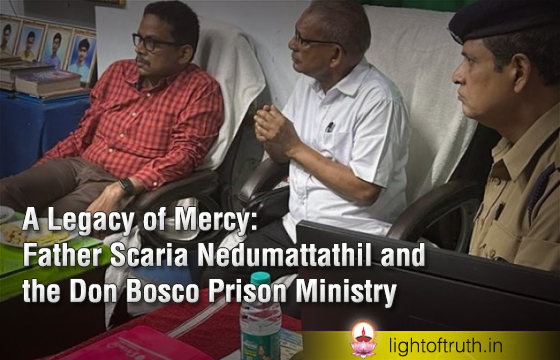
A Legacy of Mercy: Father Scaria Nedumattathil and the Don Bosco Prison Ministry

On August 10, Prison Ministry Day, we honour the remarkable journey of Father Scaria Nedumattathil, a Salesian priest from Kolkata province, who founded the Don Bosco Prison Ministry (DBPM) after a compassionate visit to Berhampore Central Correctional Home in 1995. What began as a simple act of kindness has grown into a nationwide mission of hope and transformation. For three decades, Father Scaria’s vision has remained steadfast: to restore dignity, freedom, and honour to those behind bars. His guiding principles—Reform, Release, Rehabilitate, and Reintegrate—have shaped DBPM’s outreach, impacting over 25,000 inmates and 45,000 family members. The ministry offers legal aid, counseling, vocational training, and cultural programs, helping prisoners rebuild their lives.

On August 10, Prison Ministry Day, we honour the remarkable journey of Father Scaria Nedumattathil, a Salesian priest from Kolkata province, who founded the Don Bosco Prison Ministry (DBPM) after a compassionate visit to Berhampore Central Correctional Home in 1995. What began as a simple act of kindness has grown into a nationwide mission of hope and transformation. For three decades, Father Scaria’s vision has remained steadfast: to restore dignity, freedom, and honour to those behind bars. His guiding principles—Reform, Release, Rehabilitate, and Reintegrate—have shaped DBPM’s outreach, impacting over 25,000 inmates and 45,000 family members. The ministry offers legal aid, counseling, vocational training, and cultural programs, helping prisoners rebuild their lives.

Prison officials praise DBPM’s impact. Superintendent S. Chatterjee notes improved inmate behaviour and reduced conflict, while the Inspector General of Correctional Services calls the ministry a model for reform. Father Scaria’s mission was shaped by collaborators like Father T.L. Francis and supported by the Salesian Provincial Team, including late Fathers C.J. Jacob and Thomas Panakezham. Lay leaders like Anupam Choudhury and partners like DB Tech India and Schneider Project have strengthened the ministry’s reach. Honoured with the Rector Major Paschual Chavez Award and recognized during Azadi ka Amrit Mahotsav, Father Scaria continues his work at the Human Resource Development Centre in Dhobasole, West Midnapore. His legacy lives on through Prison Ministry India, a national movement dedicated to restoring dignity and hope to society’s forgotten.

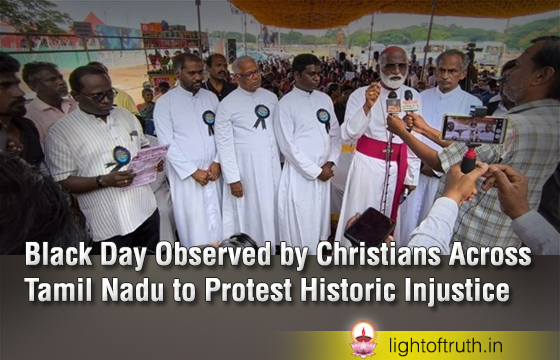
Black Day Observed by Christians Across Tamil Nadu to Protest Historic Injustice

Christians of various denominations in Tamil Nadu marked Black Day on 10 August with public demonstrations, gatherings, and awareness campaigns across all 18 dioceses of the state. In addition to parish-level meetings, the programme was conducted in 51 prominent locations in Tamil Nadu and Puducherry. Catholic Bishops, Protestant Bishops, priests, religious congregations, and lay faithful gathered — many in the streets — to hold public meetings and present memoranda to the government. The state-wide network was coordinated by the Chairman, Bishop Jeevanandam, and the Secretary, Fr. Nithiya OFM Cap, of the Tamil Nadu Bishops’ Council (TNBC) Commission for the Scheduled Caste and Scheduled Tribes, working through all Diocesan SC/ST Commission Secretaries and staff.

Black Day is observed by Christians in India, particularly Dalit Christians, to highlight the injustice stemming from the Presidential Order of 1950. This order decreed that the entitlements granted to Hindus from the Scheduled Caste category would not be extended to Dalits of other religions. Despite facing similar socio-economic challenges, such as discrimination, lack of education, and limited employment opportunities, Dalit Christians and Muslims remain excluded from these benefits. In addition to diocesan headquarters events led by bishops, priests, and religious, several meetings were held at parish level. Leaders from other faiths — including Hindus, Muslims, Buddhists, and Sikhs — attended, alongside political leaders, laity movements, and social activists. The public meetings were held under police protection.

The day’s observances included hoisting black flags in Christian homes and churches, wearing black badges, conducting public meetings and protest gatherings, delivering speeches on constitutional injustice, holding media briefings, passing resolutions demanding Scheduled Caste status, submitting memoranda to government officials and the SC/ST Commission, organising rallies and peace marches, drum beating, and forming human chains for awareness campaigns.

Protest forces Indian college to cancel Stan Swamy memorial lecture

St. Xavier’s College, Mumbai, has cancelled its annual Stan Swamy Memorial Lecture scheduled for August 9, following protests from the Akhil Bharatiya Vidyarthi Parishad (ABVP), a student organization affiliated with the RSS. The lecture, titled “Migration for Livelihood: Hope amidst Miseries,” was to be delivered virtually by Father Prem Xalxo and organized by the college’s department of Inter-Religious Studies. It aimed to honour the legacy of the Jesuit priest and tribal rights activist who died in judicial custody in July 2021.


In a letter to the college principal, ABVP Mumbai secretary Prashant Mali objected to the event, alleging that Father Swamy was a prime accused in the Bhima Koregaon case and had links to the banned CPI (Maoist). He was arrested under the Unlawful Activities (Prevention) Act (UAPA), an anti-terror law, and remained incarcerated despite suffering from Parkinson’s disease and other age-related ailments. He died at Holy Family Hospital after a cardiac arrest.


Father Stan Swamy belonged to the Jamshedpur Jesuit Province and had spent decades working alongside Adivasi communities in Jharkhand, advocating for their rights to land, forest, and livelihood. His death sparked nationwide calls for prison reform and drew attention to the treatment of elderly under-trial prisoners. This is not the first time events commemorating Father Swamy have faced opposition. In Mangaluru, another Jesuit run institution, withdrew plans to name a park after him following similar protests on October 7, 2021. The park was to be called the Father Stan Swamy Peace Park, located at the St Aloysius Institute of Management and IT in Kotekar, on the outskirts of Mangaluru.

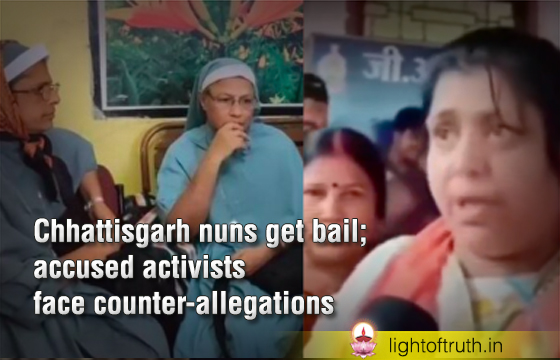
Chhattisgarh nuns get bail; accused activists face counter-allegations

A special NIA court in Bilaspur, Chhattisgarh, has granted conditional bail to the two Catholic nuns from Kerala and a tribal man who were arrested on charges of human trafficking and forced religious conversion, July 25, 2025. The bail was granted (August 2) nine days after their arrest, following a complaint by a local Bajrang Dal functionary at Durg railway station.
The court’s decision, which required the accused to submit a bond of Rs. 50,000 each and surrender their passports, was met with relief by their supporters. However, the legal and political repercussions of the incident are far from over.

The bail was granted after the defense argued that the case was “absolutely baseless.” The court’s order noted that there was no prior criminal record against the accused and that the investigation was in a preliminary stage with no direct evidence of trafficking or forced conversion.
Crucially, the parents of the women, who were alleged to be the victims, submitted statements confirming that their daughters were adults, had been practicing Christianity for several years, and had left for Agra willingly with their consent for job opportunities. The court found that the allegations were based on “mere apprehension and suspicion.”

In a significant turn of events, the three women who were allegedly being trafficked have now filed a written complaint against Bajrang Dal members and a woman named Jyoti Sharma. The women accuse the group of assault, verbal abuse, and forcing them to give false statements to the police.
One of the women, Kamleshwari Pradhan, alleged that Jyoti Sharma slapped and threatened her, telling her to say she was being taken by force. She claimed that Sharma threatened to jail her brother if she didn’t comply. Videos have also surfaced on social media showing Sharma threatening the group inside the police station. While the police have acknowledged receipt of this complaint, no FIR has been registered against Jyoti Sharma or the other Bajrang Dal members yet.

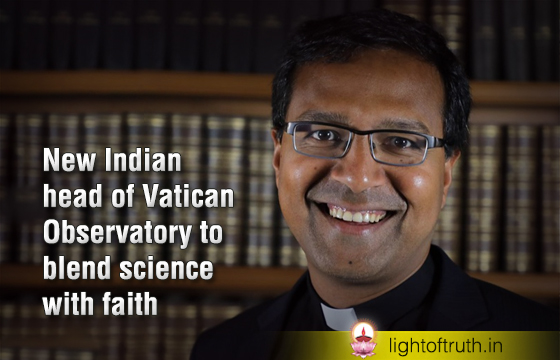
New Indian head of Vatican Observatory to blend science with faith

Indian Jesuit Father Richard D’Souza, the new director of the Vatican Observatory, says he will continue the tradition of Vatican astronomers who demonstrated how science and faith can co-exist. The 47-year-old Jesuit from western Goa state said he stands “on the shoulders of giants who have served before,” and the job is to lead the Observatory “in promoting dialogue between faith and science.” He told on Aug. 4 that the Observatory “is inter-nationally recognized because of the quality of our research and the renowned month-long biennial summer schools that we organi-ze.” Pope Leo XIV appointed D’Souza on July 31 to succeed Jesuit Brother Guy Consolmagno, who ends his 10-year term as the director of the Observatory on Sept. 19.
D’Souza, who joined the Observatory in 2016, wants to ensure that the Observatory “continues to serve the Pope and the Universal Church, promoting the dialogue between faith and science, through solid scientific research.” He said the Observa-tory, one of the world’s oldest as-tronomical institutions, continues to be independent and does not accept funding from international agencies or global science foundations of major powers.
The Vatican Observatory was engaged in several research projects aimed at advancing discoveries in astronomy and space science. In June this year, a special committee of the International Astronomical Union named an asteroid after D’Souza in honour of his research on the merger histories of galaxies. This asteroid was discovered by K. Cernis and Jesuit Father R. P. Boyle with the Vatican Advanced Technology Telescope on Mount Graham in 2012. Founded in 1891 by Pope Leo XIII, the Observatory aims to conduct research encompassing stars, meteorites, galaxies, cosmology, and the early universe, while fostering dialogue among science, theology, and the Church’s intellectual tradition.

Congress MP Hibi Eden moves adjournment motion in Lok Sabha over attack on Catholic priests

Congress leader and Member of Parliament, Hibi Eden, has submitted a notice for an adjournment motion in the Lok Sabha, calling for a discussion on the recent alleged attack on two Catholic priests, a catechist, and two nuns by approximately 70 Bajrang Dal members in Jaleswar, Odisha. In a letter addressed to the Secretary General of the Lok Sabha, Eden wrote, “I hereby give notice of my intention to ask for leave to move a motion for the adjournment of the business of the House… To discuss the recent brazen attack on two Catholic priests, a catechist, and two nuns by around 70 Bajrang Dal members in Jaleswar, Odisha.” Eden alleged that the attackers falsely accused the church members of religious conversion and assaulted them. He termed the incident as “communal abuse” and stated, “The attackers falsely accused them of religious conversions and subjected them to physical assault and communal abuse. Given the gravity of the incident and its implications for communal harmony, I request the House to adjourn its business to discuss this matter.”
In his letter, Eden outlined the key points for discussion: condemnation of the violent attack, assurance of justice for the victims, measures to ensure the safety and security of minority communities and religious personnel, and action against the perpetrators to ensure accountability. Separately, Congress MP Manickam Tagore submitted a notice for an adjournment motion in the Lok Sabha, demanding an urgent discussion on the arrests of individuals who were allegedly detained at Lodhi Colony Police Station, South District of New Delhi, for speaking in Bengali.