115-year-old Christian hospital under probe in Chhattisgarh

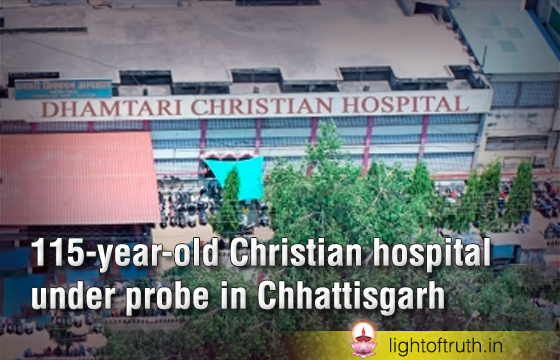
District administration in Chhattis-garh’s Dhamtari has ordered an inve-stigation into a 115-year-old Christian hospital following complaints from Bajrang Dal, Vishva Hindu Parishad (VHP) and other Hindutva organisa-tions. The groups have accused the Bathena Christian Hospital of medical negligence and forced religious con-version. The hospital was established in 1910 by American Mennonite missionaries and is recognised as the oldest hospital in Chhattisgarh.

The probe comes after Hindu organisation members specifically targeted the hospital premises on July 27, vandalising property, damaging equipment and misbehaving with doctors during their protest. Despite the targeted attack, no action has been taken against the perpetrators. Instead, authorities launched an investigation into the hospital itself, effectively legitimising the methods used by the groups. The hospital, known for providing affordable medical care, has faced repeated targeting by Hindu groups in recent months. This was not the first such incident; on June 28, VHP workers had created a ruckus for about three hours, forcibly entering the hospital, putting up flags, smearing the ground with cow dung, and damaging wheelchairs and CCTV cameras. The hospital filed police complaints about both incidents of vandalism, but authorities remained inactive against the perpetrators.
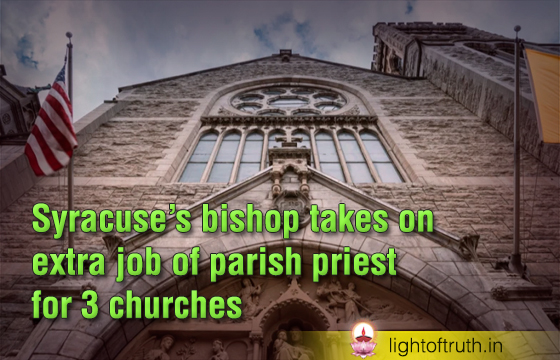
Syracuse’s bishop takes on extra job of parish priest for 3 churches

The Diocese of Syracuse, New York, announced on Aug. 9 that Bishop Douglas J. Lucia has taken on the additional job of parish priest at three churches in Baldwinsville, New York. 

The diocese announced a number of changes to pastoral assignments that went into effect on Aug. 1, including Lucia serving as pastor at St. Augustine Church, St. Elizabeth Ann Seton Church, and St. Mary of the Assumption Church. The three churches are part of the same parish and share various initiatives and resources.

“Certainly, a crucial component in our parishes is the priest. Without the priest, there is no Mass; and without the Mass there is no Eucharist, no food for the journey,” Lucia wrote in a recent letter to the churches’ parishioners.

After announcing that the previous pastor, Father Joe O’Connor, received seminary work as a new assignment, Lucia wrote to parishioners: “I know you have been wondering what is next for the Baldwinsville parishes.”

“I am able to share the news that I will be your new pastor,” Lucia said. “Although I was called to be the bishop of the Diocese of Syracuse six years ago, it has always been with the hope of continuing to be a parish priest and I guess God has taken me at my word.”

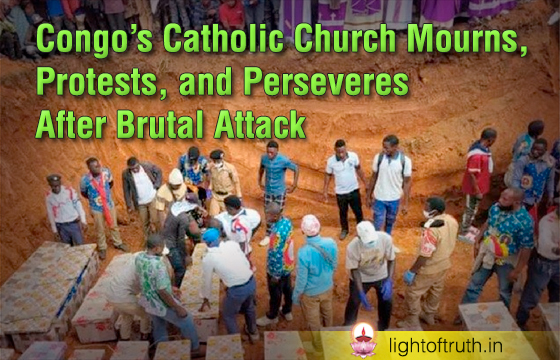
Congo’s Catholic Church Mourns, Protests, and Perseveres After Brutal Attack

The quiet Sunday rhythms of the village parish of Blessed Anuarite were shattered on July 27 when militants stormed the church during worship. Armed with machetes and fire, they left behind not just burned walls and desecrated pews, but the bodies of more than 43 worshippers—nine of them children. Others were abducted, homes and shops in the area reduced to ash. The attackers were members of the Allied Democratic Forces (ADF), an Islamist militia aligned with the so-called Islamic State. For residents of the Democratic Republic of Congo’s eastern provinces, this is not an isolated nightmare. It is part of a relentless cycle of massacres, abductions, and displacement that has continued despite the region’s prolonged “state of siege.”

In the days following the attack, the country’s Catholic bishops issued a statement that was both grief-stricken and accusatory. The National Episcopal Conference of Congo (CENCO) demanded answers—not only about the attack itself, but about the absence of protection for the population. “Security forces were nearby,” said Bishop Dieudonné Uringi of Bunia, “but they did not act in time. They should have intervened more quickly to protect the people.” CENCO’s communiqué was even more pointed: “This massacre is one of many in a province under military control for years. Killings and kidnappings happen repeatedly, and no credible explanation has been offered to reassure the people. Who are these serial killers serving? Who benefits from these crimes against peaceful citizens?” The aftermath is visible not only in the charred remains of the church but in the swelling numbers of displaced people. Many survivors fled to Bunia, where the diocese is struggling to house and feed them. “We welcome them, but we have no means to sustain them,” Bishop Uringi said, appealing for continued aid from international partners like the pontifical foundation Aid to the Church in Need.

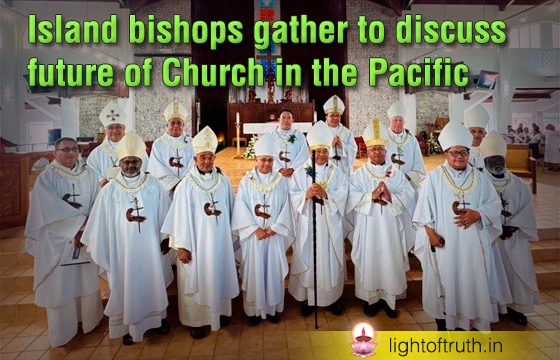
Island bishops gather to discuss future of Church in the Pacific

What does it mean to be a Church that is authentically “of the Pacific”? That was the question on the agenda when bishops from around the region gathered in early August for a week of prayer and reflection in Pago Pago, American Samoa.

The meeting, which ran from the 5th to the 11th August, was held under the auspices of CEPAC, the Episcopal Conference of the Pacific—which is, by area, the largest episcopal conference in the world.

As well as time for prayer and discussion, the gathering featured a traditional Samoan welcome ceremony, ‘conversations in the Spirit’ using synodal methodology, and an address from Archbishop Gábor Pintér, the Apostolic Nuncio to CEPAC.

In his speech, Archbishop Gábor Pintér described the Pacific as “region of breathtaking natural beauty, imbued with a profound sense of spirituality, and shaped by deep-rooted, resilient cultures.” It also, the nuncio admitted, faces “significant challenges”: climate change, economic disparities, social injustice, and youth disempowerment. These realities are “not distant concerns”, Archbishop Pintér said, but rather “woven into the very fabric of our daily lives”.

At the “very core” of CEPAC’s vision, the apostolic nuncio said, is a “deep desire to be a Church that is authentically ‘of the Pacific’ … a Church that courageously recognizes, respects, and seamlessly integrates the rich cultural heritage, ancestral wisdom, and communal values of our island nations into its very life.”
With this in mind, he suggested a number of areas for the Church in the region to focus on: care for the oceans, synodality, formation for mission, social activism, and empowerment of women and young people.

Archbishop Pintér brought his address to a close by outlining a vision of the Church in the Pacific as  “Christ-centred”, passionately committed to justice, peace, and environmental care, and “deeply rooted and flourishing within the rich cultural tapestries of our islands”.

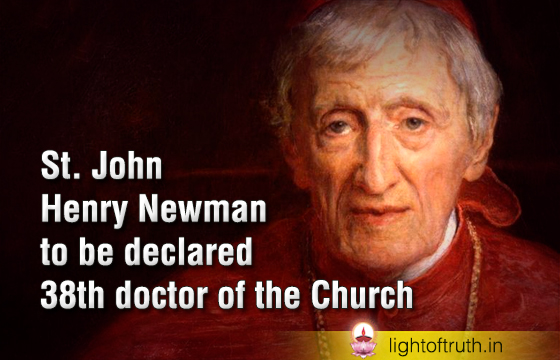
St. John Henry Newman to be declared 38th doctor of the Church

Pope Leo XIV approved the decision to declare St. John Henry Newman the 38th doctor of the universal Church. The decision to confer the title upon the 19th-century English saint — a former Anglican priest who converted to Catholicism — was confirmed during the pope’s morning meeting with Cardinal Marcello Semeraro, prefect of the Dicastery for the Causes of Saints. 

According to the Holy See Press Office, the Holy Father accepted the “affirmative opinion” of dicastery members and the plenary session of cardinals and bishops regarding the founder of the Oratory of St. Philip Neri in England.  In the Church’s 2,000-year history, only 37 other saints, including four women, have been given the title of doctor. The title is granted in recognition of an already canonized saint’s significant contribution to advancing the Church’s knowledge of doctrine, theology, or spirituality. The Vatican has not yet confirmed the date of Newman’s formal proclamation as a doctor of the Church.

Born in London and baptized into the Church of England in 1801, Newman was a popular and respected Anglican priest, theologian, and writer among his peers prior to his conversion to Catholicism. In 1845, Newman asked his friend Blessed Dominic Barberi, an Italian Passionist priest living in England, to receive him into the Catholic Church.

He was ordained a Catholic priest in 1847 and later made a cardinal by Pope Leo XIII in 1879. He chose the motto “Cor ad cor loquitur” (“Heart speaks to heart”) as an expression of his conversion in his own heart, through the heart of God. As a Catholic, Newman deepened and contributed to the Church’s teaching, thanks to his broad knowledge of theology and his keen insight into modern times, grounded in the Gospel. His body of work includes 40 books and more than 20,000 letters. Newman died in Edgbaston, England, in 1890. He was beatified by Pope Benedict XVI on Sept. 19, 2010, and canonized by Pope Francis on Oct. 13, 2019.

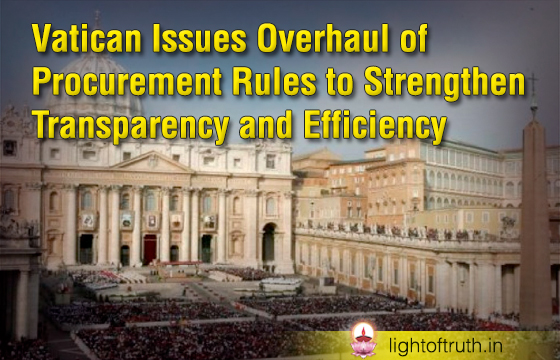
Vatican Issues Overhaul of Procurement Rules to Strengthen Transparency and Efficiency

The Vatican has unveiled a sweeping update to its public procurement regulations, introducing a streamlined framework designed to safeguard integrity while accelerating decision-making in the Holy See’s contracting processes. The reform, enacted through a General Executive Decree from the Secretariat for the Economy on August 9, implements key provisions of «Para una mejor armonización» (“For a Better Harmonization”), the motu proprio issued in January 2024. This decree builds upon the Vatican’s 2020 apostolic letter on transparency, oversight, and competition in awarding public contracts—originally promulgated by Pope Francis and later refined to better align with the evolving needs of the Church’s administration

Signed on August 5 and comprised of eight sections and 52 articles, the new regulation represents the work of multiple Vatican departments. Officials say the goal is to preserve the principles of transparency, fair competition, and equal treatment of bidders while cutting through bureaucratic bottlenecks that can delay projects.

The updated code is not only an exercise in administrative housekeeping; it reflects the Vatican’s ongoing commitment to the values embedded in Catholic social teaching. These include fairness in economic dealings, responsible stewardship of resources, and the promotion of efficiency and value for money without compromising ethical standards.

The balance between rigorous oversight and procedural simplicity has been a recurring theme in Vatican governance reforms since the apostolic constitution «Praedicate Evangelium» came into force in 2022. The new framework draws on lessons from recent years, aiming to ensure that procurement decisions are both transparent and practically executable, avoiding excessive delays or red tape. The decree took immediate effect on August 10, a day after its publication on the website of L’Osservatore Romano.

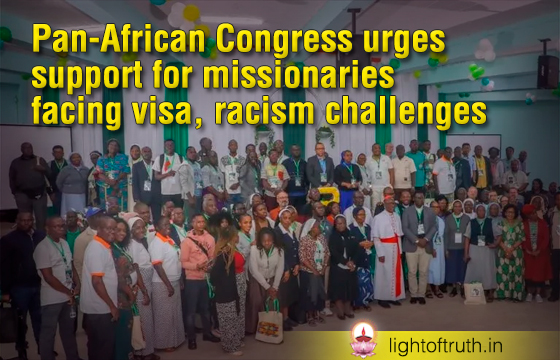
Pan-African Congress urges support for missionaries facing visa, racism challenges

Delegates of the third Pan-African Catholic Congress on Theology, Society, and Pastoral Life who gathered in Ivory Coast’s city of Abidjan from Aug. 5–10 have called for the support of African missionaries who are experiencing hardships in their missions, especially those set back by immigration challenges. In a statement at the end of the congress, the delegates said divisions such as ethnicity and racism must not stand in the way of missionary discipleship in Africa and even outside the continent.

Noting that self-reliance is an imperative for the Church in Africa, “not as isolation from other local churches but as mature participation in the universal communion of faith,” the delegates said: “This means … supporting African missionaries in the challenging mission in some parts of the world where some African missionaries experience racism and immigration restrictions.”

The delegates acknowledged that the African Church has transitioned to becoming a “Church of the Sheaves,” sharing personnel within the continent, even outside Africa. “We recognize with gratitude how far the African Church has journeyed: transiting from a mission Church receiving the Gospel to a Church of the Sheaves, sharing gifts and sending missionaries to other parts of the world,” they said, adding: “We commit ourselves to deepening this transformation as missionary disciples of the Lord to Africa and the world.”

]They said that synodality, as explored in the Synod on Synodality, is the pathway of the mission of evangelization and called for “overcoming divisions based on ethnicity, status, or ideology.” The call by the congress delegates comes amid mounting frustrations of foreign Catholic priests who have been forced out of South Africa on alleged expiry of their visas.

Hunger spreads in northern Nigeria

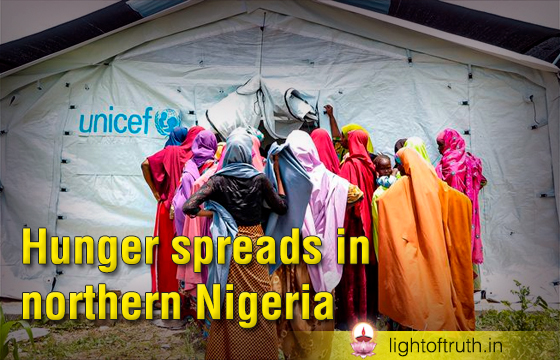
According to the International Committee of the Red Cross, more than 3.3 million people in north-eastern Nigeria are currently facing food insecurity. The vast majority are farmers who have been forced to abandon their land due to the ongoing insecurity in the region, and are thus cut off from their primary source of livelihood. Fishermen are also affected.

The Vatican’s Fides news agency has reported that security concerns are preventing herders from accessing grazing areas for their livestock and keeping fishermen from reaching waters such as Lake Chad and major rivers like the Niger and Taraba. Both groups are also suffering due to the activities of armed groups and bandits that continue to wreak havoc across northern Nigeria.

The United Nations Food and Agriculture Organisation (FAO) has also raised the alarm. The FAO has warned that during this lean season, that is the months before the harvest, over 30 million Nigerians could be at risk of food insecurity, and the Red Cross has warned that relief efforts alone may not be enough to address the situation.

Food insecurity in Nigeria is a symptom of a deeper, unresolved problem, the organisation says, namely the persistent violence caused by armed groups. Adding to the crisis, the Red Cross says, is the impact of climate change, which is driving internal displacement across the country. Nigeria is experiencing both drought in the north west and flooding in the east, two extremes that are devastating the nation’s agricultural heartlands.

Church in Haiti appeals for stop to bloodshed, impunity and fear

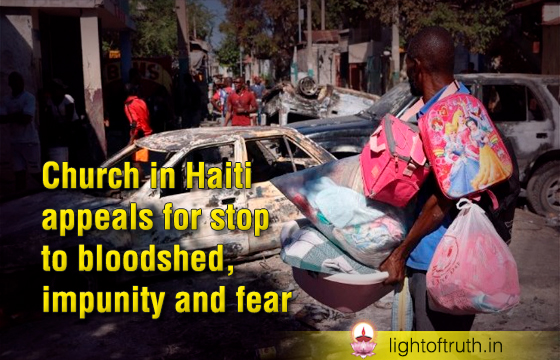
The kidnapping of nine individuals, including an Irish missionary and a child with disabilities, is being described as “a new act of barbarity,” a “shameful act,” and an expression of a “moral collapse” engulfing all of Haitian society. This is the denunciation issued by the Archdiocese of Port-au-Prince in a statement condemning what took place on Sunday, August 3rd, at the Sainte-Hélène Orphanage in Kenscoff, southeast of the capital. The Church is therefore appealing both to the faithful, called to respond with prayer and concrete humanitarian help, and to the institutions to ensure order, security, and justice.

The Archdiocese describes the kidnapping as “an attack on the noblest aspects of society”: selfless care for others, protection of childhood innocence, and faith embodied in works of mercy. For the Church in the capital, this violence affects not only the victims directly involved, but also undermines the very foundations of civil coexistence and human dignity. 

The statement expresses “deep sadness” and “great indignation,” emphasizing how such crimes reveal “the failure of the State and of a society that is losing its sensitivity to life.” It is a cry of alarm at the worsening climate of impunity, where “the unimaginable becomes routine,” and “places dedicated to care, education, refuge, and hope are becoming targets.”

World Children’s Day Committee moves to Dicastery for Laity, Family, Life

From an organization directly under the Pope’s authority, the Pontifical Committee for World Children’s Day–established last year by Pope Francis to organize and coordinate the so-called “WCDs”–has now been placed within the Dicastery for Laity, Family and Life. This decision was made by Pope Leo XIV following an audience granted to the Substitute of the Secretariat of State, Archbishop Edgar Peña Parra, on August 6, and was made public in a Rescript.


In the document–released today but dated Saturday, August 9–it is specified that: “This Superior Provision is to be communicated to the two Institutions concerned so they may carry out the transition process.” The new Vatican body was officially announced in a chirograph, a papal handwritten decree, in which Pope Francis entrusted it with the task of overseeing the ecclesial engagement and pastoral organization of the annual event.

It was Pope Francis, on November 20, 2024, who established—via a chirograph—the Pontifical Committee for World Children’s Day, giving it the mission of overseeing “the ecclesial animation and pastoral organization of World Children’s Day.” This event, inspired by the World Youth Days (WYD), is aimed at bringing together minors from around the globe for a gathering of faith, music, and testimonies. The first edition took place on May 25, 2024, at the Olympic Stadium in Rome, in the presence of Pope Francis, and saw participation from over 50,000 children and adolescents, including many from conflict zones.