Indian court agrees to review Dalit Christian plea

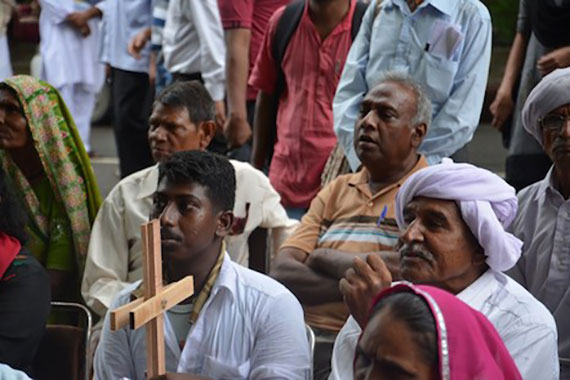
India’s Supreme Court has agreed to examine a petition calling for Dalit Christians to be afforded the same social benefits given to Dalit people from other religions and has informed the federal government about the matter.
The court was hearing a plea filed by the National Council of Dalit Christians (NCDC) seeking Scheduled Caste status for Dalit Christians.

Scheduled Caste is the official name given to lower castes that are now protected by the Indian government and offered special concessions such as civil service jobs and places in schools.

Christians are currently denied government benefits meant for the social welfare of poor people based on the argument that Christianity does follow the caste system.

The Supreme Court’s decision to review the petition was welcomed by Christian groups.

“It is a huge success for all of us as we have been longing for this day for decades. We all know that justice delayed is justice denied,” Father Vijay Kumar Nayak, secretary of the Indian Catholic bishops’ office for Dalits and lower classes told UCA News.

“Different governments have come and gone, all gave assurances but nothing happened but at least now the Supreme Court has agreed to listen to us and we welcome it wholeheartedly,” he said.

“Whatever the outcome of this step, the future of the Dalit Christians looks brighter and we are hopeful that something good comes of this,” Father Nayak said.

A bench comprising Chief Justice S.A. Bobde and justices B.R. Gavai and Surya Kant issued notice to the Ministry of Social Justice and Empowerment, National Commission for Scheduled Castes, National Commission for Minorities and Registrar General of India that it will be reviewing the petition.

“Miracle” Host sent to Rome for scientific study

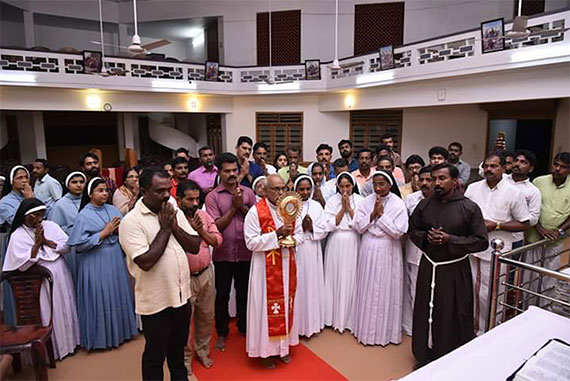
A Catholic parish in Kerala has sent its “miracle” Host to Rome for further studies as part of a process to declare it as a Eucharistic miracle. A face resembling that of Jesus had appeared on the host during Mass on November 15, 2013, at the Christ the King Church, Vilakkannur, a parish under the Syro-Malabar Archdiocese of Tellicherry.

Baby Joseph Payikatt, a former trustee of the parish, said the host was taken to the Syro-Malabar Church’s headquarters at Kakkanad, a suburb of Kochi, on January 10 and handed it over to Apostolic Nuncio Archbishop Giambattista Diquattro the next day.

The nuncio had come to St Thomas Mount in Kakkanad to attend the Syro-Malabar Church’s January 7-15 Synod.

The host has been venerated as a miracle at the Vilakkannur parish since September 21, 2018, when the archdiocese returned it after five years. Earlier, it was kept at the arch-bishop’s residence. Fr Vengakunnel with the relic “A four-member team led by our parish priest Father Mathew Vengakunnel carried the host to Kochi,” Payikatt told Matters India on January 13.

Xavier Ratna for Jesuit Felix Raj

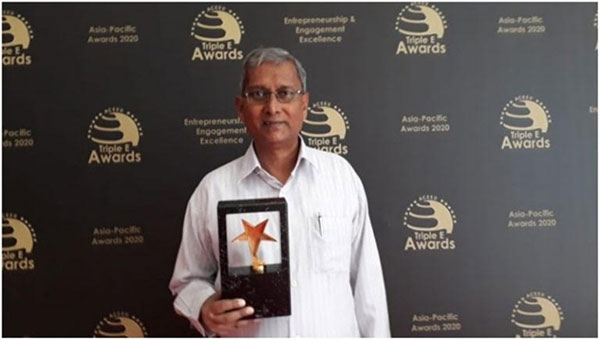
Jesuit Father Felix Raj, vice chancellor of St Xavier’s University, Kolkata, was honoured with Xavier Ratna Award by the Xavier Institute of Engineering, Mumbai on January 11 at its 11th Convocation. Father Raj was the Chief-Guest for the Convocation and delivered the Convocation Address. Jesuit Father John Rose, the Director of the Institute gave away the award on behalf of the institute and the Jesuit Province of Mumbai.

Indian Church to use new English lectionary from April

The Conference of Catholic Bishops of India (CCBI) will release the new English lectionary for the Church in India on February 16 and it will come into effect from Palm Sunday, on April 5.

The conference claims the new lectionary’s publication is a landmark in the Indian Church history and that it is a contribution of the Church in India to the Universal Church.

“It shows our biblical scholarship and liturgical competence,” says a CCBI press note from its deputy secretary general Father Stephen Alathara.

The CCBI, the national body of the Latin rite bishops in the country, had in 2015 directed its Bible and Liturgy Commissions to prepare the lectionary and they took “almost five years to complete this significant and important project.”

The lectionary presents has been prepared by experienced and prominent biblical scholars ensuring compatibility with Catholic teaching and textual accuracy from the original texts of the scriptures.

Pope shows up unannounced at funeral of lay woman and friend

Despite the ethereal air that has often surrounded popes over the centuries, Francis is famous for projecting ordinary humanity. Usually that everyman ethos expresses itself in warmth and approachability, though every now and then we also get a glimpse of grumpiness, as happened on New Year’s Eve when Francis slapped away an overly clingy woman in St. Peter’s Square. More rarely still, we also see this pope showing another classic human emotion – grief. Ironically enough, the most recent case in point also came on New Year’s Eve, although it didn’t generate anything like the media echo of the slapping incident. On Dec. 31, Pope Francis attended the funeral Mass of a friend, Italian laywoman Maria Grazia Mara, nicknamed “Nella,” who died at the age of 95 the day before.

Catholic leaders join New Yorkers in march against hate

Cardinal Timothy M. Dolan of New York and Bishop Nicholas DiMarzio of Brooklyn joined about 25,000 New Yorkers who took to the streets for a Jan. 5 “Solidarity March” in protest of anti-Semitism.

“When there’s an attack on you, there’s an attack on all of us,” Cardinal Dolan said in remarks at the rally in Brooklyn after participants had crossed the Brooklyn Bridge.

The march, which made its way from Lower Manhattan to Cadman Plaza in Downtown Brooklyn, brought together Jewish and non-Jewish residents alike from the New York area, along with a host of local leaders.

President of Asia’s bishops’ confederation calls for end of police brutality in Hong Kong

Asia’s leading cardinal was among the dozens of people to sign an open letter to the Hong Kong government to complain about “police brutality” over the Christmas period in the self-governing Chinese city. Major protests began in the former British colony in June, after the Hong Kong government attempted to push through legislation which would have allowed residents to be extradited to mainland China. Marches and demonstrations have continued regularly since then, with some drawing more than a million participants.

Row over Syro-Malabar Mass resurfaces

The question whether the celebrant should face the congregation (westward) or eastward during Mass, a bone of contention in the Syro-Malabar Church for several decades, is back in focus again. On the agenda of the Church Synod meeting at St Thomas Mount in Kochi, headquarters of the Church, from January 7 are possible changes to the liturgy and the direction the celebrant should take during Mass. Monsignor Varghese Njaliath, senior priest and an expert on liturgy, on January 2 made an appeal to the Synod not to ban the practice of priests celebrating Mass facing the congregation.