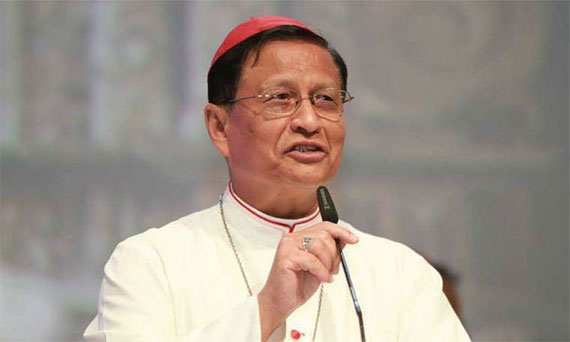
Cardinal Bo calls for ‘ecological reparation’ for indigenous peoples

A leading Asian cardinal says the world’s resources are at the mercy of a minuscule minority, and the “poor are doubly-conde-mned by an economy that favours the powerful and a carbon hegemony that destroys their liveli-hood.”

Myanmar Cardinal Charles Bo, the president of the Federation of Asian Bishops’ Conferences, was speaking at a March 19 event on the Amazon at Georgetown University.

The Amazon will be the topic of the Oct. 6-27 meeting of the Synod of Bishops in Rome.

During his lecture, the cardinal noted that Myanmar, also called Burma, is one of the poorest countries in the world.

“I have always worked with simple ethnic and indigenous communities. I come from a country where the Church is an ethnic, indigenous church,” Bo said. “We have watched in pain the destruction of the ethnic and indigenous way of life by the onslaught of market economy-oriented colonization. This is the norm elsewhere,” he said.


Indonesian nun dedicates life to making elderly people happy

Despite her advancing years and having to walk with the aid of a stick, she continues to help dozens of lonely elderly people from various religious backgrounds at a home she runs in Purwokerto, in Central Java.

Sister Indrawati of the Daughters of Mary and Joseph established the Panti Wreda Catur Nugraha home more than a decade ago to create some love and help elderly people abandoned by their families.

From just a few people, it now cares for 52 senior citizens from across Indonesia. Most were hardly able to look after themselves.

“The trauma of being rejected by their relatives is a heavy burden to carry through the last stages of their life,” Sister Indrawati said.

“All they need is love.”

She says it’s her mission to make them as happy as they can, even though to fulfill their daily needs, she has to knock on people’s doors for support.

“Other people have to help,” she said, saying she actively seeks donations and volunteers to come to the home to provide some of the residents some much-needed company.

Caring for people like them was a goal even before she became a nun, Sister Indrawati says. “Since joining my congregation in 1971, I have cared for marginalized people, particularly the elderly,” she said.

Prior to setting up the home, Sister Indrawati worked at several care homes run by the Soegijapranata Social Foundation, which was named after the first native-born Indonesian prelate, Jesuit Bishop Albert Soegijapranata.

This gave her invaluable experience in taking care of the elderly and knowing what makes them happy.

Two hundred families in Karachi flee after three young Christian women are accused of blasphemy out of revenge

A group of Christians was attacked in West Bengal by Hindu fanatics during a prayer meeting at the home of a Church member, Shibu Thomas speaking told AsiaNews.

Thomas is the founder of Persecution Relief, an organisation that defends Christians from persecution in India.

Rev Anand Hari, pastor of the Full Gospel Evangelical Church, who was leading the prayer, was severely beaten. He is now in hospital in serious condition.

The attack took place in Panch Gachia, a village in Paschim Bardhaman district, around 7.00 am (local time). “The attackers did not spare even women,” Thomas lamented. In fact, in addition to the pastor, “there were eight women and two teenagers.

“About 15-20 minutes after the meeting started, 20 people suddenly broke into the house and started hitting everyone present with fists, kicks and sticks. Then they fled, leaving the wounded on the ground.”

The leader of Persecution Relief explained that the incident attracted the attention of others, who took the reverend to a government hospital where he is still recovering.

The aggression against worshippers at prayer represents a serious example of religious intolerance, less than a month before the general election.

“In India, it has become difficult even to pray in private homes used as places of worship. Churches are attacked, destroyed, torched and vandalised,” Thomas said, this despite the fact that “The Indian Constitution recognises freedom of religion and freedom of assembly.”

“The faithful were only praying,” he explained. If people get together and pray for the sick, their country, their family and even politicians, they are not doing anything wrong.

National council of churches prays for new government

India’s largest forum for Protestant and Orthodox Churches on March 24 launched weeklong prayers for a new government. “Constitutionally, the Indian state cannot have any appeasement to any religion whether majority or minority. The contemporary tendency to polarize people in the name of religion, for political gain, has to be countered,” says a statement from the Policy Governess and Public Witness of the National Council of Churches in India (NCCI).

About 80% of the Indian population is Hindu. Muslims make up almost 15% and Christians are 2.3%.

The Indian Constitution upholds the country as a sovereign socialist secular democratic republic that does not discriminate people on the basis of religion, caste, language, gender or ethnicity. “Indian secularism is not the same as that which we see in the Western countries. Our secularism is neither antagonistic nor religiously charged. It is neutral to all religions but respects all religions and non-religious ideas,” the NCCI statement explains.

Brexit dominates Irish primate’s message for St Patrick’s Day

Brexit’son-going political and economic uncertainty was the focus of the St Patrick’s Day message of Archbishop Eamon Martin, the Primate of All Ireland. The United Kingdom’s impending departure from the United Kingdom is especially affecting the island of Ireland as it would place the EU border at Northern Ireland. Not only does this threaten to re-impose border checks between north and south, but it would even divide some Irish dioceses – including Martin’s Archdiocese of Armagh.

Survey measures US Catholics’ perceptions of the global persecution of Christians

According to a new poll, 46% of US Catholics say the global persecution of Christians is “very severe”—an increase of more than 16% compared to a year ago; and 58% of US Catholics say they are “very concerned” about the plight of their fellow faith ful—a figure up by more than 17% from February 2018. Yet, other global issues are cause of greater concern for US Catholics than the persecution of Christi-ans: they rank human trafficking, poverty and the refugee crisis as more urgent problems than the persecution of Christians.

The annual nationwide poll examining the views of US Catholics on the global persecution of Christians was conducted by McLaughlin & Associates on behalf of Aid to the Church in Need-USA. The survey aimed to measure:

The extent to which American Catholics are aware of the persecution of Christians around the world;

The countries and regions where they consider Christians to be most severely persecuted;

Specific measures and policies they want the US and other Western governments to pursue to help and protect persecuted Christians;

The extent to which they feel that the Pope, their bishops and their parishes are making the issue of the persecution of Christians a priority;

Catholic lay body concerns at polarization on eve of elections

The All India Catholic Union (AICU), Asia’s oldest Laity organization, has expressed deep concern at the communal polarization that is peaking on the eve of the general elections in the country in April and May, AICU president Lancy D’Cunha and spokes-man Dr John Dayal said in a statement here on March 24.

The AICU leadership said many communities including Muslims and Dalits (formerly untouchables) are victims of targeted violence. Of particular concern is the sudden and sustained violence against the Christian community in the Jaunpur district of Uttar Pradesh, ruled by the Bharatiya Janata Party Chief Minister Yogi Adityanath.

Christian leaders from Jaunpur gave a graphic account of the situation when they addressed the working committee of the AICU at Navsadhana, the noted Catholic mass media centre in Varanasi.

Uttar Pradesh had, in the brief period between September and December 2018, seen as many as 109 cases of violence against Christian pastors, small house churches, and women and men faithful at worship in small towns and villages. This was the highest in the country. More than 40 cases had taken place in Jaunpur alone. In the first months of 2019, the region recorded 15 more cases.

The AICU noted with concern the continuing targeted violence by hard core activists of the Sangh Parivar (right wing Hindu nationalists) in any parts of the country. In most cases, the police was either complicit, or stood by watching. The state impunity had further encouraged mobs taking the law in their own hands.

Caritas India’s Lenten campaign against malnutrition

“Nutrition: our right,” is the theme of the Lenten campaign of Caritas India for 2019. Caritas India, the charitable arm of the Catholic Church of India, has launched a Lenten campaign against hunger by creating an awareness among people regarding solidarity, food security, medical care and a dignified life for all citizens. The theme of the Lenten campaign 2019, launched “Nutrition: our right.” It aims at fighting the scourge of malnutrition, which it regards as a “painful and shameful for humanity.” According to Caritas India, the nation, with its resources, is be able to feed its inhabitants, yet it continues to be one home to one of the highest numbers of malnourished women and children in the world. According to official data, 38.4% of children in India suffer from rickets and 35.8% from underweight, both of which are liked to malnutrition.