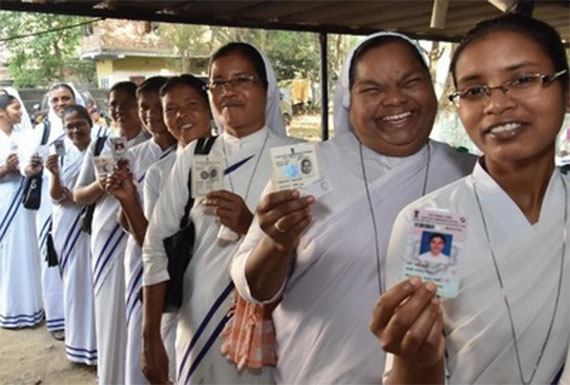
Polling goes ahead on Maundy Thursday

Voters in 13 Indian states will go to polling stations on Maundy Thursday in parliamentary elections after the High Court in Tamil Nadu state dismissed a petition from church officials to reschedule the date.

The federal Election Commission has scheduled polling in 97 constituencies of 13 states on April 18 when Christians observe Maundy Thursday this year, starting their Easter triduum leading to Good Friday and Easter. Church officials in Tamil Nadu, a southern state with 4.4 million Christians and more than any of the other 12 states, petitioned the state High Court to move polling to another day.

The High Court dismissed the petition but asked the state Election Commission to ensure that polling does not hinder Christians’ prayers.

“Since the polling is fixed on Maundy Thursday, it is expected that the Election Commission will take adequate steps to ensure that people are allowed to pray in churches situated adjacent to polling booths without any hindrance,” the court said in its March 22 verdict. The 13 states holding polls on Maundy Thursday are Assam, Bihar, Chhattisgarh, Jammu and Kashmir, Karnataka, Maharashtra, Manipur, Odisha, Tamil Nadu, Tripura, Uttar Pradesh, West Bengal and Puducherry.

Archbishop Antony Pappusamy of Madurai, president of the Tamil Nadu Bishops’ Council, had petitioned for rescheduling, arguing that hundreds of Catholic government servants with polling duties will miss prayers.

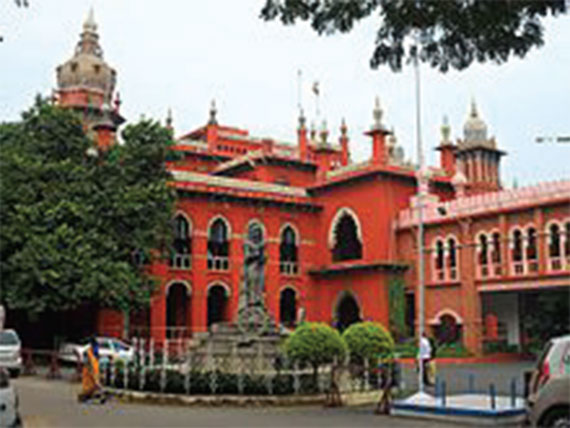
Salaries of nuns, priests in schools taxable: Madras HC

The Madras High Court has held that salaries and grants-in-aid to nuns and priests are liable to attract tax deducted at source.
“In our opinion, the provisions of Income-Tax law are dry, plain and simple, a political and a religious in character,” the court said in a recent order.

The bench, comprising Justices Vineet Kothari and C V Karthikeyan, gave the order on a writ appeal filed by the Union of India and the Income-Tax Department against the Society of Mary Immaculate and the State’s Directors of Treasuries and Accounts, School Education and Elementary Education.

The court also set aside, a previous 2016 ruling by a Single Judge of the Madras High Court on a writ petition by the Institute of the Franciscan Missionaries of Mary against the Union of India and others, which had allowed the writ petitions, and had said TDS was not applicable on salaries and other benefits given to nuns and priests working in teaching institutions.

Bishops mourn death of “Christians’ friend” Parrikar

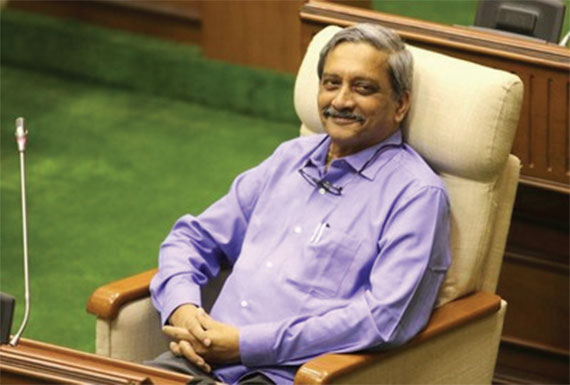
The Catholic Bishops’ Conference of India (CBCI) has expressed “profound sorrow” at the death of Manohar Parrikar, the Chief Minister of Goa and former federal Minister for Defence. Parrikar, 63 died from pancreatic cancer on March 17.

“We can truly say that Goa and India have lost a great leader and the Christian community has lost a sincere and honest friend,” said a condolence statement from the CBCI. The bishops saluted the “courage and determination” of the leader who till his last breath battled against his disease. Parrikar’s recent public appearances “manifested his daunting fortitude,” it said.

In late January despite his advanced disease, he opened the Mandovi bridge and a few days later participated in the Goa Assembly Session.
“We were happy that the Goa Chief Minister looked in high spirits not scared of his physical sufferings and undeterred by the tubes inserted inside his nasal cavity,” the statement said.

Church communicators urged to end silence, be bold

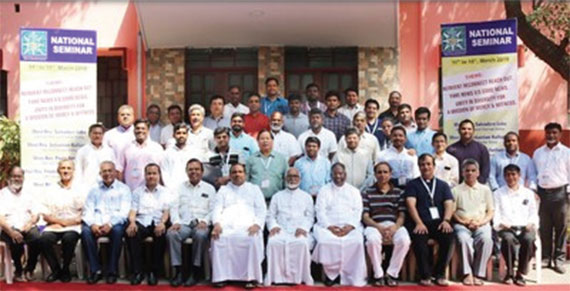
Indian Church’s top communicators were urged to boldly present Church’s perspective on issues without running away from uncomfortable realities.

Catholic Bishops’ Conference of India (CBCI) secretary general Bishop Theodore Mascarenhas and other experts suggested strategies for Church communicators to “become effective” at a March 11-15 national meeting.

Some 45 people, mostly regional directors of communication, from dioceses across India attended meeting organized by the CBCI office for Social Communications (CBCI-OSC) at Nav Sadhana Pastoral Centre in Varanasi.

Through examples, Bishop Mascarenhas illustrated how certain issues disappeared when communication on them have been “prompt and effective.”

He urged the Church communicators to speak up boldly and incisively on the issues, presenting the church’s perspective and being faithful to its teaching and values. He said Church’s silence only helps others to change the narrative. But the Church communicators must know “when to speak, and how much and what to say when they do,” the bishop said.

Religious nationalism, unemployment, top poll issues

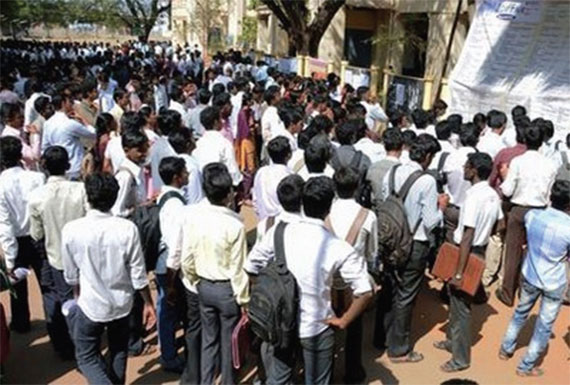
Rising unemployment and nationalism on religious lines are the two key issues bothering citizens ahead of the Lok Sabha elections, revealed a survey conducted by Lokniti-CSDS and the Azim Premji University.

“20% of those surveyed said unemployment was the biggest issue facing India, and 15% said the top government priority should be a remedy to joblessness,” said the survey titled “Politics and Society between Elections 2019.” The second and third issues cited were ‘development’ (15%) and ‘law, governance and corruption’ (13%).

60% of those interviewed for the survey said no minorities and migrants but influential people blocked progress. This sentiment was stronger among the youth. 61% of those below 35 years of age felt about elites blocking development.

51% of those above 35 years held the same view, said the report.

People also said it was easier to get admission in government schools than a water connection.

The report said though caste identities were prominent, these were over-shadowed by religious identities when it came to religious nationalism.

The survey found the Indian Army was the most trusted institution in the country with an effective trust of 88%, followed by courts (60%). Political parties were the least trusted as 55% people expressed their mistrust in them.

People in UP, Uttarakhand, Tamil Nadu, Delhi and Assam sought punishment for those who don’t say ‘Bharat Mata Ki Jai’ at public functions. But residents of Nagaland, J&K, Kerala, Mizoram, Tripura, Punjab and West Bengal disagreed.

Indian voters must ‘avoid terror of pseudo-nationalism’

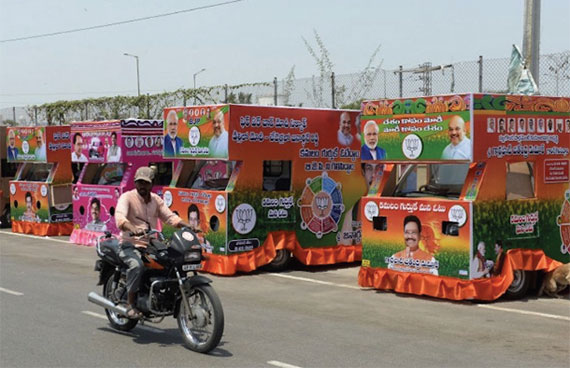
Ahead of the general elections in India in April, Church officials have issued pastoral guidelines asking Catholics to reject candidates who espouse certain ideologies and vote for guardians of secularism and democracy.

Cardinal Oswald Gracias, president of the Catholic Bishops’ Conference of India, joined other regional bishops in issuing a set of guidelines. The latest comes from the Kerala Catholic Bishops’ Council, a regional forum of bishops in southern India, favouring candidates who respect the country’s secular constitution and related institutions.

It is due to be read out in all Catholic parishes in Kerala on March 31. While it offers guidance and advice, it also stresses that the Church does not favour any specific political party or ideology.

The circular, printed in the local Malayalam language, entreats parishioners to support candidates who are committed “to the values of secularism and democracy” and who will work for the “integral development and unity of the nation.”

The message comes as Prime Minister Narendra Modi’s pro-Hindu Bharatiya Janata Party (BJP), is seeking a second term by placating Hindu voters and sensibilities.

Critics say the BJP leaders plan to amend India’s secular constitution to align it with Hindu nationalism and create a Hindu nation if voted into power, even though the party fielded two former Christian pastors for the state elections in November.

Odisha’s Marian shrine celebrates silver Jubilee

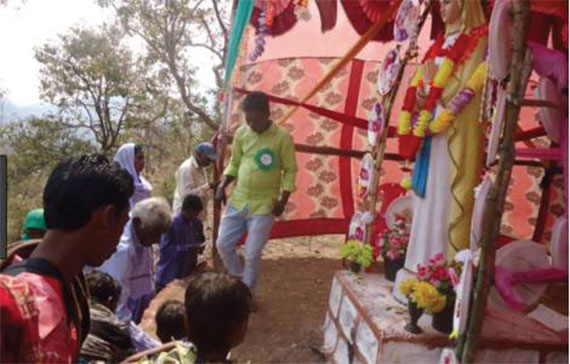
More than 45,000 people have attended the jubilee of a Marian apparition in Odisha, eastern India.

“Where there is Mother Mary there is Jesus and where there is Jesus there is satisfaction and fulfilment. Mother Mary is not only Mother of God but Mother of everyone who seeks her constant intercession,” said Arch-bishop John Barwa of Cuttack-Bhubaneswar, the main celebrant for the 25 years of spiritual journey of persecuted Christians.

Catholic Church is against forced conversions, says Bishop Mascarenhas

The Catholic Church “is against all conversions done by force or deception. At the same time, it defends the right of everyone to profess and spread their faith,” said Mgr Theodore Mascarenhas, secretary general of the Catholic Bishops’ Conference of India (CBCI).

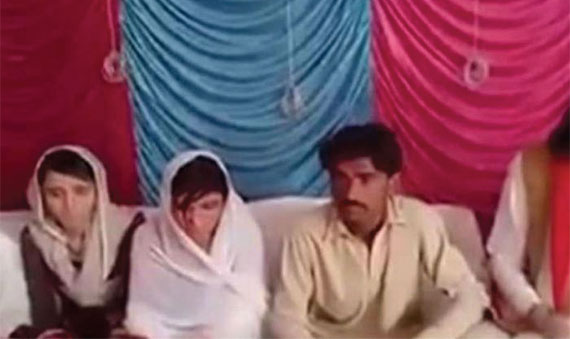
The prelate’s statement comes in the wake of the alleged abduction of two Hindu girls in the Pakistani province of Sindh, who were later forced to convert to Islam and marry two Muslim men. The issue has revived India-Pakistan tensions.

For Archbishop Mascarenhasm “freedom of religion is sacred.” The incident involving the two girls has widened the rift between the two neighbours, already defined by religious differences – Hindu India vs Muslim Pakistan – which was the basis of the violent partition of the British Raj in 1947.

Agnivesh asks pope to help nuns in rape case

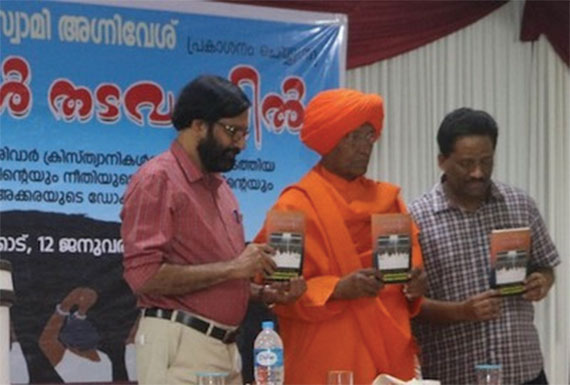
Prominent Indian social activist Swami Agnivesh has sought the intervention of Pope Francis to help five nuns who are facing a church backlash after holding a public protest demanding action against a bishop accused of raping a nun.

Agnivesh, who on Jan. 23 released his detailed letter to the Pope, told ucanews.com that the church’s moves against the nuns were “in effect a punishment given to them for speaking the truth.”

The leader of the Arya Samaj Hindu sect was referring to a case involving Missionaries of Jesus nuns in the southern state of Kerala.

Four nuns, all Kerala natives, came from different parts of India to support their former superior, who filed a police complaint in June 2018 accusing Bishop Franco Mulakkal of Jalandhar of raping her multiple times between 2014 to 2016. In September, the four joined another nuns from the congregation’s Kerala convent and held a two-week street protest that ended on Sept. 22, a day after the bishop was arrested. They have been staying in Kerala ever since.

The congregation’s current superior recently asked the four nuns to return to their respective convents. The nuns alleged it was a tactic to break their unity and weaken the case against the 54-year-old bishop. The other nun, Sister Neena Rose, has been asked to report to the congregation’s headquarters in Jalandhar and meet superior general Regina Kandamthottu on Jan. 26.

Agnivesh, a 79-year-old Hindu scholar known for his stand against India’s governing pro-Hindu Bharatiya Janata Party and Prime Minister Narendra Modi, said the nuns were being harassed for their stand for justice.

Expressing confidence in Pope Francis’ “robust sense of justice,” he said he wanted the Pope’s intervention to end the harassment.
His letter said it was “indeed shocking that, while the concerned diocese and its religious orders go easy on the alleged rapist, it is targeting those who stood and struggled for justice for the victim.”

Pope changes canon law for religious who desert community

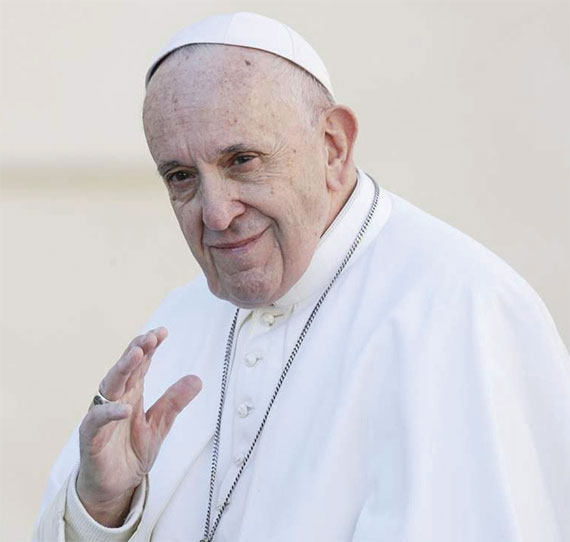
Pope Francis has amended Canon Law to create a new mechanism for dismissing a religious who has deserted their community.

Under the new law, promulgated by the Pope in an apostolic letter issued “motu-proprio,” superiors can declare a member dismissed ipso facto if they have been illicitly absent from the community for more than a year and cannot be located.

“Community life is an essential element of religious life,” Francis stated in the letter, titled Communis vita (“Common life”) and issued on March 26. He cited canon 665 of the Code of Canon Law, which provides that “religious must live in their own religious house observing common life and cannot be absent without permission of their superior.”

Under the current provisions of canon 694, which the motuproprio reforms, the ipso facto dismissal of a member of a religious community can be declared for two reasons: that he or she has “defected notoriously from the Catholic faith,” or “has contracted marriage or attempted it, even only civilly.”

With the change, Pope Francis added the ground of desertion of the community.

Now, if a member of a religious community is “absent from the religious house illegitimately, in accordance with canon 665 § 2, for twelve months without interruption” they too can be declared dismissed from the community, provided that their superiors are otherwise unable to locate or contact them.

Depending on the constitution of the religious order, decrees of dismissal must be confirmed by the Holy See or by the local bishop.