BIHAR WOMEN RISE UP FOR INDIAN DAUGHTERS’ SAFETY

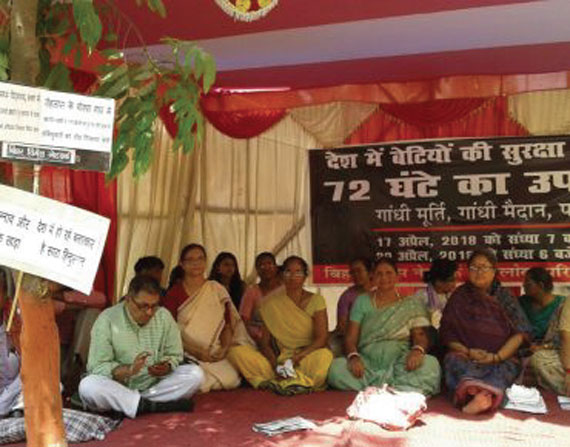
Catholic religious women joined more than 25,000 people of Bihar to undertake 72 hours of fast to demand security for the daughters of India.

Nine women and men fasted continuously during April 18- 20 while others joined them in relay fast, Rupesh, (goes by one name) of the Bihar forum of ‘Right to Food,’ one of the organizers of the program, told Matters India.

The program was held at Gandhi Maidan in Patna, a historic ground near the Ganges River in Patna, the state capital.

Politicians from different parties and the administration also attended the program, which, Rupesh claimed, has helped awaken the people of Bihar in many ways. “Our hope is that the government also wakes up to bring law and order in our nation,” he added.

Rupesh said the Bihar Women’s Network and the members of ‘Right to Food’ forum are organizing protests at various parts of Bihar dema- nding accountability from the government machinery and the people’s elected representative.

Neelu Devi, convener of Bihar Women Network, another NGO, termed as irony that the government on one hand coins slogans such as ‘save daughters, teach daughters,’ while on the other protects the perpetrators of crime against the same daughters.”

MALAYATTOOR FOLLOWS GREEN PROTOCOL, CUTS DOWN PLASTIC

In a classic example of how a joint effort can usher in change, the incessant efforts of a small group of people has ensured that the recently concluded Malayattoor pilgrimage followed the green protocol. This effort, in association with the district Suchithwa Mission and the Forest Department, could see the drastic reduction in plastic waste.

A team of four friends, Shine Varghese, Gopu Kesavan, Biju P and Dr Manoj, a researcher in waste management, who persuaded state authorities to implement the green protocol at the National Games in 2015, are behind this step as well.

In 2015 itself, they met the priests of the Syro Malabar Church, to which the pilgrimage is associated.

“In the initial period, when we first met them in 2015, they were not convinced at all. In 2017, we presented a letter from K Vasuki, the former director of the State Suchitwa Mission, who was instrumental in implementing the green protocol at the National Games. The priests then began supporting the idea. What more, the church spent Rs 30 lakh to make drinking water available on top of the hill, so that plastic bottles can be avoided,” Shine Varghese says.

THOUSANDS MOURN LOSS OF INDIAN MISSIONARY ABP

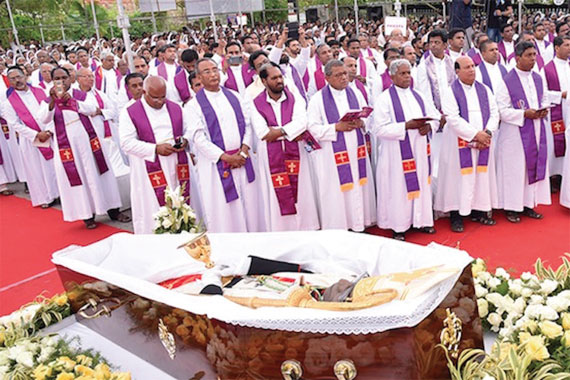
Thousands of people attended the April 23 funeral service of an arch- bishop highly regarded for his work among indigenous communities in central India.

At least 5,000 people attended the funeral for Archbishop Abraham Viruthakulangara of Nagpur at Francis de Sales Cathedral in the city of Nagpur in western Maharashtra State on April 23. Abp Viruthakulangara died of a cardiac arrest while asleep on April 19. He was in New Delhi at the time to attend a meeting of regional bishops. He was 74 years of age.

ABOLISH HATE-MONGERING ORGANIZATIONS: GOA CHURCH

In the backdrop of Kathua and Unnao rape cases, the Goa Church sees a growing trend in India to justify crimes committed against some sections of society by using the garb of nationalism. The trend has generated fear and insecurity among the citizens, it adds.

The Council for Social Justice and Peace (CSJP), the social arm of the Goa archdiocese, appealed to Prime Minister Narendra Modi to eliminate the “growing ideology of hate” and “subjugation of women” in the country.

The council expressed concern over the recent cases of rape of minor girls in Kathua (Jammu and Kashmir) and Unnao (Uttar Pradesh) and what it called killings of fellow citizens in the name of community honour, religion and nationalism.

The actual response for these incidents should be to abolish organisations that advocate the “ideology of hate” and “subjugation of women,” CSJP Executive Secretary Fr Savio Fernandes said in a statement. The council is deeply agonized over the horrendous rapes of an eight-year-old girl in Kathua, a teenager in Unnao and other such cases reported over the last few days in the country, he said.

TAMIL CHRISTIANS PROTEST AGAINST VIOLENCE, HARASSMENT

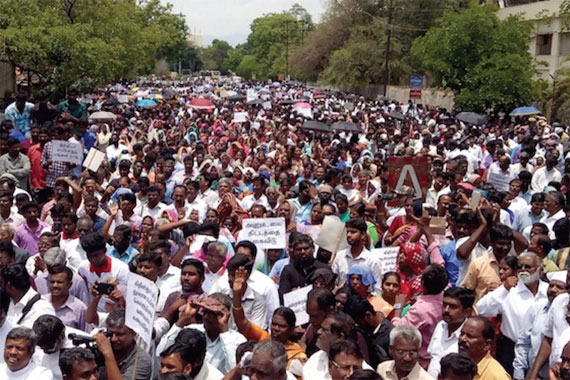
Thousands of Christians took to the streets during protests across the southern Indian State of Tamil Nadu on April 17 to demand government action to stop what they call increasing harass- ment and violence against Christ- ians. Some 20,000 Christians from various denominations filled roads in at least 16 cities and towns shouting slogans against govern- ment inaction to check anti- Christian activities allegedly carried out by upper-caste Hindu groups. The Synod of Pentecostal Churches in Tamil Nadu organi- zed the protest as Christians have been subjected to atleast 15 cases of violence in the first three months of this year.

Incidents include the myster- ious death of a pastor who was found dead a week after he complained to police about harassment from hard-line Hindus. “We are facing lot of persecution in our state,” Synod general secretary K.B. Edison told ucanews.com.

“The peaceful protest was to get the attention of the state and federal government about the serious need for security and protection of the Christian minority.

BISHOP DEMOLISHES CONVERSION ‘MYTH’ OF KERALA

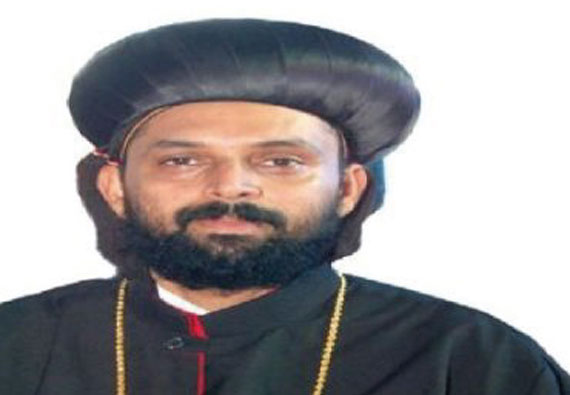
The Bishop of Niranam diocese, historically one of the oldest dioceses of the Jacobite Syrian Christian Church in Kerala, has criticized the upper caste tendencies among believers fuelled by a “mythical” belief that St Thomas converted Brahmins to Christianity in Kerala. It is also widely believed that St Thomas, one of the 12 apostles of Christ, had converted members of top Brahmin families in Kerala to Christianity. Though the Abrahamic faith is devoid of caste hierarchies, Christian families often hold get-togethers to celebrate their lineage and put out books proclaiming their Brahmin origin.

The Bishop, Geevarghese Mor Coorilos, however, in a Facebook post announced that he would not attend any such get-togethers, dubbing them as “programs to assert their artificially created upper caste identity and lineage.”

“They say their ancestors were Brahmins converted by St Thomas. They even put out their family history in books proclaiming such false notions. These baseless, savarna caste oriented and reactionary myths have to be busted,” read his statement in Malayalam, adding, “I did attend such events due to my personal intimacy with them. But, I regret it. I can’t (do it) any more.”

Syrian Christians are divided mainly into Syrian Catholic, Jacobite, Orthodox, Marthoma churches depending upon whether they owe their allegiance to the Pope in Rome, the Patriarch in Antioch, Catholicos in Kerala’s Kottayam or Metropolita in Thiruvalla. Coorilos, who belongs to Jacobite Church, has mercilessly swung an axe at the root of the age-old belief that is pervasive across all the four sects – that their ancestors are Namboodiris who were converted to Christianity by St Thomas.

It also questions the existence of churches like Malayatoor that is famously believed to be the meditative halt of St Thomas during his Kerala leg of his sojourn. Brahmins’ conversion to Christianity under St Thomas had been a point of dispute for long. Historians such as M.G.S.Narayanan had earlier questioned the claim.

Pius Melekandathil, professor at the Centre for Historical Studies, Jawaharlal Nehru University (JNU), who is an expert on maritime history and church history, admitted that it is a matter of dispute however saying that the probability factor has to be taken into consideration.

Fr Paul Thelakat, former Syro Malabar Church spokes- person, echoed Coorilose’s statement. “In India we have baned that irrespective of our religion we have been Manu sleeping within our consciousness. Everyone wants to establish one’s own upper caste glory. It is found in the ancient Christians of Kerala e.g certain families claiming to have been baptised from Brahmin families by St Thomas himself. St Thomas is supposed to have come to Kerala, it would be in the first century. Brahmins came to south India only in the 8th century. I am sorry to say upper caste mentality can be found also in Marxists in Kerala. Even though Marxism has a universal humanistic ideology, we find the upper caste surname kept, like Nampoodiripad, Menon, Pillai, Nair etc,” he said.

ODISHA’S EASTER DAY INCIDENTS: PROBE TEAM ALLEGES CONSPIRACY

A civil society fact-finding team that investigated attacks on churches and a Hindu temple in Odisha on Easter Sunday sees evidence of conspiracy to divide Christian and Hindu tribal communities in the eastern Indian state. “The attacks were highly planned and purposefully executed. It was well planned to create fear and tension among Christians and others,” the five-member team told a press conference on April 23 in Bhubaneswar, the state capital. The team released its findings on the incidents after visiting Rajgangpur, Kutra and Kuarmunda block of Sundargarh district on April 11. The team investigated the vandalism of church and temple and discussed the incidents with local people.

SEXUAL CRIMES AGAINST MINORS IN INDIA UP 500%: CRY

Crimes against minors have soared 500% over the past 10 years in India, says a new analysis by Child Rights and You (CRY). CRY has done a cumulative analysis which revealed a rise of sexual crimes against children to 106,958 in 2016 as against 18,967 in 2006. “More than 50% of crimes against children have been recorded in just five states: Uttar Pradesh, Maharashtra, Madhya Pradesh, Delhi and West Bengal,” said a CRY statement. According to the NGO, while Uttar Pradesh topped the list with 15% of recorded crimes against children, Maharashtra and Madhya Pradesh came close at 14 and 13% respectively. “It is also a matter of grave concern that in 11 out of 36 states and union territories (UTs), more than 50% of the offences against children are sexual offences and in 25 out of 36 states and UTs more than one-third of the crimes against children are sex crimes,” it added. The National Crime Records Bureau data of 2016 suggests that crimes against children in India have increased by 14% from 2015.

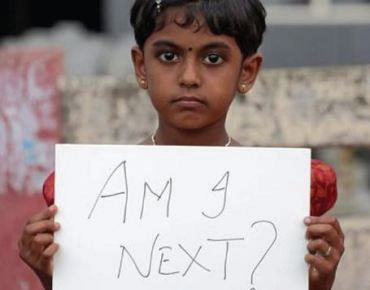
DEATH PENALTY ‘WON’T STOP’ INDIA’S CHILD RAPE CRISIS

Church leaders doubt the effectiveness of India introducing the death penalty for child rape following a nationwide call for stringent laws to end the menace.

Indian President Ram Nath Kovind on April 22 promulgated an ordinance authorizing capital punishment for those convicted of raping girls under the age of 12, a day after the cabinet under Prime Minister Narendra Modi cleared the proposal.

The government rushed through the emergency law, which needs to be ratified in the next sitting of parliament, amid outrage over increasing cases of rape and murder of children.

“The ordinance appeared to be a knee-jerk reaction to console public anger,” said Catholic nun and social worker Sister Lizy Thomas in Madhya Pradesh State. She doubted if the death penalty or longer jail terms could help curb rapes.

India reported 10 more cases of child rape on the day the law was promulgated, according to media reports.

The most discussed case has been the gang rape and murder of an 8-year-old girl in the Hindu- dominated Jammu area that was allegedly committed to drive her Muslim community away from the area.

THREE-FOURTHS OF RUSSIANS DO NOT OBSERVE THE GREAT LENT, BUT PLAN TO CELEBRATE EASTER

Most of Russians (75% in general and 72% of those who call themselves Orthodox believers) did not have any special diet during the Great Lent, which this year ends on April 30, the Lavada-Centre told Interfax. During the poll held on April 22-25 among 1600 people in 137 cities and towns of Russia it cleared out that eight per cent of Russians in general and nine per cent of Orthodox believers were going to observe fast during the last week before Easter. Another 14% of respondents (16% of Orthodox believers) observe fast partially (for example tried not to drink alcohol and restrict themselves in food). Only one per cent of Russians (one per cent of Orthodox believers) strictly observe fast.

Majority of Russians are going to celebrate Easter. 66% of respondents will decorate Easter eggs (74% of Orthodox believers), buy or bake Easter cakes – 66% and 64% correspondently, some will go to see their friends or will welcome guests at their homes – 50% and 55% correspondently, some respondents are going to visit cemeteries.