
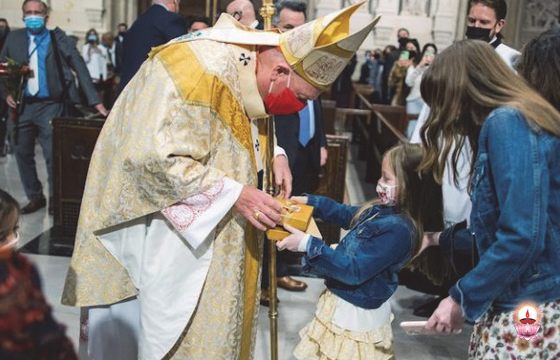
The COVID-19 pandemic took a toll on participation in religious services just as it did on workplaces, but a new survey indicates strong emotional resilience from those who consider their faith vital to their existence.
That was part of the findings of a survey conducted late last year of 1,600 adults, mostly from Washington, Maryland and Virginia. Nearly 40% of the respondents identified as Catholic.
Survey results were discussed during a May 21 webinar hosted by Catholic University’s sociology department and the Institute of Human Ecology.
Respondents who reported a decline in religiosity since the pandemic had more than twice the odds of feeling isolated and lonely than respondents who did not report such a decline.
“Religiosity seems to be a buffer against negative stresses,” said Brandon Vaidyanathan, chair of the sociology department and an associate professor of sociology.
Fewer than 20% of the sample said their mental health had worsened, he added.
The one area where people report a deterioration in their lives was in feelings of isolation, but only “a very small number,” Vaidyanathan said, reported their “sense of purpose in life having been weakened.”
Vaidyanathan, who also is a fellow of the Institute of Human Ecology, and his colleagues conducted the Mental Health in Congregations Study. It was funded with grants from the John Templeton Foundation and the H.E. Butt Foundation.
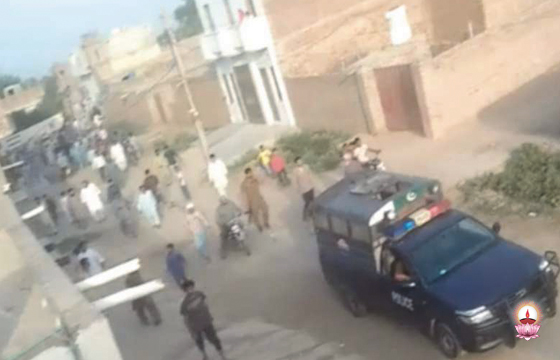
Christian Village Attacked in Pakistan
Around 200 Muslims attack-ed a Christian village in the Okara District of Pakistan.
The incident was incited May 14 when a Muslim motorcyclist, Muhammad Khalil, complained that youths cleaning a church road threw dust and water at him. At that moment, a verbal dispute took place. A few hours later, Khalil brought some friends, and they began to hit the youths with firearms and hockey sticks.
The next day, motorcyclist Mohammedan Khalil ran a raid with 200 Muslims against the Christian village. They beat Christian men and women with iron bars, overran houses, destroyed furniture, stole property and assaulted young girls.
Police were called to investigate crimes against 66 people, but 20 of the participants could not be identified.
Police still have not arrested any attackers. Based in Lahore, Kamran Chaudhary, a journalist for UCA News, told Church Militant police still have not arrested any attackers.
Day labourer Mangta Masih lost his thumb when a mob attacked his house. The 45-year-old follower of Christ.
We hid our women inside while they tried to break in. One of them grabbed me from behind, and another struck with a sickle blade. I tried to prevent the blow with my right hand. I fell down, and they kept beating us with batons. They were armed with glass bottles, stones, axes, batons and bricks. Others used stairs to climb to our roofs and started breaking our furniture. We pleaded to spare the women, but the attack continued for half an hour.
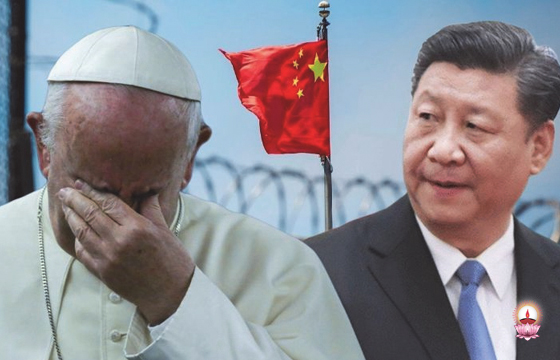
China Snubs Pope, Enforces New Clergy Laws
In a further blow to Pope Francis’ secret Sino-Vatican concordat, China is enforcing new draconian laws compelling clergy to “practice the core values of communism” and pro-mote the “sinicization of religion” — under threat of criminal sanctions.
The Measures for the Administration of Religious Clergy, issued by the Communist Party of China’s (CCP) State Bureau of Religious Affairs (SBRA), came into force on May 1 — creating an “Orwellian system of surveillance” and tightening the noose on “the already strict control on all clergy.”
The 52 articles under the measures cover the five approved religions of Buddhism, Catholicism, Protestantism, Islam and Taoism. However, the Catholic Church has been singled out for special sanctions on the issue of episcopal appointments.
Article 16 stipulates that “Catholic bishops shall be approved and ordained by the Bishops’ Conference of the Catholic Church in China” (BCCCC) with the Chinese Patriotic Catholic Association (CPCA), and BCCCC shall file a record of the ordination within 20 days to the SBRA.
Former Taiwanese bishop Andrew Tsien explains the objectives of the CPCA are “to substitute it for the true Roman Catholic Church” and, in the long term “to eliminate religion in order to achieve a pure materialistic and autocra-tic society.” The BCCC is the CCP-aligned episcopal organization.
The measure on Catholic bishops also requires “a copy of the bishop’s household registration booklet and a copy of the resident ID card” and “a statement on the democratic election of the bishop issued by the Catholic organization of the province, autonomous region, or municipality directly under the central government.”
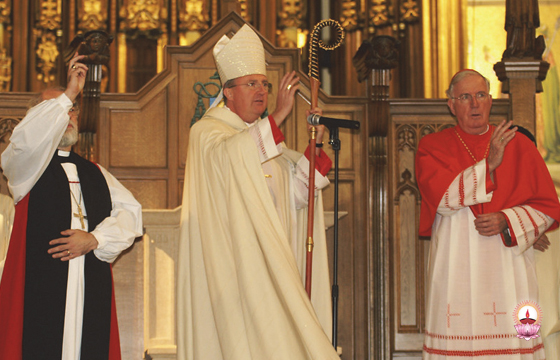
Archbishop Roche to head liturgy congregation
Pope Francis has appointed Archbishop Arthur Roche to lead the Holy See’s department for liturgy, making him the top-ranking English priest in the Curia. His appointment represents an overhaul of the office which oversees the practice of worship across the global Church.
The former Bishop of Leeds is to be the Prefect of the Congregation for Divine Worship and the Discipline of the Sacraments, a role he takes up after spending almost a decade as secretary, the number two official, at the congregation.
Along with Archbishop Roche, the Pope announced a revamped leadership team of trained liturgists at the congregation, which is tasked with furthering the implementation of the renewal of the liturgy as set out the 1962-65 Second Vatican Council.
Francis has chosen Bishop Vittorio Viola, 55, a Franciscan friar and liturgy specialist as secretary of the congregation, and Msgr Aurelio García Macías, a Spanish priest-official at the department, to be under-secretary. Bishop Viola has taught liturgy at the Benedictine-run Pontifical Liturgical Institute of Sant’Anselmo in Rome, and Msgr Garcia, who will soon be ordained a bishop, has a doctorate in liturgy from the same institute.
Archbishop Roche’s appointment makes him the highest-ranking English priest in the Roman Curia and is likely to see him named a cardinal in any forthcoming consistory. Archbishop Paul Gallagher, the Holy See’s foreign minister, is the other high-ranking English priest in the Vatican, however, Arch-bishop Roche will be the only one heading a dicastery.
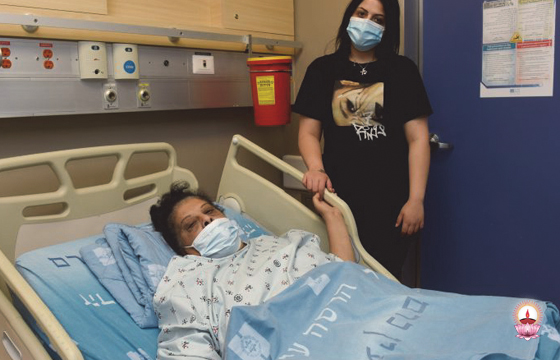
Catholic Palestinian gets kidney transplant from slain Jewish Israeli
Arab Catholic Randa Aweis, 58, recovers from a kidney transplant with her daughter Niveen, 26, in Hadassah Medical Centre in Jerusalem, May 21, 2021. Aweis received a donor kidney from an Israeli Jew, Yigal Yehoshua, 56, who died after being hit with stones during riots in Lod, Israel.
For nine years, Randa Aweis battled kidney disease, urgently in need of a transplant.
In mid-May, a donor was found for the 58-year-old mother of six, a Catholic Palestinian who lives in Jerusalem.
The circumstances were unusually painful because the donor — Yigal Yehoshua — a 56-year-old Jewish Israeli man from the mixed city of Lod who worked for tolerance and co-existence, was stoned to death by an Arab mob during violence by both Jews and Arabs in the city in mid-May. Arab and Jewish gangs rioted in mixed cities throughout Israel following the May 10 outbreak of violence between Israel Hamas May 10.
“Yigal will go straight to heaven, to a better place, and he will always be with me,” Aweis said from her hospital bed at Hadassah Medical Center, where the transplant was performed by Dr. Abed Khalaileh, director of Hadassah’s Kidney Transplan-tation Service, who is Muslim. “Here we must all, Christians, Muslims and Jews, strive for peace. I don’t distinguish bet-ween Christian, Muslim or Jew — we are all human beings.”
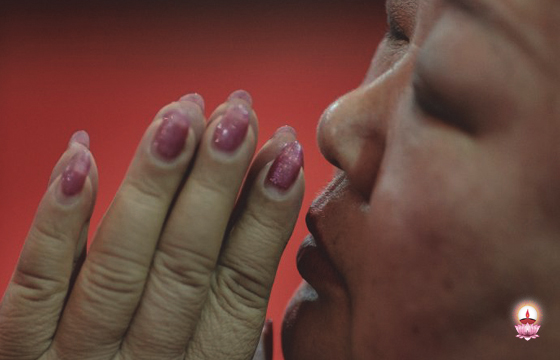
Clergy arrested as week of prayer for China begins
Days before the week of prayer for Catholics in China began on May 23 and seminarians in the country were arrested for holding Sunday, several services without the permission of the country’s Communist authorities.
In 2007, then-Pope Benedict XVI published a lengthy letter to Catholics in China in which he designated May 24, the feast of Our Lady Help of Christians, as an annual global day of prayer for the Catholic Church in China.
Earlier this year, Cardinal Charles Bo of Yangon, Myanmar, President of the Federation of Asian Bishops’ Conferences (FABC) asked that the entire week of May 23-30 be observed as a time of prayer for China, saying “We should ask Our Lady of Sheshan to protect all humanity and therefore the dignity of each and every person in China.”
“It is right that we should pray not only for the church but for all persons in the People’s Republic of China,” he said, voicing hope that China “continues to rise as a global power” and becomes “a force for good and a protector of the rights of the most vulnerable and marginalized in the world.”
Pope Francis in his May 23 Regina Coeli address gave Chinese Catholics a shout-out, congratulating them for the feast of Our Lady Help of Christians, who he said “is invoked assiduously” by Chinese Catholic families.

More Protestant churches shut as members leave: study
With fewer than 50% of Americans holding formal memberships in churches in 80 years, more Protestant church-es are closing than opening nationwide, and further decline appears “inevitable,” new data show.
Estimates made by the Nashville-based Lifeway Research, show that in 2019, well before many churches were forced to close in 2020 due to the coronavirus pandemic, approximately 3,000 Protestant churches were started in the US, but 4,500 Protestant churches closed. The findings came from an analysis of congregation data collected from 34 denominations and groups representing some 60% of Protestant churches in the U.S.
A previous analysis done in 2014 showed a net gain in churches that year when an estimated 4,000 Protestant churches were planted and 3,700 closed.
Scott McConnell, executive director of Lifeway Research, suggested in a statement that one reason for the decline in church plants is because denominations were more focused on keeping existing churches afloat.
“Over the last decade, most denominations have increased the attention they are giving to revive existing congregations that are struggling,” he said. “This has been more than a fad. This has been a response to a real, growing need to revitalize unhealthy congregations.” Earlier this year, a Gallup analysis showed that in 1937, when they first measured formal membership in houses of worship, some 70% of Americans had formal church membership and that measure remained steady for the next 60 years until it began a steady decline in 1998. In 2020, formal membership in houses of worship stood at 49%.
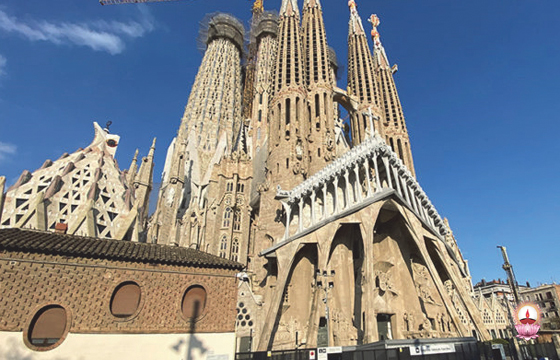
Key Spanish archdiocese to combine parishes amid falling numbers
The Barcelona Archdiocese will combine most parishes into larger pastoral communities, amid falling church attendance and secularization. A statement on the archdiocesan website said most Spanish dioceses were facing the same process. It said three to six parishes would be grouped together, resulting in 48 pastoral communities.
“The intention of an eventual diocesan reorganization is better distribution of pastoral resources, to obtain maximum pastoral efficiency and adequate support for the resulting pastoral units,” said the May 18 statement. “The aim is to reinforce common work and synodality among priests, laity, religious and deacons, when it is more difficult today for parishes to offer a full range of services.”
News of the reorganization comes amid continuing disputes over plans by the Spanish government to make the Catholic Church — whose members make up 61 percent of Spain’s 47 million inhabitants — relinquish what Spain says are improperly acquired assets.
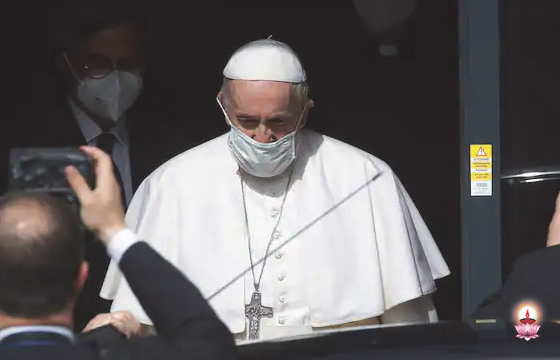
Pope moves youth seminary out of Vatican amid abuse trial
Pope Francis has decided to move a youth seminary outside Vatican City, taking action before the Vatican’s criminal tribunal renders a verdict in a sex abuse trial involving a former seminarian and an ex-rector. The Vatican made no mention of the ongoing trial in its announcement that the St Pius X pre-seminary would relocate somewhere in Rome starting in September. The facility serves as a residence for altar boys ages 12-18 who serve at papal Masses in St Peter’s Basilica.
Pakistani Christians protest over poisoning case
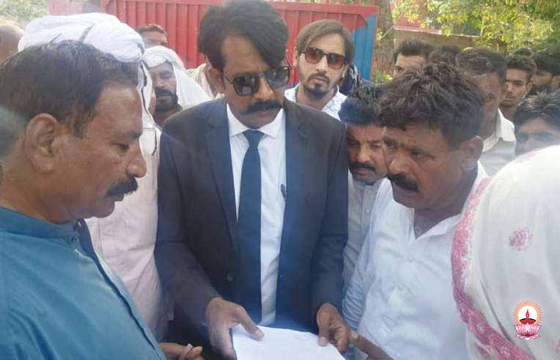
More than 300 mourners protested for several hours alongside the body of a Christian laborer allegedly poisoned by Muslims as officials urged them to bury their dead. “O Lord we are helpless” and “Injustice with Christians” stated placards as villagers from Tariqabad blocked a major road near Gojra city of Pakistan’s Punjab province on May 24 demanding registration of a police case for the killing of 32-year-old Arif Masih, who was kidnapped on May 23.
“Two men from Gujjar community raided our house and forcefully took him on a motorcycle. About an hour later, they threw him in the market at our front door. He was semi-conscious, hospitalized and died the same night,” said Rizwan Masih, his brother, in a police first information report filed following the three-hour protest.
“Last week the accused physically harassed our sister. My brother had been receiving death threats since we reported the incident at the police station. He was being forced for a truce.”
Tariqabad, a Muslim-majority village, is home to 45 Christian families. Minorities Alliance Pakistan (MAP) is providing legal aid to the dead man’s family.
“Arif Masih was murdered for demanding justice. The panchayat [local village assembly] scolded the Christian family for filing the case and threatened them with a social boycott for pursuing it. The influential accused easily attained pre-arrest bail,” MAP chairman Akmal Bhatti told.
“We condemn the murder reported earlier as a suicide. The local police were reluctant to record a report. Our people are tired of protesting with dead bodies. They were forced to protest under the scorching sun irrespective of the Covid pandemic.”
Human rights groups often complain of a biased criminal justice system in Pakistan.