
A Catholic nun was arrested in the southern Indian state of Tamil Nadu after a 17-year-old girl died by suicide.
The girl took poison January 9 at her hostel at Michaelpatti in Thanjavur district, and died 10 days later.
Sister Sahaya Mary, the 62-year-old hostel warden, was arrested under the Juvenile Act apart from charges of abetting suicide. The place is near Poondi Madha shrine that comes under the diocese of Kumbakonam.
A report in ndtv.com says the girl took poison alleging abuse by her hostel warden and an attempt to convert her family to Christianity.
“In an unverified video that has surfaced after her death, the girl says she may have been harassed and abused because her family refused to convert to Christianity,” the report says.
The ndtv.com report says the news organization could not independently verify the video that surfaced after the girl’s death. Jesuit Father Arockiasamy Santhanam, spokesperson for the National Lawyers Forum of Religious and Priests, says the First Information Report does not mention conversion. “It is the cook up story by the Hindutva elements,” he told on January 21.
According to him, the police had gone to the hospital to collect the girl’s statement.
The priest also explained that the girl had lost her mother eight years ago and her father married another woman.
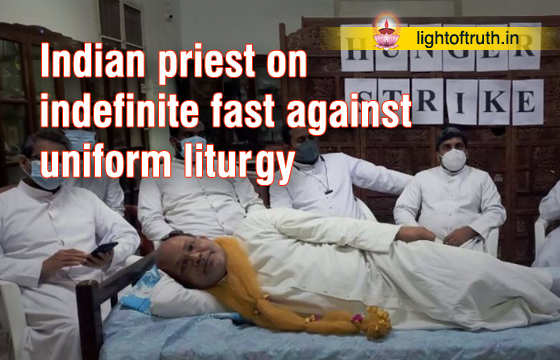
Indian priest on indefinite fast against uniform liturgy
A Catholic priest in India has launched an indefinite hunger strike against his Eastern-rite Church’s demand that all priests stop celebra-ting Mass facing the congregation in order to have uniformity in the liturgy. Father Babu Joseph Kalathil of Ernakulam-Angamaly archdiocese started his fast in the arch-bishop’s house on Jan. 12. He said the synod’s decision meant priests turning to the altar during Eucharistic prayer, which was not acceptable to him and his supporters. Fr Kalathil represented the priests of the archdiocese who pledge their full support to him. He followed by Fr Tom Mullanchira and two laymen Prakash P. John and N.O. Thomas continued the fast until Abp Kariyil CMI gave word that Mass facing the people will be followed in the archdiocese. Priests have accused Card. Alencherry and the bishops who support him of causing a rift between priests and the laity by insisting on a uniform liturgy. “If the synod continues with its adamant stand, the archdiocese with more than 500,000 followers will be in turmoil and the future of the church will also be at stake,” he said.
Nun rape case verdict evokes sympathy, support for victim
Support and sympathy for a Catholic nun continue to pour in even a week after a court in Kerala dismissed her case against a bishop.
Additional District and Sessions Court Judge G. Gopakumar on January 14 acquitted Bishop Franco Mulakkal of Jalandhar in the historic nun rape case, saying the prosecution had failed to prove the charges against him.
The nun, a former superior general of the Missionaries of Jesus, a Jalandhar diocesan congregation, had in June 2018 accused Bishop Mulakkal of raping her 13 times between 2014 and 2016.
“When it is not feasible to separate truth from falsehood, when grain and chaff are inextricably mixed up, the only available course is to discard the evidence in toto,” said Judge Gopakumar in his verdict.
“In the said circumstances, this court is unable to place reliance on the solitary testimony of a rape victim and to hold the accused guilty of the offences charged against him. I accordingly acquit the accused of the offences,” the judge added.
After the verdict was pronounced, Bishop Mulakkal came out of the court saying, “Praise God.” His supporters hail the verdict as a victory for the Church since those behind the case were its enemies. The prelate reportedly offered Mass in a charismatic retreat center and visited people who had supported him in the media.
However, the verdict sent shock and disbelief among women across the country.
Astrid Lobo Gajiwala, a Mumbai-based woman theologian, says that the judgment is “a huge deterrent to rape survivors coming forward to seek justice, especially in the Church.”
“It tremendous courage for a Catholic nun to go public about being raped by a bishop, in a Church that claims its hierarchy is divinely instituted,” explains Gajiwala, who claims to be aware of “the prolonged physical, psychological and financial toll that this case has taken on the survivor and her supporters. It is unimaginable that she would go through this if it were not true.”


Indian ‘prophet’ stuns politician with surprise gift
A self-proclaimed prophet in the north-eastern Indian state of Mizoram has caused a stir by presenting a black shawl – a symbol of mourning – to Chief Minister Zoramthanga at a Sunday prayer service.
The episode took place at Zarkawt Presbyterian Church in the state capital Aizawl on January 2. Eyewitnesses said Zoramthanga was seated behind the church elders near the altar. At the conclusion of the service, he was approached by local prophet Lal Rinwama, who was seated in the back row with two men, and presented with a traditional Puandum or black shawl.
Zoramthanga did not resist as the shawl was being wrapped around him. However, he quickly put it down on the pew, they added. Mizoram is a predominantly Christian and mostly Presbyterian state, but the tribal roots of its people ensure some superstitions continue, including the belief in local “prophets.”
It is not known why Lal Rinwama, also known as Awmtea, chose to offer the symbol of mourning to Zoramthanga, a former insurgent leader who surrendered in 1986 to join mainstream Indian politics. One person present inside the church later said that the chief minister looked “calm and not much disturbed.”
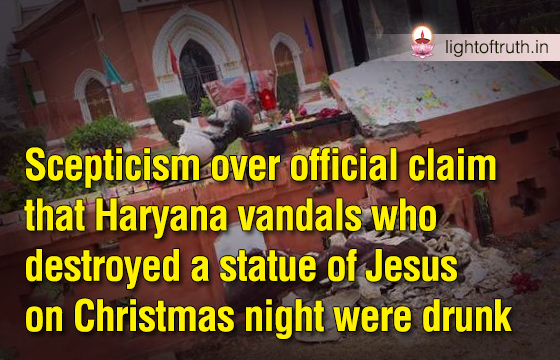
Scepticism over official claim that Haryana vandals who destroyed a statue of Jesus on Christmas night were drunk
Christian leaders in India have sought an impartial probe into the destruction of a cent-ury-old statue of Jesus Christ at a British-era Catholic church in Ambala in the northern state of Haryana.
Two men were seen on CCTV footage scaling the church compound on Christ-mas night and destroying the statue after breaking open the casket.
Police arrested two suspects after three days and a court remanded them into judicial custody. But church leaders suspect the case may get diluted with the investigating officer saying the suspected vandals were drunk.
“The police officers tasked with the investigation is siding with the suspects and trying to dilute the crime on the plea that they acted under the influence of liquor,” said Father Patras Mundu, parish priest of the Holy Redeemer Church in Ambala Cantonment in the Diocese of Simla-Chandigarh.
The police did not charge the arrested suspects for viola-ting the curfew orders imposed in the city, he said, adding that one of the arrested is a government employee and hence familiar with the laws of the land.
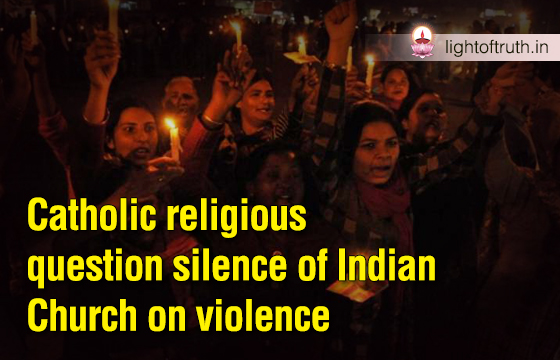
Catholic religious question silence of Indian Church on violence
A group of progressive Catholic religious in India have questioned the silence of the official Catholic Church over the continued violent attacks on Christians and other mino-rity communities across the country.
They want the Catholic Bishops’ Conference of India (CBCI) to take up the issue with Indian Prime Minister Narendra Modi and Home Minister Amit Shah to ensure immediate action against the perpetrators of hate crimes against minorities.
They also want regional bishops’ conferences to raise the issue of Christian persecution with respective state governments.
The Forum of Religious for Justice and Peace, in a letter dated Jan. 10 addressed to Cardinal Oswald Gracias, expressed shock over the silence of the CBCI even as targeted violence against Christians continued unabated in the country.
“During the two days, Dec. 24-25, the media reported seven well-planned attacks on Christian institutions across the country,” while “in the year 2021, there were 486 incidents of violence against the Chris-tian community in India, accor-ding to the United Christian Front,” the forum said.
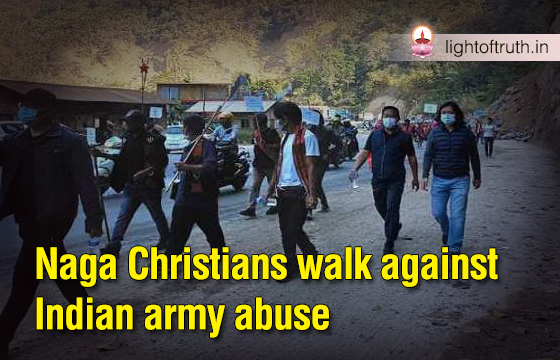
Naga Christians walk against Indian army abuse
Thousands of people, mostly Christians, in India’s north-eastern state of Nagaland took part in a two-day walkathon from commercial hub Dimapur to capital Kohima demanding the repeal of the draconian Armed Forces (Special Powers) Act (AFSPA) and justice for Naga Christians killed by the Indian army last month. Protesters including civil society activists and women and children took to the streets on Jan. 10-11 and carried placards demanding the repeal of the controversial law which was enforced in Nagaland to curb secessionist groups and armed rebellion in 1956.
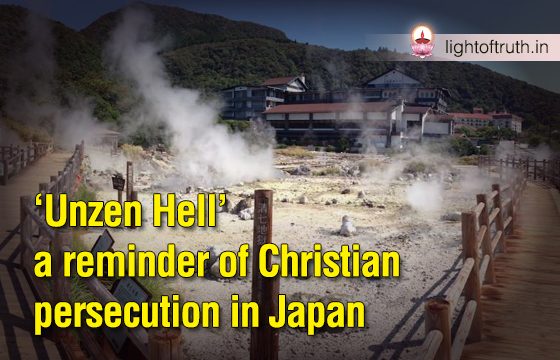
‘Unzen Hell’ a reminder of Christian persecution in Japan
The journey through Nagasaki Prefecture starts from a small town with a curious name, Obama, which has no relation with the former US president (but did make it globally notorious for a while) and only means a small beach.
It is in fact a small spa resort on Kyushu, Japan’s third-largest island, overlooking the open ocean. From here you get on a bus that climbs the sharp curves of the mountains up to a height of 700 meters. Then you finally reach Unzen, a mountain village that sprang around its famous thermal baths, the hottest in all of Japan, they say here, with temperatures reaching 120 degrees.
At some point in the 17th century, it was the site of Christian persecution when the rulers immersed Christians in the boiling waters to force them to renounce their faith.
Touristically speaking, it is the perfect venue for all those looking for a memorable snapshot to hang in that space of fleeting self-gratification on the various social networks. From the earth rise, for 20 or 30 meters, large fumes that surround a hotel whose foundations dig right into the boiling thermal waters. One wonders what technical tricks the engineers have put in place to keep those gigantic structures, some centuries-old, standing on that incandescent quagmire.
The gargling of the continuous bubbling of water, stones and mud evokes ghosts of otherworldly landscapes. It is no coincidence that the place is known as “Unzen Hell.”
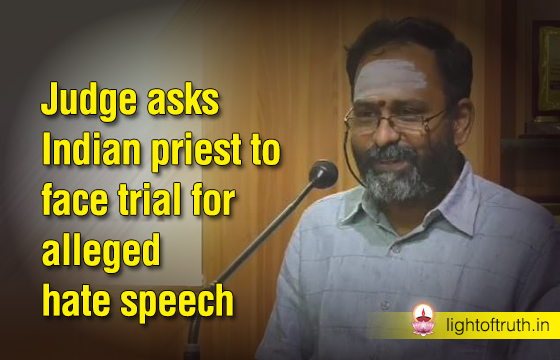
Judge asks Indian priest to face trial for alleged hate speech
The top court in southern India’s Tamil Nadu state has ordered a Catholic priest to face trial for allegedly hurting the religious sentiments of Hindus and criticized Christian missionaries claiming Jesus Christ as the only true god.
The Madras High Court on Jan. 17 said that “the offending speech” of Father George Ponnaiah, a vicar of Kuzhithurai Diocese, “prima facie attracts the offenses” under various clauses of the Indian penal code.