

The Syro-Malabar Church on January 15 appointed new prelates for its Tellicherry archdiocese and Palghat diocese.
The Oriental Catholic Church’s bishops’ synod promoted, with the papal approval, Auxiliary Bishop Joseph Pamplany of Tellicherry as the archdiocese’s new prelate. He replaces Archbishop George Njaralakatt, who has retired.
Similarly, the synod has appointed Palghat Auxiliary Bishop Peter Kochu-purackal as the diocese’s new bishop. He replaces Bishop Jacob Manathodath, who too has retired.
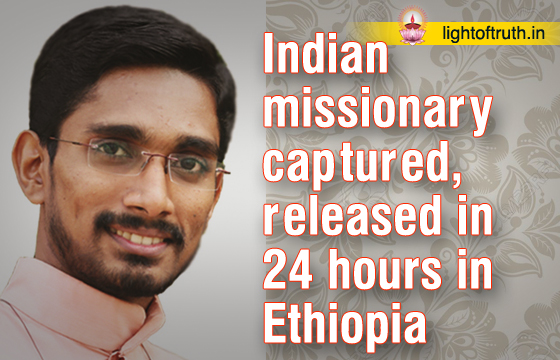
Indian missionary captured, released in 24 hours in Ethiopia
Fr Joshua Edakadambil, an Indian Catholic priest serving in Ethiopia as a missionary was kidnapped by rebel soldiers but released him in 24 hours.
The member of the Order of the Imitation of Christ, or Bethany Ashram, has been working in the Apostolic Vicariate of Nekemte in the east Afri-can country. The 32-year-old priest was abducted while going to celebrate Mass in a mission station. They then took him to a forest and kept him in their custody.
Bishop Varghese Thottamkara, Vicar Apostolic of Nekemte, said the rebel soldiers took the Indian priest for mistaken identity. They released the priest after the Church negotiated with the rebels.
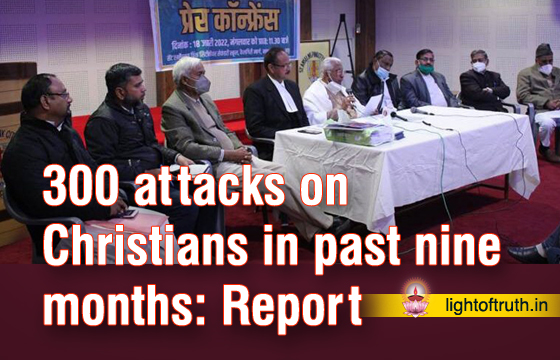
300 attacks on Christians in past nine months: Report
As many as 300 attacks on Christians have taken place in India in the past nine months, says a report of a fact-finding team. The report titled, “Christians Under Attack in India,” was released January 18 at a press conference in Jaipur, capital of the northwestern Indian state of Rajasthan.
The meet was organized by the Association for Protection of Civil Rights, United Christian Form, United Against Hate and Jaipur Catholic diocese at St. Anselm’s school in Jaipur’s Malviyanagar locality. Speaking on the attacks, Bishop Oswald Lewis of Jaipur noted that India is a country where every religion is respected and their followers have been living together with peace and harmony for centuries.
But in the past few years the minority groups have been targeted especially Christians and Muslims. It is being done by some fringe groups to destabilize the unity of the country,” the Catholic prelate bemoaned.
Bishop Lewis also said, “It is sad to see that a community that has been offering its service to everyone in the country especially the poor and marginalized, has become the target. Such attacks are on increase. Besides, the inaction of the government encourages such groups who go unpunished. The government must take stern actions against them to preserve the unity and democracy of the country.”
The Rajasthan state president of the Association for Protection of Civil Rights, Advocate Saiyad Saadat Ali said, “Our country is a secular country where everyone has the right to profess and propagate their faith. But there are some people who want to snatch away from their rights. Since some days there has been continues attacks on Christians which must be condemned. The peace loving people of the country must come forward to stop such atrocities.”

Indian bishop denies role in actor’s bail plea
A Catholic bishop in India has denied media reports that he had a hand in securing bail for a film actor charged with sexual abuse and assault on an actress in the southern state of Kerala.
Local media reports said Bishop Vincent Samuel of Neyyattinkara helped actor Gopalakrishnan Padmanabhan, better known by his stage name Dileep, to secure bail.
The reports quoted the affidavit Dileep had furnished in Kerala High Court during the hearing of a petition filed by the prosecution seeking cancellation of his bail. Police wanted him in judicial custody for further questioning in the three-year-old case.
Dileep, 54, claimed in his affidavit that a film director named Balachandra Kumar had told him that Kumar had used the influence of Bishop Samuel to secure the bail.
“It is totally a false and manipulated story and there is no iota of truth in it,” Father Christudas, vicar general of Neyyattinkara Diocese, told on Jan. 26.
“The prelate neither knows the actor nor the director, nor ever had any interaction with them,” he added.

Corruption, lack of freedoms holding back Asia-Pacific
Perceptions of corruption among Asia-Pacific countries remained almost unchanged in 2021, with New Zealand, Singapore and Hong Kong among the world’s best performers but Cambodia, Afghanistan and North Korea again ranked with the worst.
Transparency International (TI) said “grand corruption” and a lack of freedoms were holding back progress in the Asia-Pacific region.
While Asia-Pacific countries have made great strides in controlling bribery for public services, an average score of 45 out of 100 on the 2021 Corruption Perceptions Index shows much more needs to be done to solve the region’s corruption problems.
“Some higher-scoring countries are even experiencing a decline as governments fail to address grand corruption, uphold rights and consult citizens,” TI said in its annual report.
Of the 180 countries ranked by TI, it said weak scores were recorded among the world’s most populous nations, with China and India ranked 66 and 85 respectively and Indonesia, Pakistan and Bangladesh coming in at 96, 140 and 147.
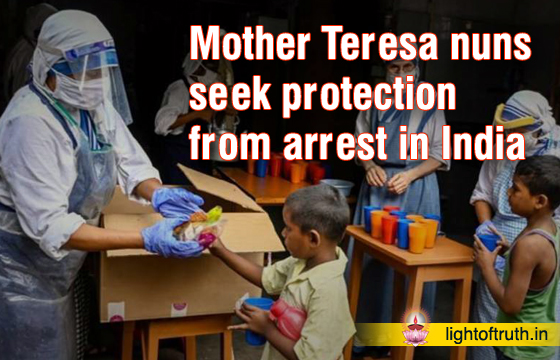
Mother Teresa nuns seek protection from arrest in India
Missionaries of Charity (MC) nuns accused of attempting to convert girl inmates at a shelter home in Vadodara city in the western Indian state of Gujarat will be hoping for protection from likely arrest when a local court hears their plea on Jan. 19.
The two nuns, who did not want to be named, had filed for anticipatory bail after police initiated a probe on December 13 following a complaint of a violation of the Gujarat Freedom of Religion Act 2003, a law that curbs religious conversion through allurement, force and coercion, at the MC-run Nirmala Shishu Bhavan.
The complaint was registered by Mayank Trivedi, a district social defence officer who claimed to have visited the shelter home on Dec. 9. The inmates were made to wear a cross around their necks and keep the Bible in a storeroom they used regularly, he alleged.
These actions, according to the complainant, hurt the religious sentiments of Hindus.
The court had restrained the police from arresting the nuns until Jan. 10 but has yet to decide their plea for anticipatory bail. The Jesuit priest said that having a textbook in one’s possession or sharing it with someone for reading is not a crime and hoped that the court will uphold the Indian constitution and the law of the land to ensure justice.
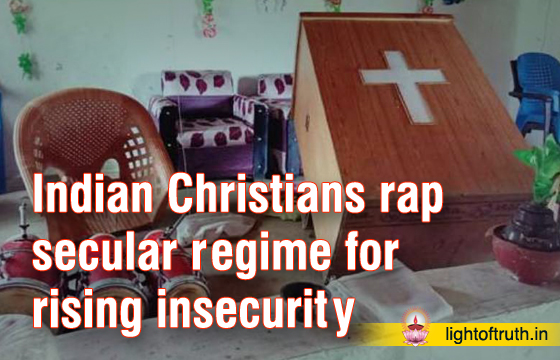
Indian Christians rap secular regime for rising insecurity
A Christian leader in the central Indian state of Chhattisgarh has squarely blamed the provincial government for failing to check attacks on the minority community after a spate of recent incidents. “Reports of Christian persecution are nothing new in this part of the country, which is very unfortunate. More than 10 attacks targeting Christians were reported from five different places during the past two weeks. It is a complete failure of the state government,” Arun Pannalal, president of Chhattisgarh’s Christian Forum, told. He said more than 200 incidents were documented in the past two years, the latest one on Jan. 9.

Dalit Christian activist bags European award
A social activist from Tamil Nadu, southern India, has received this year’s Raoul Wallenberg Prize, a prestigious award given by the European Council.
The ceremony took place in France and Arokiasamy Vincent Raj, popularly known as Evidence Kathir, received the award online on January 19. The award, given every two years, carries a cash prize of 10,000 Euros equivalent of 842,770 rupees, besides a citation.
“I am happy for Evidence Kathir. I wish him good luck for what he is doing for the Dalits and the Tribals,” said Tamil Nadu Chief Minister M. K Stalin in his congratulatory message.
Kathir runs a 25-year-old non-profit organization in Madurai that works mainly for Dalits and the Tribals in Tamil Nadu.
He and his team reach out when atrocities against Dalits and Tribals take place. He trains human rights defenders especially the youth in Tamil Nadu.
The award is seen as “a great honor” for all Dalit activists and the human defenders in Tamil Nadu.
Kathir says he has been committed to the human rights issue for the past 25 years. “It is a challenging job and I feel its great recognition for my work,” he adds.
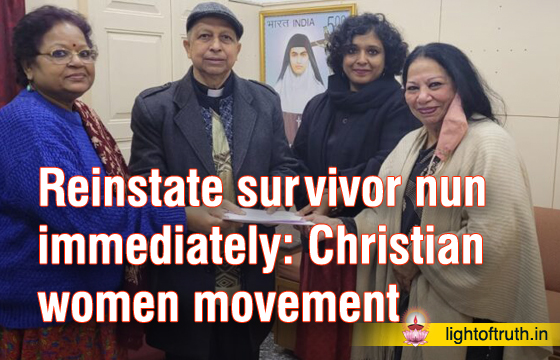
Reinstate survivor nun immediately: Christian women movement
The Delhi chapter of the Indian Christian Women’s Movement (ICWM) has demanded immediate reinstatement of the rape survivor nun in her congregation.
The movement, representing women from various Christian denominations across the country, on January 22 met Archbishop Anil J Couto of Delhi to present him a statement to pass on to Apostolic Nuncio Archbishop Leopoldo Girelli.
The statement refers to the victim in the historic nun rape case where Bishop Franco Mulakkal of Jalandhar was accused of raping a nun multiple times inside a convent in Kerala, southern India.
A court in Kerala on January 14 acquitted the prelate saying the prosecution failed to prove his guilt.
The ICWM-Delhi statement asserts that the movement “stands in complete solidarity with the victim/survivor nun who broke the silence against continuous abuse and exploitation by Bishop Franco Mulakkal” of Jalandhar.
“As women, we are feeling completely outraged and humiliated by having to prove our pain and trauma, time and time again. We are sick and tired of proving why there was a delay in filing a report. Why there was a delay in speaking up? How could we endure it for such a prolonged period of time? Because it has been instilled in us to respect the men of cloth.”
The statement points out that the bishop and nuns have “a fiduciary relationship” and the prelate should have protected those serving the Lord under him. “Instead, women in the Church are feeling unsafe and vulnerable, open to abuse in their congregations and Churches. Anyone who dares to speak against the powerful men of cloth are isolated, neglected and targeted for speaking up,” the statement bemoans.
Observing that “this travesty of justice and denial of respect to women in the Church has gone on long enough,” the movement demands an end to “inappropriate behaviour by priests, Bishops and any other in power.”

Nun rape case: ICWM’s open letter to Indian Churches
The Indian Christian Women Movement, an ecumenical group, has issued an open letter addressed to the leaders of various Churchesin the country.
We, as women of the Chur-ches, waited for the verdict impa-tiently, we were so sure that the accused will be indicted.
In our estimation, all evidence pointed to the guilt of Franco Mulakkal. All that remained was for the guilty verdict and for the Church to acknowledge its connivance and announce, in no uncertain terms, its agreement with the strongest punishment that he deserves.
But, this was not to be. Mulakkal was acquitted of all charges; and the survivor Sister was left to deal with the consequences of crimes she did not commit.
In the text of the judgment, as submitted to the court, words have been written about the nun; intimate details enumerated which should shame every Christian woman, let alone a sister who has dedicated her life to obedience and submissiveness to authority in the church.
Her defence was downplayed and she was left in the lurch by the Church. This has been the most difficult – feeling let down by the Church to which she had avowed allegiance.
For us as women of the Church this betrayal has been the most painful to accept. We call on the leadership of the Church to account for their attitude ever since the survivor Sister courageously spoke out about her ordeal. The Church did not react as it should have – letters of appeal she sent to the leadership of the Church were ignored; the church remained silent in the face of her humiliation in the court.