Catholic Sisters Help Children Living with HIV Build a Better Future
Faith Brings New Hope to Assam Village Once Known for Alcoholism
Cardinal Tagle: Friendship reveals the face of Jesus and the Church
Israel prepares ‘extensive’ West Bank operation after deadly shooting near Tal
Pope: Visit to Türkiye and Lebanon teaches that peace is possible
Thousands protest corruption in Philippines as Church leaders call for accountability
Pope: Nicaea invites Christians to unity in face of violence, conflict

Christians in general and religious orders, in particular, lay great emphasis on the obedience the subjects owe to the superior. In this context, it is insightful to reflect on the bias this obedience may carry with it. Compliance with orders issued by a higher authority is considered obedience. An actual example of obedience is when a child complies with parental instructions. Another illustration might be a soldier obeying orders from a commander. The phrase “obedience to authority bias,” popular in business ethics and behavioral psychology, refers to the tendency for people to support those who they believe to be authoritative leaders. Even if the individual thinks what they are doing is immoral, this is still true. This submission to authority is viewed in psychology and ethics as a bias with unfavourable outcomes. People frequently agree to do things that they otherwise wouldn’t do on their own as a result of obedience. It only takes one person’s authority to persuade someone to make a poor decision. The propensity for people to appease those in control is known as obedience to authority. This could also signify a readiness to carry out unethical directives. According to psychological research, people often have a tendency to respect and obey those they believe to be in legitimate positions of authority. If people fail to utilize their own independent ethical judgment, this could be problematic. Most people are able to foresee their superiors’ ne
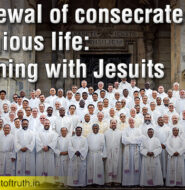
In May this year, the Jesuits had their Procurators’ Congregation in Loyola, Spain – a meeting of 88 representatives from all the provinces and regions. In the meeting they deliberated and discerned on the status of the Society of Jesus, the ways ahead in the Mission of Jesus and whether a General Congregation/Chapter should be called. Overall, it was a fruitful time of collective self-examination, prayers and deliberations for a renewed religious life. As a participant, while walking within the vicinity of Loyola, the birthplace of St.Ignatius of Loyola, I saw a huge building on a hillock, a convent. In that house which could easily accommodate a hundred people, now hardly twenty live. All consecrated women above sixty years. It is only a question of few years, when the building would be sold and the few remaining will move to some old age home. Many of the Catholic religious congregations, both men and women, are struggling. Some are dying. So the question remains, how will the consecrated religious life survive? Granting that this mode of life is fundamentally faith-based, the ultimate answer is of course, it will survive, if God wants it to. Meanwhile, what can the members of such religious congregations do on their part? Lessons from Vatican II The answer that was given by Vatican II remains valid even today: “The appropriate renewal of religious life involves two simultaneous processes: a continuous return to the sources of all Christian life and to each com
M L Satyan, Bengaluru, Matters India
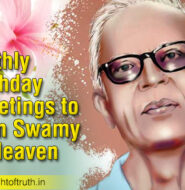
Dear Stan, It is your birthday today here on earth! You would have completed eighty-six years, if you were around. Well, that was not to be; on 5 July 2021 you were murdered by a brutal and fascist regime, which did not want a human rights defender like you to continue living! This is your second earthly birthday up above. Not sure how you will be celebrating it! But here on earth dear Stan you are missed very much! Countless people remember you: your compassion and commitment; your courage to identify with them and their struggles. These are mostly simple, ordinary people; the Adivasis and the Dalits; the excluded and the exploited, the poor and the marginalised. You lived in their midst; you basked in their presence; you smelled of the sheep like a truly good shepherd. They celebrate you today and will always do so! There is certainly no doubt of that! But I am writing this birthday letter based on the recent conversation I had with you! I can see you smiling (you always had that halting, tentative smile – slow, gentle but warm) and I can imagine others who reading this and with a sneer saying “Conversation with Stan? There must be something wrong with him!” Well let them say what they want – but I will hold my ground! It was the night of April 13/14 (less than two weeks ago), Frs. Tom Kavala and P.M. Anthony invited me to spend the night in Bagaicha. This was your home – before the ’powerful’ so unceremoniously took you away on 8 October 2021 lik
I am raising this question purposely. Why? Let me explain. On the occasion of Easter on April 9 Prime Minister Modi visited the Sacred Heart Cathedral, New Delhi. The video shows that he was welcomed by the archbishop of Delhi and other prelates of the Catholic Church. He joined a select group of Catholics as they offered prayers. The Delhi archbishop presented a Crucifix to Modi. A tree was planted by Modi in front of the cathedral, maybe in remembrance of his visit to the cathedral. Jesus had twelve apostles with him. They were selected personally by Jesus based on his own selection criteria. Probably, one of the criteria must have been “courage.” ...When the High Priest questioned Jesus about his disciples and about his teaching, Jesus answered him. One of guards there slapped Jesus and said, “How dare you talk like that to the High Priest?” Jesus answered him, “If I have said anything wrong, tell everyone here what it was. But if I am right in what I have said, why do you hit me?” (Jn.18:22-23). Jesus expected this courage from his selected apostles and disciples. The followers of Jesus in the early Christian community demonstrated the values that Jesus preached. Many disciples went far and wide to preach the good news. Many were martyred. The only Apostle Thomas came to India and preached the good news. He had to face many obstacles and challenges. But he was bold enough to face them. Finally, he too was martyred. This is the tradition on which the Cath