Catholic Sisters Help Children Living with HIV Build a Better Future
Faith Brings New Hope to Assam Village Once Known for Alcoholism
Cardinal Tagle: Friendship reveals the face of Jesus and the Church
Israel prepares ‘extensive’ West Bank operation after deadly shooting near Tal
Pope: Visit to Türkiye and Lebanon teaches that peace is possible
Thousands protest corruption in Philippines as Church leaders call for accountability
Pope: Nicaea invites Christians to unity in face of violence, conflict
In your recent issue, you have an item “Seminary Formation Always Draws Criticism: New JDV President”. True, as humans, we are always fallible. But we also learn from our failures. Hence, in October 1969, about a hundred and thirty representatives of the teaching and formation staff of the major seminaries in India came together to respond to the call of the Council. I was part of this gathering. We felt that with the fast-changing society we needed to radically rethink the formation of our priests. To be more effective we must have from the start students with greater maturity and motivation. We suggested that our candidates complete their graduation in a regular college before starting philosophy. JDV had twice taken the decision to demand graduation before philosophy. As far as I know, both the times, it went back. Ours was not an academic concern—the acquisition of a secular degree—but the human formation of our future candidates, the maturity they need to enter a major seminary today. This was also the reason we emphatically stated that the graduation be done in a regular college. We wanted the students to experience the world more; take part in all the extra-curricular activities that would bring out their talents and respond to their juvenile needs; meet women of their age, be friendly with them, experience the beauty of loving a woman and being loved by her. This proposal was voted and was accepted by a hundred and fifteen. The others—about fifteen—either

Various Hindutva organizations under RSS are making grand preparations for the construction of Ram temple in Ayodhya. They consider it liberation from mental and cultural slavery. A senior RSS functionary Dattatreya Hosabale said, “Ram Janmabhoomi movement was not just about religion but about Indian identity and nationalism.” Ever since the Supreme Court paved the way for the construction of Ram temple, devotees are sending gold and silver including ornaments and bricks to be used for construction. They feel that their dream of 500 years is getting fulfilled. Prime Minister Narendra Modi was present for the ground – breaking ceremony (Bhoomi Poojan) on August 5. Intellectuals and activists irrespective of their faith criticize temple construction while the whole country is suffering from pandemic Covid which has infected more than 1.7 million people and over 36,000 killed on August 1. The deadly virus is spreading rapidly. Millions of people in India, living Rams, are suffering from starvation, unemployment and dying of Covid 19 and other diseases. When the priestly class and common people are drugged with religion they don’t understand reason. The Ram temple is built with the blood of thousands of men and women who were killed in different communal riots over the years. Though politicians and Hindutva groups would hail the construction of Ram temple as a symbol of cultural nationalism, it will remain a symbol of violent nationalism nurtured by revenge and hatred

Three significant observances mark 9 August every year: the anniversary of the ‘Quit India Movement,’ the anniversary of the nuclear bombing of Nagasaki and the International Day of the World’s Indigenous Peoples. Though each of these observances have their own specificity, there is a deep interconnectedness among all three, particularly in the values that they are intended to highlight on a day like this! Three underlying words emphasise this” Kranti (meaning ‘revolution’), Adivasi (the Indian word for ‘indigenous people) and Nagasaki (the bombed city) KRANTI! A call to revolution! A call for change! A call for freedom. It was a clarion call given by Mahatma Gandhi, when on 8 August, 1942 at the Bombay session of All India Congress Committee, he introduced the resolution to start a ‘Quit India Movement.’ The resolution was unanimously passed at that historic meeting. Later, Gandhi gave a fiery speech at Mumbai’s Gowalia Tank Maidan (today known as August Kranti Maidan) marking the beginning of the Quit India Movement. He said, “There is a mantra, a short one that I give you. You imprint it in your heart and let every breath of yours give an expression to it. The mantra is do or die. We shall either be free or die in the attempt.” The next day on 9 August, the ‘kranti’ had begun; they were out on the streets demanding that the British should leave India immediately! Most of the leaders, who belonged to every strata of society were arrested. On ex
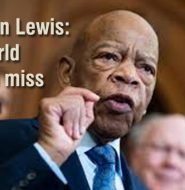
John Lewis is no more and the world will miss him! When he died on July 17, he left a great void which will never be filled! He was one of a kind who roamed this earth, impacted on the lives of many and has left us all a rich and unforgettable legacy. He was truly a wonderful human and a great hero! Ever since he died, rich and glowing tributes have been pouring in from every corner of the world; editorials and op-eds have been written on him: all remember and highlight the many causes he espoused and championed as a civil rights leader. The Congressional Black Caucus in a statement said. “The world has lost a legend; the civil rights movement has lost an icon.” John fought against every form of discrimination and divisiveness: be it racism, casteism and attacks on the minorities in India. His convictions and stand for justice -were always based on nonviolence, peace and unity. I cherish my meetings with him; he gave me value time; he was such a warm, affable, available and unassuming person despite the power he had and the influence he could wield! He was definitely a busy person, but when I spoke, he gave me his total undivided attention, listening intently! His questions were based on what I had said; areas which needed more clarification or substantiation. Right from the word ‘go’ one felt that he trusted you; believed in what you were saying , was on the same page as you were and was determined to do all h
Rights have gone all wrong in today’s India! It is a season of discontent for millions everywhere: the pandemic COVID-19 has disrupted life and livelihoods, the routine and the ‘normal.’ People have been forced to adjust and to adapt; to become more frugal, more simple and much more. It is also been a time of immense grief, pain and suffering particularly for the poor and the marginalised; the migrant worker and the daily wager; the unemployed and the differently abled. To add insult to injury, India’s insensitive ruling regime instead of responding to the genuine cries of the people has gone all out the way to decimate human rights, destroy the democratic ethos of society and to throttle every form of dissent and protest. At this moment, high among the human rights violations in the country are brutal beating in police custody and the subsequent deaths of the father and son duo, P Jayaraj (59) and his son J Bennicks (31). They were arrested on 19 June for ‘allegedly’ keeping their mobile phone shop in the main market of Sathankulam town (Tuticorin Dt, Tamilnadu) open during a curfew imposed during the pandemic lockdown (cctv footage however, belie this). They were lodged in the Kovilpatti sub-jail. Both Jayaraj and Bennicks were terribly tortured in police custody after which they were admitted to the Kovilpatti government hospital on 22 June; the son died that very night, the father breathed his last on the morning of 23 June. The police of course, have th