Catholic Sisters Help Children Living with HIV Build a Better Future
Faith Brings New Hope to Assam Village Once Known for Alcoholism
Cardinal Tagle: Friendship reveals the face of Jesus and the Church
Israel prepares ‘extensive’ West Bank operation after deadly shooting near Tal
Pope: Visit to Türkiye and Lebanon teaches that peace is possible
Thousands protest corruption in Philippines as Church leaders call for accountability
Pope: Nicaea invites Christians to unity in face of violence, conflict
It is Constitution Day once again! We, the people of India, gratefully remember 26 November 1949 when the Constitution of India was passed and adopted by the Constituent Assembly. The Constituent Assembly comprised women and men of distinction, who were able to represent the heart and soul of the people of India without fear or favour. They gave of their best, so that we may a visionary Constitution, which would be the mainstay for and of democracy in India! In less than six months from now (around end-April, early-May 2024), the General Elections 2024 are due to be held in the country. These elections are expected to be crucial in the context of the future of democracy in India. One does not need too much of intelligence to realise that the country has reached abysmal depths on possibly every parameter necessary for a vibrant, meaningful and people-centred democracy. It is imperative therefore, that every single adult citizen (above the age of 18 years) of the country exercises one’s franchise and does so wisely. Before that however, one needs to ensure that one’s name is registered on the Electoral Rolls. As a starting point: FIRST visit the website of the Election Commission of India https://eci.gov.in/ for immediate, updated and accurate information regarding the entire election process. This website has all the necessary information. In some places, it has already been announced that 9 December 2023, will be the last date for registering one’s name on the Electo
The obscure jungle district of Kandhamal in Odisha – one of the least developed among 760 districts in the country – is now known all over the world. The credit goes to the poor but valiant Christians who embraced martyrdom like the ‘Early Christians’ when they were threatened with death to forsake their faith in Christ. When the news of the Vatican granting green signal for initiating beatification process for 35 Catholic martyrs of Kandhamal was communicated by Archbishop Leopoldo Girelli Apostolic Nuncio to India, I was thrilled along with thousands. The Oct 18 ‘nihil obstat’ from the Vatican Dicastery for Causes of Saints has cleared the path “to initiate the process of beatification for the Servant of God Kantheswar Digal and companions, martyrs of Kandhamal” from the 2008 persecution of Christians. Encounters with the kins of these martyrs and thousands of living ones who survived martyrdom changed the course of my life visiting Kandhamal 35 times the ‘holy land of India’ sanctified by the blood of heroic Christians over last 15 years. Now the roads are clear for Archbishop John Barwa of Cuttack Bhubaneswar Archdiocese that covers Kandhamal, to set the canonization process in motion. The first step is going to be the Archdiocesan council meeting to decide the date and plans for officially initiating the process. It needs huge planning as it involves as many as at a time seldom in in history. How did Kandhamal achieve this unique status in the ann

On 1 October, the world will once again observe the ‘International Day of Older Persons’. It is the 33rd commemoration of this United Nations Day. Such days are often relegated to tokenism and cosmetic exercises filled with a plethora of speeches and feel- good activities. The theme ‘Fulfilling the Promises of the Universal Declaration of Human Rights for Older Persons: Across Generations,’ however, is a challenging one- which gives little room for the normal complacency or for a mere celebration of ‘yet another UN Day!’…. In order to realise the UNIDOP 2023 mission and mandate, there are clear objectives: • to increase global knowledge and awareness of the Universal Declaration of Human Rights and generate commitments among all stakeholders to strengthen the protection of the human rights of current and future generations of older persons around the world; • to share and learn from intergenerational models for the protection of human rights around the world; and • to call on Governments and UN entities to review their current practices with a view to better integrate a life course approach to human rights in their work, and to ensure the active and meaningful participation of all stakeholders, including civil society, national human rights institutions and older persons themselves, in the work on strengthening solidarity among generations and intergenerational partnerships. Whether the above will be actualised in the near or distant future is anyoneâ
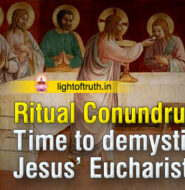
The ritual war fought on the Kerala terrain by the traditionalists and the progressives of the Syro-Malabar Church seems to be like the Kurukshetra war. Both sides are adamant. Each faction wants it to be a fight to the finish. The laity too is divided like the sheep between the contending shepherds. Decidedly, the issue is not about the essence of the Eucharist instituted by Jesus Christ. Rather, I wonder if any seasoned theologian would authoritatively claim that Jesus Christ wanted the Eucharist to be institutionalized and mystified to the extent that the faithful followers of Christ, meaning Christian worshippers, should not participate in it in full view. Let us look at it this way. There is the event, the Eucharistic Supper which Jesus shared with his disciples by breaking bread as a symbolism of ‘breaking’ his body on the Cross. Jesus thereafter told his disciples: ‘Do this in my memory.’ What preceded this sacred event was that the Master himself washing the feet of the disciples. Therefore, the context is humble service, instructing his disciples by example that any Eucharistic celebration has to have this aspect of service to the community. That Eucharistic celebration takes its meaning and worth when it is extended in humble service. ‘I the Master have done it. You too ought to follow suit.’ The only ritual, if you can call it so, at the time of the Eucharistic supper was simple. All sat around. No one had a reserved seat, not even Peter who
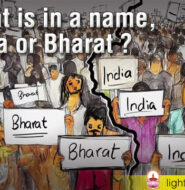
On September 5, India’s President Draupadi Murmu sent out dinner invitations to foreign delegates (heads of state) who will come to New Delhi to attend the G20 summit. The dinner card read: “The President of Bharat requests the pleasure of … on Saturday, September 09, 2023 at 2000 hours. Venue: Multifunction Hall, Level-3, Bharat Mandapam, New Delhi.” As soon as this news was out, speculation began that Narendra Modi’s government was going to change the country’s name from India to `Bharat’ ahead of the 2024 Lok Sabha polls. There was also a surmise that the special session of Parliament on September 18-22 has been called on to pass the constitutional amendment bill to this effect. And with that possibility, the gossip mill went on the overdrive about the future of the name ‘India’ used in various projects, programs and slogans of Prime Minister Modi. For example, the conjecture on the possible renaming of various state-owned institutions namely, The Reserve Bank of India, Port Trust of India, Airports Authority of India, Coal India, Steel Authority of India, Atomic Energy Commission of India, Indian Space Research Organisation, Geological Survey of India, the Election Commission of India. Speculation is also rife on the possible deletion of the name India from passports, Aadhaar, PAN and voter cards. However, no official statement has been made by the government so far. This studied silence has actually fuelled the speculation. For the first time in th